Ain’t about how fast I get there
Ain’t about what’s waiting on the other side
It’s the climb
—Miley Cyrus
Dear Class of 2020,
You have been on my thoughts quite a bit recently. It feels like only yesterday that I was standing in front of the bonfire at Camp Pecometh, sharing a ghost story with you at the 9th grade retreat, and yet now it feels like a lifetime ago when I was writing your college recommendations just this past fall. During my sabbatical this year, more than one moment from our time together has found its way into one of my chapters to illustrate a point about life in the classroom, and I wish I could do more than empathize with the challenges you currently find yourselves navigating to finish out your senior year. How abruptly and dramatically the world can indeed change!
However, once a teacher, always a teacher, and I write to your class today to offer some insights into the larger journey awaiting you following graduation in this time of great tumult. I need to start by reminding you of something very important which I have tried to teach and model over the years, and that is this: the truth always matters, and all lies—even the well-meaning ones we say each day to keep the social peace—have the potential to do great harm. If you remember nothing else, remember these two things about truth and lies: because without them, you may find yourself wandering blind through life’s many challenges, lost and adrift.
One such challenge you are already wrestling with—and one of reality’s big truths—is that you will lose some of your significant milestones. Life is full of these important moments, and sadly, even bitterly, when they are lost, they are like eggs dropped on the kitchen floor; all you can do is clean up the mess and move on. From my own journey, for example, I remember being so excited for my 50th birthday and a chance to celebrate with a big party with family and friends only to find myself spending that day in a hospice room supporting my family as my mother and stepfather faced end-of-life medical decisions. I truly understand the sorrow, anger, and frustration you are experiencing right now, and in fact, I share some of it with you. The month of May has always been a historically sad one for me as I have prepared to say goodbye each year to people about whom I care very deeply. But not getting to celebrate commencement with all of you…I get it; it just sucks. None of us asked for all this loss and death.
I use that word, “death,” very deliberately here, and I do so for a reason that is more than the obvious fact that this pandemic has cost lives. Any of you who have had my AP Biology class know that I think the only workable definition for “death” is the loss of structural organization that creates an identity. For instance, what makes me “me” is not what I am made of; every single atom in my body has now been replaced at least 8 times over the course of my life. Instead, what makes me “me” is the structure of the relationships between all those atoms, and therefore, as that structure begins to come apart, it is meaningful to speak of me as “dying” and once critical parts of the structure collapse, to speak of me as “dead.”
That means, though, that we can meaningfully talk of death in any situation that involves structural relationship that produces identity. We can speak of the death of a marriage or of a friendship; we can say that an institution has died. Being able to talk this way brings a richer understanding to such situations and moments, and that brings me to the biggest truth of all right now—the enormous, scary, “elephant-in-the-living-room” truth that even the older adults in your lives are struggling to cope with—and that is the fact that the world of three months ago, the world of your childhood, is now gone—forever. The world you grew up in is dead, and it is never coming back.
BUT—and I cannot stress that “BUT” enough!—for every death, there is always the absolute certainty of resurrection on the other side. Again, using myself as an example, when I die, the structural relationships that once made me “me” will become reworked and incorporated into new ones: first those of the decomposers, then some autotrophs and heterotrophs, until perhaps even eventually into another being capable of self-awareness. None of it will have my identity (which is why we mourn), but all of it will have my life. Even now, there are trilobites and dinosaurs and mastodons in all of us. Death simply can’t stop life, and this pandemic cannot keep our society from resurrecting itself.
However, resurrection is not resuscitation, and that is the danger of even well-intentioned lies such as “return to normal” or “after the virus.” These and similar falsehoods imply that we can resuscitate a world that no longer exists. Just as influenza, measles, mumps, polio, malaria…the list goes on…just as all those pathogens are permanent parts of the human environment we live in and have adapted to over the millennia, so too is the new coronavirus now a permanent part of that same environment, requiring us to adapt to it just as we have had to adapt to other new environments in the past.
And adaptation takes time. The COVID-19 pandemic is like a little mini-asteroid, impacting and transforming the future of life on this planet forever, and just as life restored and rebuilt itself following the dinosaur’s actual asteroid, so too will we rebuild and create our new life on the other side of this outbreak. Some of it will look like before; much of it won’t. But even the dinosaurs made it through their catastrophe (we call them birds), and in fact, if not for that earlier, real asteroid, we wouldn’t find ourselves needing to address the current situation because we would never have evolved to be having the problem in the first place.
Which is not to minimize or ignore the very real pain and suffering that is going to accompany our adaptation toward what will be the new “normal.” Nor to say that we should not do everything in our power to reduce this pain and suffering; we very much need to be doing our best to work on this together. But the simple truth is that we don’t always get to choose the “another mountain” Miley Cyrus sings about; sometimes they are just dumped in front of us, and then we have no choice but to climb them.
That, however, brings me to perhaps the most important truth of all confronting you, the Class of 2020: we do get to choose how we climb. What we do is who we are, and if we take from those who already have less…if we attack those who are different from us…if we endanger others just because we cannot see them…if we climb selfishly, thinking only about “me and mine,” then that will be who we become, and the world on the other side of this particular mountain will be even more broken than the pre-pandemic one was.
But you have the opportunity to recreate the world for the better as you climb. You can make a world where most of the wealth and power are not so concentrated among a tiny few that half of society lives perpetually in the shadow of sudden devastation and economic ruin. You can build a place where the incredibly blue skies you have seen all spring this year remain that way into your children’s children’s future. You can create systems of justice that dismantle the barriers of systemic racism and develop an economy that does not depend on the exponential consumption of finite resources. You can….
It will not be easy; no successful climb ever is. You also may not get to see what’s waiting on the other side; some summits take multiple generations. But life is about the climb, and while the trail ahead may feel daunting and even disheartening right at this exact moment in time, always remember that hope is a verb, not a noun. Hope is not something we possess or have; hope is something we do. Because to genuinely hope for anything is to do the work to make it happen. Hope for a better world? Roll up those sleeves and start the messy work of fixing it one patch of dirt at a time. Hope for better lives for everyone? Invest the necessary time and resources to accomplish it. The simple truth is that the only effective response to fear and despair is to make what we do have purpose and meaning: Hope, do. Hope, do. Hope, do. Hope….
All that doing, though, requires hope’s sibling, love, and by this stage in your lives, you all know that love is never easy. You know it means caring at least as much (if not more) about another as you do yourself. You know it means risking lofty ideals in ways that can be arduous, uncertain, and painful. You know it can endure like steel and shatter like glass, and you know that it and it alone has the power to cure brokenness—which is exactly why this new world will need all the love you can give it.
But as you get ready to take your love out into the world to start your individual adult journeys, your parents and I are here to tell you that you are about to learn something else about love: it also means letting go. And while most of this letter is intended for every member of the Class of 2020 (wherever you find yourselves and at whatever educational level), I reserve this final part for a very particular group of graduates. As one of my all-time favorites I ever taught (yes; I can say such things now that I’m no longer anyone’s actual teacher), I wanted to honor their significance in my own life by doing something this past fall which I have only done two other times in my 30 years of teaching: I purchased a full-page ad in their yearbook.
However, I no longer know when or even if they will ever see that ad. So here, Class of 2020 is one of my own acts of hope—a final gift for all of you. Congratulations!
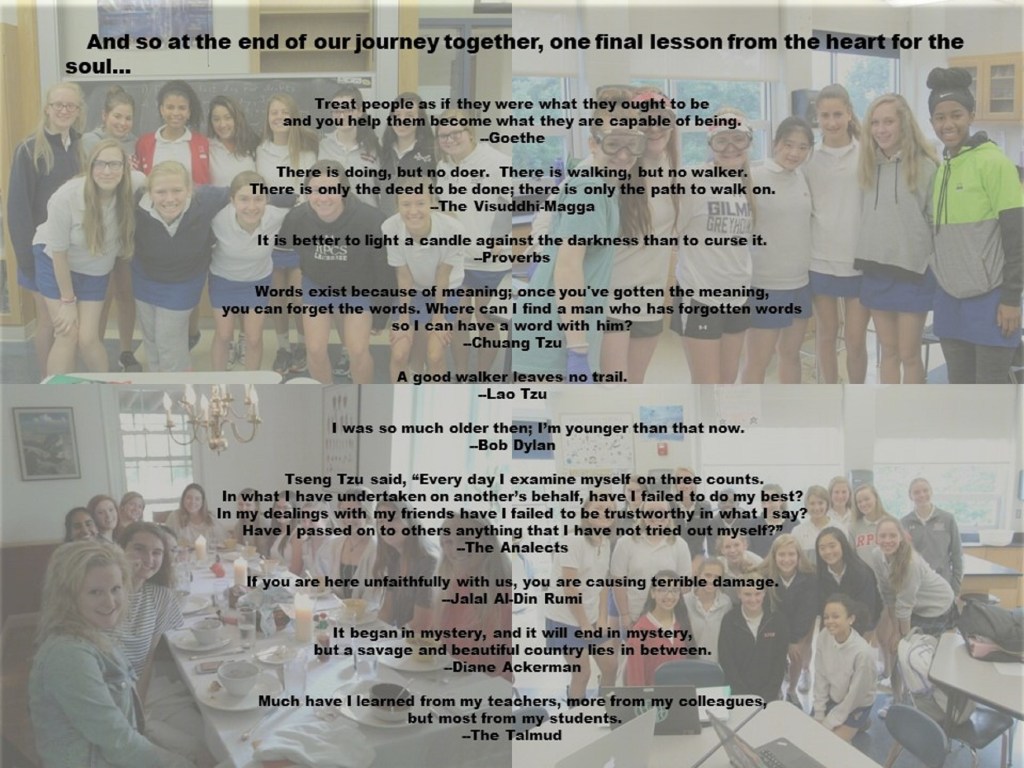

 Light a Candle
David Brock, this may be the finest piece you have ever written. As a parent of a graduating college senior who has spent 2 months of extra quality time with my now graduate, I have been part of her roller coaster ride. She has heard all the speeches and the warnings about the “new normal” and the impact has been the roller coaster ride of emotions. However, she is one of the lucky ones and so far her job offer has not been rescinded.
Thank you for putting into eloquent words (not the least of which is the biological context) all of the thoughts, hopes, and fears that we are all feeling right now.
LikeLike