In DEI work (that’s “Diversity, Equity, & Inclusion” for the uninitiated), one of the big White privilege myths that is often addressed when challenging the reality of systemic racism in this country is the notion that an equal playing field is the same as an equitable playing field. The classic argument (even among many with well-intentioned liberal bias) is that as long as society provides equal access to the opportunities for success, then meritocracy will win out, and therefore, those willing to work hard enough will rise to whatever level of accomplishment their individual efforts and talents enable them to achieve; those unwilling to do so, will not. Following this reasoning, if you are poor, it’s your own fault, and again, even many of those with liberal egalitarian values will argue that the real source of poverty and disadvantage that remain in our society is that we simply have not yet provided full equal access for everyone to the opportunities for success.
Of course, as the illustration below reminds us (one that I am indebted to my former DEI Director, Marlo Thomas, for introducing me to), the standard argument fails to take into account such things as the generational wealth that enables so many White Americans to “stand tall,” with easy access to the “game.” Nor does it recognize the reality that this wealth which most White Americans benefit from has been and continues to be acquired at the expense—the “shortening”—of those in this country who are people of color, fundamentally limiting their access to the “game.” Indeed, how many of us who are economically well-off ever truly recognize or acknowledge that the daily costs of our lifestyles are fully supplemented by the low wages paid to those who provide the goods and services we consume?
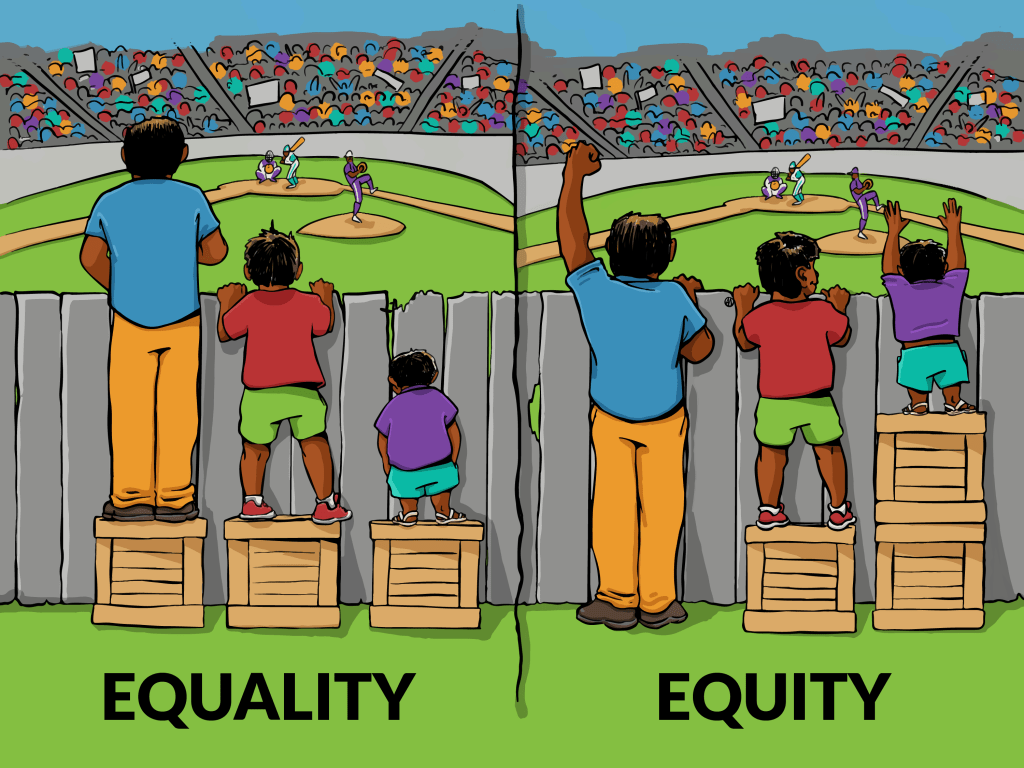
Hence, any notion that we will somehow achieve an equitable and just society if we just provide everyone with equal “boxes” on which to access successfully the socio-economic “game” is delusional at best and injurious hogwash at worst. Inequity is built into the very structure of our society, and until we start—as the illustration suggests—moving some of those “boxes” around and redistributing them, genuine equivalent access to the “game” will never happen. Yet to move those “boxes,” we must be able to identify all of them, and as some recent moments in my own life as a teacher have taught me, some “boxes” are not so easy to perceive—especially when it is so easy to fall into the “equality” equals “equity” trap even for those of us fighting to remember the difference.
The challenge is that the big scale “boxes” are readily identifiable. I have already written about the need for economic redistribution in education to achieve greater equity as well as the numerous ways in which the pandemic has only exacerbated the learning inequities already in place (see, for example, The Tally So Far or COVID-19 and the Digital Divide). Moreover, as Kalman Hettleman of the Kirwan Commission points out, we know exactly how we should be addressing all of these various inequities to counteract their impact on the disadvantaged in our society if only we have the political will to take the necessary steps.
Yet, what the pandemic has recently revealed to me in my own teaching is a more subtle inequity that for the first time in my own work on DEI issues has made me understand the illustration above in a deeply existential way that I never have before now. And it involves one of teaching’s most basic tasks: grading.
Traditionally, as I have argued previously, the whole purpose for grading has actually been to maintain the ranking of individuals in order to preserve the status quo of existing socio-economic inequalities, and as an educator, I have watched for decades now as legislation such as NCLB and state-wide testing programs such as PARC have simply reiterated and reinforced pre-existing differences in the quality of education provided in our schools. Yet, as Joe Feldman and others contend, the mere act of assessing need not inherently serve this purpose, and there are numerous steps teachers can take to make grades reflect accurate and equitable grading of a child’s true understanding of an idea, topic, subject, or skill.
One such practice that I have now employed for the past 15 years is the process of having students correct mistakes to demonstrate improved knowledge of the material, and it is my very recent evolution in this practice that has led to my deeper insight about equality vs. equity. However, to appreciate why it was such an “ah ha” moment for me, I need to briefly share my own journey with the idea of corrections. It began when I was first introduced to the work of Carol Dweck in the early 2000s on the concept of “growth mindset.” Her research showing that the most successful students were those who understand mistakes as simply learning opportunities was transformative for me (see Chapter 6), and by 2007, I was offering the option of correcting any assessed work to show better understanding. What’s more (and key to my “ah ha” moment), in wrestling with the balance between holding a child accountable for striving for their best initial effort and supporting the idea that we all “learn from our mistakes,” I settled for the compromise of allowing a student to earn back up to half-value for his, her, or their original error(s).
Starting with this current school year (influenced by the arguments of Feldman about grading for equity), I have stopped making the correction process optional and have made it a required effort for all my students. Moreover, in the face of the disparities which I have witnessed virtual learning create, I have started requiring my most challenged students—who too often are my students of color—to meet with me one-on-one to do these corrections. Yet, precisely because these one-on-ones have been primarily with some of my Black students, I have finally been able to see one of those “boxes” that needs redistributing which I’d not seen before, leading to my “ah ha” about equality vs. equity and the motivation behind this post.
What happened is that on a recent test, there was a final question where two of my Black students simply didn’t respond at all to what was being asked and, as a consequence, failed the assessment. Since all tests this year are take-home, open notes, with a full week to complete the assignment, my initial thought was that they simply hadn’t tried. Thus, corrections were going to be about having them make that effort so that they would at least pass the test. However, when I met with each of them individually, I discovered that neither had understood what the question was asking; it referenced material that was totally unfamiliar to both of them, ideas that we on the biology team had simply assumed were common knowledge to all our students. When explained what the question was, in fact, asking, each of my students immediately—and without reference to notes of any kind—verbally provided the 100% correct answer.
To say I felt humbled is an understatement. First, that all of us on the biology team had so clearly failed to double-check that we were being responsive to the life-experiences of all our students in the wording of our questions. Second, that my own initial assumption had been about lack of effort and that I had unwittingly fallen into the false meritocracy argument myself (“all my students had had equal access to exactly the same test; therefore, any differences must be about individual effort”). But, third, and most importantly, that my students clearly understand and knew the material; they simply needed a translation in order to demonstrate it. So how was earning only half-credit back an equitable response?
The answer is that it wasn’t and isn’t, and in that moment, the image of the illustration above burst from my memory. If I graded my students equally, I would be denying some of them potential future access to the “game;” I would be leaving some of them staring at the “fence” and, even worse, maybe believing that that was all they were capable of doing. But if I graded them equitably, I would be showing all my students their admittance to the “game” and the right of each of them to claim their participation in it.
It was one of the easier decisions of my career.
It was also, as I have suggested, a deeply profound one for me. It reminded me yet again that I never will be finished unpacking my White privilege or uncovering my implicit biases. It reminded me how deeply ingrained and subtle those unquestioned assumptions can be even when I am actively digging away every day to unearth them. And it reminded me that seeking equity must always be an active process, deliberately moving “boxes” to achieve it, and that as educators, we must always be on the lookout for those “boxes”—wherever we may find them and no matter how small they may appear to be.
References
Dweck, C. (2016) Mindset: The New Psychology of Success. New York: Ballantine Books.
Hettleman, K. (Oct. 9, 2020) A Cure for COVID-19 Learning Loss: Tutoring. The Baltimore Sun. https://www.baltimoresun.com/opinion/op-ed/bs-ed-op-1011-covid-learning-loss-20201009-tk342ghe5jb4je75rwn6tc6uai-story.html.
Hettleman, K. (March 15, 2021) What Will be the Bang for Maryland’s New Education Bucks? The Baltimore Sun. https://www.baltimoresun.com/opinion/op-ed/bs-ed-op-0315-edr-maryland-education-funds-20210315-et5zvvzdkzey7op44wrs5262fm-story.html.
Feldman, J. (2018) Grading for Equity: What It is, Why It Matters, and How It Can Transform Schools and Classrooms. Thousand Oaks: Corwin Press.
Newhouse, K. (May 11, 2020). Why Grading Policies for Equity Matter More Than Ever. Mindshift. https://www.kqed.org/mindshift/55889/why-grading-policies-for-equity-matter-more-than-ever?fbclid=IwAR2Wz2sXs_xdS0rLh9Oxhrgrfx0NP5oHjSfz6Z4SSK7dY2e3zz248-L9ilM
O’Connor, K. (2011) A Repair Kit for Grading: 15 Fixes for Broken Grades. New York: Pearson.

 Light a Candle