Tseng Tzu said, “Every day I examine myself on three counts.
In what I have undertaken on another’s behalf, have I failed to do my best?
In my dealings with my friends, have I failed to be trustworthy in what I say?
Have I passed on to others anything that I have not tried out myself?”
—The Analects
Dear Members of the Class of 2022,
I have often wondered at times if the universe was not trying to foreshadow the unexpected character of our journey through these past four years when for the only time in my career, the 9th grade retreat was in the school gym instead of Camp Pecometh. And I told my ghost story illuminated by the light of a 60-watt bulb on the auditorium stage rather than the roar of a wood burning fire. It’s just not the same without the smores.
But journey we did, and OMGg (that’s “Oh, My Goggles!” for the uninitiated), what a journey it has been. Lockdowns and quarantines; zoom school and hybrid classes; mask mandates and vaccines; lost learning and missed milestones…we have endured much in our endeavor to regain some normalcy at school. Nor has it just been school. Inflation and supply chain issues; political insurrection and conspiracy theories; culture wars and a million COVID deaths…the pandemic has left no corner of society untouched or unmarked, and now we have a war involving a nuclear power run by a ruthless sociopathic dictator. It’s been a LOT!
Yet here we still are, with all of you getting ready to walk across the stage, collect that diploma, and head out into the next chapter of your lives, and as I have done for a couple of years now, I want to offer some thoughts that might inform this transition. Especially at a time when the litany of challenges in the world can feel utterly overwhelming and the urge simply to shut down feel so great. You did not create the world you are inheriting, but we, the adults who love you, want you to live in it as successfully and meaningfully as possible. Hence, here at the end of our journey together, one final lesson from the heart for the soul.
To begin with, always remember that life is just plain messy. From a flat tire discovered coming out of the grocery store to the misplaced charger for a dying phone, it simply is not possible to anticipate, plan, and prepare for everything that happens in daily life. Inconvenience and hassle are just baked into the nature of existence, and you can expend an enormous amount of wasted energy trying to resist this fundamental truth before making your peace with it. My recommendation? Make peace now; start saving all that precious energy for life’s truly messy moments. Because from the unexpected death of someone you love to the medical diagnosis you don’t see coming, there will be future pandemic-level moments of messiness that will upend your lives entirely. It’s called being human, and if the actual pandemic has gifted you with anything, it is the strengthened resilience to survive, even to thrive in the face of life’s messiness.
In fact, you are probably the most resilient generation since the Great Depression of the 1930s, and that is good news because you are going to need this freshly nurtured superpower from these past four years to confront the environmental and social challenges awaiting you as adults. And that’s my next point: just because life is messy doesn’t make you impotent to deal with the mess. It can be awfully tempting to allow the scale of certain problems—climate change, for example, or systemic racism—to fill us as individuals with a sense of despair that discourages taking any action to address them and then to allow ourselves to feel overwhelmed by a sense of hopelessness. But as I have told my classes for decades: hope is not a noun; it is not a feeling. It is a verb. Hope is something you do. For instance, to be hopeful about reversing climate change, you walk or bike rather than drive; you eat plants rather than meat. To be hopeful about overcoming systemic racism, you patronize BIPOC owned businesses rather than Walmart; you challenge the relative who just made a prejudiced remark rather than remain silent.
And before there is the usual—almost inevitable—“how can only one person make a difference?” protest, let me share one of teaching’s most famous fables. The story goes that there has been an enormous hurricane, and a local fisherman has gone down to the beach to observe the damage, only to discover that the tidal surge has thrown at least a thousand or more starfish up onto the shoreline. They cover the sand as far as the eye can see, and off in the distance, the fisherman notices a youth walking down the shore, picking up one starfish at a time and hurling them back out to sea. As the fisherman approaches the youth, he can only think how Sisyphean is this task, and he confronts the youth: “What in the world are you doing? What difference can your feeble efforts possibly make for all these starfish?” The youth listens respectfully and then leans down, picks up another starfish, and hurls it as far out into the water as possible. Turning back to the fisherman, the youth responds, “Made a difference for that one” and continues steadily down the beach tossing starfish out to sea.
Thus, never underestimate your power to effect positive change in the face of life’s messiness; never underestimate your power to make a difference in the lives of all around you. Indeed, as a biologist, I can assure you that every literal breath you take and every molecule you cycle through your digestive tract occurs in a web of ecological relationship that impact every single living thing around you. Every course of action you take ripples out into this wider web, and in fact, the real problem with the attitude “how can one person make a difference?” is that it fails to recognize our complete interconnection with everything and everyone. Making a difference is what we do all the time!
It is also why each of us bears the great responsibility to choose our actions wisely. Especially when communicating with others. That text dashed off in a fit of anger, that dangerous TikTok challenge posted, that falsehood tweeted, snapchatted, or instagramed…. How we craft our language when engaging with people matters, and we need to be framing our public conversations with much greater care than a lot of us are currently doing. Truth matters, and it matters precisely because every single thing you do makes some manner of difference in the lives of all around you. Falsehoods harm; misinformation and disinformation harm. So be the light of truth that heals, that repairs, that uplifts.

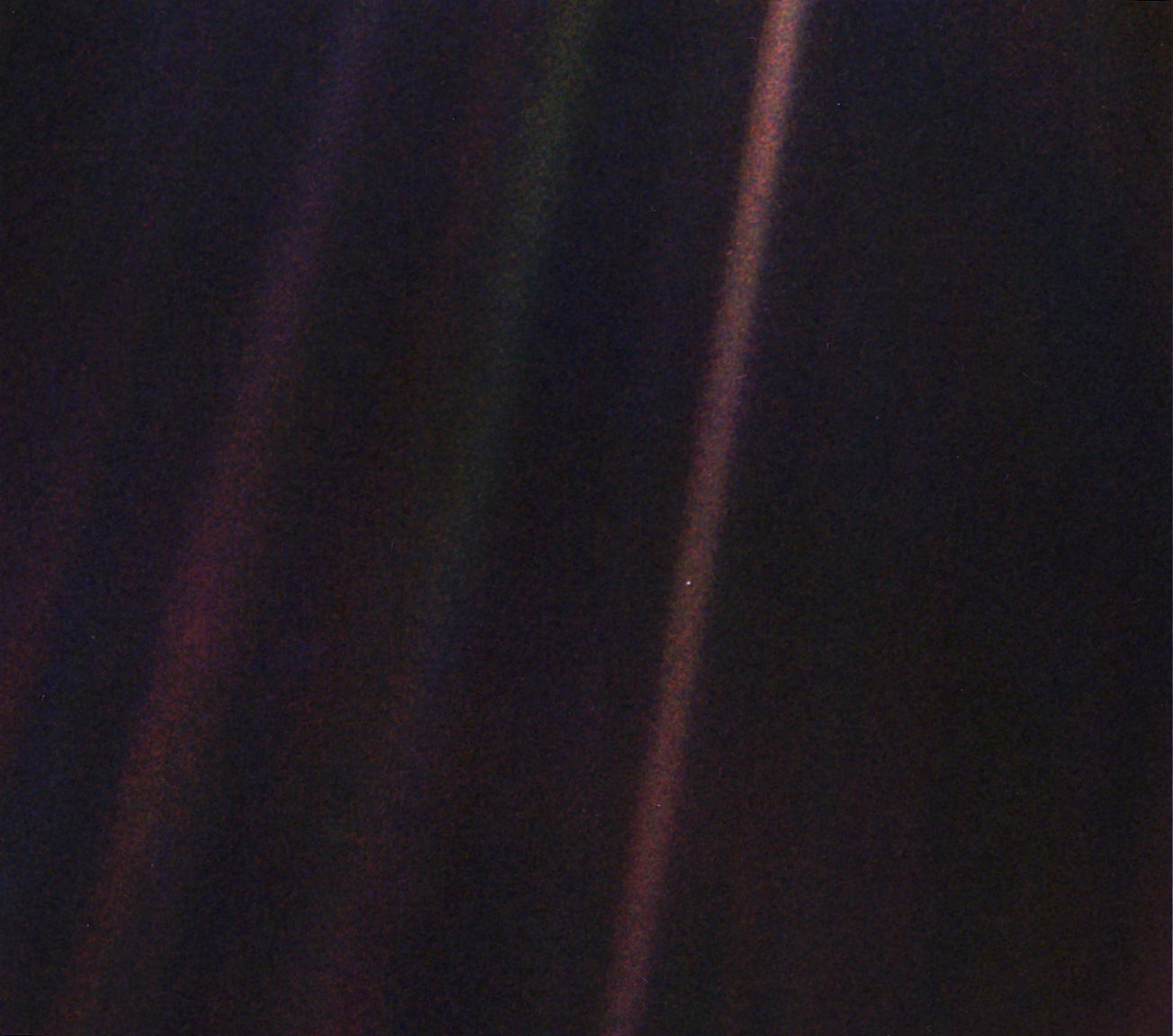
And keep perspective. The picture on the left is from the Apollo 8 expedition, and the picture on the right with the little blue dot is from the Voyager 1 space probe from nearly 4 billion miles away. They are both pictures of our shared home, and at this point, it is worth quoting the renowned cosmologist, Carl Sagan, for those of you who have not heard or read his famous words:
Look again at that dot. That’s here. That’s home. That’s us. On it everyone you love, everyone you know, everyone you ever heard of, every human being who ever was, lived out their lives. The aggregate of our joy and suffering, thousands of confident religions, ideologies, and economic doctrines, every hunter and forager, every hero and coward, every creator and destroyer of civilization, every king and peasant, every young couple in love, every mother and father, hopeful child, inventor and explorer, every teacher of morals, every corrupt politician, every “superstar,” every “supreme leader,” every saint and sinner in the history of our species lived there–on a mote of dust suspended in a sunbeam.
The Earth is all we have, and as biologist Robin Wall Kimmerer contends, it is not enough to sustain our shared home; we need reciprocity with it. Sustainability implies how much can we take before systems collapse. Reciprocity is the understanding that we must give back to our environments as well as consume what we need to thrive, that we need to strive for harmonic balance, not simply avoid ruin, and so far, the differences too many of us have been making in this world have not achieved this.
But that brings me to another point: be graceful with one another. Just because we bear the responsibility of making a difference in all that we do doesn’t mean we will always live up to that responsibility. Most people most of the time are doing what seems reasonable to them, and in those moments when one person’s “reasonable” conflicts with another’s, mistakes will happen; you will bruise others and be bruised; sin is real. But you have the power to forgive—yourself as well as others—and with it, you have the power to restore wholeness to you, to your family, to your community, and to a broken world—the ultimate power of hoping.
Which brings me to my last little bit of wisdom to share as we approach the end of our time together. There is an idea in Zen Buddhism known as “Mu,” and it is the notion that when we find ourselves unable to resolve a particular problem that sometimes the fault lies in the quality of the question we are asking. Hence, a Zen master will often say to a disciple struggling with a problem, “Mu”—you need to be asking a different question. I share this concept of “Mu” with you because as you live out your lives and find yourselves in situations where what seems reasonable to you conflicts mightily with what seems reasonable to another, my experience has been that the two questions we most often ask in those moments are: 1) how can that possibly be reasonable to you? and 2) how can I defeat you?
To which I suggest to you, the best answer to both questions is “Mu.”
Congratulations and best of luck!

References
Images Courtesy of NASA at https://www.nasa.gov/.
Kimmerer, R. W. (May 12, 2022) The Intelligence of Plants. On Being. https://onbeing.org/programs/robin-wall-kimmerer-the-intelligence-of-plants-2022/.
Sagan, C. (1994) Pale Blue Dot: A Vision of the Human Future in Space. New York: Random House.

 Light a Candle
As I approach completion of my 81st year on this planet, I needed this letter as much as those who are just emerging from their first 12 years of school. These are lessons to be heard and reheard, learned and relearned throughout life. Well said and a great reminder to those of us further along in the journey as we continue the pilgrimage of life.
LikeLike