The Talk

In the days immediately following the mass shooting at the Tops Friendly Markets in Buffalo, NY, NPR was interviewing an elderly African-American woman who lives in the neighborhood, discussing racism and the threat of White supremacists in America when the topic of The Talk came up—the one Black parents have to have with their children about the dangerous realities of growing up and living in our society—and you could hear the capitalization in the woman’s voice.  But as she was speaking about The Talk, she wondered aloud, with a tone of despair, why White parents don’t seem to feel the need to talk with their own children about the racism in our society, and it was crystal clear from her intonation that this time, she was using the lower-case version of “talk.”  

I found the difference striking, and it got me to thinking:  what might the White parent equivalent of The Talk involve? How might I speak to my own hypothetical children about the role the mere color of their skin is going to play in their daily lives? What would I tell them about their automatic part in this country’s systemic racism simply for having been born here as a White person?

Here’s my preliminary draft of what I think I would say:

My dearest child, I need to speak with you today about an uncomfortable topic: the unearned and frequently unrecognized privilege you have in this life simply because of the color of your skin.  You can stand on any street corner, walk any sidewalk in this town, and never find yourself hostilely confronted by people demanding to know what you are doing there.  No one will follow you with suspicion around in a department store or ask, “can I help you?” in a tone that implies you shouldn’t be there, and people will not cross the street to walk on the other side when they see you coming.

Furthermore, should you ever find yourself pulled over for some minor traffic offense, it will not occur to you to feel anxious about your actual survival; you’ll merely feel the normal anxiety that comes from getting caught doing something the law says you shouldn’t.  And when you do go out, we as your parents don’t have to hear each ring of the phone with dread until you are once more safely at home.

And that, my child, is just the beginning of the privilege affforded you by your white skin.  You will be seen faster by doctors in the emergency room, and you are likely to be healthier in the first place because you possess the political clout to NIMBY that trash incinerator from ever being built right next to your house. You will possess wealth you never earned simply from the unpaid and underpaid labor of centuries of first slavery and then systemic racism—remember that even the most ardent 19th Century abolitionist benefited from cheaper clothing due to who farmed and harvested the cotton—and you will spend a lifetime with better access to credit, housing, and education than most of the people of color in your community.

In addition, you will regularly see yourself and others like you in the media, in the professions, and in positions of power, and that, my child, brings me to perhaps your greatest, most hidden privilege of all:  you do not have to see yourself.  When you look in the mirror, you do not have to see your Whiteness; you do not have to notice it.  You will often hear many liberal, well-intentioned White Americans profess they are “colorblind” when it comes to an individual’s racial identity—when in reality, what they are blind to is the color of their own skin…and all the privilege that comes with it.  Therefore, see your Whiteness, my child, because only then can you understand your own part in the racism of our society and start working to become the active anti-racist we know you are capable of being….

Like I said, just an initial draft for the White version of The Talk.  I’ve obviously left out how enormous the cost of this privilege is, how brutalizing it has historically been to our communities of color, and I’ve left out just how challenging confronting the realities of this privilege is for those of us who are White—the work is arduous and long—and of course, I’ve left out the truth that there are parts of The Talk that would be more appropriate at certain ages than at others.  Thus, in reality, we are talking about The Talks.

But that brings me to a different question:  how do we go from having to have The Talk to just talking? How do we humanize everyone in each other’s eyes? Here is where I think education comes into the picture.  It is why we need to teach the accurate history of this country in our schools.  It is why we need to read and hear different voices in our classrooms.  It is why I would argue that we should require our students to start studying a foreign language no later than Kindergarten, and it is why we need students to learn and understand that “race” is a 100% social contrivance; it has absolutely no biological root whatsoever. 

Because when we know each other’s stories, we can no longer see anyone as “Other,” only as “another,” and when everyone is simply another fellow human being, it becomes very hard to support, justify, and maintain the unjust systems that require The Talk in the first place.

A Letter to the Class of 2022

Tseng Tzu said, “Every day I examine myself on three counts.
In what I have undertaken on another’s behalf, have I failed to do my best?
In my dealings with my friends, have I failed to be trustworthy in what I say?
Have I passed on to others anything that I have not tried out myself?”

—The Analects

Dear Members of the Class of 2022,

I have often wondered at times if the universe was not trying to foreshadow the unexpected character of our journey through these past four years when for the only time in my career, the 9th grade retreat was in the school gym instead of Camp Pecometh.  And I told my ghost story illuminated by the light of a 60-watt bulb on the auditorium stage rather than the roar of a wood burning fire.  It’s just not the same without the smores.

But journey we did, and OMGg (that’s “Oh, My Goggles!” for the uninitiated), what a journey it has been.  Lockdowns and quarantines; zoom school and hybrid classes; mask mandates and vaccines; lost learning and missed milestones…we have endured much in our endeavor to regain some normalcy at school.  Nor has it just been school.  Inflation and supply chain issues; political insurrection and conspiracy theories; culture wars and a million COVID deaths…the pandemic has left no corner of society untouched or unmarked, and now we have a war involving a nuclear power run by a ruthless sociopathic dictator.  It’s been a LOT!

Yet here we still are, with all of you getting ready to walk across the stage, collect that diploma, and head out into the next chapter of your lives, and as I have done for a couple of years now, I want to offer some thoughts that might inform this transition. Especially at a time when the litany of challenges in the world can feel utterly overwhelming and the urge simply to shut down feel so great.  You did not create the world you are inheriting, but we, the adults who love you, want you to live in it as successfully and meaningfully as possible.  Hence, here at the end of our journey together, one final lesson from the heart for the soul.

To begin with, always remember that life is just plain messy.  From a flat tire discovered coming out of the grocery store to the misplaced charger for a dying phone, it simply is not possible to anticipate, plan, and prepare for everything that happens in daily life.  Inconvenience and hassle are just baked into the nature of existence, and you can expend an enormous amount of wasted energy trying to resist this fundamental truth before making your peace with it.  My recommendation? Make peace now; start saving all that precious energy for life’s truly messy moments.  Because from the unexpected death of someone you love to the medical diagnosis you don’t see coming, there will be future pandemic-level moments of messiness that will upend your lives entirely.  It’s called being human, and if the actual pandemic has gifted you with anything, it is the strengthened resilience to survive, even to thrive in the face of life’s messiness.

In fact, you are probably the most resilient generation since the Great Depression of the 1930s, and that is good news because you are going to need this freshly nurtured superpower from these past four years to confront the environmental and social challenges awaiting you as adults.  And that’s my next point:  just because life is messy doesn’t make you impotent to deal with the mess.  It can be awfully tempting to allow the scale of certain problems—climate change, for example, or systemic racism—to fill us as individuals with a sense of despair that discourages taking any action to address them and then to allow ourselves to feel overwhelmed by a sense of hopelessness.  But as I have told my classes for decades:  hope is not a noun; it is not a feeling. It is a verb.  Hope is something you do.  For instance, to be hopeful about reversing climate change, you walk or bike rather than drive; you eat plants rather than meat.  To be hopeful about overcoming systemic racism, you patronize BIPOC owned businesses rather than Walmart; you challenge the relative who just made a prejudiced remark rather than remain silent.

And before there is the usual—almost inevitable—“how can only one person make a difference?” protest, let me share one of teaching’s most famous fables.  The story goes that there has been an enormous hurricane, and a local fisherman has gone down to the beach to observe the damage, only to discover that the tidal surge has thrown at least a thousand or more starfish up onto the shoreline.  They cover the sand as far as the eye can see, and off in the distance, the fisherman notices a youth walking down the shore, picking up one starfish at a time and hurling them back out to sea.  As the fisherman approaches the youth, he can only think how Sisyphean is this task, and he confronts the youth: “What in the world are you doing? What difference can your feeble efforts possibly make for all these starfish?” The youth listens respectfully and then leans down, picks up another starfish, and hurls it as far out into the water as possible.  Turning back to the fisherman, the youth responds, “Made a difference for that one” and continues steadily down the beach tossing starfish out to sea.

Thus, never underestimate your power to effect positive change in the face of life’s messiness; never underestimate your power to make a difference in the lives of all around you.  Indeed, as a biologist, I can assure you that every literal breath you take and every molecule you cycle through your digestive tract occurs in a web of ecological relationship that impact every single living thing around you.  Every course of action you take ripples out into this wider web, and in fact, the real problem with the attitude “how can one person make a difference?” is that it fails to recognize our complete interconnection with everything and everyone.  Making a difference is what we do all the time!

It is also why each of us bears the great responsibility to choose our actions wisely.  Especially when communicating with others.  That text dashed off in a fit of anger, that dangerous TikTok challenge posted, that falsehood tweeted, snapchatted, or instagramed….  How we craft our language when engaging with people matters, and we need to be framing our public conversations with much greater care than a lot of us are currently doing.  Truth matters, and it matters precisely because every single thing you do makes some manner of difference in the lives of all around you.  Falsehoods harm; misinformation and disinformation harm.  So be the light of truth that heals, that repairs, that uplifts.

And keep perspective.  The picture on the left is from the Apollo 8 expedition, and the picture on the right with the little blue dot is from the Voyager 1 space probe from nearly 4 billion miles away.  They are both pictures of our shared home, and at this point, it is worth quoting the renowned cosmologist, Carl Sagan, for those of you who have not heard or read his famous words:

Look again at that dot. That’s here. That’s home. That’s us. On it everyone you love, everyone you know, everyone you ever heard of, every human being who ever was, lived out their lives. The aggregate of our joy and suffering, thousands of confident religions, ideologies, and economic doctrines, every hunter and forager, every hero and coward, every creator and destroyer of civilization, every king and peasant, every young couple in love, every mother and father, hopeful child, inventor and explorer, every teacher of morals, every corrupt politician, every “superstar,” every “supreme leader,” every saint and sinner in the history of our species lived there–on a mote of dust suspended in a sunbeam. 

The Earth is all we have, and as biologist Robin Wall Kimmerer contends, it is not enough to sustain our shared home; we need reciprocity with it.  Sustainability implies how much can we take before systems collapse.  Reciprocity is the understanding that we must give back to our environments as well as consume what we need to thrive, that we need to strive for harmonic balance, not simply avoid ruin, and so far, the differences too many of us have been making in this world have not achieved this.            

But that brings me to another point: be graceful with one another. Just because we bear the responsibility of making a difference in all that we do doesn’t mean we will always live up to that responsibility.  Most people most of the time are doing what seems reasonable to them, and in those moments when one person’s “reasonable” conflicts with another’s, mistakes will happen; you will bruise others and be bruised; sin is real.  But you have the power to forgive—yourself as well as others—and with it, you have the power to restore wholeness to you, to your family, to your community, and to a broken world—the ultimate power of hoping.

Which brings me to my last little bit of wisdom to share as we approach the end of our time together. There is an idea in Zen Buddhism known as “Mu,” and it is the notion that when we find ourselves unable to resolve a particular problem that sometimes the fault lies in the quality of the question we are asking.  Hence, a Zen master will often say to a disciple struggling with a problem, “Mu”—you need to be asking a different question.  I share this concept of “Mu” with you because as you live out your lives and find yourselves in situations where what seems reasonable to you conflicts mightily with what seems reasonable to another, my experience has been that the two questions we most often ask in those moments are: 1) how can that possibly be reasonable to you? and 2) how can I defeat you?

To which I suggest to you, the best answer to both questions is “Mu.”

Congratulations and best of luck!

References

Images Courtesy of NASA at https://www.nasa.gov/.

Kimmerer, R. W. (May 12, 2022) The Intelligence of Plants.  On Being. https://onbeing.org/programs/robin-wall-kimmerer-the-intelligence-of-plants-2022/.

Sagan, C. (1994) Pale Blue Dot: A Vision of the Human Future in Space. New York: Random House.

Asset Framing

Is your first thought about them
one that affirms the spirit
of the person in front of you?

—Trabian Shorters

If all we look for is pathology,
we’ll miss everyday moments of promise.

—Mike Rose

Like those in the medical profession, part of my job as an educator is to diagnose what’s wrong so that I can prescribe the fix.  In fact, I spend significant time and effort in the classroom each day determining what ails and figuring out how to cure it.  However, this approach to teaching and learning carries with it a great danger and that is that the human mind tends to define people by their situations.  For example, we seldom say of the economically disadvantaged that “so and so is a poor person;” rather, we speak of “The Poor”—as if somehow it is a personality trait—and consequently, in challenging situations (such as a “struggling school” or a “difficult class”), we have a bad habit of defining those involved by the problem (“the students are inferior”).  Which is not to say that a given problem or challenge is not real but “that is not what defines us.  That’s not what defines anyone” (Shorters).

The simple truth is that how we talk about a particular situation, individual, or community matters, and the language we use determines the kinds of thinking we engage in when trying to fix or repair something that’s wrong.  When we frame matters in terms of deficits—”disadvantaged,” “at-risk,” “marginalized”—we are using the language from the investment world of “cost control” and “risk management,” and as social visionary, Trabian Shorters points out from his work with non-profits seeking to address issues of poverty:

there’s a difference between risk management and equity investing…if you’re talking about being equitable, then you have to define people by their assets.  You’ve got to say, what is it we are investing in? We’re not investing in poverty.  Who invests in poverty? You’re not trying to grow poverty.

Or as he also frames it:

When you’re going to tell the story where all you do is point out what’s broken, but you don’t point out what’s working in a culture, well, recognize that you’re inclining people to think that all that exists about that culture is brokenness.

And that, Shorters argues, is where we need to change the language of the conversation.  The alternative is what he refers to as “asset framing,” and it is the notion that we need to start any understanding of a problem or challenge with the positive values and aspirations of the community or individuals involved.  Imagine, he suggests, that at your first encounter with someone new that you were asked to tell that person everything that was wrong with them.  Our immediate gut reaction simply reading such an idea repels at its inherent wrongness, and yet it is precisely what we do whenever we begin our initial description of a person or community as “disadvantaged,” or “at-risk,” or “marginalized.”  We’ve tagged them as fundamentally broken before we even begin, and the result, Shorters argues, is that our thinking about how to help is already impaired.  He doesn’t deny that there could, in fact, be an important problem to solve; it’s just counter-productive, he insists, for that to be the starting point for identifying any real solution to it.

I have found the ideas and insights of Shorters quite useful in my thinking about the question, “what are schools for?” and this has been especially true when it comes to one of the more notorious answers to this question:  the school-to-prison-pipeline.  Again, the insight Shorters provides about this concept is that it all has to do with the language framing it.  As he points out, the “zero-tolerance” policies of schools starting in the 1980s were rooted in the deficit-framed fears about life among America’s urban poor, and soon the resulting increase in suspensions and expulsions placed more and more young people (especially black males) on the streets where their absence from school impaired the very education that might provide them the economic opportunity needed to keep them from a life on the streets.  Deficit-framed fears became a self-fulling prophecy, and therefore, “when you deficit frame, your solutions end up creating problems you have to fix later.  We built the [very] thing that we’re [now] trying to solve” says Shorters.

What, though, if we used the language of valuation and aspiration? As Shorters argues, “if we recognize that poor kids still contribute, then we look for ways to move the systemic obstacles to their abilities to do so…and when you asset-frame instead of using [the earlier] sort of deficit-framing jargon, when you define the student by their aspiration to grow up and graduate, then all the unjustness of the obstacles becomes easier to appreciate” as well.  Asset-framing, he declares, fundamentally changes the entire conversation about the school-to-prison-pipeline as a response to “what are schools for?” and makes obvious the necessary changes in our schools to disrupt this manifestation of systemic racism in our society.

Asset-framing can also alter how we look at the ideas I explored in Why Schools? and Whose Intelligence? when trying to answer “what are schools for?”  For instance, instead of starting with the learning deficit the pandemic has created in all our children, how might we asset-frame the current situation in our schools? We have communities of caring adults and children who are happy to be back in person interacting with their peers.  When framed this way, the challenge facing schools stops being “how do we overcome the loss?” and becomes “how do we support the caring adults and use the children’s joy to address the gaps in their cognitive skills and knowledge?”

And if we stop framing the conversation around different intelligences in terms of limited hierarchies and affirm “the intelligence not only in the boardroom but on the shop floor; in the laboratory and alongside the house frame,” then we will construct classrooms “brimming with a diversity of interests, motivations, and abilities” (Rose, p. 97 & 139).  We will construct educational programs that address all manners of employing the mind, and we will have schools that honor all forms of work.  We might even be so bold as to start paying all employed individuals a living wage.

I know; I know.  That last borders on utopianism in our dystopian culture, and as I challenged early on in my LaC updates, it really is pie. We can only divide a finite amount of resources so many ways, and thus, for the “have-nots” to have more, the “haves” have to have less, and no amount of “lifts all boats” capitalist mythology can alter this fundamental truth about the natural world.  As the pandemic has fully revealed, biology trumps wishful thinking every single time.

Yet, there I go again with my natural habit to frame things in terms of their deficits.  Granted, it’s hard not to focus on the pathology when the problems and challenges facing the entire world right now are as enormous as they are, and even Shorters recognizes:

we have reached a point where our normal set of cultural and governmental organizational systems, they clearly aren’t adapting fast enough for the realities that we’re encountering.  Like, as a society, as individuals in the society, we are creepingly and more and more aware that those in charge are not capable of securing us, right? And of course, that’s innately terrifying.

But then he goes on to say:

If we’re going to change our culture, we have to change our narrative.  That’s what it comes down to.  We have to change the mental models that our brains are using to make sense of the world, because the ones we have right now, they’re failing us—dramatically, you know.  So that’s where, like when I think about our work, I love that this level of instability means we can actually make real progress on racial bias.  We can make real progress on gender bias.  We can make real progress on economic instability and bias, because the answers that we would’ve given 30 years ago, nobody believes them anymore.  You can’t convince people of the old path.

Change our narrative? Our mental models? An ecological paradigm for education and what schools are for, anyone?

References

Rose, M. (2014) Why School? Reclaiming Education for All of Us.  New York: The New Press.

Shorters, T. (Feb. 3, 2022) A Cognitive Skill to Magnify Humanity.  On Being with Krista Tippett. https://onbeing.org/programs/trabian-shorters-a-cognitive-skill-to-magnify-humanity/.

Whose Intelligence?

A mind is a terrible thing to waste.
—UNCF

Before continuing with my series on “what are schools for?” I must offer a full confession: for my entire youth and much of my adult and professional life, I have been on what I now consider the wrong side of this post’s topic:  whose intelligences might we want to value in our schools?  A magna cum laude, Phi Beta Kappa with multiple graduate degrees, I am the poster-child for valuing the traditional academic understanding of what it means to call someone intelligent.  Or to labor the obvious, I am a science teacher; I educate young people in an intellectual discipline for a living.  Hence, when it comes to exploring how our schools and society value—and devalue—the many different types of intelligence humans express in their lives, my historical bias is clear, and I just need to be forthright about that “elephant in my living room” before continuing.

But now, I want to explore “the powerful effect our assumptions about intelligence have on the way people are defined and treated in the classroom, the workplace, and the public sphere” (MW, p. xxxix)1 and to examine the role our schools play in what types of intelligences our society chooses to value.  I want to unpack not only my own bias but those of our society to see how we might want to change our schools and move away from the “college-readiness” pipeline that has become the obsession of education reformers for the past twenty years and move toward the kind of “adulting-readiness” discussed in my previous posting, Why Schools?

Of course, whenever discussing the concept of intelligence, it is critical to remember that this feature of the brain is not a fixed value and that an individual’s IQ, EQ, and CQ are all malleable properties that can vary and change significantly over the course of a lifespan (see Chapter 3, Chapter 6, and Teaching Creativity).  Yet, what I want to challenge us also to remember is that a society’s understanding of intelligence is equally malleable and heavily influenced by historical place and time.  Indeed, “a society can validate some expressions of intelligence and award less merit to, even deny, others” (MW, p. 212), and in our own—where we have inherited from the Ancient Greeks the celebration of analytical reasoning over physical labor2—this “opposition of hand to brain” has led to theories of intelligence that “restrict, even categorically rule out, the possibility of the full expression of mind for whole groups of people” (MW, pp. 141 & 102).

No where do we see this more (nor worse) than among the working poor and those traditionally known as blue-collar workers.  In our society’s cultural contract, adults who wait tables, or cut hair, or stock shelves, or perform any of a host of other forms of physical labor for a living simply do not possess certain types of intelligence.  And since “judgments about intelligence carry great weight in our culture” (MW, p. xli), this alleged absence risks becoming attributed to an individual person’s character, with all the moral freight that comes with that.  As Trabian Shorters, founder and CEO of BMe Community, points out, the brain’s innate pattern mapping process can start to ascribe what are simply features of a person’s life at a given moment in time (e.g. waiting tables to meet financial need) to aspects of that person’s fundamental properties (“only smart enough to wait tables”).  The result is that our society’s valuation of certain types of intelligences over others can lead to harmful stereotyping, with all the socio-economic inequities that come with that.  Or as fellow educator, Mike Rose, at UCLA’s Graduate School of Education and Information Studies puts it, “the politics and power plays by which particular interest groups get one kind of work categorized as ‘skilled’ and another as ‘semi-skilled’ or ‘unskilled’ have significant economic and social consequences” (MW, p. xlvi).

Yet what the extensive research of Rose and others has shown is that “the world of everyday work provides a rich display of the kinds of mental activity long valued by those who study human thought” (MW, p. 201). The intelligences employed by those who do the “hand” work which our society devalues are no different in kind than those who do the “brain” work which our society so heavily rewards, and the memory skills needed to navigate a restaurant dinner rush, the design skills needed to craft a cabinet, the 3-dimensional reasoning needed to coif a client’s hair…these are merely three small examples from Rose’s own research which he uses successfully to refute our society’s artificial “hand-brain” division when it comes to understanding human intelligence. 

However, if the traditional “hand-brain” split is wrong and if we now have actual research refuting it, why do we continue to employ it—particularly in how we structure schools and education? Part of the answer, of course, is the cynical one that those in positions of power will do just about anything to remain in power (witness the current Republican-dominated state legislatures in action!), and from this standpoint, education in this country is all but deliberately designed to sort, divide, grade, and assign each person their “proper” socio-economic position in the system of wealth and white privilege. 

But part of the answer may also have to do with how we communicate about intelligence, and here, Rose suggests something I find intriguing.  He argues that what is missing when it comes to our understanding of the intelligences employed during “hand” work are the vocabularies we have already created to describe the intelligences used during “brain” work.  It is these missing terminologies, he claims, that keep our society from recognizing the wealth of mental activity employed during physical labor, and thus, it is limitations in our lexicon about whose intelligences we might value in our schools that contributes to the limitations in whose intelligences we actually do. Furthermore, because “the richness of [a school’s] program matches the perception of the capacity of the people who populate it” (WS, p. 180), schools found in communities where “hand” work dominates are structured accordingly, with the impoverished educational programs that simply reinforce the social separations of the cynical response to why we keep using the “hand-brain” division in the first place.  Or to paraphrase the work of the renowned Paulo Freire, what we cannot talk about, we cannot change.

Which is precisely the situation we find ourselves in with our current, massive cultural divides.  So not only does whose intelligences we value impact the quality of education and even the kinds of education offered in our schools; it impacts our ability to have meaningful dialogue around a whole host of social issues.  Hence, unless we start to value the full range of intelligences in our schools and the work that employs them, we face a great impasse moving forward as a nation.  Democracies flourish when all their citizens have a valued voice in the political and socio-economic “conversation,” and until we structure our schools to enable all intelligences to realize their full potential, we risk silencing everyone.

How we might do this restructuring is what I will explore next.

1Because I will be referencing the research of Mike Rose from two different sources, I will be using the abbreviation “MW” for The Mind at Work and “WS” for Why School?

2It is worth noting as an aside that the Ancient Greeks’ “life of the mind” was built at the expense of an economy based nearly entirely on slave labor.

References

Fish, T. & Solomon, L. K. (Sept. 28, 2021) New View EDU Episode 8: Schools as Practice Zones for Adulting; An Interview with Julie Lythcott-Haims. National Association of Independent Schools. https://www.nais.org/learn/nais-podcasts/new-view-edu/episode-8-schools-as-practice-zones-for-adulting/

Freire, P. (1970) Pedagogy of the Oppressed.  New York: Continuum Publishing Company.

Rose, M. (2014) The Mind at Work: Valuing the Intelligence of the American Worker.  New York: Penguin Books.

Rose, M. (2014) Why School? Reclaiming Education for All of Us.  New York: The New Press.

Shorters, T. (Feb. 3, 2022) A Cognitive Skill to Magnify Humanity.  On Being with Krista Tippett. https://onbeing.org/programs/trabian-shorters-a-cognitive-skill-to-magnify-humanity/.

Why Schools?

How we think about and voice the purpose of school matters.
It affects what we put in or take out of the curriculum and how we teach that curriculum.
It affects the way we think about students—all students—about intelligence, achievement,
human development, teaching and learning, opportunity and obligation.
And all of this affects the way we think about each other and who we are as a nation.

—Mike Rose

Those who are regular readers may have noticed that it has been an unusually long time for me since my last posting.  However, I have been deeply enmeshed in the thinking and writings of Julie Lythcott-Haims, Mike Rose, and Trabian Shorters that has kept me quite busy, and they have all had me doing some intense, prolonged thinking about a question: “What are schools for?” 

As the lengthy epigram above points out, how we think about schools and their ultimate purpose matters—a lot!—and as I have pondered the work of these authors and this question about schools, I have realized that while I have voiced myself extensively about the educational process and even its ultimate purpose, I have not really explored the formal institutional systems through which we engage in educating individuals in this country and how we have structured those systems and for what purpose.  Therefore, in the coming series of postings, I am going to explore three things:  what we might want to accomplish with our schools, whose intelligences might we want to value with our schools, and how the framing of these two questions impacts how we ultimately address them.

Part 1:  Adulting

As I have explored in an earlier post as well as in Chapter 8, the classic purpose of schools in the last 100+ years in the United States has been essentially social engineering.  Education from this view serves the purpose of preparing individuals for their specific “cog” in society’s “machine,” and “the task of the efficient school system is to guide people into their likely place in the social order” as quickly and predictably as possible (MW, p. 178).1  Furthermore, this emphasis on schools generating the “correct” social ordering has taken on a progressively greater economic character over the past few decades until now, “kids go to school to get themselves and the nation ready for the global marketplace” (WS, p. 72).

Yet there are fundamental problems with this strictly socio-economic, social ordering understanding of schools.  First, as fellow educator, Mike Rose, at UCLA’s Graduate School of Education and Information Studies points out, “this rhetoric of job preparation and competition can play into reductive definitions of teaching and learning” like the Cartesian one I have been arguing against since this project’s inception.  Indeed, so reductive can this understanding of schools become that we have seen in every single one of the last three national school reform movements efforts to “teacher proof” the educational process.  After all, the thinking has gone, “since teachers are—when it comes down to it [according to this reductive view]—the problem, we [need to be] busy devising systems and techniques to direct them, [using] objective statistical procedures to measure their effectiveness” through standardized tests (WS, pp. 71-72).

The “only” problem with this vision for schools and education is that “you can prep kids for a certain kind of test, get a bump in scores, yet not be providing a very good education” because the quality of learning you are prepping the kids for happens to be inferior from the very beginning (WS, p. 51).  Furthermore, this vision rests on the insulting belief that teaching is not a demanding profession with its own unique skills, talents, and expertise.  As Rose challenges: “a presidential candidate tours a hospital, but isn’t a ‘urologist for a day.’  A philanthropist visits a women’s shelter, but doesn’t lead a counseling session.  As a teacher all my adult life, I can’t help but be bothered by the familiar implication that anyone can teach”(WS, p. 78).  Because if “anyone” could teach, our schools would not be facing the current staffing crisis and the average tenure of someone in the teaching profession would be more than a measly 5 years.

In addition, there is also something problematic as well about the recent emphasis on the strictly socio-economic purpose of schools and the need to endow future workers with the now nearly mythic “21st Century Skills!” Demanding that schools be all about employment needs smacks a bit of hypocrisy on the part of the business community that is allegedly so in need of such workers and, consequently, in favor of the kinds of schools that would produce them because: 

Our new economy, we are told, requires people who are critically reflective and can make careful distinctions; who can troubleshoot and solve problems; who have an interpretive, analytical edge; who are willing to stop and ponder.  Yet young people grow up in an economy of glitz and thunder.  The ads that shape their needs and interests—and the entertainment produced for them—champion appearance over substance, power over thought.  Such tactics make money in the short run, but what effects do they have on youth culture over time?  The relationship of mass culture and individual habits of mind is complex, to be sure.  But there is a significant disjunction between the kind of youngster business says it needs from the schools and the kind of youngster one could abstract from a youth culture that is so powerfully influenced by business interests. (WS, p. 81)

What we are left with, then, between the reductive, Cartesian, teacher-proofed understanding of schools and an economy that actively undermines the very purpose it claims schools are for is a very pinched and restrictive vision of the educational system in this country.  To answer the question “what are schools truly for?” from this perspective is to have our schools become merely mechanisms for churning out unquestioning consumers who will engage productively in their assigned employment until death-do-us-part.  And any notion that such institutions would actually be educating critical thinkers (let alone collaborators or empathizers or any of the other so-called “21st Century Skills”) is the cynical equivalent of declaring the emperor’s new clothes “positively smashing!”

 Worse still, according to Julie Lythcott-Haims, former Dean of Freshman and Undergraduate Advising at Stanford University, such a vision for schools fails to produce the functional adults any society needs simply to survive. As she puts it, “let’s not lose sight of the fact that this young human is whom you’re bringing forth out of relative incapacity as a 5-year-old into this place of 18 where they might be capable of more of less fending,” and when schools serve a strictly socio-economic, social ordering mission, she argues, they fail to teach children the very “becoming” skills necessary for them to engage in what she terms “adulting.”  Granted, she acknowledges, “these becoming skills are not very visible.  They’re hard to see; they’re hard to measure, and as a result, they get dwarfed by the things that are measurable.”  But she believes that they are the most critical things our children should be learning in schools, and she is convinced—and I agree—that most schools right now are failing at this most important of education’s jobs.

Why, though? What has brought schools to this dysfunctional state in which Lythcott-Haims and I suggest they find themselves? A principal cause, I suspect, is the changes we have observed in parenting habits in our society post 9/11.  As the research of M.I.T.’s Sherry Turkle has shown, parents today insist on maintaining an almost omnipresence in their child’s lives via technology and the micro-scheduling of nearly every minute of the day.  They seek to keep their children as safe as possible in a world where the awareness of deadly violence is perpetually available through the apps on their phones, and thus, when schools have the “audacity” to suggest that a child be allowed to fall down and fail in order to learn the necessary skills to stand up and succeed, “they are [left] in a tough spot because [their] students are getting mixed messages” (p. 247). 

The result is that too many of our schools have backed down from their most important educational mission (no teacher or school administrator enjoys an angry parent on their doorstep!), and the consequence is schools where students no longer practice the “adulting” skills they will need to become one one day.  Indeed, I actually suspect that one possible source of the anxiety, helplessness, and despair so many young adults report feeling about their futures is because our schools stopped deliberately “tripping” them so that they could learn how to “stand up” again.  To feel empowered to effect change, you have to have actually practiced employing real power!

Which brings me to the next logical question:  how to we fix our schools? How do we transform them back into the institutions for practicing “adulting” that is what schools truly should be for?  I suspect I could devote the rest of my career to answering these questions, but let me elaborate on just two simple suggestions of how we might begin. 

First, stop over-managing students’ tasks and time for them.  A decade ago, I could post my course syllabus and calendar up on my school’s on-line management system with the expectation that my students would keep track of deadlines, assignments, etc., thereby learning the skills needed in adulthood to succeed in navigating through lifes’ events.  But today, I am required to use my school’s on-line system to manage my students’ progress for them, uploading in advance all items they need so that the system can tell them what to do and when to do it. The result? Teenagers who are completely dependent on technology to steer them through their routines and who freak out when I make an abrupt adjustment based on a lesson I have determined needs repairing.

The second suggestion I have is to promote a growth mindset in children by creating in our courses and curricula deliberate opportunities where students are guaranteed to stumble and fail on a first (or even second) attempt at some task, skill, or activity.  We already do the equivalent in sports training; so why not in our academic programs as well? By doing so and by providing the corresponding support to learn from their mistakes, students will not only eventually succeed at mastering the specific academic challenges we want them to; they will master one of adulting’s most important skills:  how to fend when life does not go your way—something those of us who are adults know will happen…and likely happen multiple times!

Now I know from conversations with fellow educators—and particularly school administrators who have to deal more directly with parents—that both of my suggestions may feel harder to do in the midst of a pandemic, where we are already battling enormous learning deficits; hence, why make school even more challenging? However, I would argue that failing to learn adulting is, in fact, part of this larger learning deficit our society needs to help our children overcome as we move forward in the pandemic’s wake, and we need to be addressing it as immediately as possible.

After all, as I have quoted Garry Trudeau’s Doonesbury character, Rick Redfern, before, “the world needs grownups.”

1Since I will be referencing the research of Mike Rose from two different sources, I will be using the abbreviation “MW” for The Mind at Work and “WS” for Why School?

References

Fish, T. & Solomon, L. K. (Sept. 28, 2021) New View EDU Episode 8: Schools as Practice Zones for Adulting; An Interview with Julie Lythcott-Haims. National Association of Independent Schools. https://www.nais.org/learn/nais-podcasts/new-view-edu/episode-8-schools-as-practice-zones-for-adulting/

Loewus, L. (May 4, 2021) Why Teachers Leave—Or Don’t: A Look at the Numbers.  Education Weekhttps://www.edweek.org/teaching-learning/why-teachers-leave-or-dont-a-look-at-the-numbers/2021/05.

Rose, M. (2014) The Mind at Work & Why School: Valuing the Intelligence of the American Worker.  New York: Penguin Books.

Rose, M. (2014) Why School? Reclaiming Education for All of Us.  New York: The New Press.

Thompson, T. (Sept. 22, 2021) Young People’s Climate Anxiety Revealed in Landmark Survey.  Nature.  https://www.nature.com/articles/d41586-021-02582-8.

Turkle, S. (2017) Alone Together: Why We Expect More from Technology and Less from Each Other, 3rd Edition.  New York:  Basic Books.

U.S. Department of Education (2011) Facts about the Teaching Profession for A National Conversation about Teaching.  https://www2.ed.gov › teaching-profession-facts.

That Pesky Brain

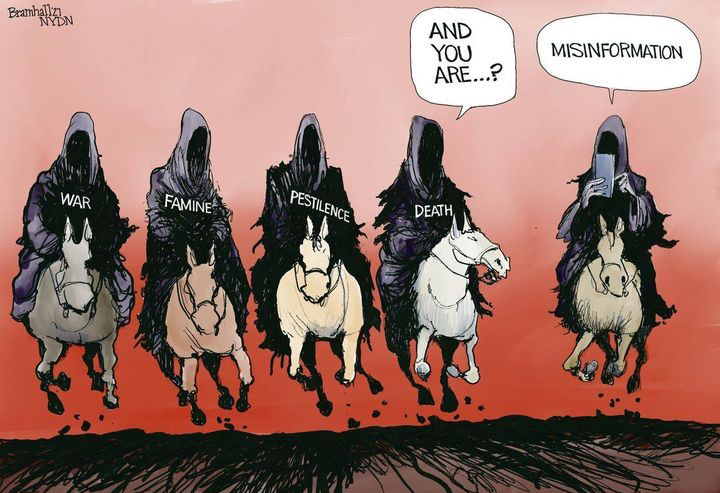
If you were to poll people today about the greatest challenge facing not just this country but humanity itself, the list of logical candidates that come immediately to mind might include the pandemic (duh!), the climate crisis (another no-brainer), and the authoritarian threats to democracy (including numerous state republican legislatures here at home).  However, I would argue that an even greater challenge we face today is misinformation (and its manipulative cousin, disinformation), and I am not alone in this conviction.  The World Health Organization has actually called the attack on empirical truth today in various media and on-line venues an “infodemic,” and in one of my favorite political cartoons of the past year (for which I can only provide a link due to copyright), Bill Bramhill of the New York Daily News has the traditional Four Horsemen—War, Famine, Pestilence, & Death—joined by a fifth called “Misinformation,” riding right along beside them, head buried in a cellphone. 

Yet, psychologists who study and research the phenomenon of “fake news” point out that probably the greatest challenge facing us is neither the misinformation nor disinformation itself but rather the very nature of how our brains process information in the first place.  The science shows that we are all susceptible to what Sander van der Linden of the University of Cambridge calls “the six degrees of manipulation”—impersonation, conspiracy, emotion, polarization, discrediting, and trolling—because anytime we hear something, we instinctively process it through our pre-existing biases, employing what is known as “selective skepticism” to filter our attention.  Indeed, so potent and hard-wired is this confirmation bias, that even when we later hear a correction that we deliberately choose to accept as valid, our thinking and decision making will still operate employing the original message.  In other words, we will regularly behave subconsciously out of the original bias even when we have rationally embraced that it is false or wrong.

What this all means for lucid reasoning is sobering.  Our tendency in education is to assume that if we can just convince people to fact check enough or teach individuals how to discern legitimate sources of information from spurious ones, then rational thought and empirical truth will prevail—that we can persuade hesitant individuals to vaccinate and mask up; that we can convince climate change deniers of our mutual peril; that we can make the right to vote equally accessible to all.  We want to believe that the data will prevail and that people can indeed recognize when the emperor truly is naked.

Yet our pesky brain seems to be standing in the way of everyone (or maybe anyone!) achieving authentic insight, and to get some idea of just how easy it can be do go down the proverbial rabbit hole of misinformation and disinformation, I recommend exploring an on-line activity developed by van der Linden and his colleague, Jon Roozenbeek, called Go Viral!  Especially for those of us who do not spend our days on TikTok, Yik Yak, and Instagram (avoid them even!), this plunge into the world of social media and its role in van der Linden’s “six degrees of manipulation” is quite revelatory as to the power of these technologies to shape how we experience and interact with others in the world.  If you have never experienced the power of “likes,” the dopamine hits that come with them, and the ugly choices one might make to keep them coming, then this on-line game can be positively eye-opening.

What are we to do, then, if even our own brains seem against us? How do we successfully fight misinformation and disinformation in ourselves—let alone society at large? It can feel like a futile battle, and anyone who has seen the recent Netflix satire, Don’t Look Up, about an extinction-level sized comet hurtling toward the earth knows exactly what I’m talking about when I say it seems as if a just, harmonious, healthy society is simply no longer possible in the worldin which we live.  As Stephan Lewandowsky of the University of Bristol points out, “even in the best of all possible worlds, correcting misinformation is not an easy task,” and “psychologists who study fake news warn that it’s an uphill battle, one that will ultimately require a global cooperative effort among researchers, governments, and social media platforms.”

However, perhaps all is not lost.  That game van der Linden and Roozenbeek developed? It turns out that its purpose is to inoculate and immunize individuals against the power of “fake news,” and the research into its impact has shown that it boosts a person’s ability to identify and resist misinformation for a full two months after playing it.  What’s more, if all the adults in children’s lives would start taking their stewardship of the future seriously, we would not even have need for such a game in the first place.

What do I mean by that? I mean reading a book to your toddler instead of shoving a screen in front of their face to occupy them.  I mean denying smartphone technologies to those too young to know how to use them appropriately because otherwise we are doing the equivalent of giving guns and alcohol to our children and expecting their undeveloped prefrontal cortices to make smart choices.  I mean contacting your legislator and demanding social media reform, and if you are a legislator, having the guts to standup to a monopoly that threatens the very fabric of our society.  I mean getting off our own devices and living in the immediate now: experience boredom and the creativity it engenders, examine the quality of one’s thoughts, touch another’s life with your actively focused attention.

As for educators, I’m afraid we do indeed have our work cut out for us.  We have to be willing to collect every cellphone in the room at the start of every class.  We have to be willing to immediately but kindly drop whatever is happening in a lesson to address a falsehood the moment it pops up in class just as we would a micro-aggression.  We have to teach media literacy in the context of our subject matter even if doing so means we don’t get the Krebs Cycle or the 30 Years War covered.  Most importantly, we have to model the embracement of empirical truth in our own behaviors if we are to expect and encourage our students to do the same.

Anything less on the part of all of us who are adults, and our children are not going to get the future they deserve.

References

Abrams, Z. (March 1, 2021) Controlling the Spread of Misinformation.  American Psychological Association. https://www.apa.org/monitor/2021/03/controlling-misinformation.

Committee on Homeland Security & Governmental Affairs. (Oct. 28, 2021) Social Media Platforms and the Amplification of Domestic Extremism & Other Harmful Content (Full Committee Hearing). The United States Senate. https://www.hsgac.senate.gov/hearings/social-media-platforms-and-the-amplification-of-domestic-extremism-and-other-harmful-content.

Staff (March 28, 2019) Reading to your toddler? Print books are better than digital ones.  Michigan IThttps://michigan.it.umich.edu/news/2019/03/28/reading-to-your-toddler-print-books-are-better-than-digital-ones/.

Getting It Right

If we don’t get this right, then it will affect their trajectory in life. So we have to get this right.
—Mohammad Choudhury, Maryland Superintendent of Schools

Learning’s Lost

Since the initial days of the pandemic, I have made no attempt to hide my concerns as an educator for the potential long-term costs of this disease to today’s children.  Whether writing about the impact of pivoting to all virtual learning in the spring of 2020 or the possible disruption to brain development in our youngest this past winter, I have been actively pondering and discussing how our collective handling of this disease might be altering future generations ever since the very first lockdowns occurred.

Well, the official statistics are now in (at least in Maryland), and the picture is as grim as I and others have feared.  Only 15% of children in grades 3-8 passed the Maryland Comprehensive Assessment Program math test (given this fall for diagnostic purposes only), and only 35% passed the English test—a drop from pre-COVID of more than half for the math scores and 8% for the English scores.  Furthermore, statewide, only 40% of those entering Kindergarten arrived with the necessary toolkit to be ready to learn at the start of the current school year (down from 47% in 2019), and in the Baltimore City Schools, that number was only 25%.  Gloomier still, as State Superintendent Mohammed Choudhury points out, “the declines were worse among students who have been out of in-person school for the longest.”

Not that Maryland is alone.  Nationwide, of the 12 states that have collected data so far, the decrease in math and English skills has been on average 14% and 6% respectively.  Thus, my home state is right there in the mix when it comes to the amount of damage to learning the pandemic has caused, but that is a dubious claim at best to “celebrate.”  The simple truth is that all the educational setbacks forecast by myself and other have come to fruition, and to quote Choudhury again: “I was not surprised by what I saw.  I was just waiting for this moment.”

Numbers, though, do not tell the whole story.  It’s not just learning skills students are missing coming into schools this year; their emotional and intellectual stamina to engage in learning has weakened as well.  I have seen it in my own high school students as we have returned to in-person learning, watching them struggle to rebuild the mental “muscles” required to deal with workloads and pace-of-day that more closely resemble pre-pandemic times.  Yet mine at least had something to build back up.  Our youngest learners have not even had the chance to start building those “muscles” in the first place.  Preschoolers, for example, are arriving at schools expecting instant gratification, struggling with basic skills such as sharing and waiting one’s turn, and even something as rudimentary as toilet training has regressed because “children ages 3 to 5 have never been to a bathroom outside their own home” (Mugele).  As a result, “the development pace of almost everything related to our youngest learners has slowed, and the transition to school life is taking longer” (Bowie). 

“Longer,” though, is more than a little problematic for this age-group of children because as the neuroscience and education research of institutions such as the Center for Advanced Study of Teaching and Learning at the University of Virginia have shown, the most dramatic learning takes place prior to third grade.  These are the critical years in which the foundation for all future learning is laid, and with the pandemic interrupting the normal brain development of our youngest learners for three academic years now, we have genuine grounds for concern about their long-term academic success.  Toss in the possible epigenetic changes I wrote about recently, and as Superintendent Choudhury argues, “if we don’t get this right, then it will affect their trajectory in life.  So we have to get this right.”

Moving Forward?

What, though, will it mean to “get this right?” What will that look like? What should it look like? Spokespersons and stakeholders for the Blueprint for Maryland’s Future (our new multi-billion dollar education reform program) have presented the case that it should look primarily like funds for tutoring and other forms of direct remediation to get kids caught up, along with staff development for addressing their emotional and mental health needs brought on by virtual and hybrid learning.  All of which are fine, but these all assume a “fix it” approach to the problems the pandemic has created in education—as in, “fix it and forget it.”  It is a solution that employs the dysfunctional mechanistic, Cartesian approach to teaching and learning that started this whole education project of mine in the first place, and what no one in education (or society at large for that matter) seems to want to address is that the very nature of the pandemic is not going to allow a “fix it and forget it” solution to how to “get this right” for anything, including schools.

For example, the need for the Prince George’s County schools to return to virtual learning until mid-January due to the explosion of new COVID cases is only the most recent example of the fact that this virus is not going away, and its disruptions to our society are permanent.  No matter how badly all of us in schools (and the rest of life) may desire to “return to normal”—to “fix it and forget it”—the reality is that the dynamic interactions of SARS-CoV-2 with the human body are inherently ecological in character, and ecological relationships are, by definition, perpetually in flux, ever changing. 

Which means that the kind of change needed to “get this right” is not about fixing; it is about adapting.  As Nancy Mugele, Head of Kent school has remarked: all of us in education “have had to be flexible, patient, and ready to teach skills that students would normally come to school possessing.”  What I will argue, though, is that this extra flexibility and patience is the new normal.  The speech delays, for instance, which Mugele has observed in their youngest students is going to continue to require her teachers to focus “more on intentionally developing language skills, letter sounds, and pronunciation” for the foreseeable future because the environmental conditions of the pandemic that have generated this delay are not abating.  That was the illusion presented with the roll out of the vaccines:  that here was a magic genii that would make everything right again. Ecological relationships simply don’t work that way, and therefore, we aren’t simply going to “fix” the educational damage our children have endured; we are going to have to adapt to managing it.

However, adaptation puts the emphasis on teaching and learning’s qualities, not its quantities, and the problem here is what UT Austin professor, J.W. Traphagan calls our society’s obsession with “quantocracy”—the “idea that everything must be counted and then judged on the basis of how many of something we have accumulated” (and where the one who dies with the most “wins”).  Simply look back to where I started this post: with statistics about the Maryland Comprehensive Assessment Program and the pandemic induced drop in test scores.  Even the economics of our schools are about quantity, with the number of “butts in seats” directly determining the amount of state funding a given school receives. 

Yet, the truth is that those stats tell us very little about the individual students or their character as learners, and the refusal of so many parents to return their students back to pre-pandemic schools may say something about the quality of education they realized their child was receiving when they could see it firsthand on a screen.  Regardless, the disruption of the pandemic is here to stay, and it is going to fundamentally alter the availability of any kind of quantity; so “getting it right” is going to require a different approach to the problem than simply the availability and distribution of resources.

But that brings me back to what started the Light a Candle project in the first place:  that the metaphor and paradigm we need for education is an ecosystem, not a machine.  And the truth is that ecosystems of any kind are intricate, non-linear structures that either adapt as an entire collective of relationships or perish.  Hence, we can start recognizing the nuanced complexities in our schools as well as society brought on by the realities of the pandemic and start adjusting our behaviors accordingly (e.g. providing noise cancelling headphones to 3-5 year olds to help them cope with anxiety about using public toilets). Or we can stay the course of one-dimensional attempts to “fix & forget” we are currently on toward the kind of civil breakdown historian Jill Lepore discusses in her thought-provoking piece, “Is Society Coming Apart?

I will examine the challenges facing how we might accomplish the first choice in my next post.

References

Bowie, L. (Dec. 9, 2021) Dramatic Drop in Student Test Scores.  The Baltimore Sun. https://www.baltimoresun.com/education/bs-md-maryland-test-scores-20211208-wk5aen5r5bfx5eag2p57pamjcy-story.html.

Bowie, L. (Dec. 14, 2021) Kids Are Coming Back to Schools.  The Baltimore Sun. https://digitaledition.baltimoresun.com/html5/desktop/production/default.aspx?&edid=fd7d909a-ba04-4d6e-9449-b67b84df593b.

Lepore, J. (Nov. 25, 2021) Is Society Coming Apart? The Guardian. https://www.theguardian.com/society/2021/nov/25/society-thatcher-reagan-covid-pandemic?utm_source=pocket&utm_medium=email&utm_campaign=pockethits.

Mugele, N. (Nov. 9, 2021) How COVID-19 Affects the Youngest Learners. NAIS. https://www.nais.org/learn/independent-ideas/november-2021/how-covid-19-affects-the-youngest-learners/?utm_source=tw&utm_medium=social&utm_campaign=mc&utm_content=hw#.YYw1vKg6RrU.linkedin.

State of Maryland (2020) Maryland Commission on Innovation & Excellence in Education. http://dls.maryland.gov/pubs/prod/NoPblTabMtg/CmsnInnovEduc/2019-Interim-Report-of-the-Commission.pdf#page=11.

Traphagan, J.W. (Dec. 5, 2021) We Should Want Quality, Not Quantity. The Baltimore Sun.  https://digitaledition.baltimoresun.com/html5/desktop/production/default.aspx?&edid=1e402ed8-cf55-4ae4-a6e5-07bdcbfb5901.

In This Week’s News…

Recently, my mother and I were chatting over zoom when she asked a most unanticipated question: “are the schools in your area offering ‘mental health’ days?” I was nonplussed; the idea of a “mental health” day has a long history in our family, and my sister and I were allowed one per quarter during high school if we kept our grades up.  So I wasn’t exactly sure what she was asking.  However, I replied that I knew the Baltimore County Schools had recently announced they were giving the Wednesday before Thanksgiving off to reward teachers and staff for working so hard to return to in-person learning, and I asked her whether that was the kind of thing she meant.

It turned out that she did, in fact, mean “mental health” days and that the school districts in the St. Louis area are taking what are effectively “snow days” from time to time, supposedly to support the mental health and wellbeing of students and staff alike as they continue to struggle with the impacts of the pandemic.  My niece, who is a sophomore in high school there, has apparently had some already this year, and my mother was curious about how regional this phenomenon was and what my thoughts were as an educator about it.

Little did either of us know that what we were discussing at the time turns out to be part of a far larger pattern, reported on this past week on NPR, and that the justification being offered by at least some of the St. Louis area schools about aiding mental health might not be so magnanimous after all.  With the pandemic only intensifying and accelerating the staffing challenges already confronting education, it seems that schools at all levels in this country are now fighting on a sometimes daily basis simply to keep their literal doors open.  Add in the bus driver shortage (so prevalent here in Maryland that I don’t even feel the need for a citation for this claim) and we not only have under-staffed schools; we have under-studented schools.

The simple truth, as my sister, the social worker, reminded me the other day, is that “burnout” is rapidly becoming a by-word for all who work in the human services sector of the economy, and insufficient employment in our schools is going to join overwhelmed hospitals and overworked actual mental health care providers in weighing down any return to “normalcy” we are longing to experience.  Indeed, the very day the NPR story aired, I learned the sad news that one of the teachers at my school who had only just been hired in August—and a 15 year veteran in the profession!—had resigned effective immediately, citing his uncertainties about his ability to care for the kids anymore.  Other colleagues, of course, have had to pick up his classes, putting an ever-greater burden on them, and the risk of popping even more “rivets” increases.  Toss in the new omicron variant of COVID, and one might begin to think that the wonder isn’t that NPR can report on so many schools cancelling classes unexpectedly; the wonder is that so many schools are managing to stay open at all. 

Yet, what has me motived to write once again isn’t the growing mental and emotional ennui and exhaustion that people who actively care for others are feeling right now.  No, what has triggered this particular post is something one of the people interviewed in the NPR story said.  The reporter was speaking with a mother from Montgomery County about their board of education’s decision to cancel the half-day of school the Wednesday before Thanksgiving when this individual remarked that:

Sitting there in the audience as a parent, it really hit me that I … and everybody in our community can no longer count on the public schools. And I feel like after the last year and a half, there was a lot of that sentiment that this is just not something we can count on [anymore].

Here was someone from one of the wealthiest school districts on the planet—whose teachers cannot even afford to live in the county where they teach and so face enormous daily commutes in the D.C. traffic—and she’s complaining about the inconvenience of losing what was a half-day schedule in the first place.  To say I heard those words with a wide range of emotional response is a restraint on my part (and a lot of cortisol in the amygdala for that early in my morning!).  But my overwhelming feeling was a sense of angry sadness because this mother’s words were simply capturing the essence of what so many interviewed in the story were basically complaining about:  we need schools to babysit our children so that we can go about our adult lives, and we’re tired of having our adult lives unexpectedly interrupted. 

Now, having written extensively before about how anti-child and anti-parenting our culture has become, hearing it yet again shouldn’t have surprised me or pressed so many of my proverbial buttons quite so quickly.  But part of the reason why I say my reaction was “angry sadness” is that the insight this NPR story provoked was the realization that we have created a socio-economic system of such massive consumption that it requires our schools to serve as housing centers for our children simply to function.  In fact, listening to the hourly-wage essential-work parents interviewed for this story, it was clear:  they have no choice but to see schools this way because without essentially tax-funded day-care centers for their children, no one in the house eats and even the house could disappear. 

However, just because our schools do serve this purpose doesn’t mean they should, and while I’m not naïve—education in this country has always served an economic role—school-as-babysitter should not be one of them.  What’s more, the fact that the pandemic has revealed our economy’s total reliance on this school-as-babysitter paradigm to sustain itself should give all of us significant pause.  Because what it says about a society that it has become so consumed with consuming that its citizens must live paycheck to paycheck isn’t pretty.

In fairness to the NPR story, it did address the negative impacts these disruptions in schools are having on children’s learning, especially at-risk children and those with special needs, and I add my voice that the sooner we address all the learning loss the pandemic is creating (about which I have spent much of the past year writing), the sooner we can rebuild our economy and stabilize our collective lives once more.  But if all we do is return to the old paradigm that understands our educational system simply for the role it plays in enabling the full adult employment needed to drive our consumption-dependent version of capitalism, then we will have missed the opportunity for reflection and educational change which the pandemic has provided us. 

I do agree with President Biden that we can build back better.  But only if we change our understanding of what “better” means.

References

Casert, R. & Woodward, C. (Nov. 27, 2021) Latest Variant Raises Alarms.  The Baltimore Sunhttps://digitaledition.baltimoresun.com/html5/desktop/production/default.aspx?edid=b9d0869c-d482-4d22-8580-334a16babaab.

Kamenetz, A. (Nov. 23, 2021) Parents are Scrambling After Schools Suddenly Cancel Class Over Staffing and Burnout. NPR Morning Editionhttps://www.npr.org/2021/11/23/1057979170/school-closures-mental-health-days-families-childcare-thanksgiving-break.

Seasons

Not knowing eternity is to do evil things blindly.
—Lao Tzu

To everything there is a season and a time to every purpose under heaven.
—Ecclesiastes 3:1

To understand today’s posting, I’m going to need to teach some biology first.  Specifically, I am going to need to explain a concept that most people even with a background in biology are not always aware of—the concept of epigenetics.  This idea and its field of study explore how environmental impacts on an organism’s genetic code can be passed down through generations independent of the genetic code itself, and it is yet another stake in the heart of what for decades was considered the Central Dogma of genetics:  that a sequence of DNA codes for a specific protein which produces a specific trait.  Turns out, per usual, the truth is more complicated.

What’s more, it can also seem somewhat eerie, especially when we look at an example of epigenetics in action.  Take the common white rat.  This favorite of genetic research everywhere has a gene, called fosB, that directly impacts the nurturing behaviors of female rats with their young.  Normal rat mothers will actively groom their offspring, cuddle with them, and perform other calming, attentive behaviors that significantly support and impact their offspring’s proper development.  However, there is a mutation possible in the fosB gene that can render a rat mother perpetually anxious and inattentive toward her offspring—which if passed down through the germline makes future daughters and granddaughters, etc. anxious and inattentive as well.

So far, seems like classic inheritance, right? Inherit the normal fosB gene, and you’re an attentive, nurturing mama rat; inherit the defective fosB gene, and you’re an anxious and negligent mama rat.  Ah! But it turns out that if you take female baby rats with normal fosB genes and place them with an inattentive, neglectful mother, these rats with normal fosB genes will grow up to be anxious and distracted mothers themselves.  And so do their daughters and granddaughters even as the normal fosB gene is passed on to them!  In fact, it can take up to 8 generations of rats before this normal fosB gene starts working properly again in the mother rats.

What gives? We know that differences in environment can impact whether a specific gene is activated or not, and a classic example is the extra melanin production in human skin in response to strong exposure to UV light radiation.  But when there is less UV light, this melanin production decreases.  Change the environment; change the activation and/or activity of the gene.  With the fosB gene, though, we seem to have a situation where it is as if one time exposure to UV caused my skin to stay perpetually high in melanin and then I passed this trait down to my children, their children, and their children’s children.  Given the power of the genetic code (I look like my father for a reason), how is it possible that a one-time environmental impact can cause the impact itself to be passed on independent of the gene involved?

It turns out that our cells have two processes, methylation and acetylation, that enable them to take certain sections of our DNA and keep those sequences either permanently unavailable for expression (methylation) or always available for expression (acetylation)—basically keeping some genes “off” at all times while others are kept perpetually “on.” Which makes lots of biological sense for a complex organism such as ourselves (and our rat friends) because since we all come from a single fertilized egg, every cell of our bodies possesses every single gene, and I do not want my brain cells, for example, ever activating my digestive enzyme genes. Nor do I want the cells lining my stomach ever activating my neurotransmitter genes.  In a similar fashion, since every cell of my body is a eukaryotic cell that needs to transform energy, manufacture proteins, and other tasks common to all my cells, I want the genes for these general functions always activated.

Certain genes, though, such as the fosB gene in rats, can be either methylated or not and still others, such as the one for cortisol in the human brain, can either be acetylated or not.  Therefore, there are certain genes where their expression, their “on-off” status, is very environmentally dependent, and it turns out that this status can be passed down from one generation to the next without any actual alteration in the genetic code itself.  It is a process that is well documented but not yet fully understood, known as epigenetics, and it has revolutionized our understanding of a whole host of human traits from obesity to mental illness.

What, though, does any of this have to do with the primary focus of this project, namely education?

Well, what triggered this walk down my memory lane was hearing neuroscientist, Bessel van der Kolk, speaking with Krista Tippet and revealing that he was one of the survivors of the Dutch Winter during World War II—an event that we now know to be one of the most significant epigenetic events of the Twentieth Century.  The basics are that during the last winter of the war (1944-45), the famine conditions were so severe in the Netherlands as the retreating Nazi’s stripped the country of every resource available that any fetus conceived in the fall or early winter methylated key genes associated with metabolism to help it survive the starvation.  Any fetus, though, conceived in the late winter/early spring—and therefore benefiting from the famine relief brought by the surging Allied troops—did not. 

How do we know all of this? It turns out that when an explanation was sought by the Dutch medical system for why the children and grandchildren of the winter babies seemed to inherit all of their parents’ tendencies toward obesity, hypertension, and cardiovascular diseases while the children and grandchildren of the spring babies did not—populations that were each basically the exact same generations and so should display similar medical patterns—researchers found that the presence or absence of methylation markers appeared clearly on the DNA samples taken from each of these two groups, separated by a single environmental event.

Again, though, I can hear a reader wondering what any of this has to do with teaching and learning?

It turns out for anyone not familiar with his work that van der Kolk specializes in the impact of trauma on the mind and body, and he was conversing with Tippet about the potential impacts of the pandemic’s trauma on people.  That caused me to have one of those small epiphany moments as all the ideas of trauma, the Dutch Winter, COVID, and epigenetics coalesced into a single thought:  what epigenetic impact will the pandemic have that could potentially impact generations of humans to come?

We know, for example, that trauma of any kind has the potential to cause epigenetic changes, and in fact, part of what makes Post Traumatic Stress Disorder (PTSD) so challenging to treat is the on-going highly elevated levels of cortisol in the brain (acetylation in action!).  Moreover, while the kinds of environmental events that can trigger PTSD in individuals is not likely to cause the PTSD itself to be passed down (since the acetylation isn’t occurring in the gamete cells), the elevated cortisol from any pandemic stress a pregnant mother might be experiencing can enter her blood stream, crossing the umbilical cord to the developing fetus, where it can impact gamete cell development (something similar is what happened in the Dutch Winter).

And since cortisol levels in the brain are critical to the success or failure of the memory process (see Chapter 3), how the regulation of those genes gets passed down to future generations impacts all future teaching and learning.  Any stress induced epigenetic changes the pandemic is having on all our genomes has the potential to impact education’s effectiveness for at least a couple of generations (the great grandchildren of the winter babies displayed healthier phenotypes).  Therefore, whether the pandemic causes the mutism of a young boy challenging his Baltimore City school teacher’s attempts to teach him right now or the pandemic produces inheritable methylation and/or acetylation of key genes governing brain development in the future, the pandemic will very likely be impacting how we teach and learn for decades to come.

What’s more, I haven’t even touched upon what epigenetic changes the pandemic might be causing to genes governing an individual’s physical health and the known impact that can have on learning.  Hence, when the experts keep saying that we have no idea yet of what the long-term impacts of COVID are, we need to recognize that they are not just talking about the direct medical consequences it might have for an individual who contracted the disease.  They are talking about the unknown long term potential impacts on every single one of us for possibly generations.

Which can feel scary and overwhelming and despairing even if you are not a fellow educator facing pandemic children in the classroom right now (and might explain the behaviors of the “roaring 1920s” even if they didn’t know the biology then).  However, I would conclude by offering a note of cautious optimism:  those winter babies? They did, in fact, grow up to help rebuild Europe, and they and their children lived long enough to help form the European Union, and—in a definite piece of irony—their grandchildren lived long enough to produce the healthier great-grandchildren who are presently rioting in the streets of the Netherlands protesting the restrictions of their own “Dutch Winter” that will introduce its own set of epigenetic change. Who said nature doesn’t have a sense of humor?

The simple truth facing us at this time (and always if we have the wisdom to recognize it) is that life’s cycles transcend us, with eternity sweeping us along in its currents, and it is how we navigate this journey that ultimately matters.  Change is the only thing that is changeless, and as the generations before us had to deal with their own “winters” as best as able, so too must we deal as best we can with ours.

Remember, hope is a verb.

References

Bowie, L. (Nov. 14, 2021) “We Didn’t Ask for This.”  The Baltimore Sun.  https://digitaledition.baltimoresun.com/html5/desktop/production/default.aspx?edid=a9897f19-3d9f-4abf-9819-2260fef2a265.

Carey, N. (2012) The Epigenetics Revolution.  New York: Columbia University Press.

Nestler, E. (December, 2011) Hidden Switches in the Mind.  Scientific American.  Pp. 77-83.

Tippett, K. (Nov. 11, 2021) Bessel van der Kolk: Trauma, the Body, and 2021.   On Being. https://onbeing.org/programs/bessel-van-der-kolk-trauma-the-body-and-2021/#transcript.

Quarter 1 Grades & Comments: The Kids Are Not Quite All Right

One key reason parents will pay for a private school education is the more individualized attention teachers can pay to their child, and so for twenty-five years now, the last week of October and the first week of November have involved an annual ritual for me of writing a detailed report on every single one of my students at the end of first quarter.  The expectation for these reports is that I will provide an individualized appraisal of both the academic and social-emotional progress of each child, using observable phenomena to support my evaluation; if I were still in my public high school days, it would be the equivalent of a parent-conference night where every single one of my 120 or so students’ guardians actually showed up to have a conversation with me about their child.  “Grades & Comments” are a lot of work.

They provide, though, a great snapshot of the state of education at one’s school as you reflect on the insights provided by other colleagues (whether proofing comments as a grade-level dean or reading them as a student’s advisor), and from snapshots shared with colleagues across the land (and even around the world), the picture right now is a little bleak looking.  The physics teachers at my school, for example, report having to spend the entire first quarter remediating their junior’s and senior’s math skills simply to get to the point where they can teach the actual physics—with all the consequent loss of 8 weeks of content that otherwise would have been covered.  Colleagues from area schools who, like me, teach biology to Ninth graders have all been commiserating together that we’re on the third lab report of the year and are not seeing the growth in the mastery of experimentation skills we have observed in the past.  And my friends in the humanities are struggling mightily with reading and writing skills that are at least 4 months behind where they should be.

In fact, 97% of the teachers in the U.S. alone report observing significant learning loss among their students, and if you live in the developing world, the situation is even uglier.  The United Nations has identified at least 48 countries whose school systems are at extreme or high risk of total collapse, and most of these are in sub-Saharan Africa where the global inequities in access to education were already exacerbated.  Thus, if you are someone like 17-year-old Mathias Okwako of Uganda—who must now mine swampy soil for gold dust using mercury, a known neurotoxin he can absorb directly through his exposed skin—then your learning loss after 77 weeks out of school may be permanent.

And it’s not just traditional knowledge learning that is being lost.  Educators around the world are reporting on how immaturely so many of their students are behaving given their chronological ages, and I can certainly add my own anecdotal voice to theirs.  I have been watching my seniors this year struggle with their executive brain functioning in puzzling ways that remind me regularly of Tenth graders I’ve taught, and it wasn’t until my Homer Simpson “Doh!” moment that I recalled that the last time these seniors were in normal school was about two-thirds into their sophomore year:  in terms of the development of their social-emotional intelligence, my current seniors are Tenth graders, and it makes me somewhat anxious for them heading off to college next fall.

What’s worse is that none of the loss I have been describing is likely to rebound quickly given that in our country alone, tens of thousands of teachers and students have already had their school year significantly disrupted by the need to quarantine after testing positive for COVID.  Compound the problem with the staffing issues confronting schools today, and we’ve got a very real potential crisis in learning world-wide that could ripple through our economies and political systems for decades to come.  We are already experiencing what mere supply chain issues caused by the pandemic can do to the costs and conveniences of daily life; just imagine what would happen if there are not enough adequately educated people to create supply chains in the first place.

All of which brings me back to a point I made early on in this pandemic, and that is: we are all enduring a natural disaster, and we have got to start thinking and acting about it that way.  Just this past Friday during our professional development day, we were examining data from a safety survey our students had taken at school, and I was surprised by how many of my colleagues were so shocked by the level of trauma the survey revealed our students are still feeling.  How can so many very bright people not recognize that what we are all enduring right now is going to leave permanent scars on every single one of us?

I feel similarly perplexed at how many people don’t get that our economy is never going to be the same again, either.  Our shopping habits, our consumption habits, our job-hunting habits, our work habits…nothing is going to return to the world of 2019, and since so many of us keep failing to understand this—viewing this pandemic as it if were the common cold where the illness only temporarily disrupts life before a quick return to normal—people keep getting upset and frustrated by the “refusal” of the pandemic to allow us to get back to our previous lives, not recognizing that what is rapidly becoming an endemic disease has disrupted and changed our lives forever—whether we like that reality or not!

Which is not to say there is no hope or that healing and wellness cannot occur.  But as a society, we have got to start grappling and grasping with the new reality that what constitute hope, healing, and wellness now look different! To use an analogy from the medical field, stroke survivors can and do rebuild meaningful, fulfilling lives.  But they are not the same lives, nor are they the same people afterwards, and the same must be said of all of us who have lived through this natural disaster.

That, though, brings me back to my kids and that survey.  Along with the voices of pain from last year’s experiences, there were voices of joy at the return to in-person learning, and anyone who has paid any attention to the news this week has heard the excited voices of 6- and 7-year-olds as they have been interviewed about their vaccinations and what it can mean for seeing grandparents and having sleepovers again.  Rebuilding is happening, and learning losses are being remediated; it is simply going to take a long time and will look nothing like before.

In the meantime, my fellow educators and I must help our students learn to how to thrive in this reality.  For example, for my current seniors, the pandemic has been high school.  Lockdowns, hybrid classrooms, on-line learning, masks—these are the only high school experience they will ever have (as can equally be said of the elementary and middle school experiences of children of other ages).  It is therefore incumbent on any of us who work with children to help them all embrace and celebrate the person each of them is becoming during this time and to help them all begin to understand one of life’s eternal truths: that “now” is all any of us ever actually have; that each of us seldom truly controls what that “now” is like (our individualist delusions to the contrary); and that, therefore, whatever “now” we are experiencing is when we must be our truest, best, most authentic self because when else can we be?

Or to put it perhaps as starkly as possible, the German psychiatrist, Victor Frankl is reputed to have said to a fellow inmate digging a trench with him in a Nazi concentration camp: “this is where you’ve got to find your happiness—right here, in this trench, in this camp” (Monks of New Skete).  Because when else will you when all there is for anyone is the right now?

References

Bowie, L. (Sept. 28, 2021) More than 4,000 Maryland Public School Students Have Tested Positive for COVID.  The Baltimore Sunhttps://www.baltimoresun.com/education/bs-md-quarantine-schools-20210928-6fddt6pjc5aovokstbqr5pinmq-story.html.

Holt, L. (Nov. 4, 2021) Nashville Schools Struggling Amid Pandemic Setbacks.  NBC Nightly Newshttps://www.nbcnews.com/nightly-news/video/nashville-schools-struggling-amid-pandemic-setbacks-125423685742.

Monks of New Skete (1999) In the Spirit of Happiness.  Boston: Little, Brown and Company.

Muhumuza, R. (Nov. 3, 2021) Ugandan Kids Lose Hope Amid School Closures.  The Baltimore Sun.  https://digitaledition.baltimoresun.com/html5/desktop/production/default.aspx?&edid=224347a8-0363-4361-91a9-76be8c7e642f.