Blog Feed

COVID-19 and the Digital Divide

Education has become
the modern American caste system.
—
Ted Dintersmith

What’s Missing?

With the mad dash to on-line learning to cope with the pandemic, some of my readers have asked my thoughts about this particular approach to education and whether I think it can be as effective as teaching in person.  I have said elsewhere that I think teachers basically relate for a living, and therefore, like most in my profession, I am biased toward actually being with my students.  Indeed, just the other day, the pain in the voices of teachers interviewed on NPR as they shared their feelings of loss was plainly evident, and with all the “social distancing” going on for so long right now, even the most introverted among us are recognizing the value of human contact.

However, merely missing our students does not in and of itself say anything about the educational value of on-line teaching and learning one way or the other, and therefore, I am going to suggest that we must ask two questions about this topic if we want to have a “meatier” understanding of the worth of the virtual classroom.  First, I think we need to ask what is missing when we teach this way; second, I think we need to ask what is at risk when we teach this way.  Let’s start with the former.

One thing that is potentially missing when moving education exclusively on-line is that for disciplines that rely heavily on collaboration (such as my own) it places some very practical limitations on what can be accomplished.  Yes, yes; I know Zoom is everyone’s new best friend.  But anyone who has worked in a small group knows that there is a synergy from the immediacy of the interaction that even technologies such as Zoom, Facetime, Google Duo, etc. cannot replace, and while anecdotal data at best, I have seen this firsthand even when watching a research team during my summer internship craft a shared Google Doc together.  The ideas simply flow faster and more frequently.

Which is also part of the practical limitation on-line environments have.  I have sat on enough distance meetings to know that the actual communication process itself takes longer (in part because technology’s current bandwidth simply makes the instantaneously in-person impossible), and thus, either a problem-solving process takes longer, leaving less time for the next problem, or fewer problems get tackled.  The bottom line is that an exclusively virtual education places limits on productivity.

Furthermore, for disciplines that rely on direct physical interaction, on-line learning is effectively impossible.  VR has made some pretty significant strides, but if you are a dance instructor right now, about all you can do is have your students practice individual technique.  Choreography requires dancers, plural, together in the same room at the same time.  Also, unless parents and guardians are available to follow their child’s elementary teacher’s instructions on how to do it, younger children are not learning how to read right now.  Ask any experienced 1st and 2nd grade educator:  there is no more hands-on intellectual activity in the world than learning to read.

Another significant aspect of in-person education that goes missing from on-line learning is the socialization process.  As I mentioned briefly in Chapter 3, you are not born with the different parts of the brain communicating very effectively, and a significant role schooling plays in human society is to help teach the cerebrum how to control the limbic system.  We need to do this because located within the more ancient limbic system parts of the brain is a structure known as the amygdala, which is responsible for what are known as the primary emotions:  fear, anger, want, and lust.  They are called the primary emotions because they are the first emotional response to anything and everything we experience.  There is then a direct line of neurons between the amygdala and the hippocampus (discussed extensively in Chapter 3), and the latter uses these first emotional tags to judge whether the awareness of given situation is worthy of shipping off to long-term memory for future reference.

What’s more, if we look at that list of emotions, this process makes perfect sense from the perspective of evolution:  each primary emotion is involved in the act of survival.  We want to remember what to avoid, where to eat, and who to mate; if we don’t, we are not very likely to pass on our genes to the next generation. 

But as instinctive responses, these are not very helpful in a society.  Anyone who has worked with, been around, or raised toddlers knows that they bite and throw tantrums (fear and anger), take and don’t share (want), and can be prone to “playing doctor” (lust).  We use the educational process (along with parenting) to teach the part of the brain that makes us fully human, the cerebrum, to control these responses and to—as parents and teacher alike like to say—“make smart choices.”  Moreover, we need to do it all over when puberty floods the limbic system with hormones and signals it has never seen before, and the amygdala threatens to take control again.  There is, after all, a reason for Mark Twain’s famous quote: “when I was a boy of 14, my father was so ignorant I could hardly stand to have the old man around. But when I got to be 21, I was astonished at how much he had learned in seven years.”

This need to teach the cerebrum to control the limbic system, though, is only one component of the socialization process.  As I have argued throughout this project, one of the fundamental things authentically engaged teachers do is serve as role models of what it means to be genuinely human, and that is rather challenging to do on-line.  Our uses of technology already have us “struggling to maintain meaningful connection with each other” and in full “relational retreat” (Turkle, pp. 6 &154). Moving teaching and learning exclusively on-line simply exacerbates this situation.  It places electronic barriers to the communal character that I have argued is the very heart of the teaching and learning process, and thus on-line learning can never adequately replace what happens in a brick-and-mortar classroom (see Chapter 9 for more about the impact of technology on education).  

The bottom line is that teaching is fundamentally about loving, and we cannot love in the same way through a wi-fi connection.  I think as a society we once kidded ourselves that we could.  But all of us currently experiencing the enforced distance from our extended families due to COVID-19 understand now—more deeply now than we ever have before—how video chatting is just not the same as in-person contact.  It can help, but it is not entirely adequate.  In fact, as Sherry Turkle observed in a recent NPR interview, the isolation from the coronavirus pandemic may finally be getting people to see what has been truly missing from our always-on-our-devices world. 

Speaking of missing, the last thing I think we lose when we move exclusively to on-line educating is some of the motivation needed to stay on-task during the learning process.  Not everything we study in order to become functional adults is intrinsically exciting or interesting, and not every subject is a given child’s, tween’s, or adolescent’s intellectual passion.  Hence, staying on-task on-line when simply being on-line itself presents a nearly infinite world of possible distractions is likely to challenge the resolve of even our most dedicated students.  Younger children especially can have difficulty focusing even when a teacher is physically present with them, and with a parent or guardian perhaps needing to telecommute in the next room, the absence of the practical supervision that in-person education provides cannot help but have an adverse impact on both the quantity and quality of learning taking place.

What’s at Risk?

In addition to limiting the amount and type of content that can be taught when the entire educational process moves on-line, there are also some negative things I think we actively risk happening when we do so.  One of them is that it can be all too easy to fall back on lecturing and other passive reception models when using this vehicle to provide content.  As discussed in Chapter 3, the employment of such methods is effectively bad brain science as these types of engagement with content do not lead to successful memory retention, and as examined in Chapter 4 and 5, the less students are actively “doing” a particular discipline, the less learning is actually taking place.  That is why, for example, teaching children to read on-line is so nearly impossible; you need someone sitting down with the child with a book, pointing at words together, using phonetics, etc. to make it happen.  Simply listening to a teacher read a story on Zoom as the students follow along with their own copy doesn’t get the job done, just as watching a cooking show does not create the conditions to learn how to cook!

Furthermore, a related risk that happens with virtual learning is that it is too easy to equate training with teaching.  Granted, there has been a traditional distinction between these two processes that says training is something we do with skills while teaching is about knowledge.  But I don’t think this distinction gets to the true difference between the two processes.  I think training is fundamentally passive in character while teaching is fundamentally active, and here’s why:  when I was in high school, I worked for MacDonald’s, and on the first day on the job, I was taken to a room and shown a video tape of how to run the fryer.  I then spent the next several work shifts doing what I had been shown.  Running the fryer was a skill I was shown and then did.  But when I was even younger, I learned a very different skill, reading, and yet no one would ever say that I was trained to read.  We would say that I was taught to read, and we would do so because learning to read required a dynamic back-and-forth engagement between myself and my teachers for me to master this skill.

Hence, I would argue that what distinguishes training from teaching is not the nature of the content or material but the mode of transition.  That is why I am concerned that educating in the virtual realm risks conflating the two.  When doing on-line teaching, it is far too easy simply to show something and think that learning has happened—to train when one thinks they are teaching—and it is yet another reason why lecturing is among the least effective pedagogical methods:  it is basically verbal showing.

However, all these potential risks to the pedagogy of teaching pale in comparison to the real risk the move to exclusive on-line learning will actually have on far too many of our children:  the digital divide.  Depending on which FCC data examined, somewhere between 19 and 21.3 million individuals in this country currently have no access at all to any fixed broadband internet connection (defined by the FCC as a link with at least a 25Mps Download—3 Mbps Upload processing speed).  These are people who literally cannot get on-line at all because the hardware for doing so is simply not in place, and most of them live in our rural areas (14.5 to 18.8 million).  This data does not include the effectively 99% of Americans who have mobile access through smartphone technologies with at least the minimum speed of 5Mps/1Mbps, but because many available mobile speeds are not adequate for the kind of information processing needed for even adequate on-line learning, this leaves millions of children effectively shut out of school as they are required with their families to shelter in place during the current pandemic.

Furthermore, there is rural and there is rural.  In Maryland and Connecticut, for example, 94.8% and 99.5% of their respective rural citizens have access to fixed broadband internet; whereas only 48.7% on average of those living in rural Nevada, New Mexico, Oklahoma, and Wyoming have access.  Therefore, where a child lives right now directly impacts that child’s likelihood of moving successfully to the on-line learning the COVID-19 virus is necessitating, and because that will impact the quality and quantity of their educational experience for the foreseeable future, already existing inequities between urban and rural parts of our society will simply grow ever larger.

Yet there is an even larger group of Americans that are on the wrong side of the digital divide because of economic disparities, not just an absence of technological infrastructure.  According to the Brookings Institute, there were 18 million households in 2018 (an estimated 100 million people; roughly a third of our population!) without the ability to afford the broadband subscription necessary for on-line education.  What is more, hidden within those numbers is a little examined issue, and that is that the majority of these digitally disconnected households are located not in rural areas but in our urban metros.  Thus, 13.9 million of those 18 million households live in cities and their surroundings, and as was true with the rural data, it also matters where you live geographically, with eight of the metropolitan areas with the highest rates of digital poverty (20% of their total populations) located in the Southeast.  Indeed, if we examine the data for Maryland (see map), it will not shock any of us living here to see where the highest concentration of these zones of digital poverty are.  Nor, shamefully, what most likely is the color of the skin of the people living in them.
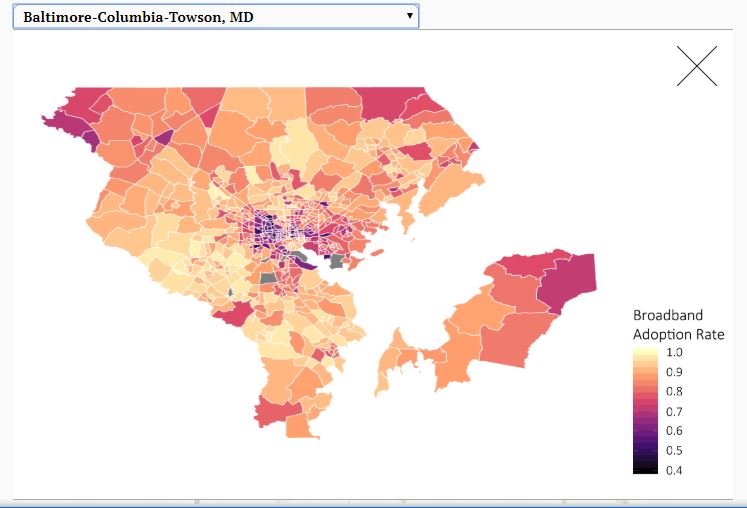
Brookings Instiute’s Digital Poverty Data for Maryland

The simple reality is that there are entire populations of our students throughout the United States for whom a need to move entirely to on-line learning is at the very best problematic, and that’s before confronting the fact that many of these same children also do not even have access to the actual devices needed to do it in the first place.  The data on this additional disparity is too anecdotal to make statistical claims, but that doesn’t make its impact any less real or keep it from making the digital divide even worse.  Therefore, the disparities of the digital divide are even greater than I am fully able to describe, and so too, then, is the risk it presents during the current situation of increasing the injustices and systemic racism it already helps to perpetuate. 

What’s more, the students struggling with the digital divide are not the only marginalized children at risk in the all-on-line learning situation.  Those with learning disabilities, those who fall along the autism spectrum, those for whom English is a second language—all need levels of extra support not easily provided over the internet.  In addition, there are all the homeless kids and other children living with the threat of violence, neglect, and/or abuse for whom daily schooling often provides the only safe space in their lives. Thus, perhaps the biggest risk of all to the abrupt move to on-line learning forced on so many of us by the COVID-19 virus is that every child in our society who was already at an educational disadvantage is likely to fall even further behind in terms of learning, simply compounding already challenging socio-economic issues. 

It’s not a pretty picture, and I simply pray that there are enough caring adults out there in the lives of all our children to help them make it to the other side as undamaged as possible.  Stay safe; stay well!

References

FCC (n.d.) Eighth Broadband Progress Report https://www.fcc.gov/reports-research/reports/broadband-progress-reports/eighth-broadband-progress-report

FCC (2019) Broadband Deployment Report https://docs.fcc.gov/public/attachments/FCC-19-44A1.pdf

Fishbane, L. and Tomer, A. (Feb. 6, 2020) Neighborhood Broadband Data Makes It Clear: We Need an Agenda to Fight Digital Poverty.  The Brookings Institute. https://www.brookings.edu/blog/the-avenue/2020/02/05/neighborhood-broadband-data-makes-it-clear-we-need-an-agenda-to-fight-digital-poverty/

NPR Morning Edition (April 3, 2020) K-12 Schools Try To Salvage The Term By Teaching Remotely, April 3. https://www.npr.org/2020/04/03/826522327/k-12-schools-try-to-salvage-the-term-by-teaching-remotely?utm_medium=RSS&utm_campaign=morningedition.

NPR On-Point (April 1, 2020). Staying Connected, Virtually:  What We Lose Online. https://www.npr.org/podcasts/510053/on-point

Turkle, S. (2017) Alone Together: Why We Expect More from Technology and Less from Each Other, 3rd Edition.  New York:  Basic Books.
Maybe It’s Pie After All…

To Have and Have Not

There is a popular bumper sticker on a car along the commute I have taken to and from the school where I once taught that reads:

Equal Rights For Others
Does Not Mean
Fewer Rights For You.
It’s Not Pie.

I have thought a lot about this sentiment as I have walked by it over the years, especially during the current socio-economic situation in this country, and while at heart, I respect and agree with the spirit of it, I’m not sure letter of it doesn’t reveal some important misunderstandings on the part of  its car’s owner—especially given the level of affluence in that neighborhood, where such a liberal stance is easy to display at no real cost to one’s self.

Yet maybe…just maybe, there may be some underlying truth to this “pie” thing, and to understand why (and what any of this has to do with education), I need to start this discussion by asking the question:  what do we actually mean by “Rights?”  Like “intelligence,” it is a term we use rather loosely in our society, and it can mean anything from a privilege (I have the right to get a driver’s license once I turned 16) to an entitlement (the classic “life, liberty, and the pursuit of happiness”).  Some have even seen “Rights” as having to do with freedom, such as Roosevelt’s famous Four Freedoms used to validate the Allied efforts in WWII:  Freedom of Speech, Freedom of Worship, Freedom from Want, & Freedom from Fear.

I share this latter notion of “Rights” because the Big Four point to an important paradox about why understanding what is or is not a “Right” could mean that sometimes “equal rights for others” may, in fact, result in “fewer rights for you”—as unjust as that may sound to our egalitarian ears.  To see why, consider the first two freedoms:  like those of religion, speech, assembly, redress, privacy, etc. in the U.S. Constitution’s Bill of Rights, they are all expense-free.  There is absolutely no economic cost whatsoever, for example, to every single person having an equal right to speak freely.  Hence, for me to argue that others have the right to say what they want does not take away from—or impact in any way!— my right to do likewise.

However, to argue that someone else has the freedom from want…to say, for example, that everyone has an equal right to health care, an equal right to the same quality of education, an equal right to the economic resources needed to live…  Suddenly a “Right” has financial costs, and the moment “cost” enters the equation, then equal rights for you can at least theoretically mean the possibility of fewer rights for me.  It certainly looks like it has the potential to become about “pie.”

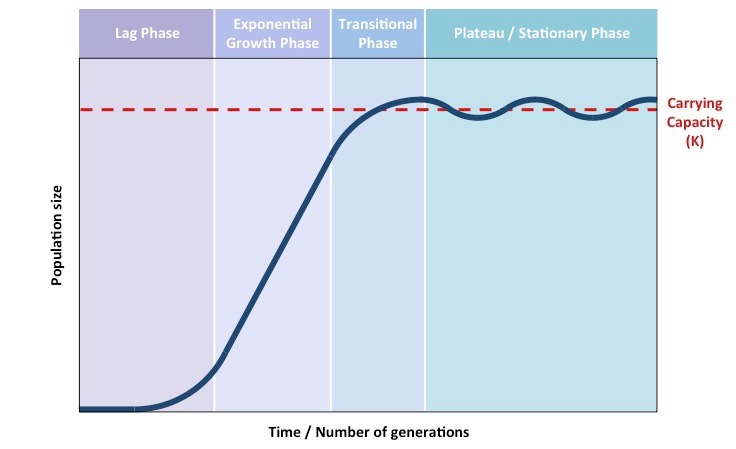
To see how, I need to take a brief detour and introduce my readers to the study of population dynamics.  This is the discipline in biology that looks at how various factors in a given ecosystem influence the number of a given species living there, and it turns out that changes in size of the populations of any and all organisms follow two common patterns as they live and reproduce in the environment in which they find themselves.  These are traditionally known as the J-curve or exponential phase and the S-curve or logistical phase, and if you look at the graph below, you can see that during the J-curve phase, a population will explode in size.  In the real world, this phase only happens when a population of organisms enters a new environment where all the resources it needs for survival are in over-abundance, and it is what is happening with the current situation with the COVID-19 virus:  a seemingly limitless supply of humans is available to use to reproduce and so its population soars! We, of course, experience this as ever growing numbers of sick people since we effectively are the virus’ “food.”

Image result for s curve population growth
https://ib.bioninja.com.au/options/option-c-ecology-and-conser/c5-population-ecology/sigmoid-growth-curve.html

No environment, though, has truly limitless resources, and so eventually a population of organisms reaches the maximum size that environment can support (the dotted line on the graph, known as the carrying capacity).  It then enters the S-curve phase in which reproductive rates can only temporarily surpass available resources before starvation and competition kill off enough organisms for shorter periods of exponential growth, and the cycle repeats, achieving a homeostatic population size in that particular environment.

This, by the way, is why all the epidemiologist right now keep talking about “flattening the curve.”  By slowing the exponential rate of COVID-19 reproducing and spreading among people (i.e. making the slope of that line in the exponential phase of the graph less steep or “flattened”), the virus will take longer to reach its carrying capacity, and that buys two things that are not mutually exclusive:  fewer viruses means fewer sick people in fewer hospital beds, enabling us to treat more people to help them live; more time means the chance to actually lower COVID-19’s carrying capacity through the development of better treatments and an eventual vaccine.  “Flattening the curve” and the steps to make it happen truly are a win-win!

But what, I suspect some of my readers are asking, does any of this have to do with “Rights?” Or Education? To answer, I need to elaborate first on what that dotted line, the carrying capacity, truly means.  In any ecosystem, there are finite amounts of resources; this is true even at the scale of our planet:  as boundless as the world’s oceans may seem, there are only so many water molecules on this planet. But if there are always limits on the resources available, then there are also always limits on how to distribute those resources.  For example, in a room of 3 people and 9 balls, the distribution might range from a single person having all 9 while the others have none to each person getting 3.  But the number of ways to divide the balls up between them is finite, and the same is true for the resources in any given ecosystem.

What this means for a population of organisms, though, is that there are only so many ways to divide an ecosystem’s finite resources among the individual members of that population.  That is what that dotted line represents:  both the limits on the resources and the limits on how they can be divided.  The actual graph, on the other hand, represents the size of the total population, not the number of specific individual members.  Hence, while the total population size might drop from one of the S-curve crests due to many organisms dying from lack of resources, there can and will be individuals within the population (or groups of them) who survive the drop precisely because they took extra resources away from the dying individuals.  Put simply, because there is not enough to go around in the first place, those individuals or groups who get more of what little there is make it; while those who can’t, don’t.

Yet if a “Right” has costs and even the resources at the level of the entire planet earth are finite….  Now is the picture starting to come into focus? To make it even more so, let’s do a little thought experiment using my home state of Maryland.  Let’s say that a high-quality education is a Right that all children in this state have and that the tax revenues of Maryland are the finite resource for this “ecosystem.”  We’ll let PARCC test scores and the Maryland School Report Card grades represent how high-quality an education a given group of children are receiving—which I fully acknowledge is a flawed measure at best, but it is a measure—and we’ll compare two school systems that no one living here would contest do not represent two ends of the spectrum of educational outcomes in Maryland:  Montgomery County (MC) and Baltimore City (BC).  Ready? Let’s begin.

The local tax revenues for MC in 2019 provided $10,807 of resources for each child in their schools, and BC provided $3,703 per child.  The most recent PARCC scores in MC are 3 times higher than those in BC, and MC is 10 times stronger on the Maryland School Report Card.  The correlation between resources and high-quality education seems rather obvious, which suggests that to get equal educational rights for BC children just might involve fewer rights for the MC kids.  It’s starting to look a lot like “pie.”

Yet lest I be accused of misconstruing the data, the picture gets a little more complex because the State of Maryland appears to understand that it might be “pie” and redistributes some of the state tax revenues to try to balance things out.  For example, MC only received $5,507 per child from the state in 2019; while BC received $12,223, bringing the MC total to $16,314 and the BC total to $15,926.  In fact, by the time federal dollars and all other miscellaneous tax revenues are included, BC came out on top with $17,493 for each student; while MC had “only” $16,859.  Furthermore, BC per pupil spending wasn’t even the highest in the state; Worchester County (WC) and Somerset County (SC) topped things off at $18,472 and $18,353 per child respectively.

These numbers, though, would seem to undermine the whole “pie” idea completely since BC and SC schools are among the most underperforming in the state; while MC & WC are among the highest performing districts.  It would appear that there is absolutely no correlation after all between access to resources and the quality of education received, and suddenly the “pie” idea about an equal right to a high-quality education in BC and SC meaning less right to it in MC & WC seems incorrect, if not outright false. Maybe equal rights for others when it comes to high-quality education truly doesn’t mean fewer rights for you.

Ah! But like any good rhetorician, I have saved the coup de grâce for last, and in truth, I have left out a significant feature of the total picture.  If we return to those local tax revenues, we find that WC, like MC, provided a lot of local resources in 2019 ($13,528 per child); while SC, like BC, did not have much to contribute ($3,618), and what these local numbers reflect is the larger economic disparities between these various communities.  MC and WC have some of the wealthiest families in Maryland, and as Brown, Sargrad, & Benner report, PTAs and private donors in MC and WC raise millions of extra dollars for their schools; something the communities of BC and SC simply cannot do.  Once again, then, we see that the uneven distribution of finite resources leads to unequal access to high-quality education, and if we believe that the educational rights of all the children of BC, MC, WC, and SC should be equal, then somebody has to give up some of their resources for the sake of the others.

Interestingly enough, that is precisely what the recent Kirwan Commission has recognized about the status of the different school districts throughout Maryland, and in its final report, the Commission lays out the necessary educational reforms needed to address (and redress) the current situation in my state’s schools.  But, as I discussed in Chapter 7, our governor has actually raised “dark money” to resist the implementation of the Commission’s recommendations precisely because of its estimated eventual $4 billion per year cost and the perceived threat to the business community, and in fact, during the shortened 2020 state legislative session, the most contentious debates were fueled by the question of where the money was going to come from to fund the implementation of the recommended restructurings and improvements.  The bottom line, sadly, is that with certain types of Rights, it is about “pie.” 

Yet, what if there’s more than enough “pie” to go around in the first place?

Chasing Beans

It was a cold and blustery out on the playing field, feeling more like January than late April, and I had to suppress a grin: it was a perfect day for this lesson.
“Okay, everyone.” I announced. “As an introduction to our ecology unit, we are going to look at the distribution of natural resources today, and specifically, we’re going to look at the impact humans have on them.”
I handed a stack of cheap, disposable cups to Claire to pass out, and then held up a clear plastic freezer bag containing a bunch of white beans. There were some puzzled looks.
“Scattered throughout the grass are beans like these.” I told them, pointing with my arm. “And your task is to collect as many of them as possible during two five minute time periods. Each bean in your cup will be worth one point, and today’s entire assignment will be worth a total of fifty points. So if you collect fifty beans, you’ll have a perfect score.”
There were some anxious looks.
“And if we don’t find fifty?” asked Chris, hesitantly.
“Then your grade will be however many you do.” I replied.
The ensuing protest was expected, and I held up my hand for silence. I knew I was deliberately lying, but I also knew that the whole point of the actual lesson depended on them initially believing that their grade truly did depend on capturing beans.
“I am completely serious.” I told them. “There are several stages to this simulation, and you will have lots of opportunity to gather beans before it ends. But at the end of class, the beans in your cup is your grade for today.”
There was stunned and perplexed silence.
“Are we all clear about what you’re to do?” I asked. They nodded anxiously, and I put a whistle to my mouth and blew.
The class streaked across the field like fat on a hot griddle, some methodical in their searches; while others studied their classmates and pounced when a pocket of beans was discovered. But they were all intensely earnest in the hunt.
Finally, I whistled again and waved everyone back over to huddle up.
“Gather back around,” I told them. “And very carefully look at the bottom of your cup for a letter. Without spilling your beans.” I waited until they had all done so and then gestured to three spots around me. “If you have the letter ‘I,’ go over there; if you have the letter ‘D,’ over there; and the letter ‘U’ over there.”
The girls collected into their respective groups, and I handed each one a paper sandwich bag and a permanent marker.
“Count the total beans in each group, write that number on the bag, and place everyone’s beans in it together.” I instructed.
Again, they followed my directions dutifully, but as the sole member of the “I” group, MariaLisa looked like she was about to cry. So I walked over and leaned in to whisper, “Trust me after all these months to know that I promise it will be okay in the end.”
She sniffed and nodded, giving me a weak smile, and I turned back to the rest of the groups.
“Everyone finished counting?” I asked.
They collectively nodded, and I recollected each group’s bag before putting my whistle to my mouth again.
“Five more minutes!” I said and blew the whistle.
This time, the girls raced off with even greater urgency, and where they had clamored and complained earlier, now no one spoke at all. They just silently dashed from spot to spot on the field, and when the final toot brought them back together, the sense of dejection was palpable.
“Well, I failed that lab,” declared Em.
“At least you have other people in your group!” MariaLisa protested. “You have a chance of having enough beans to pass. I don’t even have that.”
I interjected. “Everyone needs to do like before, and then we can get out of this freezing wind and go back inside for the rest of the simulation.”
So they counted and muttered and handed me their bags, and we adjourned to the classroom, where I had the girls remain in their groups, asking a member of each to write their grand total on the board. Then I began the true lesson.
“I need all groups to pile their beans in the center of their table.” I announced. “And I need at least two members from each team to get her calculator out and ready to use.”
I waited for this to happen and then proceeded. “Now I need to know what five percent and thirty-five percent of the grand total of all beans in the room is, and I need to know….”
Fingers started to fly as I rattled off a whole series of math questions about the data, jotting answers on the board as students from each group called them out. Then I paused, studying the board.
“Okay…” I said, doing some quick calculations in my head. “Caroline, your group needs to count out 128 of your beans and give them to MariaLisa, and Kate, I need your group to count out ninety-four beans and also give them to MariaLouisa.”
Suddenly the largest pile of beans in the room now belonged to one person–who simply looked bewildered, relieved, and scared all at the same time.
“We are now at the final stage of the simulation.” I said. “And when I say ‘go,’ you will have exactly thirty seconds to do whatever you wish to gather as many beans as you can.” I glanced at the clock meaningfully. “But at the end of the thirty seconds, the number of beans in your cup is the number that will determine your final grade.” I paused to let that sink in, turned to watch the clock, and said “Go.”
A look of sudden awareness came across Chris’ face, and she started to shout “Everybody, wait!” But the erupting chaos drowned out her voice like a tsunami.
They walk into that one every time. I thought, bemused.
“STOP!!” I shouted, and the room went still. Fist clenched crushed plastic cups; scattered beans covered the floor; the place looked like a grenade had gone off.
“Please take your regular seats and take out something write with and a piece of paper.” I instructed. “You need to total the beans in your cup.” I continued. “And write that number at the top of your page. Then take a few minutes to answer these prompts.” I lifted the middle board.
There were several looks of disgust as many of them realized how few beans they had. But as they studied the prompts and started to write, I could tell they were beginning to realize that maybe something else was going on today that simply struggling to collect beans.
“Okay!” I smiled. “Let’s start by easing the tension. There is absolutely no grade for the number of beans you collected today. You can all relax and take a deep breath.”
“I knew he couldn’t mean it!” swore Em. “From the very beginning, I kept thinking ‘Mr. Brock wouldn’t possibly ever really do this to us.’ ”
There were murmurs of assent.
“So why did you do it, Mr. Brock?” Chris asked with a Cheshire-cat grin.
I nodded and gestured to all of them. “Why don’t we start by sharing what you all wrote? How did it feel to be in class today?”
“Well, for one thing, I couldn’t believe you were having us chase after a bunch of stupid beans for a grade!” Dasha grumbled.
That produced a near unanimous declaration of assent, and I waited until I had their attention again.
“How is chasing after beans any different than chasing after points?” I replied.
Dasha just rolled her eyes, but several of them suddenly looked quite thoughtful.
“Come on, Mr. Brock! Points get a good grade, but beans are just…. beans!” She argued.
“Why do you want a good grade?” I asked her, and she looked at me as if I had suddenly gone all stupid.
“To get into a good college!” She stated, gesturing as if that were obvious.
“And why do you want to get into a good college…?” I continued.
“So I can have a good job someday!” She said, flabbergasted. She had taken the bait.
“And you want a good job…?” I inquired, gently.
“So that you can have money to live and raise your kids and….”
“And buy some beans for them to eat?” I asked her, interrupting.
I looked around at all of them as understanding began to dawn.
“How is chasing after beans any different than chasing after grades or anything else you need to survive?” I demanded. “You can at least eat the beans.” I waited for that point to sink in and then continued. “What you did today was what every organism has to do: find the resources to survive.”
I pointed over at the two groups who had lost beans. “But it was also about how those resources get redistributed by human behavior and choices. How did it feel to have to give up what you had worked so hard to collect?” I asked them.
“I was pretty pissed,” replied Lucy, with others in her group nodding vigorously.
“YOU were pissed?” The members of Kate’s group declared. “We lost so much there wasn’t even the chance of having enough beans to pass!”
“What about the ‘I” group?” I interjected. “MariaLisa all by herself? How do you think she felt?”
“Relieved!” came the nearly universal chorus.
“And maybe a little guilty.” Chris added quietly.
Everyone swung around to face her, looking puzzled, and she continued.
“Think about it.” She said. “MariaLisa had more beans than she could ever possibly use, and she could clearly see that your group practically didn’t have any at all. I’d feel a little guilty in that situation.”
There were a few nods of agreement and some speculative looks around the room, and I knew it was time to bring the final lesson home.
“Here’s what the numbers mean.” I told them. “If we treat your class as the equivalent of all the people on the planet, the three people in the ‘U’ group represent the portion of humanity living in the underdeveloped countries. Twenty-five percent of all humans have access to only five percent of the world’s resources. The one person in the ‘I’ group represents how many people live in the industrialized world–places like the United States and Europe. Ten percent of the world consumes thirty five percent of its resources, leaving the remaining sixty percent of the resources for the sixty-five percent of the people in the developing world.”
I paused to let all of that sink in before asking, “How many of you passed?”
Only five girls raised their hands.
“What about the whole room?” I gestured. “Were there, in fact, enough resources so that everyone could have at least passed if you hadn’t all fought for the beans?”
Several started rapidly entered numbers in their calculators, but Chris just raised her hand and I pointed at her.
“That’s why I shouted for everybody to wait.” She said. “I had multiplied all of us by thirty-three in my head and knew that number was smaller than the totals on the board.”
I turned to my number crunchers. “And if you had all shared equally…?”
The disgust in Em’s voice was almost physical. “We could have all earned an 85! We’d have all gotten a solid B!”

Is Too Little “Pie” Inevitable?

As my students discovered that day, where there is enough wealth of resources, the equitable sharing should mean that no one has to have fewer rights so that others can have equivalent ones.  The problem is that we live in an economic system that not only does not promote sharing, it is actively antagonistic to it.  Mathematicians studying capitalist, free-market economies have discovered that the best models for describing how wealth gets distributed in such economies always leads to its inevitable inequitable distribution.  “In fact, these mathematical models demonstrate that far from wealth trickling down to the poor, the natural inclination of wealth is to flow upward, so that the ‘natural’ wealth distribution in a free-market economy is one of complete oligarchy” (Boghosian, p. 77) and, therefore, total economic inequality. 

Returning to our earlier example, it appears that if the 3 people decide to trade and sell those 9 balls, eventually one of them will end up with all the balls and the other two with nothing. It is why today the best estimates are that 26 people currently possess as much wealth as the bottom half of all the humans on this planet—roughly 3.5 billion people (Boghosian, p. 72)—and to put that in perspective, that’s the equivalent of a single classroom of students having as much money and resources as all the human beings living in Africa, India, and China combined.

Moreover, as these mathematical models indicate, the only way to counteract this inevitable inequity is the deliberate and active redistribution of wealth from those who have to those who have not.  Hence, the only way we will get equal access to high-quality education in Maryland (or anywhere else) is to pay for it, and the only way that happens is if some pay more because others cannot.  In addition, the old “you-get-what-you-pay-for” cliché is a cliché for a reason, and it is important to remember that the alternative to making sure that everyone has equal rights to a high-quality education contains its own costs.  In the case of schools, the documented drop in the quality of education described in my Introduction has led to a less skilled workforce and a decrease in creativity (see Chapter 9) that directly correlates with the steady decrease in entrepreneurship in this country over the past 40 years and the corresponding absence of new economic opportunity. 

That might not matter if you’re one of the 26 and their peers.  But if you are one of those 3.5 billion and their peers, that loss has been deeply felt, and if the morality of the situation doesn’t convince, then perhaps pragmatism will.  The ghosts of Louis XVI, Marie Antionette, and Czar Nicolaus (as well as the memories of my students that day) can all too readily inform what really happens when the “have nots” get desperate.  The planet earth is a finite place, and as the cheesy line from Disney’s High School Musical reminds us, we really are “all in this together.”

References

Boghosian, B. (2019) The Inescapable Casino.  Scientific American, November.  Pp. 70-77.

Brown, C.; Sargrad, S.; Benner, M. (2017) Hidden Money: the Outsized Role of Parent Contributions in School Finance. Center for American Progress. https://www.americanprogress.org/issues/education-k-12/reports/2017/04/08/428484/hidden-money/.

Buchanan, L. (2015) American Entrepreneurship is Actually Vanishing.  Here’s Why. INC, May. https://www.inc.com/magazine/201505/leigh-buchanan/the-vanishing-startups-in-decline.html.

Gaines, D. (2019) Maryland PARCC Results At A Glance: English Scores Up, Math Down.  Maryland Matters. https://www.marylandmatters.org/2019/08/28/maryland-parcc-results-at-a-glance-english-scores-up-math-down/.

Maryland Association of Counties. (2019) Education Funding Per Student Charts for 2019. https://conduitstreet.mdcounties.org/2019/02/20/funding-per-pupil-charts-for-2019/https://conduitstreet.mdcounties.org/2019/02/20/funding-per-pupil-charts-for-2019/.

Maryland Public Schools. (2019) Maryland 2018-2019 Report Card. http://marylandpublicschools.org/stateboard/Documents/12032019/TabF-MarylandReportCard.pdf.

State of Maryland (2020) Maryland Commission on Innovation & Excellence in Education. http://dls.maryland.gov/pubs/prod/NoPblTabMtg/CmsnInnovEduc/2019-Interim-Report-of-the-Commission.pdf#page=11.

Catechism and AI

In response to Chapter 4, one of my readers brought up the issue of Artificial Intelligence (AI) and whether computer learning isn’t basically the catechism method I criticize so vigorously, and I would like to reply by unpacking two ideas that I don’t really address anywhere in this project but which do have an impact on how we educate children.  The first is:  what do we mean by intelligence? The second is:  are learning and understanding the same thing? 

The word “intelligence” in our society is a term we throw around rather loosely (and as we shall see, the notion of “AI” is a prime example).  But in the biological sciences, the concept of intelligence has a very precise definition:  it is the capacity in animals to solve novel problems using pre-existing knowledge.  It correlates significantly in the mammalian brain with the percentage by mass and volume devoted to the cerebrum, particularly the pre-frontal cortex (PFC), and in birds with the percentage devoted to the nidopallium caudolaterate (NCL).  Humans, for example, have the highest PFC percentage amongst mammals; while corvids and parrots are the birds with the highest NCL (there’s a reason parrots can communicate with us!).  In fact, the 3% difference in the cerebrum between humans (~76%) and chimpanzees (~73%) is likely one of the significant reasons we build zoos for them and not the other way around.

This correlation also helps explain why intelligence changes and grows as we develop from infancy to adulthood.  As I discuss at different points throughout this project, the brain both grows additional neurons and synaptic connections at key stages of development, and it adds additional knowledge to its long-term memory (LTM) with each new life experience.  Thus, as a child ages and matures, both the ability to solve novel problems as well as the pre-existing knowledge to draw on to do so increases.  It is yet another reason for having a growth mindset and again why we need to expose children to as wide an array of problems and different experiences as possible (i.e. the value of the liberal arts).

But this correlation also has implications for other aspects of education as well.  That 76% is highly consistent within the human population, which is why I have taught my students for years that by biological definition, we are all equally intelligent:  we all have the same hard-wired capacity to solve novel problems.  Schools, though, have a long history of focusing on memory processing and retrieval rather than novel problem solving, too often wrongly equating an individual’s speed at LTM input and output with intelligence, and that has led to a whole cascade of ill consequences. 

For starters, since the hippocampus responsible for LTM access can be one of the more variable parts of the brain between individuals, equating memory speed with intelligence has led to the longstanding bad habit in education of calling those with quick memory processing “highly intelligent” or “gifted” and those with slow memory processing “less intelligent” or “remedial.” This, in turn, has frequently led to homogeneous grouping (i.e. “tracking”), where the “gifted” get presented with more interesting, challenging, and novel problems than the “remedial” receive—which can itself lead to differences in PFC development that can simply reinforce the grouping decisions—all of which can lead to significant differences in the quality of education and future career opportunities available to a given child.  And as discussed in Chapter 8, those differences ultimately lead to many of the educational inequities and socio-economic injustices in our society.

It is why I continue to argue that all children need and deserve complex novel problems to train their intelligence; they simply also need whatever time their individual brains require to solve them.  Many of my most successful students in my AP Biology class had challenges with memory processing.  They simply took longer to solve the complex problems I assigned them, and since one of them who has stayed in touch with me just graduated from medical school, I think it is safe to say that her intelligence was never at issue.

Another consequence that happens in education from equating intelligence with memory speed is that doing so has only reinforces the use of the catechism as a teaching tool:  here’s the question; here’s the answer; remember it; when I ask this question, give this answer.  Those who can do that rapidly, as I have said before, look very successful in school, and those who can’t, do not.  Yet there is minimal to zero novelty in this process at all.  No one employing it is challenging a child to solve a new and previously unseen problem; in fact, an genuine problem is never presented at all, just a pre-determined question with a pre-determined answer.  Therefore, using a catechistic approach to teaching does absolutely nothing whatsoever to help develop intelligence because it never even employs actual intelligence in the first place.

That is also precisely why the use of this term in AI is such a total misnomer.  There is not an AI in the world that can tackle something truly novel, and to see why, we need to address my second question from earlier:  are learning and understanding the same thing? The short answer is no, but to grasp why, it is actually helpful to learn a bit about how AI really works.

As I argue in Chapter 4, the ability to interpret data and make judgments about it is the essence of the learning process, and in this regard, AI does engage in learning.  It employs algorithms to generate a pattern found in the data fed to it (e.g. pictures of cats) and then tests that pattern by predicting whether the next set of data (e.g. a picture of a dog) matches.  When it predicts correctly, it reinforces the algorithm’s use of that pattern to make future judgments; when it predicts incorrectly, it uses the algorithm to refine the pattern and tries again.  This is why it takes tremendous amounts of data (i.e. millions of pictures) before an AI can, in fact, correctly identify a given picture as a cat (or anything else), and it is why AI learning uses a catechistic approach because its purpose is fundamentally that to which a catechism is put:  always get the same correct answer to the same question.

However, while learning involves figuring out how to interpret data and make judgments about it, understanding is related to intelligence in that when we understand something, we can make novel meaning from our learning.  Something an AI simply cannot do.  As Lars Holmquist points out, AI cannot understand even something as basic as sentence—which is why, for example, chatbots cannot correctly carry on a successful conversation using natural language:  they cannot understand a novel query.

But that does not mean AI is not capable of developing some highly sophisticated responses to situations involving judgments about pattern recognition.  For example, in the research M.I.T.’s Sherry Turkle has done, she has witnessed devices such as Paro (a robot resembling a baby harp seal) respond to voices and touch with the mimicked caring behaviors one would expect from a warm, fuzzy animal.  Similarly, other AIs have been developed to learn complex games such as chess and Go that are capable of playing and beating an actual human opponent—in no small part because the speed with which an AI can judge the patterns on the game board are vastly faster than those of the human brain. 

Yet no matter how well it presents caring actions in response to input, a Paro is not capable of actual caring.  Nor can game playing AIs understand the game they are playing (they could not, for instance, modify the rules based on how a game is currently played; they can only play that game).  In both situations, a computer is merely mimicking at set of behaviors, not originating them, and as Turkle points out from her research, that ability to mimic—no matter how sophisticated—cannot be interpreted as evidence for an actual mind at work.  AI still fails the Turing test precisely because it is not another human being.

What happens, though, if we decide to start altering the parameters of the test? What if “acts as if it cares” becomes good enough? In researching for Chapter 9 and the impact of technology on the teaching and learning process, I came to realize that today’s technology presents a potential danger far greater than the one it poses for education and that is its impact on how we engage in human relationship.  What happens in a world of AI where your refrigerator (or any other networked device in your house) can act as if it is capable of being in a relationship with you when it has absolutely no capacity at all to understand what a relationship is? We may presently make fun of this idea in such episodes of The Big Bang Theory where the character, Raj, falls for the Siri on his I-Phone, but how many of us now have an Alexa or an Echo in our homes and think of them—at least a little—as another person in our home?

Turkle calls it the “alive enough” (p. 35) approach to our interactions with our devices, and she shares stories of Paros standing in for human companionship in nursing homes (their actual intentionally designed purpose by the way!) and of a young woman she met at a psychology conference who “confided [to Turkle] that she would trade in her boyfriend ‘for a sophisticated Japanese robot’ if the robot would produce what she called ‘caring behavior’…a responsive robot, even one just exhibiting scripted behavior, seemed better to her than a demanding boyfriend” (p. 8).  Texting already now stands in for human conversation for an entire generation, and on-line lives in artificial worlds are for some more satisfying than IRL. When, Turkle and others ask, does “a pretend world of as-if feelings, as-if empathy” (p. xxiv) stop being seen as one of mental pathology and start becoming seen as one of normalcy?

Yet, I think one of the reasons we are all finding the current shelter-in-place of the COVID-19 pandemic so challenging to tolerate is that evolution has hard-wired us to be social creatures, with actual physical interaction.  Even self-imposed quarantine for a good cause still feels, like solitary confinement, a bit like punishment.  We genuinely crave and genuinely need real, authentic companionship, and while brain scans now show that our favorite substitute, dogs, apparently really do love us, even they are not fully adequate to the task. 

Simply put, no AI can ever understand how to love.  But it is scary how many of us seem to be convincing ourselves—like the movie, Her, suggests—that faking it is good enough.  We are already in danger of descent into total narcissism as a society; how far do we want to let AI take us down that rabbit hole before it is too late?

References

Güntürkün, 0. (2020) The Surprising Power of the Avian Mind.  Scientific American, January; pp. 48-55.

Herculano-Houzel, S. (2009) Frontiers in Human Neuroscience. https://www.ncbi.nlm.nih.gov/pmc/articles/PMC2776484/#:~:text=Now%20that%20numbers%20of%20neurons,et%20al.%2C%202009).

Herculano-Houzel, S. (2012) The Remarkable, Yet Not Extraordinary, Human Brain as a Scaled-up Primate Brain and Its Associated Cost. https://www.ncbi.nlm.nih.gov/pmc/articles/PMC3386878/.

Holmquist, L. (2017) Intelligence on Tap:  AI as a New Design Material. https://dl.acm.org/doi/fullHtml/10.1145/3085571.

NOVA. (2020) Dog Tales. https://www.pbs.org/wgbh/nova/video/dog-tales/.

Turkle, S. (2017) Alone Together: Why We Expect More from Technology and Less from Each Other, 3rd Edition.  New York:  Basic Books.