Blog Feed

The Wonder Years or the Blunder Years?

Wisdom isn’t something we get. It is something we do.
—Diana Butler Bass

Learning begins on the first day of life—and not the first day of class.
—Dana Suskind & Lydia Denworth

A good friend of mine (and fellow graduate student at the time) once looked across a shared meal with me at the Cheddars near Vanderbilt University and observed, “it’s never silent in there is it?” A little startled at her astuteness, I nodded in the affirmative (having been well trained by my mother and grandmothers “not to talk with my mouth full”) and eventually replied that no, my brain was always “ON,” laser-focused, 24/7, 365.  It was, indeed, never silent.

It is why to this day, large crowd situations drive me crazy—I already have more than enough stimulus on the inside, thank you!—and it is why even my daydreams regularly have almost Walter Middy level detail to them.  I continually have a wide range of ideas bouncing off each other in my head, waiting to see if any pattern emerges, looking for the structures on which I can hang some thoughts, and as a voracious reader, I am always adding to the bounce pile.

I share this bit of self-knowledge because readers might look at my actual list of references for this latest offering to my LAC project and wonder what chemicals I have been ingesting to think they have anything in common.  But if folks will be patient, I promise to reveal the unique tapestry I believe they offer about some important choices we face as both a culture and a society when it comes to education and our children.

The weaving begins when my mother recently introduced me to Diana Butler Bass, and a blog she writes, called The Cottage.  Bass was reflecting on ideas I’ve already explored in my recent series on time and education—how “not everything happens for a reason” and how “life can be so absurd”—when she caught my attention with an idea which both Burkeman and May (whose work I have been recently exploring) hint at but never overtly acknowledge:  everything may not happen for a reason, “but everything that happens matters. Because it is the one life each of us has” (Bass; my emphasis).

And at no time in life is this more true—or more critical—than early childhood.  For example, we have known for years that the early interactions between parent and infant are critical for proper language development and emotional maturation and that there is a direct correlation between the quantity of words an infant is exposed to—as well as the amount of direct parent-infant/toddler exchanges—and their later success in school, both academically and behaviorally. 

But new research shows that the quality of words is even more of a predictor of language development; hence, the richness of the parent/child dialogue matters more than we once thought, and what’s more, brain scans have revealed that the connections between caregivers and the very young occur at the actual neural level as these dialogues are taking place. Or to put it simply, when parent and infant are interacting, their brain waves literally sync up.  Doing so then leads to the reinforcement of brain patterns in the infant that lead to better social learning, problem-solving skills, and vocabulary development later in life—all the foundation for future learning success. Hence, “research strongly supports the need for parents to have time with their children [and] underlines why parents need access to high-quality affordable childcare” for those times requiring a non-parental adult caregiver (Suskind & Denworth, p. 52). 

Yet unlike every other industrialized nation on this planet, the United States has no national parental leave policy whatsoever, and even where individual states have passed parental leave laws, they almost always involve unpaid time off, guaranteeing only a job to which to return.  The result is that the Organization for Economic Cooperation and Development’s most recent report in 2020 on 5-year-old preparedness for school and learning showed that U.S. children are significantly worse off than children in comparable countries such as England.  U.S. children across the board show lower literacy and numeracy scores, poorer self-regulation, and less engagement in acts of cooperation, kindness, and other prosocial behaviors (Suskind & Denworth, p. 50).  As a nation, we are quite literally leaving our children behind those in socio-economically equivalent societies.

However, let’s imagine for a moment that we have a magic wand, and suddenly, congress comes to its senses and passes a national parental leave law.  Does it matter if it is unpaid or paid leave? The answer is “yes,” and recent research on paid parental leave has looked beyond simple economic impacts and has started examining its impact on the health of mothers and children.  And—drum roll!—there are non-economic benefits: there is less postpartum depression, lower infant mortality, fewer rehospitalizations, and there is an increase in measures of infant attachment, more timely immunizations, and longer durations of breast feeding.  Add dad into the paid leave equation, and it turns out divorce rates go down as well.

Furthermore, additional research has demonstrated a direct difference in brain development between infants whose parent(s) are on paid versus unpaid leave.  For all children with parents on paid leave, their language skills are higher by age 2, and in situations where the parent has only a high school degree or less, paid leave leads to an improvement in emotional skills in their children that is absent in similarly educated parents on unpaid leave.  What’s more, paid leave changes the actual patterns of brain activity, dramatically increasing in very young children the percentage of higher frequency brain waves associated with being better prepared later for success in school.  Hence, what all this research indicates is “why paid leave at the birth of a child is consistent with policy centered on early brain development” (Suskind & Denworth, p. 52).

So why aren’t such policies in place? And why does paid leave make a material difference in infant development over unpaid leave given that both provide the extra interaction time so critical to language acquisition and emotional maturation?

I’m going to tackle the second question first because it helps us better understand the answer to the one about policy, since it turns out that both questions involve the impact of economic insecurity on families.  Parents on unpaid leave, like those already living in poverty, have higher levels of cortisol—the stress hormone—than both the baseline level in the general population and in parents on paid leave.  The supposition is that unpaid leave leads to concern and worry about the economic future, and this stress directly impacts that quality of parent-infant interactions—especially for those taking place in lower-income families, where job security is already often more tenuous.  The bottom-line is that unpaid leave or no-leave-at-all both generate home environments with potentially toxic levels of stress, and “we know that very young children do best when they are protected from toxic stress and when their lives are stable and predictable” (Suskind & Denworth, p. 53).

Yet, if stable and predictable, low stress environments lay the foundation for healthy brain development in our children, why aren’t there policies in place to promote families having them? The truth is that there is one such policy in place and it is the federal child tax credit (and similar ones in certain states) for families with young children.  A 2019 National Academy of Science report demonstrated that these tax credits have the most potential for generating family economic stability (and therefore lower cortisol levels in caregivers), and the full “benefits of these credits became clear during the pandemic, when a historic expanded tax credit brought about an immediate reduction in childhood poverty rates” (Suskind & Denworth, p. 53), easing the stress of the pandemic itself on families.  In fact, the pandemic saw the lowest numbers of children experiencing poverty in over a generation; hence, as a society, we do already know what works to help provide a stable foundation for childhood development.

However, as columnist, David Brooks, points out, we are also a society deeply divided over its moral character, entrenched so intensely in either the progressive or conservative tradition that we seem no longer capable of acknowledge the flaws and weaknesses of both—nor the true need for both.  Consequently, a closely divided U. S. Senate refused at the end of 2021 to extend the pandemic child tax credits that had made such a positive impact on family’s lives, and the result is that “the childhood poverty rate spiked from 12 to 17 percent higher than before the pandemic,” pushing an additional 3.7 million children who had not been before COVID arrived into poverty (Suskind & Denworth, p. 53).

To put that into perspective, that’s the equivalent of taking the entire population of the city of Chicago and suddenly making them poor.  Worst, it’s our children we are talking about here!  What kind of society does not do everything in its power that every other industrialized country on this planet does—from tax credits to paid paternal leave to universal, high-quality preschool—to provide the foundation for proper brain development?

Sadly, the answer that weaves its way into this tapestry can be found in the examples of Florida Governor, Ron DeSantis, and the Texas State Board of Education.  DeSantis is so determined to instill his own form of indoctrination to counter the realities that our nation was founded in significant part on slavery and that LGBTQ+ individuals possess moral dignity that should be honored that he is accelerating the teacher loss in a state that already has a shortage of more than 9,500 of them—including a school in Brevard county that has 20 openings in a total staff of 40.  Meanwhile, the Texas State Board of Education, in revising the Texas Essential Knowledge and Skills for Science K-12 Standards, allowed members of the Texas Energy Council to water-down (and even remove) references to the human responsibility for the climate change crisis to the point where all children now have to know about carbon is that the element has a natural biogeochemical cycle that it moves through over time.

What’s worse is that both these examples have the potential to have national impacts.  DeSantis is considered a front-runner for the 2024 Republican nominee for president, with the potential support of a U.S. Supreme Court that apparently wants to make The Handmaid’s Tale the law of the land and the marriage of one of its own justices illegal.  Add in Mitch McConnell as potential Senate President, and at least a century of growth in human rights are on the line—not least of which may be the right to fair, equitable, and honest public education.

But at least in the case of DeSantis, there has to be an election, and elections can be lost.  Because of the size of Texas, it carries the economic weight of the proverbial 800-pound gorilla, and therefore, textbook publishers will write what Texas asks and so influence what’s actually commercially available for many of the other public schools in the nation.  Of course:

Texas isn’t the only major buyer of textbooks.  Other large states such as California have adopted standards that embrace the science of climate change, leading to a divide.  Textbook publishers create one set of products to sell in Texas and states that lean the same way and a second set of products for states aligned with California.  This poses an equity problem: the education a child receives on an issue central to the modern world depends on what state they happen to live in (Worth, p. 49), leading to the potential for even further political divide in this country.

I know, I know.  Enough already.  We all know (or at least have strong suspicions) that the world’s going to hell on a rocket; so get off my proverbial soap box about everything that’s wrong and be silent already—especially since it might appear that I’m starting to sound like I’m cursing the darkness rather than lighting candles against it. 

Except, I’m not quite done weaving.  There is one last thread to bring into this tapestry, and it starts with an alternative understanding of wisdom, different from what I think the role of wisdom is in education.  Here, I want to investigate what is referred to as the “Wisdom Literature” or “Wisdom Tradition” within the Hebrew scriptures and what it might have to teach us about “living in a world going to hell on a rocket.”

First, I need to provide a brief lesson in Bible scholarship for the uninitiated.  Unlike the Christian rendering of what they refer to as the Old Testament, the Jewish tradition does not combine all its scriptural passages into one single book.  Nor does it give each collection of passages equal weight in terms of significance.  Thus, there is The Torah, “The Five Books of Moses,” that is considered the most important of the scriptures and which religious scholar, Pete Enns likes to refer as the narrative, the story of how were supposed to live a faithful life.  Then there are The Prophets, which Enns likens to the eternal reminders of ways in which we have not lived up to the “supposed.”  And final, there are The Writings, a collection of books sometimes known as the Wisdom Literature, which Enns suggests serve the purpose of pointedly challenging that we basically never live up to the “supposed.”

Of The Writings, the two most pertinent to this discussion are perhaps the most familiar ones, Proverbs and Ecclesiastes.  The former, of course, contains lots of concrete suggestions and pithy sayings on how to live the “supposed” successfully, and the latter—whose famous “there is a time” passage is a standard at funerals—basically declares: not only is the world going to hell on a rocket, but it has always gone to hell on a rocket, and it is always going to go to hell on a rocket; so make peace that you are on a rocket (I think the author of Ecclesiastes would have appreciated Burkeman’s basic position that the miracle is that you get to have a bad day in the first place).

What, though, do a book about how to make choices and a book that says all choices are pointless have to do with wisdom, let alone political divisions over policies about paid parental leave and effective infant brain development? The answer comes from Enns who points out that if you examine Proverbs closely, you discover that it is constantly telling the reader to “Do A” only to be immediately followed by “Don’t do A”—often in the exact same passage—and he suggests that this was a deliberate decision on the part of Hebrew scriptures editors, as was the decision to include the quite nihilistic sounding Ecclesiastes because, as he fleshes out in his conversation with Bass, when you examine everything that is written in Proverbs and Ecclesiastes, you realize that the wisdom they are calling us to is the challenge of determining when “Do A” is the right choice while riding the rocket, and when “Don’t do A” is the right choice.

Or to put it in the language I used in A Modestly Meaningful Life, as you consume your oxygen and food and produce your carbon dioxide and urine—ultimately the only thing any of us ever do (Ecclesiastes’ point)—do these things thoughtfully, with considered reflection.  Pay careful attention to the consumption and the production because, as Burkeman puts it, “life just is a process of engaging with problem after problem, [therefore give] each one the time it requires (p. 181; original emphasis).  The wisdom of Proverbs and Ecclesiastes, Enns suggests, is that of course life is pointless but that what happens in life matters—what you do to yourself and others matters—because our experience of life is altered every time something transpires in it.  Therefore, wisdom is our capacity to choose well between “Do A/Don’t do A” in a particular situation.

Which brings me full circle, with my final weft to complete this tapestry.  A choice confronting us as a nation is clear: “healthy brain maturation represents the foundation of our country because it represents our future.  That means there is nothing more important we can do as a society than foster and protect the brain development of our children” (Suskind & Denworth, p. 53).  And the research is equally clear: paid parental leave maximizes language development and emotional response in infants and toddlers, the two most critical skills for success in formal schooling—where one might hope such well-developed brains could resist indoctrination into white privilege and climate crisis denial. 

Thus, we have an opportunity for wisdom, both as individuals and as a larger society, and my question for all of us is: what are we going to do with this opportunity? We know what is best for our children, and we know it is ultimately best for our own future (they are, after all, going to be responsible for taking care of us one day!).  So whether it is working within a single company as employee or boss to change policy or voting and lobbying at some level of government to change policy, each of us has the power to employ our wisdom on what happens to our kids.

Because while there really is nothing new under the sun and all is ultimately vanity, what happens does matter—to them; to all of us.  That’s the paradox:  life is both meaningless and meaningful, and it is in the tension of that paradox that we must prepare our children to live out their best possible lives.  Hopefully, we are all up to the challenge.

References

Allen, G. (July 13, 2022) Florida Gov. DeSantis Takes Aim at What He Sees as Indoctrination in Schools. NPR Morning Edition.  https://www.npr.org/2022/07/13/1110842453/florida-gov-desantis-is-doing-battle-against-woke-public-schools.

Bass, D. (July 12, 2022) Pete Enns on Wisdom. The Cottagehttps://www.youtube.com/watch?v=ctCttCt3pg4.

Bass, D. (July 12, 2022) Summer Wisdom Journey: Ecclesiastes—Delight and Despair. The Cottage. https://dianabutlerbass.substack.com/p/summer-wisdom-journey-ecclesiastes?utm_source=substack&utm_medium=emailhttps://dianabutlerbass.substack.com/p/summer-wisdom-journey-ecclesiastes?utm_source=substack&utm_medium=email.

Brooks, D. (May 19, 2022) How Democrats Can Win the Morality Wars.  The New York Times. https://www.nytimes.com/2022/05/19/opinion/democrats-morality-wars.html.

Burkeman, O. (2021) Four Thousand Weeks: Time Management for Mortals. New York: Farrar, Straus and Giroux.

May, K. (2020) Wintering: The Power of Rest and Retreat in Difficult Times.  New York: Riverhead Books.

Suskind, D. & Denworth, L. (June 2022) The Path to Better Childhoods.  Scientific American. Pp. 48-53.

Worth, K. (July 2022) Climate Miseducation: How Oil and Gas Representatives Manipulate the Standards for Courses and Textbooks from Kindergarten to 12th Grade.  Scientific American.  Pp. 42-49.
A Modestly Meaningful Life

A time to weep and a time to laugh,
A time to mourn and a time to dance.

—Ecclesiastes 3:4

The human disease is often painful,
but it’s only unbearable
for as long as you’re under the impression
that there might be a cure.

—Charlotte Joko Beck

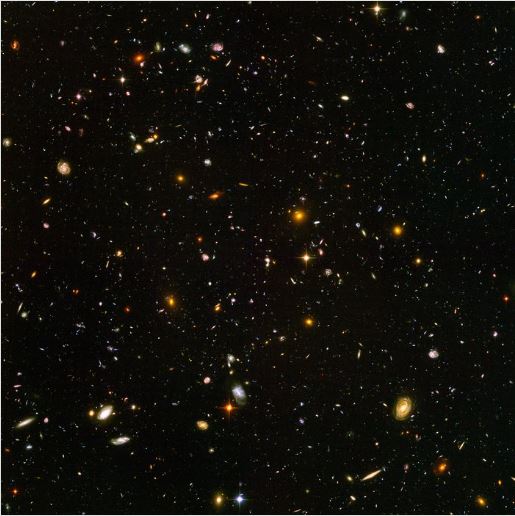
Many years ago, the school I was then at had the privilege of having noted astrophysicist, Mario Livio—he of Hubble Telescope fame—come and address the entire Upper School about his work at the Space Telescope Institute at Johns Hopkins University.  His address was about the many wonders Hubble had revealed about the nature of the universe, and on one of his slides, he displayed this image:

He explained that this is what is known as an ultra-deep field image and that the points of light that look like individual stars are in reality entire galaxies, each containing hundreds of millions, if not billions, of individual stars.  He then when on to share that the image we were looking at represented only 1 degree of the night sky, and that if we were to rotate the telescope through a full 360 degrees—and he slowly, deliberately turned his body through an entire rotation to emphasize his point—we would observe that what is in that image would be observed in every single degree. What’s more, he punctuated, that was with rotating the space telescope along only one axis! In short, he summed up, “we live in a universe of uncountable numbers of stars with uncountable numbers of worlds, each its own potential haven for life.”

The audience was spellbound, and the Q&A that followed, lively.  But what I remember most about that day was later in the afternoon, as my AP biology students filtered into the room, I asked them what they had thought about Dr. Livio’s lecture, and Serene Mirza replied, staring at me with this look of total bewilderment:

He was awesome, Mr. Brock.  But I have to confess, hearing him and seeing that image…well, it made me wonder: Why we are even bothering having class today? What’s the point of studying any of the stuff we’ve been learning? If the universe is that vast, can anything be relevant? Can any of us be relevant?

The short answer to her question, of course, is “no.”  My student was totally correct in her observation, and as journalist, Oliver Burkeman puts it, “it’s useful to begin this stage of our journey [about time] with a blunt but unexpectedly liberating truth: that what you do with your life doesn’t matter all that much—and when it comes to how you’re using your finite time, the universe absolutely could not care less” (p. 208).1  The basic truth is that at a fundamental level, all any of us are are consumers of food and oxygen and producers of urine and carbon dioxide—just like every other vertebrate on the planet.  Indeed, as I start the year with my Advanced Biology class, I point out that we are even more basic than that; that we basically consist of electrons transiting from one atomic orbital to another.

And if you think of all the countless humans who have consumed their food and oxygen and produced their urine and carbon dioxide, who have had their electrons transit and then left no trace of themselves whatsoever…well, you get the idea.  We have zero cosmic significance as a species, let alone as individual members of that species.

Yet there seems to be this deeply rooted psychological urge, bordering on biological need, to believe that what we do with our discrete unique lives should somehow matter, should make a significant difference in the proverbial grand scheme of things, and in fact, there is a term in psychology for this belief: egocentricity bias.  What’s more, when we think about it from an evolutionary standpoint, this bias makes perfectly good sense because if each of us had a genuine sense of our own irrelevance, we might not struggle as hard to survive and reproduce.  We need to think highly of ourselves in order to propagate the species.

It is also true that it is not a certainty easy to swallow.  As essayist Katherine May points out:

Some ideas are too big to take in once, and completely.  Believing in the [irrelevance] of my place on earth—radically and deeply accepting it to be true—is something I can do only in fits and starts.  It is in itself an exercise in mindfulness.  I remind myself of its force, but the belief soon seeps away.  I remind myself again.  It drifts off with the tide.  This does nothing to diminish the power of the next realization, and the next.  I am willing to do it over and over again, throughout my life.  I am willing to accept it may never actually stick (p. 234).

Yet there is a value to it sticking, even if only a little, because “to remember how little you matter, on a cosmic scale, can feel like putting down a heavy burden that most of use didn’t realize we were carrying in the first place” (p. 210).  When you let go of the idea that you must somehow make your life matter, “you’re freed to consider the possibility that many of the things you’re already doing with [your life] are more meaningful than you’d supposed—and that until now, you’d subconsciously been devaluing them, on the grounds that they weren’t ‘significant’ enough” (p. 212; original emphasis).  Thus:

From this new perspective, it becomes possible to see that preparing nutritious meals for your children might matter as much as anything could ever matter, even if you won’t be winning any cooking awards [and] that virtually any career might be a worthwhile way to spend a working life, if it makes things slightly better for those it serves (p. 213).

The truth is that the majority of us live modestly meaningful lives and that even those who make it into the pages of our history live, at best, slightly more significant ones.  Think about it.  Our knowledge of the Pharaohs of Egypt or the Mayan Kings or the Xia Dynasty is already extremely limited, and 10,000 years from now even that little will most probably have faded into oblivion.  And in as little on the cosmic scale as a million years from now…?! As the poet, Shelley, once wisely wrote:

My name is Ozymandias, King of Kings;
Look on my Works, ye Mighty, and despair!
Nothing beside remains. Round the decay
Of that colossal Wreck, boundless and bare
The lone and level sands stretch far away.

However, there is one way in which every single human who lives, has ever lived, and ever will live has deeply meaningful and lasting significance, and here is where the educator in me stirs.  As I teach my seniors, every single one of us participates in an intricate web of ecological—as well as sociological—relationships, each of us a nexus point, and every single action we take as individuals generates waves that ripple out throughout that web. 

The food you eat and the soap you bathe with? They determine the microbial populations that inhabit your body, which in turn contribute to the quality of your health….  Where you purchase those and other items? It impacts the livelihoods of those in the supply chain, which in turn contributes to the stability of your neighborhood….  How often you drive? That governs the amount of carbon dioxide you contribute to a changing climate, which in turn alters the weather you experience as it manipulates the jet stream….

I could clearly go on indefinitely, but that is why I always end the school year with my seniors the same way.  Throughout the year, they have had to write “Issues in Science” essays about how some of the biological ideas we have studied have the potential to impact society at large (e.g. since energy transformation in living systems never stops, how do we define death?2) and so after our last unit of the year—the environmental science one where I have to teach them just how badly humans have screwed the planet up—I inform them on the very last day of class that I am assigning them their final “Issues in Science” topic. 

My speech pretty much goes like this:

Today, I am assigning you your last Issues in Science paper—pause to allow for the looks of shock, consternation, and anger to appear on their faces—Relax, you’re not writing this paper for me.  No, this is an essay you are going to write with your lives—with the decisions you make and the actions you take—I’m just the messenger making you aware of the topic for it.  And I won’t be grading this essay; the universe will.  A universe which, as we have learned this year, grades on one scale and one scale only:  pass/fail. What’s more, if you think I’ve been a demanding grader!—pause to let that one sink in; there are some chuckles and knowing smiles—You are now among some of the most knowledgeable people on the planet, and knowledge as we know is power, which makes you among some of the most powerful people on the planet as well.  Hence, your final Issues topic is this:  What will you do with your power?

Or as I may now have to phrase it:  What will you do with your modestly meaningful life?

To which, all of us, I would ask the same.

If you’re reading this, you know what I’ve done so far with mine.

1Unless otherwise indicated, all quotes are from Burkeman’s Four Thousand Weeks.

2Read Carl Zimmer’s Life’s Edge if you want to see just how challenging defining life or death truly is; the legal definition alone has changed more than once in my lifetime.

Author’s Note: “A Modestly Meaningful Life” is the last in my series on time and education. Be sure to check out: “The Clock Is Always Ticking…,” “Managing ‘Now’,” and “A Time for Every Purpose.”

References

Burkeman, O. (2021) Four Thousand Weeks: Time Management for Mortals. New York: Farrar, Straus and Giroux. May, K. (2020) Wintering: The Power of Rest and Retreat in Difficult Times.  New York: Riverhead Books.

A Time for Every Purpose

Change will not stop happening.
The only part we can control is our response.

—Katherine May

The Navajo people learned a long time ago
that winter is the ultimate test of applied faith.

–Rex Lee Jim

As I mentioned in The Clock is Always Ticking…, I have been reading two books about time, and while I have obviously focused so far these past couple of posts on journalist, Oliver Burkeman’s thoughts about our modern misunderstandings about time, I want to turn now to the one that is about a distinct type of time in our lives.  But because the content of both books have informed my thinking equally—even when writing primarily about Burkeman’s ideas—I want to allow him to set the stage:

The reason time feels like such a struggle is that we’re constantly attempting to master it—to lever ourselves into a position of dominance and control over our unfolding lives so that we might finally feel safe and secure, and no longer vulnerable to events…. [And] this dream of somehow one day getting the upper hand in our relationship with time is the most forgivable of human delusions because the alternative is so unsettling.  But unfortunately, it’s the alternative that’s true: the struggle is doomed to fail…. So insecurity and vulnerability are the default state—because in each of the moments that you inescapably are, anything could happen, from an urgent email that scuppers your plans for the morning to a bereavement that shakes your world to its foundation (B, pp. 215-217).1

That last example of inevitable change is what essayist, Katherine May would call an instance of “wintering”—those periods of brokenness and crisis where a life felt emptied of meaning forces us to find “the courage to stare down the worst parts of our experience and commit to healing them the best we can” (M, p. 120).  It can be a time of great sorrow and discomfort, and since “everybody winters at one time or another” (M, p. 10), I want to join May in exploring some of its properties—especially because winters play such a crucial role in both our individual and collective lives.

For starters, May wisely points out, “however it arrives, wintering is usually involuntary, lonely, and deeply painful,” and that is why like actual winter, it is often perceived as simply a period of endurance—“nows” that are best gotten through as quickly as possible and soon, hopefully, forgotten.  But, she reminds us, “when everything is broken, everything is also up for grabs.  That’s the gift of winter:  it’s irresistible.  Change will happen in its wake, whether we like it or not [and] we can come out of it wearing a different coat”—which is why “amid the transformation of winter—the unwelcome change—is an abundance of life” that provides the foundation for the chance for growth.  Hence, “winter is not the death of the life cycle, but its crucible” (M, p. 11, 121, 67, & 14). 

Our time in the crucible, though, confronts us with one of life’s more painful realities, and that is that “our lives, thanks to their finitude, are inevitably full of activities we’re doing [and people we’re knowing] for the very last time” (B, p. 132).  The brokenness of relationship lies at the heart of all wintering, and that is what can make our winters feel so excruciatingly long and disheartening.  Yet even out of this brokenness, there lies the potential for learning because since any specific experience might be the last of that kind:

We should therefore try to treat every such experience with the reverence we’d show if [we knew] it were the final instance.  And indeed there’s a sense in which every moment of life is a “last time.”  It arrives; you’ll never get it again—and once it’s passed, your remaining supply of moments will be one smaller than before (B, p. 133; my emphasis).

Which is why May challenges us to pay attention to our wintering:

We must stop believing that these times in our lives are somehow silly, a failure of nerve, a lack of will power.  We must stop trying to ignore them or dispose of them.  They are real, and they are asking something of us.  We must learn to invite winter in.  We may never choose to winter, but we can choose how (p. 13; original emphasis).

Therefore,

More than any other season, winter requires a kind of metronome that ticks away its darkest beats, giving us a melody to follow into spring.  The year will move on no matter what, but by paying attention to it, feeling its beat, and noticing the moments of transition—perhaps even taking time to think about what we want from the next phase in the year—we can get the measure of it (M, pp. 115-116).

Only by attending to our winters, she argues, can we recognize the newly forming roots within us, waiting to spring forth, and only by attending to our winters can we perceive the earlier buds we formed prior to it that will blossom us back to full life.

In addition, she emphasizes, “when you start tuning in to winter, you realize that we live through a thousand winters in our lives—some big, some small” (M, p. 117)—and that as one lives through each of them, “you begin to acquire what has become the least fashionable but perhaps most consequential of superpowers: patience” (B, p. 171).  Because each of us learns that we cannot force the pace of our winters, and our “reward for surrendering the fantasy of controlling the pace of reality is to achieve, at last, a real sense of purchase on that reality” (B, p. 177).  Wintering, May insists, is how we discover who we fully are.

She also believes it “offers us a cyclical metaphor for life, one in which the energies of spring arrive again and again, nurtured by the deep retreat of winter.”  She wants to contest our modern “habit of imagining our lives to be linear, a long march from birth to death” as a “brutal untruth” because “life meanders like a path through the woods.  We have seasons when we flourish and seasons when the leaves fall from us, revealing our bare bones.  Given time, they grow again” (M, p. 68).

Of course, the paradox is that life is both cyclical and linear, and that is why I have found the writing of both Burkeman and May so compelling and so intertwined.  As we spiral through our “nows,” we generate our meanings by what we choose to attend to and what we choose to neglect, and in so doing, we are reminded of “the sheer astonishingness of being” (B, p. 65; original emphasis), of having any time—any life—at all.  In fact, “when you turn your attention to the fact that you’re in a position to have an irritating [or painful experience such as wintering] in the first place, matters are liable to look very different indeed” (B, p. 67; original emphasis).  The miracle is that any of us are here at all.

I realize at this juncture, many readers may be wondering what does any of this have to do with education and its improvement—the proclaimed purpose of this entire project—and my short response is that our students experience winters just like we do and that one of the properties of an authentically engaged teacher (elaborated on in Chapter 2) is generating appropriately intimate rapport with them.  As teachers, we must recognize the wintering times in the children under our care, aid them in navigating them and passing on the wisdom from our own winters when appropriate through that rapport. 

But most importantly, we must remember to avoid the terrible habit so deeply ingrained in our culture of:

Looking at other people’s misfortunes and feeling certain that they brought them upon themselves in a way that you never would.  This isn’t just an unkind attitude.  It does us harm, because it keeps us from learning that disasters do indeed happen and how we can adapt when they do.  It stops us from reaching out to those who are suffering.  And when our own disaster comes, it forces us into a humiliated retreat, as we try to hunt down mistakes that we never made in the first place or wrongheaded attitudes that we never held (M, p. 122).

We must never judge a student’s winter, and it is our responsibility as authentically engaged teachers to use our rapport to help them avoid judging themselves as well.  As the adults in the room, we know firsthand wintering is already challenging enough without unnecessary and ill-conceived blaming and shaming, and so we need to aid our students whenever possible in breaking the terrible habit of always seeking fault.  Most of the time there simply isn’t any; manure just happens, and we need to support them in embracing this fundamental truth.

We can also support them through their winters in our capacity as co-learners because at the heart of wintering is the problem of the human condition: we can imagine things otherwise.  Both Burkeman and May directly address this issue, but I like how May writes about it better:

As I walk, I remind myself of the words of Alan Watts: “To hold your breath is to lose your breath.” In the Wisdom of Insecurity, Watts makes the case that always convinces me, but which I always seem to forget: that life is, by its very nature, uncontrollable.  That we should stop trying to finalize our comfort and security, and instead find a radical acceptance of the endless, unpredictable change that is the very essence of this life.  Our suffering, he says, comes from the fight we put up against this fundamental truth” (M, pp. 232-233).

I love those words “the case that always convinces me, but which I always seem to forget.”  It is so tempting to want to control—especially during our winters—and by modelling our own struggle to remember one of life’s fundamental truths, sharing it with our students, seeking to learn “radical acceptance” together, we teach and empower them to do more than make it through their winters:

We teach and empower them to journey through every season of their lives.

1Because I am quoting from both Burkeman’s and May’s work, I am using last initials for an abbreviated citation system to keep the read smoother.

Author’s Note: “A Time for Every Purpose” is the third in my series of posts on time and education. Be sure to check out “The Clock Is Always Ticking…” and “Managing ‘Now’,” and “A Modestly Meaningful Life.”

References

Burkeman, O. (2021) Four Thousand Weeks: Time Management for Mortals. New York: Farrar, Straus and Giroux.

May, K. (2020) Wintering: The Power of Rest and Retreat in Difficult Times.  New York: Riverhead Books.

Managing “Now”

Do not rule over imaginary kingdoms
of endlessly proliferating possibilities.

—Geshe Shawopa

The real measurement of any time management technique
is whether or not it helps you neglect the right things.

—Oliver Burkeman

Today, I want to continue exploring our understanding of how we experience time and its implications for education by suggesting that if all you have is “now,” then what you pay attention to in your “now” takes on enormous consequence.  As journalist, Oliver Burkeman points out, “your experience of being alive consists of nothing other than the sum of everything to which you pay attention” (p. 91), and therefore the choices you make about the focus of your attention quite literally define who you are and what is important, meaningful, and significant to you.  Indeed, “what you pay attention to will define, for you, what reality is” (p. 91).1

Here, though, is where life in the digital age has gotten highly problematic.  The on-line world of apps and social media are “essentially a giant machine for persuading you to make wrong choices about what to do with your attention—and therefore with your finite life—by getting you to care about things you didn’t want to care about [in the first place]” (p. 94), and since this persuasion process is deliberately baked-in to the system, “all the feuds and fake news and public shamings on social media aren’t a flaw from the perspective of the platform owners; they’re an integral part of the business model” (p. 95).  Combine this fact with certain problematic hard-wired features of our pesky brains and the limbic system, and the reality so many of us live in today has become twisted and misshapen, almost malignant.  As Burkeman eloquently sums it up:

Because the attention economy is designed to prioritize whatever’s most compelling—instead of whatever’s most true, or most useful—it systematically distorts the picture of the world we carry in our heads at all times…so it’s not simply that our devices distract us from more important matters.  It’s that they change how we’re defining ‘important matters’ in the first place (p. 96).

Something that as a classroom teacher, I can say that I have witnessed firsthand.  A recent example comes from this past school year when I watched students whose academic records suggested that studying in the library would be a far better use of their free periods consume that time instead, on a daily basis, making TikTok videos—because the videos are now the “important matters” for these children and not their education. I could go on, but I have already written extensively in Chapter 9 about the impact of technology on teaching and learning and the steps we need to be taking in education to counteract its negative impacts; so I invite those interested in a deeper dive into this topic read that chapter. 

Here, I bring up the issue of what our children are paying attention to because having spent an entire year in Zoom school and hybrid classes—with all the consequent damage we now know it caused—I would argue that there are some additional steps we need to be taking in education right now to repair what’s important in our students’ lives.  For one thing, we need to prioritize activities in the physical world over the digital world in our classrooms because learning “in real life” engages more higher order thinking centers in the brain, generates more creative thought, and produces more effective problem solving. “In real life” enables us as educators to redirect student attention to what genuinely matters and to engage them in critiquing what doesn’t.

We also need to prioritize synchronous, collaborative activities involving direct student interaction in our classrooms because they nurture and develop the empathy, communication, and negation skills so desperately absent from the digital world but so critical for grappling with truly important matters. If individuals do not know how to engage directly and productively with one another in the real world, we have no hope of solving the many crises facing it and us, and it is, in fact, a lack of empathy, communication, and negotian skills that is helping foment the enormous political divisions in this country:

A society in thrall to [individualism], as ours is, ends up desynchronizing itself, [and since] grassroots politics—the world of meetings, rallies, protests, and get-out-the-vote operations—are among the most important coordinated activities that a desynchronized population finds it difficult to get around to doing, the result is a vacuum of collective action, which gets filled by autocratic leaders, who thrive on the mass support of people who are otherwise disconnected—alienated from one another, stuck at home on the couch, a captive audience for televised propaganda (pp. 199-200).

Recent years have shown how dangerously close we have come to flirting with totalitarianism in this country, and the simple truth right now is that our society is in genuine danger of “coming apart at the hinges” as the old cliché goes.  Unless we wrangle the on-line world and dramatically reduce—if not eliminate—its toxicity, we will not…no, cannot maintain a stable society, and if we do not teach our children what is truly important and how to pay attention to it—modeling those behaviors in our own lives as well—then I fear that I may find myself, like the prophet, Jeremiah, authoring my own Lamentations one day.

In other words, if we do not all start properly managing our “now,” choosing the right things to neglect and teaching our children to do likewise, we may not have a “next.”

1All material quoted in this posting are taken from Burkeman’s Four Thousand Weeks.

Author’s Note: “Managing ‘Now’ ” is the second in my series of posts about time and education. Be sure to check out “The Clock Is Always Ticking…,” “A Time for Every Purpose,” and “A Modestly Meaningful Life.

References

Borenstein, S. (April 30, 2022) Brainstorming Dampened in Video Meetings, Study Shows.  The Baltimore Sun.

Burkeman, O. (2021) Four Thousand Weeks: Time Management for Mortals. New York: Farrar, Straus and Giroux.

May, K. (2020) Wintering: The Power of Rest and Retreat in Difficult Times.  New York: Riverhead Books.

The Clock Is Always Ticking…

Arguably, time management is all life is.
—Oliver Burkeman

As a classroom teacher, it is not uncommon for me to overhear some of my students say from time-to-time “How I wish it were Friday!”  Other popular variations include “I can’t wait for Spring Break” or “Only (fill-in-the-number) days before summer.”  And whenever I hear one of them express this desire for time to go faster, I always reply with the gentle admonishment “You shouldn’t wish your life away”—to which the response is almost always a rolling of the eyes and an “oh, Mr. Brock!”

But once, one of my students actually listened, and the reason I know that she listened was because when she wrote me a letter her senior year, thanking me for being her teacher, she told me that the most important thing she had ever learned from me was the time in 9th grade when I had said to one of her friends not to wish her life away.  The words had struck a chord and stuck with her, and she shared that ever since that time, whenever she found herself starting to wish for the day or week or some other timeframe to be over, she would deliberately stop and remind herself not to wish her life away—to remain in the moment and appreciate the “now.”

I share this reminiscence because I have recently read two books in which the concept of time is the central theme—one about how we use it; one about a type of it—and they both brought to mind the memory of Casey because in reading them, I have come to realize that she might be right all those years ago: that the most important lesson I may have ever taught her (or any of my other students) is not to wish life away. 

Or to elaborate a little further, to have a healthier understanding of time and its role in our lives than most of us in today’s world do.  It starts, according to journalist Oliver Burkeman, with the recognition that our perception of time in modernity is basically broken.  As he puts it, prior to modernity:

There was no need to think of time as something abstract and separate from life: you milked the cows when they needed to be milked and harvested crops when it was harvesttime, and anybody who tried to impose an external schedule on any of that—for example, by doing a month’s milking in a single day to get it out of the way, or by trying to make the harvest come sooner—would rightly have been considered a lunatic (p. 20).

However, with the rise of industrialization, people started to conceive of time as a “thing,” a resource that we could each somehow possess and manipulate, and when perceived this way, the reality of time confronts us with the reality of finitude—that the time I “possess” is confined by definition to the brevity of my lifespan.  The consequent fear, Burkeman argues, causes:

Most of us [to] invest a lot of energy, one way or another, in trying to avoid fully experiencing the reality in which we find ourselves…The details differ from person to person, but the kernel is the same.  We recoil from the notion that this is it—that this life, with all its flaws and inescapable vulnerabilities, its extreme brevity, and our limited influence over how it unfolds, is the only one we’ll get a shot at (p. 29; original emphasis).

In fact, that “extreme brevity” is the source of the title for Burkeman’s book.  “Four Thousand Weeks” is roughly the amount of time an individual living to 80 has, and since a little over 1300 of those weeks will be spent sleeping (a biological fact I’m not sure even Burkeman has factored into his thinking), the amount of time for doing anything in this world is brief indeed! What all this means for the practicalities of life is worth quoting Burkeman extensively because he puts it so eloquently.  For starters, it means owning that in a very real way, each of us is our time, that “that’s how completely our limited times defines us…[It] isn’t just one among various things we have to cope with; rather, it’s the thing that defines us as humans, before we start coping with anything at all” (p. 59).  And since we are our time, “every decision to use a portion of time on anything represents the sacrifice of all the other ways in which you could have spent time, but didn’t” (p. 33). 

Furthermore, “since hard choices are unavoidable [when making such decisions], what matters is learning to make them consciously, deciding what to focus on and what to neglect, rather than letting them get made by default” (p. 32).  Thus, properly grasping the finitude of our choices “means standing firm in the face of FOMO, the ‘fear of missing out,’ because you come to realize that missing out on something—indeed, on almost everything—is basically guaranteed” (p. 33), and that includes having to say “no” to doing things that you do, in fact, want to do.  As essayist, Katherine May, puts it: “the problem with ‘everything’ is that it ends up looking an awful lot like nothing: just one long haze of frantic activity with all the meaning sheared away” (p. 19).

Here’s where the educator in me kicks in: not a single one of us can do it all—including most especially even all the things we find actual value in doing—and yet this is not a message we proactively teach our children.  Indeed, in the college prep world where I work, we frankly teach students the exact opposite.  We encourage every student to take the most rigorous course load while playing a varsity sport, while engaging in community service, while running six clubs, while maintaining a YouTube channel while….  You get the picture.  It’s all about the resume for the college application process, and we wonder why so many of our students struggle with anxiety, depression, and burn-out.

Now, I understand and appreciate that we don’t want to place too many limits on our children’s exploration of the world too soon, to close too many doors on opportunities for future livelihoods before they even grasp such livelihoods exist.  But what Burkeman challenges me to challenge my fellow educators is that helping students learn to make deliberate choices between all the things that they want to do—to confront at least some of their finitude—is to help prepare them for the realities of adulthood which they will experience soon enough and to provide space for better health.  The message “you can be anything you want to be” is not only a lie; it can be mentally and physical dangerous as an individual drives themselves to try.  We need to stop teaching it and teach instead “you will have chances to be a variety of things in this world, and we want to help you begin to decide which of these choices you might finally invest yourself in to spend your limited time.”

Of course, the “be anything” myth is not the only delusion our modern misunderstanding of time generates.  According to Burkeman, there is a second delusion we have today that is also the result of this misunderstanding of time as some kind of “thing” we can possess, and that is that we can somehow manage and control the future.  As he points out, the future simply doesn’t exist.  We can’t somehow step outside of time to manipulate it; hence, all we have is the immediate present as we are experiencing it.  We can, of course, make plans for, say, the next three hours of our experience.  But “even if you do end up getting the full three hours, precisely in line with your expectations, you won’t know this for sure until the point at which those hours have passed into history.  You only ever get to feel certain about the future once it’s already turned into the past” (pp. 117-118).  Simply put, “you can’t know that things will turn out all right.  The struggle for certainty is an intrinsically hopeless one” (p. 119; original emphasis), and therefore, “it’s not merely a matter of spending each day ‘as if’ it were your last, as the cliché has it.  The point is that it always actually might be.  I can’t entirely depend upon a single moment of the future” (p. 61).

Of course, it is obviously not possible to function without making some plans about a possible future.  If I want to eat dinner later this evening, I must generate a grocery list and then execute it.  But as Burkeman reminds us:

The real problem isn’t planning.  It’s that we take our plans to be something they aren’t.  What we forget, or can’t bear to confront, is that, in the words of the American meditation teacher Joseph Goldstein, “a plan is just a thought.”  We treat our plans as though they are a lasso, thrown from the present around the future, in order to bring it under our command.  But all a plan is—all it could ever possibly be—is a present-moment statement of intent.  It’s an expression of your current thoughts about how you’d ideally like to deploy your modest influence over the future.  The future, of course, is under no obligation to comply (p. 123).

Again, the educator in me kicks in, and I feel the tension in Burkeman’s words.  On the one hand, planning and goal setting are critical skills we must teach our children to do; on the other hand, I have seen students become so invested in a particular plan (e.g. gaining admission to a certain college or university) that when the future fails to comply, they experience crushing emotional devastation.  The fundamental truth—as a wrote more about in my Letter to the Class of 2022—is that the corollary to “the future is under no obligation to comply” is that “life is just messy.”  Resilience is as critical a skill as planning, and therefore, as I argue in more detail in Chapter 6, we must as educators deliberately provide chances for our students to have their plans fail in our presence, where we can provide the immediate support and care to teach them how to cope.  Small scale failures of the future’s compliance can nurture successfully handling the devastating failures of its compliance.

Which leads me back to my own immediate “now” and another reflection that Burkeman’s ideas about time trigger in me:  if all you have is now, then there is no ultimate “here”—no final destination—to arrive at someday.  Yet how often is our message in education (and parenting) one of arrival? Get the necessary grades in high school so that you can get into a good college…go to that college so that you can get a high paying job…climb the stages of your job to create a career…use your career to have and support a family…play games of mental stimulation with your toddler to get them into the right pre-school….  It seems that a dominant lesson we teach in our society is that your life will have meaning…eventually. 

However, this “obsession with extracting the greatest future value out of our time blinds us to the reality that, in fact, the moment of truth is always now—that life is nothing but a succession of present moments, culminating in death…and that therefore you had better stop postponing the ‘real meaning’ of your existence into the future, and throw yourself into life now” (pp. 135-136).  Now granted, Burkeman’s words are intended primarily for an adult audience, and the realities of human development require a structured timeline and planning to achieve functional adulting.  But I have watched 8-year-olds in Meeting for Worship at my Quaker School sit still in mindful silence for thirty minutes, and the pedagogical approach I present in Chapters Four and Five can cause students to be fully invested in the learning moment.  So it is possible to stop postponing real meaning into the future in educational settings and enable students to be in their “now.”

But when we do that, we need to keep in mind that what everyone is paying attention to in that “now” is that “now”—your perception defines it—and in today’s “attention economy,” those of us in the classroom are finding ourselves fighting what often feels like a losing battle for our students’ attention. 

However, I will leave that battle for another time (witticism intended), and until then, I hope you keep successfully finding your own real meaning in your own “now.”

Author’s Note: “The Clock Is Always Ticking…” is the first in my series about time and education. Be sure to look for “Managing ‘Now’,” “A Time for Every Purpose,” and “A Modestly Meaningful Life.”

References

Burkeman, O. (2021) Four Thousand Weeks: Time Management for Mortals. New York: Farrar, Straus and Giroux.

May, K. (2020) Wintering: The Power of Rest and Retreat in Difficult Times.  New York: Riverhead Books.

The Talk

In the days immediately following the mass shooting at the Tops Friendly Markets in Buffalo, NY, NPR was interviewing an elderly African-American woman who lives in the neighborhood, discussing racism and the threat of White supremacists in America when the topic of The Talk came up—the one Black parents have to have with their children about the dangerous realities of growing up and living in our society—and you could hear the capitalization in the woman’s voice.  But as she was speaking about The Talk, she wondered aloud, with a tone of despair, why White parents don’t seem to feel the need to talk with their own children about the racism in our society, and it was crystal clear from her intonation that this time, she was using the lower-case version of “talk.”  

I found the difference striking, and it got me to thinking:  what might the White parent equivalent of The Talk involve? How might I speak to my own hypothetical children about the role the mere color of their skin is going to play in their daily lives? What would I tell them about their automatic part in this country’s systemic racism simply for having been born here as a White person?

Here’s my preliminary draft of what I think I would say:

My dearest child, I need to speak with you today about an uncomfortable topic: the unearned and frequently unrecognized privilege you have in this life simply because of the color of your skin.  You can stand on any street corner, walk any sidewalk in this town, and never find yourself hostilely confronted by people demanding to know what you are doing there.  No one will follow you with suspicion around in a department store or ask, “can I help you?” in a tone that implies you shouldn’t be there, and people will not cross the street to walk on the other side when they see you coming.

Furthermore, should you ever find yourself pulled over for some minor traffic offense, it will not occur to you to feel anxious about your actual survival; you’ll merely feel the normal anxiety that comes from getting caught doing something the law says you shouldn’t.  And when you do go out, we as your parents don’t have to hear each ring of the phone with dread until you are once more safely at home.

And that, my child, is just the beginning of the privilege affforded you by your white skin.  You will be seen faster by doctors in the emergency room, and you are likely to be healthier in the first place because you possess the political clout to NIMBY that trash incinerator from ever being built right next to your house. You will possess wealth you never earned simply from the unpaid and underpaid labor of centuries of first slavery and then systemic racism—remember that even the most ardent 19th Century abolitionist benefited from cheaper clothing due to who farmed and harvested the cotton—and you will spend a lifetime with better access to credit, housing, and education than most of the people of color in your community.

In addition, you will regularly see yourself and others like you in the media, in the professions, and in positions of power, and that, my child, brings me to perhaps your greatest, most hidden privilege of all:  you do not have to see yourself.  When you look in the mirror, you do not have to see your Whiteness; you do not have to notice it.  You will often hear many liberal, well-intentioned White Americans profess they are “colorblind” when it comes to an individual’s racial identity—when in reality, what they are blind to is the color of their own skin…and all the privilege that comes with it.  Therefore, see your Whiteness, my child, because only then can you understand your own part in the racism of our society and start working to become the active anti-racist we know you are capable of being….

Like I said, just an initial draft for the White version of The Talk.  I’ve obviously left out how enormous the cost of this privilege is, how brutalizing it has historically been to our communities of color, and I’ve left out just how challenging confronting the realities of this privilege is for those of us who are White—the work is arduous and long—and of course, I’ve left out the truth that there are parts of The Talk that would be more appropriate at certain ages than at others.  Thus, in reality, we are talking about The Talks.

But that brings me to a different question:  how do we go from having to have The Talk to just talking? How do we humanize everyone in each other’s eyes? Here is where I think education comes into the picture.  It is why we need to teach the accurate history of this country in our schools.  It is why we need to read and hear different voices in our classrooms.  It is why I would argue that we should require our students to start studying a foreign language no later than Kindergarten, and it is why we need students to learn and understand that “race” is a 100% social contrivance; it has absolutely no biological root whatsoever. 

Because when we know each other’s stories, we can no longer see anyone as “Other,” only as “another,” and when everyone is simply another fellow human being, it becomes very hard to support, justify, and maintain the unjust systems that require The Talk in the first place.

A Letter to the Class of 2022

Tseng Tzu said, “Every day I examine myself on three counts.
In what I have undertaken on another’s behalf, have I failed to do my best?
In my dealings with my friends, have I failed to be trustworthy in what I say?
Have I passed on to others anything that I have not tried out myself?”

—The Analects

Dear Members of the Class of 2022,

I have often wondered at times if the universe was not trying to foreshadow the unexpected character of our journey through these past four years when for the only time in my career, the 9th grade retreat was in the school gym instead of Camp Pecometh.  And I told my ghost story illuminated by the light of a 60-watt bulb on the auditorium stage rather than the roar of a wood burning fire.  It’s just not the same without the smores.

But journey we did, and OMGg (that’s “Oh, My Goggles!” for the uninitiated), what a journey it has been.  Lockdowns and quarantines; zoom school and hybrid classes; mask mandates and vaccines; lost learning and missed milestones…we have endured much in our endeavor to regain some normalcy at school.  Nor has it just been school.  Inflation and supply chain issues; political insurrection and conspiracy theories; culture wars and a million COVID deaths…the pandemic has left no corner of society untouched or unmarked, and now we have a war involving a nuclear power run by a ruthless sociopathic dictator.  It’s been a LOT!

Yet here we still are, with all of you getting ready to walk across the stage, collect that diploma, and head out into the next chapter of your lives, and as I have done for a couple of years now, I want to offer some thoughts that might inform this transition. Especially at a time when the litany of challenges in the world can feel utterly overwhelming and the urge simply to shut down feel so great.  You did not create the world you are inheriting, but we, the adults who love you, want you to live in it as successfully and meaningfully as possible.  Hence, here at the end of our journey together, one final lesson from the heart for the soul.

To begin with, always remember that life is just plain messy.  From a flat tire discovered coming out of the grocery store to the misplaced charger for a dying phone, it simply is not possible to anticipate, plan, and prepare for everything that happens in daily life.  Inconvenience and hassle are just baked into the nature of existence, and you can expend an enormous amount of wasted energy trying to resist this fundamental truth before making your peace with it.  My recommendation? Make peace now; start saving all that precious energy for life’s truly messy moments.  Because from the unexpected death of someone you love to the medical diagnosis you don’t see coming, there will be future pandemic-level moments of messiness that will upend your lives entirely.  It’s called being human, and if the actual pandemic has gifted you with anything, it is the strengthened resilience to survive, even to thrive in the face of life’s messiness.

In fact, you are probably the most resilient generation since the Great Depression of the 1930s, and that is good news because you are going to need this freshly nurtured superpower from these past four years to confront the environmental and social challenges awaiting you as adults.  And that’s my next point:  just because life is messy doesn’t make you impotent to deal with the mess.  It can be awfully tempting to allow the scale of certain problems—climate change, for example, or systemic racism—to fill us as individuals with a sense of despair that discourages taking any action to address them and then to allow ourselves to feel overwhelmed by a sense of hopelessness.  But as I have told my classes for decades:  hope is not a noun; it is not a feeling. It is a verb.  Hope is something you do.  For instance, to be hopeful about reversing climate change, you walk or bike rather than drive; you eat plants rather than meat.  To be hopeful about overcoming systemic racism, you patronize BIPOC owned businesses rather than Walmart; you challenge the relative who just made a prejudiced remark rather than remain silent.

And before there is the usual—almost inevitable—“how can only one person make a difference?” protest, let me share one of teaching’s most famous fables.  The story goes that there has been an enormous hurricane, and a local fisherman has gone down to the beach to observe the damage, only to discover that the tidal surge has thrown at least a thousand or more starfish up onto the shoreline.  They cover the sand as far as the eye can see, and off in the distance, the fisherman notices a youth walking down the shore, picking up one starfish at a time and hurling them back out to sea.  As the fisherman approaches the youth, he can only think how Sisyphean is this task, and he confronts the youth: “What in the world are you doing? What difference can your feeble efforts possibly make for all these starfish?” The youth listens respectfully and then leans down, picks up another starfish, and hurls it as far out into the water as possible.  Turning back to the fisherman, the youth responds, “Made a difference for that one” and continues steadily down the beach tossing starfish out to sea.

Thus, never underestimate your power to effect positive change in the face of life’s messiness; never underestimate your power to make a difference in the lives of all around you.  Indeed, as a biologist, I can assure you that every literal breath you take and every molecule you cycle through your digestive tract occurs in a web of ecological relationship that impact every single living thing around you.  Every course of action you take ripples out into this wider web, and in fact, the real problem with the attitude “how can one person make a difference?” is that it fails to recognize our complete interconnection with everything and everyone.  Making a difference is what we do all the time!

It is also why each of us bears the great responsibility to choose our actions wisely.  Especially when communicating with others.  That text dashed off in a fit of anger, that dangerous TikTok challenge posted, that falsehood tweeted, snapchatted, or instagramed….  How we craft our language when engaging with people matters, and we need to be framing our public conversations with much greater care than a lot of us are currently doing.  Truth matters, and it matters precisely because every single thing you do makes some manner of difference in the lives of all around you.  Falsehoods harm; misinformation and disinformation harm.  So be the light of truth that heals, that repairs, that uplifts.

And keep perspective.  The picture on the left is from the Apollo 8 expedition, and the picture on the right with the little blue dot is from the Voyager 1 space probe from nearly 4 billion miles away.  They are both pictures of our shared home, and at this point, it is worth quoting the renowned cosmologist, Carl Sagan, for those of you who have not heard or read his famous words:

Look again at that dot. That’s here. That’s home. That’s us. On it everyone you love, everyone you know, everyone you ever heard of, every human being who ever was, lived out their lives. The aggregate of our joy and suffering, thousands of confident religions, ideologies, and economic doctrines, every hunter and forager, every hero and coward, every creator and destroyer of civilization, every king and peasant, every young couple in love, every mother and father, hopeful child, inventor and explorer, every teacher of morals, every corrupt politician, every “superstar,” every “supreme leader,” every saint and sinner in the history of our species lived there–on a mote of dust suspended in a sunbeam. 

The Earth is all we have, and as biologist Robin Wall Kimmerer contends, it is not enough to sustain our shared home; we need reciprocity with it.  Sustainability implies how much can we take before systems collapse.  Reciprocity is the understanding that we must give back to our environments as well as consume what we need to thrive, that we need to strive for harmonic balance, not simply avoid ruin, and so far, the differences too many of us have been making in this world have not achieved this.            

But that brings me to another point: be graceful with one another. Just because we bear the responsibility of making a difference in all that we do doesn’t mean we will always live up to that responsibility.  Most people most of the time are doing what seems reasonable to them, and in those moments when one person’s “reasonable” conflicts with another’s, mistakes will happen; you will bruise others and be bruised; sin is real.  But you have the power to forgive—yourself as well as others—and with it, you have the power to restore wholeness to you, to your family, to your community, and to a broken world—the ultimate power of hoping.

Which brings me to my last little bit of wisdom to share as we approach the end of our time together. There is an idea in Zen Buddhism known as “Mu,” and it is the notion that when we find ourselves unable to resolve a particular problem that sometimes the fault lies in the quality of the question we are asking.  Hence, a Zen master will often say to a disciple struggling with a problem, “Mu”—you need to be asking a different question.  I share this concept of “Mu” with you because as you live out your lives and find yourselves in situations where what seems reasonable to you conflicts mightily with what seems reasonable to another, my experience has been that the two questions we most often ask in those moments are: 1) how can that possibly be reasonable to you? and 2) how can I defeat you?

To which I suggest to you, the best answer to both questions is “Mu.”

Congratulations and best of luck!

References

Images Courtesy of NASA at https://www.nasa.gov/.

Kimmerer, R. W. (May 12, 2022) The Intelligence of Plants.  On Being. https://onbeing.org/programs/robin-wall-kimmerer-the-intelligence-of-plants-2022/.

Sagan, C. (1994) Pale Blue Dot: A Vision of the Human Future in Space. New York: Random House.

Asset Framing

Is your first thought about them
one that affirms the spirit
of the person in front of you?

—Trabian Shorters

If all we look for is pathology,
we’ll miss everyday moments of promise.

—Mike Rose

Like those in the medical profession, part of my job as an educator is to diagnose what’s wrong so that I can prescribe the fix.  In fact, I spend significant time and effort in the classroom each day determining what ails and figuring out how to cure it.  However, this approach to teaching and learning carries with it a great danger and that is that the human mind tends to define people by their situations.  For example, we seldom say of the economically disadvantaged that “so and so is a poor person;” rather, we speak of “The Poor”—as if somehow it is a personality trait—and consequently, in challenging situations (such as a “struggling school” or a “difficult class”), we have a bad habit of defining those involved by the problem (“the students are inferior”).  Which is not to say that a given problem or challenge is not real but “that is not what defines us.  That’s not what defines anyone” (Shorters).

The simple truth is that how we talk about a particular situation, individual, or community matters, and the language we use determines the kinds of thinking we engage in when trying to fix or repair something that’s wrong.  When we frame matters in terms of deficits—”disadvantaged,” “at-risk,” “marginalized”—we are using the language from the investment world of “cost control” and “risk management,” and as social visionary, Trabian Shorters points out from his work with non-profits seeking to address issues of poverty:

there’s a difference between risk management and equity investing…if you’re talking about being equitable, then you have to define people by their assets.  You’ve got to say, what is it we are investing in? We’re not investing in poverty.  Who invests in poverty? You’re not trying to grow poverty.

Or as he also frames it:

When you’re going to tell the story where all you do is point out what’s broken, but you don’t point out what’s working in a culture, well, recognize that you’re inclining people to think that all that exists about that culture is brokenness.

And that, Shorters argues, is where we need to change the language of the conversation.  The alternative is what he refers to as “asset framing,” and it is the notion that we need to start any understanding of a problem or challenge with the positive values and aspirations of the community or individuals involved.  Imagine, he suggests, that at your first encounter with someone new that you were asked to tell that person everything that was wrong with them.  Our immediate gut reaction simply reading such an idea repels at its inherent wrongness, and yet it is precisely what we do whenever we begin our initial description of a person or community as “disadvantaged,” or “at-risk,” or “marginalized.”  We’ve tagged them as fundamentally broken before we even begin, and the result, Shorters argues, is that our thinking about how to help is already impaired.  He doesn’t deny that there could, in fact, be an important problem to solve; it’s just counter-productive, he insists, for that to be the starting point for identifying any real solution to it.

I have found the ideas and insights of Shorters quite useful in my thinking about the question, “what are schools for?” and this has been especially true when it comes to one of the more notorious answers to this question:  the school-to-prison-pipeline.  Again, the insight Shorters provides about this concept is that it all has to do with the language framing it.  As he points out, the “zero-tolerance” policies of schools starting in the 1980s were rooted in the deficit-framed fears about life among America’s urban poor, and soon the resulting increase in suspensions and expulsions placed more and more young people (especially black males) on the streets where their absence from school impaired the very education that might provide them the economic opportunity needed to keep them from a life on the streets.  Deficit-framed fears became a self-fulling prophecy, and therefore, “when you deficit frame, your solutions end up creating problems you have to fix later.  We built the [very] thing that we’re [now] trying to solve” says Shorters.

What, though, if we used the language of valuation and aspiration? As Shorters argues, “if we recognize that poor kids still contribute, then we look for ways to move the systemic obstacles to their abilities to do so…and when you asset-frame instead of using [the earlier] sort of deficit-framing jargon, when you define the student by their aspiration to grow up and graduate, then all the unjustness of the obstacles becomes easier to appreciate” as well.  Asset-framing, he declares, fundamentally changes the entire conversation about the school-to-prison-pipeline as a response to “what are schools for?” and makes obvious the necessary changes in our schools to disrupt this manifestation of systemic racism in our society.

Asset-framing can also alter how we look at the ideas I explored in Why Schools? and Whose Intelligence? when trying to answer “what are schools for?”  For instance, instead of starting with the learning deficit the pandemic has created in all our children, how might we asset-frame the current situation in our schools? We have communities of caring adults and children who are happy to be back in person interacting with their peers.  When framed this way, the challenge facing schools stops being “how do we overcome the loss?” and becomes “how do we support the caring adults and use the children’s joy to address the gaps in their cognitive skills and knowledge?”

And if we stop framing the conversation around different intelligences in terms of limited hierarchies and affirm “the intelligence not only in the boardroom but on the shop floor; in the laboratory and alongside the house frame,” then we will construct classrooms “brimming with a diversity of interests, motivations, and abilities” (Rose, p. 97 & 139).  We will construct educational programs that address all manners of employing the mind, and we will have schools that honor all forms of work.  We might even be so bold as to start paying all employed individuals a living wage.

I know; I know.  That last borders on utopianism in our dystopian culture, and as I challenged early on in my LaC updates, it really is pie. We can only divide a finite amount of resources so many ways, and thus, for the “have-nots” to have more, the “haves” have to have less, and no amount of “lifts all boats” capitalist mythology can alter this fundamental truth about the natural world.  As the pandemic has fully revealed, biology trumps wishful thinking every single time.

Yet, there I go again with my natural habit to frame things in terms of their deficits.  Granted, it’s hard not to focus on the pathology when the problems and challenges facing the entire world right now are as enormous as they are, and even Shorters recognizes:

we have reached a point where our normal set of cultural and governmental organizational systems, they clearly aren’t adapting fast enough for the realities that we’re encountering.  Like, as a society, as individuals in the society, we are creepingly and more and more aware that those in charge are not capable of securing us, right? And of course, that’s innately terrifying.

But then he goes on to say:

If we’re going to change our culture, we have to change our narrative.  That’s what it comes down to.  We have to change the mental models that our brains are using to make sense of the world, because the ones we have right now, they’re failing us—dramatically, you know.  So that’s where, like when I think about our work, I love that this level of instability means we can actually make real progress on racial bias.  We can make real progress on gender bias.  We can make real progress on economic instability and bias, because the answers that we would’ve given 30 years ago, nobody believes them anymore.  You can’t convince people of the old path.

Change our narrative? Our mental models? An ecological paradigm for education and what schools are for, anyone?

References

Rose, M. (2014) Why School? Reclaiming Education for All of Us.  New York: The New Press.

Shorters, T. (Feb. 3, 2022) A Cognitive Skill to Magnify Humanity.  On Being with Krista Tippett. https://onbeing.org/programs/trabian-shorters-a-cognitive-skill-to-magnify-humanity/.

Whose Intelligence?

A mind is a terrible thing to waste.
—UNCF

Before continuing with my series on “what are schools for?” I must offer a full confession: for my entire youth and much of my adult and professional life, I have been on what I now consider the wrong side of this post’s topic:  whose intelligences might we want to value in our schools?  A magna cum laude, Phi Beta Kappa with multiple graduate degrees, I am the poster-child for valuing the traditional academic understanding of what it means to call someone intelligent.  Or to labor the obvious, I am a science teacher; I educate young people in an intellectual discipline for a living.  Hence, when it comes to exploring how our schools and society value—and devalue—the many different types of intelligence humans express in their lives, my historical bias is clear, and I just need to be forthright about that “elephant in my living room” before continuing.

But now, I want to explore “the powerful effect our assumptions about intelligence have on the way people are defined and treated in the classroom, the workplace, and the public sphere” (MW, p. xxxix)1 and to examine the role our schools play in what types of intelligences our society chooses to value.  I want to unpack not only my own bias but those of our society to see how we might want to change our schools and move away from the “college-readiness” pipeline that has become the obsession of education reformers for the past twenty years and move toward the kind of “adulting-readiness” discussed in my previous posting, Why Schools?

Of course, whenever discussing the concept of intelligence, it is critical to remember that this feature of the brain is not a fixed value and that an individual’s IQ, EQ, and CQ are all malleable properties that can vary and change significantly over the course of a lifespan (see Chapter 3, Chapter 6, and Teaching Creativity).  Yet, what I want to challenge us also to remember is that a society’s understanding of intelligence is equally malleable and heavily influenced by historical place and time.  Indeed, “a society can validate some expressions of intelligence and award less merit to, even deny, others” (MW, p. 212), and in our own—where we have inherited from the Ancient Greeks the celebration of analytical reasoning over physical labor2—this “opposition of hand to brain” has led to theories of intelligence that “restrict, even categorically rule out, the possibility of the full expression of mind for whole groups of people” (MW, pp. 141 & 102).

No where do we see this more (nor worse) than among the working poor and those traditionally known as blue-collar workers.  In our society’s cultural contract, adults who wait tables, or cut hair, or stock shelves, or perform any of a host of other forms of physical labor for a living simply do not possess certain types of intelligence.  And since “judgments about intelligence carry great weight in our culture” (MW, p. xli), this alleged absence risks becoming attributed to an individual person’s character, with all the moral freight that comes with that.  As Trabian Shorters, founder and CEO of BMe Community, points out, the brain’s innate pattern mapping process can start to ascribe what are simply features of a person’s life at a given moment in time (e.g. waiting tables to meet financial need) to aspects of that person’s fundamental properties (“only smart enough to wait tables”).  The result is that our society’s valuation of certain types of intelligences over others can lead to harmful stereotyping, with all the socio-economic inequities that come with that.  Or as fellow educator, Mike Rose, at UCLA’s Graduate School of Education and Information Studies puts it, “the politics and power plays by which particular interest groups get one kind of work categorized as ‘skilled’ and another as ‘semi-skilled’ or ‘unskilled’ have significant economic and social consequences” (MW, p. xlvi).

Yet what the extensive research of Rose and others has shown is that “the world of everyday work provides a rich display of the kinds of mental activity long valued by those who study human thought” (MW, p. 201). The intelligences employed by those who do the “hand” work which our society devalues are no different in kind than those who do the “brain” work which our society so heavily rewards, and the memory skills needed to navigate a restaurant dinner rush, the design skills needed to craft a cabinet, the 3-dimensional reasoning needed to coif a client’s hair…these are merely three small examples from Rose’s own research which he uses successfully to refute our society’s artificial “hand-brain” division when it comes to understanding human intelligence. 

However, if the traditional “hand-brain” split is wrong and if we now have actual research refuting it, why do we continue to employ it—particularly in how we structure schools and education? Part of the answer, of course, is the cynical one that those in positions of power will do just about anything to remain in power (witness the current Republican-dominated state legislatures in action!), and from this standpoint, education in this country is all but deliberately designed to sort, divide, grade, and assign each person their “proper” socio-economic position in the system of wealth and white privilege. 

But part of the answer may also have to do with how we communicate about intelligence, and here, Rose suggests something I find intriguing.  He argues that what is missing when it comes to our understanding of the intelligences employed during “hand” work are the vocabularies we have already created to describe the intelligences used during “brain” work.  It is these missing terminologies, he claims, that keep our society from recognizing the wealth of mental activity employed during physical labor, and thus, it is limitations in our lexicon about whose intelligences we might value in our schools that contributes to the limitations in whose intelligences we actually do. Furthermore, because “the richness of [a school’s] program matches the perception of the capacity of the people who populate it” (WS, p. 180), schools found in communities where “hand” work dominates are structured accordingly, with the impoverished educational programs that simply reinforce the social separations of the cynical response to why we keep using the “hand-brain” division in the first place.  Or to paraphrase the work of the renowned Paulo Freire, what we cannot talk about, we cannot change.

Which is precisely the situation we find ourselves in with our current, massive cultural divides.  So not only does whose intelligences we value impact the quality of education and even the kinds of education offered in our schools; it impacts our ability to have meaningful dialogue around a whole host of social issues.  Hence, unless we start to value the full range of intelligences in our schools and the work that employs them, we face a great impasse moving forward as a nation.  Democracies flourish when all their citizens have a valued voice in the political and socio-economic “conversation,” and until we structure our schools to enable all intelligences to realize their full potential, we risk silencing everyone.

How we might do this restructuring is what I will explore next.

1Because I will be referencing the research of Mike Rose from two different sources, I will be using the abbreviation “MW” for The Mind at Work and “WS” for Why School?

2It is worth noting as an aside that the Ancient Greeks’ “life of the mind” was built at the expense of an economy based nearly entirely on slave labor.

References

Fish, T. & Solomon, L. K. (Sept. 28, 2021) New View EDU Episode 8: Schools as Practice Zones for Adulting; An Interview with Julie Lythcott-Haims. National Association of Independent Schools. https://www.nais.org/learn/nais-podcasts/new-view-edu/episode-8-schools-as-practice-zones-for-adulting/

Freire, P. (1970) Pedagogy of the Oppressed.  New York: Continuum Publishing Company.

Rose, M. (2014) The Mind at Work: Valuing the Intelligence of the American Worker.  New York: Penguin Books.

Rose, M. (2014) Why School? Reclaiming Education for All of Us.  New York: The New Press.

Shorters, T. (Feb. 3, 2022) A Cognitive Skill to Magnify Humanity.  On Being with Krista Tippett. https://onbeing.org/programs/trabian-shorters-a-cognitive-skill-to-magnify-humanity/.

Why Schools?

How we think about and voice the purpose of school matters.
It affects what we put in or take out of the curriculum and how we teach that curriculum.
It affects the way we think about students—all students—about intelligence, achievement,
human development, teaching and learning, opportunity and obligation.
And all of this affects the way we think about each other and who we are as a nation.

—Mike Rose

Those who are regular readers may have noticed that it has been an unusually long time for me since my last posting.  However, I have been deeply enmeshed in the thinking and writings of Julie Lythcott-Haims, Mike Rose, and Trabian Shorters that has kept me quite busy, and they have all had me doing some intense, prolonged thinking about a question: “What are schools for?” 

As the lengthy epigram above points out, how we think about schools and their ultimate purpose matters—a lot!—and as I have pondered the work of these authors and this question about schools, I have realized that while I have voiced myself extensively about the educational process and even its ultimate purpose, I have not really explored the formal institutional systems through which we engage in educating individuals in this country and how we have structured those systems and for what purpose.  Therefore, in the coming series of postings, I am going to explore three things:  what we might want to accomplish with our schools, whose intelligences might we want to value with our schools, and how the framing of these two questions impacts how we ultimately address them.

Part 1:  Adulting

As I have explored in an earlier post as well as in Chapter 8, the classic purpose of schools in the last 100+ years in the United States has been essentially social engineering.  Education from this view serves the purpose of preparing individuals for their specific “cog” in society’s “machine,” and “the task of the efficient school system is to guide people into their likely place in the social order” as quickly and predictably as possible (MW, p. 178).1  Furthermore, this emphasis on schools generating the “correct” social ordering has taken on a progressively greater economic character over the past few decades until now, “kids go to school to get themselves and the nation ready for the global marketplace” (WS, p. 72).

Yet there are fundamental problems with this strictly socio-economic, social ordering understanding of schools.  First, as fellow educator, Mike Rose, at UCLA’s Graduate School of Education and Information Studies points out, “this rhetoric of job preparation and competition can play into reductive definitions of teaching and learning” like the Cartesian one I have been arguing against since this project’s inception.  Indeed, so reductive can this understanding of schools become that we have seen in every single one of the last three national school reform movements efforts to “teacher proof” the educational process.  After all, the thinking has gone, “since teachers are—when it comes down to it [according to this reductive view]—the problem, we [need to be] busy devising systems and techniques to direct them, [using] objective statistical procedures to measure their effectiveness” through standardized tests (WS, pp. 71-72).

The “only” problem with this vision for schools and education is that “you can prep kids for a certain kind of test, get a bump in scores, yet not be providing a very good education” because the quality of learning you are prepping the kids for happens to be inferior from the very beginning (WS, p. 51).  Furthermore, this vision rests on the insulting belief that teaching is not a demanding profession with its own unique skills, talents, and expertise.  As Rose challenges: “a presidential candidate tours a hospital, but isn’t a ‘urologist for a day.’  A philanthropist visits a women’s shelter, but doesn’t lead a counseling session.  As a teacher all my adult life, I can’t help but be bothered by the familiar implication that anyone can teach”(WS, p. 78).  Because if “anyone” could teach, our schools would not be facing the current staffing crisis and the average tenure of someone in the teaching profession would be more than a measly 5 years.

In addition, there is also something problematic as well about the recent emphasis on the strictly socio-economic purpose of schools and the need to endow future workers with the now nearly mythic “21st Century Skills!” Demanding that schools be all about employment needs smacks a bit of hypocrisy on the part of the business community that is allegedly so in need of such workers and, consequently, in favor of the kinds of schools that would produce them because: 

Our new economy, we are told, requires people who are critically reflective and can make careful distinctions; who can troubleshoot and solve problems; who have an interpretive, analytical edge; who are willing to stop and ponder.  Yet young people grow up in an economy of glitz and thunder.  The ads that shape their needs and interests—and the entertainment produced for them—champion appearance over substance, power over thought.  Such tactics make money in the short run, but what effects do they have on youth culture over time?  The relationship of mass culture and individual habits of mind is complex, to be sure.  But there is a significant disjunction between the kind of youngster business says it needs from the schools and the kind of youngster one could abstract from a youth culture that is so powerfully influenced by business interests. (WS, p. 81)

What we are left with, then, between the reductive, Cartesian, teacher-proofed understanding of schools and an economy that actively undermines the very purpose it claims schools are for is a very pinched and restrictive vision of the educational system in this country.  To answer the question “what are schools truly for?” from this perspective is to have our schools become merely mechanisms for churning out unquestioning consumers who will engage productively in their assigned employment until death-do-us-part.  And any notion that such institutions would actually be educating critical thinkers (let alone collaborators or empathizers or any of the other so-called “21st Century Skills”) is the cynical equivalent of declaring the emperor’s new clothes “positively smashing!”

 Worse still, according to Julie Lythcott-Haims, former Dean of Freshman and Undergraduate Advising at Stanford University, such a vision for schools fails to produce the functional adults any society needs simply to survive. As she puts it, “let’s not lose sight of the fact that this young human is whom you’re bringing forth out of relative incapacity as a 5-year-old into this place of 18 where they might be capable of more of less fending,” and when schools serve a strictly socio-economic, social ordering mission, she argues, they fail to teach children the very “becoming” skills necessary for them to engage in what she terms “adulting.”  Granted, she acknowledges, “these becoming skills are not very visible.  They’re hard to see; they’re hard to measure, and as a result, they get dwarfed by the things that are measurable.”  But she believes that they are the most critical things our children should be learning in schools, and she is convinced—and I agree—that most schools right now are failing at this most important of education’s jobs.

Why, though? What has brought schools to this dysfunctional state in which Lythcott-Haims and I suggest they find themselves? A principal cause, I suspect, is the changes we have observed in parenting habits in our society post 9/11.  As the research of M.I.T.’s Sherry Turkle has shown, parents today insist on maintaining an almost omnipresence in their child’s lives via technology and the micro-scheduling of nearly every minute of the day.  They seek to keep their children as safe as possible in a world where the awareness of deadly violence is perpetually available through the apps on their phones, and thus, when schools have the “audacity” to suggest that a child be allowed to fall down and fail in order to learn the necessary skills to stand up and succeed, “they are [left] in a tough spot because [their] students are getting mixed messages” (p. 247). 

The result is that too many of our schools have backed down from their most important educational mission (no teacher or school administrator enjoys an angry parent on their doorstep!), and the consequence is schools where students no longer practice the “adulting” skills they will need to become one one day.  Indeed, I actually suspect that one possible source of the anxiety, helplessness, and despair so many young adults report feeling about their futures is because our schools stopped deliberately “tripping” them so that they could learn how to “stand up” again.  To feel empowered to effect change, you have to have actually practiced employing real power!

Which brings me to the next logical question:  how to we fix our schools? How do we transform them back into the institutions for practicing “adulting” that is what schools truly should be for?  I suspect I could devote the rest of my career to answering these questions, but let me elaborate on just two simple suggestions of how we might begin. 

First, stop over-managing students’ tasks and time for them.  A decade ago, I could post my course syllabus and calendar up on my school’s on-line management system with the expectation that my students would keep track of deadlines, assignments, etc., thereby learning the skills needed in adulthood to succeed in navigating through lifes’ events.  But today, I am required to use my school’s on-line system to manage my students’ progress for them, uploading in advance all items they need so that the system can tell them what to do and when to do it. The result? Teenagers who are completely dependent on technology to steer them through their routines and who freak out when I make an abrupt adjustment based on a lesson I have determined needs repairing.

The second suggestion I have is to promote a growth mindset in children by creating in our courses and curricula deliberate opportunities where students are guaranteed to stumble and fail on a first (or even second) attempt at some task, skill, or activity.  We already do the equivalent in sports training; so why not in our academic programs as well? By doing so and by providing the corresponding support to learn from their mistakes, students will not only eventually succeed at mastering the specific academic challenges we want them to; they will master one of adulting’s most important skills:  how to fend when life does not go your way—something those of us who are adults know will happen…and likely happen multiple times!

Now I know from conversations with fellow educators—and particularly school administrators who have to deal more directly with parents—that both of my suggestions may feel harder to do in the midst of a pandemic, where we are already battling enormous learning deficits; hence, why make school even more challenging? However, I would argue that failing to learn adulting is, in fact, part of this larger learning deficit our society needs to help our children overcome as we move forward in the pandemic’s wake, and we need to be addressing it as immediately as possible.

After all, as I have quoted Garry Trudeau’s Doonesbury character, Rick Redfern, before, “the world needs grownups.”

1Since I will be referencing the research of Mike Rose from two different sources, I will be using the abbreviation “MW” for The Mind at Work and “WS” for Why School?

References

Fish, T. & Solomon, L. K. (Sept. 28, 2021) New View EDU Episode 8: Schools as Practice Zones for Adulting; An Interview with Julie Lythcott-Haims. National Association of Independent Schools. https://www.nais.org/learn/nais-podcasts/new-view-edu/episode-8-schools-as-practice-zones-for-adulting/

Loewus, L. (May 4, 2021) Why Teachers Leave—Or Don’t: A Look at the Numbers.  Education Weekhttps://www.edweek.org/teaching-learning/why-teachers-leave-or-dont-a-look-at-the-numbers/2021/05.

Rose, M. (2014) The Mind at Work & Why School: Valuing the Intelligence of the American Worker.  New York: Penguin Books.

Rose, M. (2014) Why School? Reclaiming Education for All of Us.  New York: The New Press.

Thompson, T. (Sept. 22, 2021) Young People’s Climate Anxiety Revealed in Landmark Survey.  Nature.  https://www.nature.com/articles/d41586-021-02582-8.

Turkle, S. (2017) Alone Together: Why We Expect More from Technology and Less from Each Other, 3rd Edition.  New York:  Basic Books.

U.S. Department of Education (2011) Facts about the Teaching Profession for A National Conversation about Teaching.  https://www2.ed.gov › teaching-profession-facts.