Thanks Gifting

We must find the time to stop and thank
the people who make a difference in our lives.

—John F. Kennedy

Many years ago, at my previous school, my brilliant friend and colleague, Paige—who was then serving as our 9th grade academic dean—had an inspired idea:  use the last advisory time before the Thanksgiving holiday break to write thank you cards to the adults in the community.  Simple templates were printed onto standard 20 lb. copy paper, passed out along with pencils to the students, and during the 30-minute period, each advisee was asked to write a short card to any three grownups in the school of their choosing to share why they were grateful for that particular individual.  They could write to more than three adults, but they had to identify at least three to whom to express their gratitude.  Cards were collected, sorted, and placed in mailboxes (or delivered in person when it was a member of the maintenance or cafeteria staff).

It quickly became an annual tradition at the school, and what started out as three cards from each child to any three adults soon morphed into cards for other students (after you had thanked your three adults!), which morphed into the each child getting a thank you card written by one of the adults…until the last advisory before Thanksgiving was practically this festival of gratitude!

Little did we know at the time that we were lowering everyone’s stress and cortisol levels (right before exam time!), improving everyone’s immune responses (right before the height of flu and cold season), and causing everyone’s brains to release lots of the feel-good neurotransmitters serotonin and dopamine (right before the darkest days of the calendar year).  However, neuroscience about the impact of gratitude on the brain and body is now quite extensive, and all of it is positive.  Today, we know that the simple act of offering thanks for and to the other people in our lives is enormously beneficial for all involved, and gratitude journals are now even part of the psychiatric toolbox for treating clinical depression.

What’s more, an act of gratitude does not have be some kind of grand gesture or involve only the most intimate people in our lives.  A few extra words of kindness to your local barista or a short, unexpected text thanking a colleague for help with a task have been shown to lower blood pressure, induce feelings of calm, and focus attention. And in the hyperpolarized, frenetic, overstressed, crisis-driven world we live in today, we can each of us use all the calm and focus we can get!

Which brings me back to where I started.  I remember still how much gladness the sight of that small stack of notes in my school mailbox brought me, and I have even kept a few of those cards for those days when almost nothing goes well and I need to be graceful with myself.  But at the school where I am now, they have not had this tradition. So I am bringing it along with me a little at a time.  During zoom year, of course, there could be no cards, and there was also pretty minimal contact with my fellow colleagues that fall. Thus, I had to have my advisees e-mail teachers for whom they were grateful instead and didn’t really have the chance much to spread the idea to the other adults.  But this past year, another teacher joined me, “simply loving the idea!” and that gave me the impetus this year to share the idea with the administrative team in charge of our advisory program, planting the seed in the hope of bearing fruit.

And this recent Monday, fruit was born! My readers can well imagine the smile on my face as I witnessed several other teachers walking across our quad toward where faculty mailboxes are located, each carrying their own stack of cards for delivery, and it was a smile that only grew when—for the first time in four years—my own mailbox revealed two cards waiting for me.

Including one highly unexpected one from a student whom I would have said was not a big fan of me or my class she’s currently taking.  Yet there it was in writing, words of gratitude for my efforts to make learning interesting and appreciation for what she described as “your unassuming sense of humor”—who knew I had one??—and I was once again reminded of two important things as an educator:  first, we can never really know the full extent of our impact on those we teach or the larger world into which we send them out, and second, it can be the greatest gift of all to know about the positive impact we have had.

Thus, on this national day devoted to giving thanks, I encourage everyone to consider giving the gift of thanks.  Reach out to that someone—maybe some teacher or mentor—who has made a constructive contribution to informing who you are and thank them directly.  Share with them what they did that added value to your life, let them know how grateful you are.  Even if it is only a simple text or a brief e-mail, I can assure you that you will giving a gift with lasting impact.

And who knows? Your blood pressure might improve in the process as well. 😊

References

Emamzadeh, A. (July 21, 2021) The Benefits of Texting Your Gratitude. Psychology Today.  https://www.psychologytoday.com/us/blog/finding-new-home/202107/the-benefits-texting-your-gratitude.

Fox, G. (August 4, 2017) What Can the Brain Reveal About Gratitude? University of California at Berkeley Greater Good Science Center. https://greatergood.berkeley.edu/article/item/what_can_the_brain_reveal_about_gratitude.

Days of Atonement & Awe

a·tone·ment (n.) def.:  a satisfaction or reparation for a wrong or injury; amends; expiation

awe (n.) def.:  a mixed feeling of reverence, fear, and wonder

As I shared in my most recent post, the Jewish high holy days are a way of marking time that appeals to me, and as I write these words today, it happens to be Yom Kippur—the Day of Atonement—the highest of the high holy days and the most significant day in Judaism’s religious calendar.  It is a day when—like Easter in the Christian tradition—even some of the most unobservant of those of the Jewish faith may find their way into a synagogue, and it is the last of what are sometimes referred to as the Days of Awe, a period of time that as I pointed out last time is one of self-reflection and self-reckoning:  a reboot for the year to come.

But as I reboot this time, with the new school year now well in stride, I’ve been enduring Ian’s remnants for the past five miserably rainy days, watching the pictures coming out of southwest Florida—reminding myself with each complaint that “at least your roof is still over your head”—and I cannot help but think more intensely and intently about the concept of atonement.  The injuries being endured by Ian’s survivors are the direct result of the injury we have committed to the planet’s climate, and as the Colorado river dries up (another big story in recent news), the lives of over 50 million people are being put at risk as a direct result of the injurious demands of a whole range of human behaviors—from agriculture to homes to (craziest of all) [expletive deleted] golf courses in an [expletive deleted] desert! Add in our injury to the pollinators we rely on for a third of our food supply, our injury to the waters that provide sustenance for over 3 billion humans, and our injury to truth-telling, threatening democratic societies around the world, and well…we Homo sapiens have a lot of atoning to do.

What’s more, that’s with me simply focusing on an incomplete listing of the “injury” part of atonement’s definition. I haven’t even touched on all the social and economic wrongs in need of amending in this world, and so with such an overwhelming amount of atoning to do, it’s enough to make one want to throw one’s hands up in despair and give up—something, sadly, many of the millennials and Gen Z generation are doing as they deliberately decide not to have children because of climate change and today’s economic challenges.

But anyone who has read anything I have ever written knows that “hands in despair” is almost never where I leave things (confessing that Notes from the Trenches was just plain grim). While I believe it is critical to face even the harshest truths without blinders of any kind, I believe equally strongly that we must do so because it is the only way to heal.  Atonement cannot happen without honest confession.  Amends cannot be made without acknowledgement of the harm. We cannot repair a relationship or a world without taking responsibility for the alientation we have caused—the sin we have done.

Nor can owning our sin be a “one-and-done.” Instead of thinking or living in terms of an annual Day of Atonement, I want to suggest that we think of each and every single one of our days as ones for atoning.  Each time we walk or bike instead of driving, we are amending our impact on climate change.  Each time we support a local farmer, plant pollinator friendly gardens, avoid using pesticides or fertilizers, or reduce our consumption of meat, we atone for the poor choices of both earlier generations and (for many of us) our earlier selves. When we, individually or as a society, deliberately choose healing actions on a daily basis in response to the injuries and wrongs of ourselves and others, then the concept of Yom Kippur isn’t just an annual self-analysis; it is a way of living. 

Which brings me to the other concept I’ve been thinking about both intensely and intently these past several days:  awe.  Even with all my learning about Judaism (my mentor in college and graduate school was the Jewish philosopher, Steven Schwarzschild), I have regularly puzzled about why this period in the religious calendar is regularly called the Days of Awe.  I know the official, codified reason, but the notion that one can create conditions for awe has always struck me as a little bizarre (a sensation not limited to my experience of Judaism; all religious liturgy and ceremony has just never done anything for me).  To me, awe is something spontaneous, infrequent, and usually associated with the natural world—not a series of ritual observances.

However, as I was outlining my thoughts for this post, I happened to read an editorial in the newspaper and hear a story on NPR’s 1A show that jogged my thinking a little.  The author of the former was writing about how “learning to find small satisfactions where we can is the key to life during climate change.”  He was pointing out that the reality of climate change is not going away anytime soon and, thus, we “must find beauty in the here and now…[taking our] small satisfactions where [we] find them” (Cummings). 

His words then primed me for what happened later while listening to Avery Kleinman interview Temple Grandin about her new book on visual learners.  The two of them were discussing the variety of ways humans think (words vs. images) when Grandin mentions some recent research about dogs that suggests that because their olfactory sense is also wired into their visual cortex that when dogs think, they use 3D images of their smells—that their sense of smell is fully 3-dimensional in character.

Now I know it’s the biology nerdling in me, but like Kleinman (who actually says “lifting my dropped jaw off the desk”), I felt this overwhelming sense of awe upon learning this new piece of knowledge (the hairs on my arms even stood up), and that’s when I had one of those mini-epiphanies we all get from time to time:

1) Moments of awe present themselves daily, if only we are open and receptive to experiencing and acknowledging them.  2) Furthermore, they will be present no matter what the conditions of the world are to which we find ourselves needing to adapt (such as climate change).  3) Therefore, awe—simply put—is all around us all the time, and it is ours for the having if we will only do so.

Wow, I thought, sitting there in the car with this freshly minted though, and suddenly, I am feeling a lot less puzzled about why Judaism might refer to this time in their religious calendar as the Days of Awe.  Just as the concept of Yom Kippur can teach us that atonement is a way of living that puts one right with the world—one that truly can bring expiation for any of the world’s sins—so too can Aseret Yemei Teshuvah (the Hebrew for the high holy days) teach us that there will always be awe in our lives if we will only perceive it.  The fundamental truth is that as we are repairing the world’s injuries and righting its wrong, repenting actively for our own contribution to the harm, we also need to be embracing the awe that accompanies the healing.

Which I now realize is part of what has always appealed to me about how Judaism celebrates the coming of the next year. I have written before about my belief that sin and salvation are the spiritual equivalent of breathing and how, like actual breathing, it is what you do with the life the breathing produces that matters. So too must atoning and awing go hand-in-hand, laying the foundation for a purposeful and more profound existence.

And when we engage in an annual ritual to deliberately remind ourselves of this fundamental truth, we do a better job of practicing it the remaining days of the year. So for my Jewish friends and Jewish readers out there: my gratitude for a cultural gift that can enlighten and inform all of our lives and Shana Tova!

References

Cummings, K. W. (Oct. 5, 2022) Learning to Find Beauty in the Changing Climate.  The Baltimore Sun. https://digitaledition.baltimoresun.com/html5/desktop/production/default.aspx?edid=f18ee75d-54f8-4c33-b299-a1243519e536.

Italie, L. (Oct. 2, 2022) Going Without Children.  The Baltimore Sun. https://digitaledition.baltimoresun.com/html5/desktop/production/default.aspx?&edid=fd156cb0-8d26-4e6e-8955-e0cbda2a564d.

Kleinman, A. (Oct. 5, 2022) Temple Grandin on the Power of Visual Thinking. 1A. https://the1a.org/segments/temple-grandin-on-the-power-of-visual-thinking/.

Schwarzschild, S. (1990) The Pursuit of the Ideal: Jewish Writings of Steven Schwarzschild (ed. by M. Kellner).  Albany: SUNY Press.

New Year’s Resolutions

As I have remarked more than once, I have always felt a kinship with how Judaism keeps its calendar.  The coming of fall, with the return to the classroom, has been the start of my new year for nearly as long as I can remember, and in fact, 54 of my 59 years has been spent in or working for schools of one kind or another.  It is always with a sense of rebirth each September that I great my old friend, Orion, during my morning run, hanging once more in the southern sky. Hence, Rosh Hashana and Yom Kippur have always made more sense to me than what is basically a celebration of the winter solstice and an excuse to party amidst the gloom of the darkest time of year (as if we needed an excuse to fight back against the gloom!).

However, one thing I appreciate that is common to both the Jewish Days of Awe and the Euro-American New Year traditions is the notion that here is a time for taking stock of one’s self, a time for reflection and honest admission, a time for resolve—to own the truth about one’s self and use it to chart a new course for the coming year.  And so, it is in that spirit that I write today.

First, the stock-taking.  It is an ugly and grim time to be an educator in this country.  As members of an already underpaid and underappreciated profession, we have been front-line workers for over two years now in the middle of a pandemic—with little to no formal recognition that we have, in fact, been on the front-line, putting our health and well-being at risk.  We have been tasked with managing the greatest loss in learning in history while simultaneously coping with a mental health crisis where 37% of students report feeling “so sad and helpless they couldn’t participate in regular activities” and one in five have seriously considered or attempted suicide (Prinstein & Ethier) .  The pandemic has unleashed a wave of social and behavioral problems, and so we now have annual required A.L.I.C.E. training for active shooter situations and are regularly attacked by the political Right for teaching important truths—even facing legal sanction and job termination in an ever-growing number of states for doing so.

The potentially dispiriting thing is that I could go on and on with my “ugly and grim” stock-taking, and the burn-out has taken its toll.  More than 50% of teachers polled this year by the National Education Association state that they are thinking about or actively leaving the profession, and in fact, the profession has become so unappealing that there are not enough individuals in the teacher training pipeline to meet demand—leaving schools scrambling this fall to fill quite literally hundreds of vacancies, even in the most affluent districts.

Why, then, are any of us still in the classroom? Why am I? Because as with all stock-taking, we must look at the entirety of a situation, and there is much that is beautiful and rewarding about teaching at this time as well.  Each day, we who teach provide children with the intellectual tools and skills they will need to function successfully as adults.  Each day, we who teach help children build the foundation for pursuing their passion, sometimes even inspiring what that passion is.  Each day, we who teach engage with and help construct the moral character of our students.  Each day, we who teach aid with losses and bind up wounds, both literal and figurative.  Each day, we who teach engage children’s minds and enlarge their worlds.  Each day, we who teach model what it means to be human well and in so doing, draw out that capacity in our charges.  In short, each day, we who teach get to leave the world a little better place than we found it, and how many jobs get to say that?

Thus, having taken full stock of both the ugly & grim and the beautiful & rewarding, we turn to part two of charting a new course for the months ahead, the “infamous” New Year’s Resolutions.  Here are mine:

  • That I will be patient with my students’ learning losses even as I aid their recovery.
  • That I will treasure seeing the totality of each of their faces, never forgetting what a gift it is to do so.
  • That I will always care more about my students than the discipline I am teaching them.
  • And that I will always speaking truth to them, regardless of cost.

What might your resolutions be for the coming year?

References

Allen, G. (July 13, 2022) Florida Gov. DeSantis Takes Aim at What He Sees as Indoctrination in Schools. NPR Morning Edition.  https://www.npr.org/2022/07/13/1110842453/florida-gov-desantis-is-doing-battle-against-woke-public-schools.

Freeman, C. & LeBoeuf, S. (Aug. 3, 2022) Severe Maryland Teacher Shortage Highlights Difficult Working Conditions at K-12 Schools.  The Baltimore Sun. https://www.baltimoresun.com/education/bs-md-teacher-shortage-20220802-ogngisg4djdxznxccmqgspw54i-story.html.

NEA News (Feb. 1, 2022) Survey: Alarming Number of Educators May Soon Leave the Profession.  National Education Association. https://www.nea.org/advocating-for-change/new-from-nea/survey-alarming-number-educators-may-soon-leave-profession.

Prinstein, M. & Ethier, K.A. (September 2022) Protecting Kids’ Mental Health.  Scientific American; p. 11.

Reason’s Guide: EQ in the Classroom

Reason guides but a small part of man, and that the least interesting.
The rest obeys feeling, true or false, and passion, good or bad.

—Joseph Roux

As the summer winds down, I find myself looking back on the past couple of months and the extra research and writing that this time of year allows, and I am considering what I want to take from my own learning from this process into both the classroom this fall as well as what will be the start of my 60th rotation around the sun.  With age comes at least the potential for some wisdom, and with the usual anticipation of the start of another school year, I am thinking about what new insights I might employ to guide my life as an educator.

One that comes from a recent conversation has to do with “magical thinking.”  This is a concept used in anthropology to refer to ritualistic behaviors (words and/or deeds) that are done with the intent to either avert an unavoidable event or to cause a desirable one over which one has no actual control.  Some examples include “if I pray hard enough, my loved-one suffering terminal cancer won’t die” as well as “if we dance correctly, the rains will come,” and my kindred-spirit of so many of this summer’s blogs, Oliver Burkeman, would contend that all time-management plans are “magical thinking” at its finest:  “if I just manage my time in such-and-such a fashion, I will get everything done.”

Of course, all of us engage in moments of “magical thinking” at some point in our lives; it’s simply a very human way of coping with the powerful emotions involved in times of intense personal struggle or challenge.  As the Peanuts character, Peppermint Patty once observed right before taking a test (and as tongue-in-cheek commentary on the Supreme Court’s famous ruling banning formal teacher-led prayer in public schools), “some prayer will always be with us.” 

However, with us or not, “magical thinking” can be highly problematic if we’re trying to meet the demands of an actual challenge or persevere through an actual struggle.  Patty’s prayer can’t help her take her test successfully, and the most efficient time management system in the world won’t enable any of us to get everything done.  Dancing can’t make it rain, and “thoughts and prayers” won’t prevent mass shootings.  At best, “magical thinking” is a coping mechanism for soothing our finitude—a placebo for an aching soul—but at worst, it is a substitute for making difficult choices and taking effective action.

And that’s what got me to thinking about it as an educator:  where might we be unwittingly (or even wittingly) employing “magical thinking” in our schools?

One area where I think we might be is in the realm of emotional intelligence.  For example, in spite of knowing full well that “emotions determine whether academic content will be processed deeply and remembered” (p. 30) and that “just one caring adult can make the difference between whether a child will thrive or not” (p. 36), we still have the bad habit of disciplining emotional outbursts, believing that punishing a cry for help will somehow improve or fix the situation, and we still hear the infamous “don’t let them see you smile until Christmas” offered as classroom management advice to new teachers, trusting that a rigid environment means learning must be happening.  Both behaviors rely on a ritualistic response that almost never meets the actual demands of the challenge, and on the rare occasion they do, like all “magical thinking,” there is sometimes just luck (it will eventually rain at some point in time after people have danced).

But when I suggest that we may be employing “magical thinking” when it comes to emotional intelligence in our schools, I’m thinking more along the lines of that most primitive of rituals: active denial—if we just ignore a problem, it will magically go away.  And the problem confronting schools is that EQ is a skill, a critical one for learning and one that like all intelligences requires training and practice, and we neither actively teach it nor do we give it formal workouts it in our educational systems.  Basically, we just pretend that children will become emotionally intelligent on their own somehow, without any direct intervention, and while we know that the simple act of living will nurture any type of intelligence to a degree, we also know from research on IQ how much thoughtful, planned instruction increases cognitive intelligence beyond a child’s general environment.  Similar research on EQ has shown similar results, and thus, as Marc Brackett, Director of the Yale Center for Emotional Intelligence points out, since “the three most important aspects of learning—attention, focus, and memory—are all controlled by our emotions, not by cognition” (p. 195), we might want to start deliberately teaching emotional intelligence in our schools.

And we might want to be doing so sooner rather than later.  I have written before about the damage to education caused by the pandemic, and the emotional trauma from this natural disaster is a significant component of that damage.  One in five children in this country are currently experiencing a significant mental health crisis such as depression or anxiety (I have relatives among them), and we know from the research that individuals with well-developed EQ cope more effectively with issues of mental health and respond better when professional treatment is required.  Hence, without emotional intelligence curricula in our schools, we are essentially “failing to recognize trauma’s effects on learning [and] risk compounding the trauma and jeopardizing students’ prospects in school” (p. 192).

Yet even if without the pandemic, we would still have a serious predicament when it comes to learning and the absence of emotional intelligence curricula in our schools.  Our children and youth are steadily losing their ability to read one another’s emotions due to the amount of time they spend on their screens, and the research about this is clear:  “in one study, sixth graders who went five days without glancing at a smartphone or other digital screen were better at reading emotions than their peers from the same school who continued to spend hours each day looking at their phones, tablets, computers, and so on” (p. 85).  Remembering that “the three most important aspects of learning—attention, focus, and memory—are all controlled by our emotions, not by cognition,” and this skill loss has significant and troubling implications for our future.

The solution, of course, is pretty straightforward:  develop EQ curricula and integrate them into our schools.  Indeed, Brackett and his team at Yale have an existing program called RULER that they have helped place into about a quarter of the New York City Schools and are now working with the Connecticut Association of Public School Superintendents and Connecticut Association of Boards of Education to make “Connecticut the First Emotionally Intelligent State!” (p. 217).  It is why I read Brackett’s book; it was assigned reading for the team I will be joining this fall to generate an emotional intelligence program at my school, one that every child will participate in through our advisory program. 

So the necessary work is underway, but it needs spreading.  If you are reading this—whether as a parent, an educator, or simply a concerned citizen—consider sharing it with someone you know in the educational or political power structure.  They may push back with arguments such as “we’re already facing a teacher shortage crisis” and “you’re asking to put yet one more thing on people’s plates.”  But the data from the Aspen Institute and others is clear: emotional intelligence education “is not a distraction from the ‘real work’ of math and English instruction; it is how instruction can succeed” (p. 192; my emphasis).  All it takes is a seed to get something started, and you are in a position to help sow. “Magical thinking” certainly isn’t going to solve this problem, and as Brackett wisely observes:

Until SEL [Social-Emotional Learning] permeates the entire school village and community leaders become a vocal, energized force for SEL, it won’t occupy its proper place…only when everyone demonstrates that SEL matters will politicians, school boards, and administrators pay attention and make the necessary effort.  That commitment filters into the classroom, the cafeteria, the gymnasium, the playground, the school bus, to the principals and teachers and aids and guidance counselors, to parents, and, ultimately, to the benefit of all.  [Because] when we unlock the wisdom of emotions, we can raise healthy kids who will both achieve their dreams and make the world a better place (p. 218).

That’s a future I think we all can live with.

References Brackett, M. (2019) Permission to Feel: The Power of Emotional Intelligence to Achieve Well-Being and Success.  New York: Celadon Books.

Guatemala

Preface: recently, I have had quite a few of my regular readers ask whether I have any hope for humanity at all, given how much of my time a spend writing about our challenges, and I’d like to start to answer that question with an excerpt from an essay I wrote nearly 20 years ago following participation in a two-week archaeological dig of a Pre-Classic period Mayan ruin.  My time in Guatemala had a profound impact on me and my understanding of my place in the world and would lead to the evolution of my understanding of hope that I will address in the Coda.

September 2004

These reflections start, oddly enough, with a Sunday school lesson.  My formal relationship with the institutional church came to an end long ago, but I still attend with my mother when I am back visiting her in St. Louis out of a respect for–more than anything else–her role in my own spiritual journey. And since I was leaving the country from there so that my family could watch over my dog while I was away, fortune seemed to have it that I happened to sit in on her class the morning before my flight.  They were discussing a passage from the tenth chapter of Paul’s first letter to the Corinthians.  But the general ethos of that epistle was having a stronger influence than any given line of scripture on the conversation, and it was this that triggered what would end up being–as you will eventually see–an extremely pertinent memory for me.

But before sharing, it occurs to me that a brief aside is warranted for those in my audience not fully familiar with the New Testament in order to provide historical and cultural context.  The church at Corinth was one of the strongest and most influential Paul helped found following his conversion, but it was also a church who’s members struggled greatly with the realities (and temptations) of the Greco-Roman society of which they were a part.  Many of its members, claiming to lead godly inspired lives, were still engaging in the common social habits of their day (e.g. hopping down to the local pagan temple to “visit” the prostitutes [i.e. the “priests” and “priestesses”]), and Paul basically uses his first letter to the Corinthians (in truth, letters) to chew them out for not living lives in full accordance with their claims to be Christians.

Why Paul’s general tone here is so important to understanding what I remembered that morning is because discussing Corinthians reminded me of what the noted New Testament scholar, Jerome Murphy-O’Connor said in his biography of Paul.  Murphy-O’Connor points out that Paul struggled all his life with the apparent discrepancy between the power of his own encounter with the Sacred and the apparent absence of this power in so very many of those who professed belief in Christ.  His own experience on the road to Damascus had utterly and completely transformed (literally “converted”) him into a totally different person, one who had to live life differently than before because engaging the Sacred was now an integral part of who he was.  Yet as he tried to bring this experience to others through his preaching and teaching, he kept crashing into the reality that so many who claimed to have encountered the Sacred did not live transformed lives.  As I pointed out that morning in the class, what frustrated and angered Paul so much about the Corinthians (and why he chastises them so vehemently in his letters to them) was that here was one of his successful congregations and even they were still screwing up–living lives that showed little or no transformation, no “conversion,” of any kind.  Paul just couldn’t get how anyone could have walked away from knowing the Sacred firsthand and not lived an authentic new existence as a direct cause–effect consequence, and it troubled him deeply to the day he died.

Recalling a scholar’s insights about St. Paul may seem as relevant to what follows as the Federal Reserve Board’s current economic policies are to the orbit of Mars, but I ask that you bear with me.  Like an Amish barn raising, these ruminations need to construct some separate individual walls first before they can be assembled in unison to create a whole. We have wall “1.”  Now wall “2.”

Part of the challenge I have found with sharing my journey in Guatemala with others–and probably a significant source of my hesitation to discuss it casually with those who ask–is that so much of the impact of those weeks involves a sort of “Gestalt” of a whole rather than easily described defining moments.  Which might sound like the broad experience often referred to as “culture shock,” but that’s not what I’m talking about here.  In my life I have already lived and worked for prolonged periods amidst poverty (which I can attest looks pretty much the same everywhere); so the deprivation and destitution I saw in the towns and villages was nothing new to me.  With a psychological profile shared with less than 3% of humanity, I was already well versed in living on a daily basis feeling always vaguely alienated; I’m a “stranger in a strange land” in my own society, let alone someone else’s.  I live on the East Coast; so overcrowding and the consequent denuding of environmental resources that accompany it didn’t seem any more pathetic and sad than it does here–hillsides and lakes stripped of their resources look, again, pretty much the same whether in Maryland or Guatemala (it is a little more painful in Guatemala because the original beauty of the jungle is so much greater than Maryland, but that’s about the only difference).  Finally, even the language barrier didn’t tug particularly hard at my awareness.  Having spent so much time on the Colorado Plateau, I am used to being immersed in the sounds of Spanish (even if I don’t always understand it).  Thus, while I certainly experienced the frustration of the communication barrier at times, I never felt emotionally ill-at-ease because of it.

No, what made Guatemala so disturbing for me was in a very pivotal sense just how analogous and homologous it seemed.  Certain elements of our society which I have always assumed were deeply cultural and, therefore, both unique and–more importantly–consequently malleable suddenly didn’t seem so unique, cultural, or–frighteningly–malleable.  One particularly important aspect of American life, for example, that I have always taken for granted was simply an outgrowth of our distinctly rabid individualism is our rapacious conspicuous consumption of resources simply for the sake of consuming.  I have seen our poor buy $200 status-symbol sneakers instead of adequately feeding their children.  But I have always thought that was just us–that that was simply what the messages of our society taught everyone: whoever dies with the most, wins. 

In Guatemala, however, I saw exactly the same thing–villagers owning cell phones with 11 unschooled children working to help pay for it; towns building elaborate arches over their main road to welcome visitors but leaving the coffee processing plant needed to employ people half-finished and vandalized.  Suddenly, “us” and “our” was “they” and “them,” and I was left having to confront the frightening truth that rapacious consumption seems to be a trait of our species, not a trait of one of our cultures.

There were numerous other parallels that I found equally disturbing, but on one particular day toward the end of my stay, there was one specific event that brought a clarity to this “Gestalt” of “sameness” which I was experiencing that led to the realization that has so disconcerted me.  We were returning from the dig site through the village mid-afternoon, and up ahead of us, we could see some children laughing and playing in the street, dragging some kind of what, at a distance, appeared to be wagon.  The adults in the vicinity were looking on with expressions of content amusement, and it was clear everyone was enjoying the moment.  My two fellow volunteers and I also started to smile and make appropriate comments when we realized as we got closer that the “wagon” was in fact a dead animal of some kind with a long rope attached to its neck. 

That observation silenced us, but upon reaching the party of children, we saw that the animal, a cat, was in fact not fully dead.  Instead, it was slowly being garroted by the tightening noose of rope as the children raced back and forth, dragging the cat behind them.  We could see where the rope had cut through the bleeding animal’s fur and skin and was tearing at the underlying tissue, and it was clear from the weak, shuddering muscular spasms of the cat’s hind legs that the children had been “playing” with it for quite some time.  The animal was clearly terminally damaged, but probably had several more minutes before it would finally decease.  It was hard not to stare in horror at all the surrounding villagers–child and adult alike–but because we were in no position to intervene safely, we could only walk on by, leaving the animal to its fate.

The image of that cat twitching haunted me afterward for days. But what truly burdened me–and will do so until my own death–was the discernment that a species who condones torturing other organisms to death simply for its own pleasure is not long for this world.  And before anyone starts to protest, remember that such lovely activities as boxing and bow-hunting are quite legal in the United States and our most popular sport is football.  Even something as “innocent” as one of my state’s beloved traditions, the crab feast, involves the deliberate infliction of extreme pain (being steamed to death is probably second only to crucifixion as one of the most agonizing ways to go).  It is a biological myth that these so-called lower organisms do not feel pain like we do.  The capacity for pain is the second neural function to evolve in organisms with sensory input (for obvious advantageous survival reasons), and anything more sophisticated than a tapeworm feels it fully.  The earthworm wriggles on the hook for the same reason you or I would wriggle if we found ourselves impaled with a metal rod through our bodies, and the power of that moment in Guatemala again came out of its “sameness.”  Once more, I found myself forced to acknowledge that something dark and ugly was in fact a human trait, not merely some cultural attribute.

Now the darker side of human nature is hardly something new, nor at forty-one years of age can I claim any lack of familiarity with it, including my own (sadly, I have even witnessed the abuse of animals before; although, in those instances, I was in a cultural position to do something safely about it).  So why, then, did this particular encounter with the darkness prove so troubling to me? To understand that, I must build the third “wall” of my “barn;” so I beg your patience with a brief biology lesson.

Most of us are familiar with the current population crisis facing our species, but what few who are not directly involved in the environmental sciences know is just how terrifying that crisis really is.  The study of population dynamics is one of the more mathematical parts of biology, and the algorithms and equations used to describe what happens to populations of organisms over time are as deterministic as Newton’s laws of motion.  If the model states “if p, then q” and condition “p” exists, then “q” will happen just as certainly as F=ma or E=mc2.  The problem, of course, is that finding the absolutely correct equation given the myriad variables is impossible, and so for any given species and situation, there end up being ranges of models which share common features that are “tweaked” according to the available data.

Right now, the equations modelling the human population all agree that our species went past the Earth’s carrying capacity sometime between 1975 and 1982 (with some extreme models putting it +/– 3 years).  What that means is that our species has grown so numerous that even if every last arable piece of land, etc. were put to nothing but only keeping individuals alive that there are literally not enough physical resources to sustain doing it.  The key, of course, is “sustain” because what blinds most people to the problem is that simply keeping the existing humans alive temporarily is possible but only at the expense of permanently consuming resources that can not be replenished to keep the process going.  As E.O. Wilson translates this fact into perspective in The Future of Life, we would have to have 4! more entire planet Earths to provide every human currently alive the basic standard of living we take for granted in this country.

The consequence of exceeding our carrying capacity, of course, is the same consquence as that of every other living organism: there is massive death and the population crashes back below the carrying capacity.  There is not a population model in existence that does not agree on this elementary truth, and there is not an environmental scientist who does know that this truth is as deterministic as gravity. We are headed for an evolutionary bottleneck, and the human species will crash.

But here is where the possible range of models comes into play (and as you will see, why my reaction to Guatemala was what it was).  Some, like Wilson, subscribe to what I will call the “optimistic” model.  According to this model, within the next 200–500 years (5 to 10 generations; again depends on your starting variables), civilization as we know it will completely rupture apart; there will be massive pandemics, famines, and extinctions; and those humans that survive will be living in a world reminiscent of Western Europe in the year 600 C.E.  Now, I want to emphasize that what this model describes is the optimistic outcome of the population equations. Just as the ancient Romans slid into barbarism, the entire species will slide into barbarism, and that is the BEST we can expect.  At the other end of the range of models is what I will call the “pessimitic” one, that of Peter Ward and some of his colleagues, and according to this model, what lies at the end of the population crash is not barbarism but extinction.  Humans simply will not be anymore.  “Wall 3″ really could be a wall.

And that’s where my experience in Guatemala comes into the dialogue.  I have known for many years that the adult lives of my students would be materially less well off than my own, and I have known that their own childrens’ lives will be harsher still, their grandchildrens’ still worse, and so forth.  I have known that the rapacious material excesses of my own society will contribute to its own slow self-destruction and that we will take much of the ecology of the planet with us.  I have known, as have all population dynamicists, that we are headed toward a population crash and that the effects of a crash on a social species will be distinctly unpleasant.

But I have always thought that the “optimistic” model of Wilson and others was right.  That our capacity for rational self-determination would lead us to choose the kinds of difficult actions that could carry some survivors through the bottleneck.  I have even been a teacher because of a hope that some wisdom will make it through the generations and better guide my students’ great-great-great-great grandchildren when they rebuild their world someday.

Now, however, I have no choice but to recognize that these models are probably wrong and that as a species, we simply will not be here in 500 years.  The Mayans, themselves, rebuilt their society three times, only to overconsume, overpopulate, and crash each time, learning nothing from the time before.  They could do so, though, because each time they crashed, they simply migrated to a new location (going from the Pacific side of the isthmus to the Atlantic side).  This time, they have no where to go that someone else is not already there–none of us do–which is what made that conjunction of the utter “other-ness” of living Mayan culture with its equally powerful “sameness” I also experienced so jarring: it wasn’t that which made them uniquely Mayan that had destroyed themselves time and again; it was that which made them human that had destroyed them time and again. 

And a species that kills for pleasure and consumes simply to consume will not survive a time when there is no where else to go. Guatemala has shown me where it has to end, and I am left very much wondering what meaning or purpose there is to my life.

The paradox–and my fourth “wall”–is that even as this knowledge and these thoughts churn away following my return home, I have gone back to school this fall full of renewed energy and drive to work as diligently as ever for a world that will never exist.  I have already written three grant proposals for my summer research program, continued working to publish a lab manual with two of my students, and started writing letters of recommendation for my seniors.  I have made repairs on the house, helped my dog heal from a bad bout with intestinal flu, and enjoyed dining out and a couple of good movies.  In short, I have plunged into living as I have always done.

Of course, many might respond to that with “well, Duh! No one would actually live out such knowledge through their actions; if nothing else, the animal part alone would just keep living normally.”  But I need to emphasize that I know we are doomed as a species in the same way a terminal cancer patient knows they are going to die. I have even in my private moments gone through the five classic stages of grieving.  The last of which is acceptance, and therein perhaps lies the power of the paradox because it brings me back to where I started this tale: with Paul (and the “barn” gets raised).

The paradox of our species is that we evolved a brain capable not only of interpreting sensory data but of also having experiences that seem to transcend the empirical world.  And what I find most fascinating is that whether one chooses to be a classic analytical scientific reductionist and argue from studies of Buddhist monk brain waves that the “Sacred” is simply a totally subjective state of mind or whether one chooses to be an ardent theologian arguing for the existence of God, the consquence of a transcendent encounter (whether you call it remapping the synapses or faith) remains the same: a life utterly transformed in its character. 

I know; I have experienced it in my transcendent moments and know their power.  And what I have had to come to accept in the past weeks is that who this encounter makes me is someone who fights for the “optimist” model of our future even while knowing the other model is most probably correct.  One of my most fundamental values has always been the old proverb that it is better to light a candle against the darkness than to curse it.  What I have learned from Guatemala is that I cannot NOT “light candles;” it simply isn’t in me.  As Martin Luther said at his ecclesiastical trial: “Hier bleib Ich; Ich kann nicht anders.”

Which for me is the real power of Murphy-O’Connor’s insight I shared earlier.  I have always known that you cannot cause another to have transformational experiences.  No one can ever directly make someone else have this awareness, and the practical consequence of this basic reality is that all Paul’s evangelizing in the world was not going to cause the Corinthians (or anyone else) to be transformed (and I suspect Paul actually knew this).  However, because he had known the transformation himself, he had to act as if others could be brought to it.  He had to act as if the “Sacred” could be brought into people’s lives.  He had to act as if others would someday live out this transformation in their own lives because he literally could not do otherwise as a consequence of his own transformation.

I have started to discover post-Guatemala that I, too, seem incapable of not living out of my own awareness of that which transcends.  Because in spite of possessing the most grim factual knowledge of my life, I find that I literally can’t despair (partly because the utter rationalist in me knows that other factors can radically influence the models[1]).  Like Paul, I find that I don’t have much choice but to live with the paradox of “as if,” and like him, I have to do so more than anything else because I simply cannot do otherwise and remain who I am. 

Some days that is more comforting than others, and some days not.  But I struggle with discovering acceptance in the face of ultimate mortality just as those who have come before me have, and perhaps like some of them, I will discover my paradox’s truth strong enough to get me through to the other side. 

My mentor, the Jewish philosopher and theologian, Steven Schwarzschild once wrote that he and his brother often said that just because the world is coming to an end is no excuse not to get properly dressed for dinner; so ala Luther: Here I stand attired to dine; I can do no other.


[1] We might get lucky, for instance, and have an asteroid hit the planet soon, wiping out the majority of people and allowing us to co-evolve better with the rest of the planet–though it should be pretty sobering that mass destruction can be seen as a “hopeful” thing.

Coda

Anyone who has been following my posts this past month knows that I have found the journalist, Oliver Burkeman’s ideas about “time” truly revelatory, and he has made me much more conscious and self-aware about how I am using mine.  However, there is one thing I think he gets wrong—or more accurately, misunderstands—and that is the concept of hope.

“Hope” to Burkeman is a passive thing.  He thinks that to hope for something “means disavowing your own capacity to change things” (p. 231) and placing “your faith in something outside yourself, and outside the current moment…to make things all right in the end” (p. 230).  He is in complete agreement with environmentalist Derrick Jensen that “ ‘When we stop hoping that the awful situation we’re in will somehow resolve itself, when we stop hoping the situation will somehow not get worse, then we are finally free—truly free—to honestly start working to resolve it’ ” (p. 231).  Hence, for Burkeman, “to give up hope…is to reinhabit the power that you actually have” (p. 231).

Now, anyone who has been following my thoughts already knows that I think hope is a verb, that it means avowing your own capacity to change things and that when an individual hopes, they are already inhabiting their power to engage in the very work that needs doing.  To hope is to do.

However, prior to Guatemala, I would have been sympathetic to Burkeman’s position.  I tended then to think of hoping as a feeling, an emotional coping mechanism for dealing with despair.  But as I returned to daily life in the classroom, knowing my very nature compelled me to “light candles” even in the face of overwhelming knowledge about my students’ futures, I began to realize that what makes light efficacious is that it actually dispels some darkness.  Hoping for a better future meant actively dispelling some of what stood in the way of that, and thus, hope, for me, became a verb.

Yet before someone shouts “Semantics!” and argues that Burkeman and I are ultimately on the same page—people need to be actively doing things about today’s problems rather than passively praying that things will get better—I want to suggest that words and how we understand them matter, and I think Burkeman misunderstands.  Here’s why: if you understand hope as I do, then the opposite of hope is not the despair it would be for Burkeman; it’s apathy.  People who work to affect change have to have a sense of and belief in their own agency, and without it, what’s left is a sense of futility.  Hope, I would argue, is our faith in that agency, and when I hope, I’m not just applying that agency, I’m actively believing in its power.  Hence, to give up hope is to surrender your agency as an effector of change.

That’s what Guatemala ultimately taught me.  I could be hopeless in the face of humanity’s most probable fate, giving in to indifference, caring only about the wants of me and mine.  Or I could be hopeful, discovering as Diana Butler Bass reminds us that the opposite of despair is not hope but delight—delight in the changes I could and was affecting.  Thus, if you ask me if I have any hope for humanity, my answer is that I have nothing but hope for humanity—and I’ll keep using my agency to do so as long as my share of 4000 weeks allows.

References

Bass, D. (July 12, 2022) Summer Wisdom Journey: Ecclesiastes—Delight and Despair. The Cottage. https://dianabutlerbass.substack.com/p/summer-wisdom-journey-ecclesiastes?utm_source=substack&utm_medium=emailhttps://dianabutlerbass.substack.com/p/summer-wisdom-journey-ecclesiastes?utm_source=substack&utm_medium=email.

Burkeman, O. (2021) Four Thousand Weeks: Time Management for Mortals. New York: Farrar, Straus and Giroux.

Murphy-O’Connor, J. (1996) Paul: A Critical Life. Oxford: Clarendon Press.

Ward, P. (1994) The End of Evolution. New York: Bantam Books.

Wilson, E.O. (1992) The Diversity of Life. Cambridge: Harvard University Press.

The Wonder Years or the Blunder Years?

Wisdom isn’t something we get. It is something we do.
—Diana Butler Bass

Learning begins on the first day of life—and not the first day of class.
—Dana Suskind & Lydia Denworth

A good friend of mine (and fellow graduate student at the time) once looked across a shared meal with me at the Cheddars near Vanderbilt University and observed, “it’s never silent in there is it?” A little startled at her astuteness, I nodded in the affirmative (having been well trained by my mother and grandmothers “not to talk with my mouth full”) and eventually replied that no, my brain was always “ON,” laser-focused, 24/7, 365.  It was, indeed, never silent.

It is why to this day, large crowd situations drive me crazy—I already have more than enough stimulus on the inside, thank you!—and it is why even my daydreams regularly have almost Walter Middy level detail to them.  I continually have a wide range of ideas bouncing off each other in my head, waiting to see if any pattern emerges, looking for the structures on which I can hang some thoughts, and as a voracious reader, I am always adding to the bounce pile.

I share this bit of self-knowledge because readers might look at my actual list of references for this latest offering to my LAC project and wonder what chemicals I have been ingesting to think they have anything in common.  But if folks will be patient, I promise to reveal the unique tapestry I believe they offer about some important choices we face as both a culture and a society when it comes to education and our children.

The weaving begins when my mother recently introduced me to Diana Butler Bass, and a blog she writes, called The Cottage.  Bass was reflecting on ideas I’ve already explored in my recent series on time and education—how “not everything happens for a reason” and how “life can be so absurd”—when she caught my attention with an idea which both Burkeman and May (whose work I have been recently exploring) hint at but never overtly acknowledge:  everything may not happen for a reason, “but everything that happens matters. Because it is the one life each of us has” (Bass; my emphasis).

And at no time in life is this more true—or more critical—than early childhood.  For example, we have known for years that the early interactions between parent and infant are critical for proper language development and emotional maturation and that there is a direct correlation between the quantity of words an infant is exposed to—as well as the amount of direct parent-infant/toddler exchanges—and their later success in school, both academically and behaviorally. 

But new research shows that the quality of words is even more of a predictor of language development; hence, the richness of the parent/child dialogue matters more than we once thought, and what’s more, brain scans have revealed that the connections between caregivers and the very young occur at the actual neural level as these dialogues are taking place. Or to put it simply, when parent and infant are interacting, their brain waves literally sync up.  Doing so then leads to the reinforcement of brain patterns in the infant that lead to better social learning, problem-solving skills, and vocabulary development later in life—all the foundation for future learning success. Hence, “research strongly supports the need for parents to have time with their children [and] underlines why parents need access to high-quality affordable childcare” for those times requiring a non-parental adult caregiver (Suskind & Denworth, p. 52). 

Yet unlike every other industrialized nation on this planet, the United States has no national parental leave policy whatsoever, and even where individual states have passed parental leave laws, they almost always involve unpaid time off, guaranteeing only a job to which to return.  The result is that the Organization for Economic Cooperation and Development’s most recent report in 2020 on 5-year-old preparedness for school and learning showed that U.S. children are significantly worse off than children in comparable countries such as England.  U.S. children across the board show lower literacy and numeracy scores, poorer self-regulation, and less engagement in acts of cooperation, kindness, and other prosocial behaviors (Suskind & Denworth, p. 50).  As a nation, we are quite literally leaving our children behind those in socio-economically equivalent societies.

However, let’s imagine for a moment that we have a magic wand, and suddenly, congress comes to its senses and passes a national parental leave law.  Does it matter if it is unpaid or paid leave? The answer is “yes,” and recent research on paid parental leave has looked beyond simple economic impacts and has started examining its impact on the health of mothers and children.  And—drum roll!—there are non-economic benefits: there is less postpartum depression, lower infant mortality, fewer rehospitalizations, and there is an increase in measures of infant attachment, more timely immunizations, and longer durations of breast feeding.  Add dad into the paid leave equation, and it turns out divorce rates go down as well.

Furthermore, additional research has demonstrated a direct difference in brain development between infants whose parent(s) are on paid versus unpaid leave.  For all children with parents on paid leave, their language skills are higher by age 2, and in situations where the parent has only a high school degree or less, paid leave leads to an improvement in emotional skills in their children that is absent in similarly educated parents on unpaid leave.  What’s more, paid leave changes the actual patterns of brain activity, dramatically increasing in very young children the percentage of higher frequency brain waves associated with being better prepared later for success in school.  Hence, what all this research indicates is “why paid leave at the birth of a child is consistent with policy centered on early brain development” (Suskind & Denworth, p. 52).

So why aren’t such policies in place? And why does paid leave make a material difference in infant development over unpaid leave given that both provide the extra interaction time so critical to language acquisition and emotional maturation?

I’m going to tackle the second question first because it helps us better understand the answer to the one about policy, since it turns out that both questions involve the impact of economic insecurity on families.  Parents on unpaid leave, like those already living in poverty, have higher levels of cortisol—the stress hormone—than both the baseline level in the general population and in parents on paid leave.  The supposition is that unpaid leave leads to concern and worry about the economic future, and this stress directly impacts that quality of parent-infant interactions—especially for those taking place in lower-income families, where job security is already often more tenuous.  The bottom-line is that unpaid leave or no-leave-at-all both generate home environments with potentially toxic levels of stress, and “we know that very young children do best when they are protected from toxic stress and when their lives are stable and predictable” (Suskind & Denworth, p. 53).

Yet, if stable and predictable, low stress environments lay the foundation for healthy brain development in our children, why aren’t there policies in place to promote families having them? The truth is that there is one such policy in place and it is the federal child tax credit (and similar ones in certain states) for families with young children.  A 2019 National Academy of Science report demonstrated that these tax credits have the most potential for generating family economic stability (and therefore lower cortisol levels in caregivers), and the full “benefits of these credits became clear during the pandemic, when a historic expanded tax credit brought about an immediate reduction in childhood poverty rates” (Suskind & Denworth, p. 53), easing the stress of the pandemic itself on families.  In fact, the pandemic saw the lowest numbers of children experiencing poverty in over a generation; hence, as a society, we do already know what works to help provide a stable foundation for childhood development.

However, as columnist, David Brooks, points out, we are also a society deeply divided over its moral character, entrenched so intensely in either the progressive or conservative tradition that we seem no longer capable of acknowledge the flaws and weaknesses of both—nor the true need for both.  Consequently, a closely divided U. S. Senate refused at the end of 2021 to extend the pandemic child tax credits that had made such a positive impact on family’s lives, and the result is that “the childhood poverty rate spiked from 12 to 17 percent higher than before the pandemic,” pushing an additional 3.7 million children who had not been before COVID arrived into poverty (Suskind & Denworth, p. 53).

To put that into perspective, that’s the equivalent of taking the entire population of the city of Chicago and suddenly making them poor.  Worst, it’s our children we are talking about here!  What kind of society does not do everything in its power that every other industrialized country on this planet does—from tax credits to paid paternal leave to universal, high-quality preschool—to provide the foundation for proper brain development?

Sadly, the answer that weaves its way into this tapestry can be found in the examples of Florida Governor, Ron DeSantis, and the Texas State Board of Education.  DeSantis is so determined to instill his own form of indoctrination to counter the realities that our nation was founded in significant part on slavery and that LGBTQ+ individuals possess moral dignity that should be honored that he is accelerating the teacher loss in a state that already has a shortage of more than 9,500 of them—including a school in Brevard county that has 20 openings in a total staff of 40.  Meanwhile, the Texas State Board of Education, in revising the Texas Essential Knowledge and Skills for Science K-12 Standards, allowed members of the Texas Energy Council to water-down (and even remove) references to the human responsibility for the climate change crisis to the point where all children now have to know about carbon is that the element has a natural biogeochemical cycle that it moves through over time.

What’s worse is that both these examples have the potential to have national impacts.  DeSantis is considered a front-runner for the 2024 Republican nominee for president, with the potential support of a U.S. Supreme Court that apparently wants to make The Handmaid’s Tale the law of the land and the marriage of one of its own justices illegal.  Add in Mitch McConnell as potential Senate President, and at least a century of growth in human rights are on the line—not least of which may be the right to fair, equitable, and honest public education.

But at least in the case of DeSantis, there has to be an election, and elections can be lost.  Because of the size of Texas, it carries the economic weight of the proverbial 800-pound gorilla, and therefore, textbook publishers will write what Texas asks and so influence what’s actually commercially available for many of the other public schools in the nation.  Of course:

Texas isn’t the only major buyer of textbooks.  Other large states such as California have adopted standards that embrace the science of climate change, leading to a divide.  Textbook publishers create one set of products to sell in Texas and states that lean the same way and a second set of products for states aligned with California.  This poses an equity problem: the education a child receives on an issue central to the modern world depends on what state they happen to live in (Worth, p. 49), leading to the potential for even further political divide in this country.

I know, I know.  Enough already.  We all know (or at least have strong suspicions) that the world’s going to hell on a rocket; so get off my proverbial soap box about everything that’s wrong and be silent already—especially since it might appear that I’m starting to sound like I’m cursing the darkness rather than lighting candles against it. 

Except, I’m not quite done weaving.  There is one last thread to bring into this tapestry, and it starts with an alternative understanding of wisdom, different from what I think the role of wisdom is in education.  Here, I want to investigate what is referred to as the “Wisdom Literature” or “Wisdom Tradition” within the Hebrew scriptures and what it might have to teach us about “living in a world going to hell on a rocket.”

First, I need to provide a brief lesson in Bible scholarship for the uninitiated.  Unlike the Christian rendering of what they refer to as the Old Testament, the Jewish tradition does not combine all its scriptural passages into one single book.  Nor does it give each collection of passages equal weight in terms of significance.  Thus, there is The Torah, “The Five Books of Moses,” that is considered the most important of the scriptures and which religious scholar, Pete Enns likes to refer as the narrative, the story of how were supposed to live a faithful life.  Then there are The Prophets, which Enns likens to the eternal reminders of ways in which we have not lived up to the “supposed.”  And final, there are The Writings, a collection of books sometimes known as the Wisdom Literature, which Enns suggests serve the purpose of pointedly challenging that we basically never live up to the “supposed.”

Of The Writings, the two most pertinent to this discussion are perhaps the most familiar ones, Proverbs and Ecclesiastes.  The former, of course, contains lots of concrete suggestions and pithy sayings on how to live the “supposed” successfully, and the latter—whose famous “there is a time” passage is a standard at funerals—basically declares: not only is the world going to hell on a rocket, but it has always gone to hell on a rocket, and it is always going to go to hell on a rocket; so make peace that you are on a rocket (I think the author of Ecclesiastes would have appreciated Burkeman’s basic position that the miracle is that you get to have a bad day in the first place).

What, though, do a book about how to make choices and a book that says all choices are pointless have to do with wisdom, let alone political divisions over policies about paid parental leave and effective infant brain development? The answer comes from Enns who points out that if you examine Proverbs closely, you discover that it is constantly telling the reader to “Do A” only to be immediately followed by “Don’t do A”—often in the exact same passage—and he suggests that this was a deliberate decision on the part of Hebrew scriptures editors, as was the decision to include the quite nihilistic sounding Ecclesiastes because, as he fleshes out in his conversation with Bass, when you examine everything that is written in Proverbs and Ecclesiastes, you realize that the wisdom they are calling us to is the challenge of determining when “Do A” is the right choice while riding the rocket, and when “Don’t do A” is the right choice.

Or to put it in the language I used in A Modestly Meaningful Life, as you consume your oxygen and food and produce your carbon dioxide and urine—ultimately the only thing any of us ever do (Ecclesiastes’ point)—do these things thoughtfully, with considered reflection.  Pay careful attention to the consumption and the production because, as Burkeman puts it, “life just is a process of engaging with problem after problem, [therefore give] each one the time it requires (p. 181; original emphasis).  The wisdom of Proverbs and Ecclesiastes, Enns suggests, is that of course life is pointless but that what happens in life matters—what you do to yourself and others matters—because our experience of life is altered every time something transpires in it.  Therefore, wisdom is our capacity to choose well between “Do A/Don’t do A” in a particular situation.

Which brings me full circle, with my final weft to complete this tapestry.  A choice confronting us as a nation is clear: “healthy brain maturation represents the foundation of our country because it represents our future.  That means there is nothing more important we can do as a society than foster and protect the brain development of our children” (Suskind & Denworth, p. 53).  And the research is equally clear: paid parental leave maximizes language development and emotional response in infants and toddlers, the two most critical skills for success in formal schooling—where one might hope such well-developed brains could resist indoctrination into white privilege and climate crisis denial. 

Thus, we have an opportunity for wisdom, both as individuals and as a larger society, and my question for all of us is: what are we going to do with this opportunity? We know what is best for our children, and we know it is ultimately best for our own future (they are, after all, going to be responsible for taking care of us one day!).  So whether it is working within a single company as employee or boss to change policy or voting and lobbying at some level of government to change policy, each of us has the power to employ our wisdom on what happens to our kids.

Because while there really is nothing new under the sun and all is ultimately vanity, what happens does matter—to them; to all of us.  That’s the paradox:  life is both meaningless and meaningful, and it is in the tension of that paradox that we must prepare our children to live out their best possible lives.  Hopefully, we are all up to the challenge.

References

Allen, G. (July 13, 2022) Florida Gov. DeSantis Takes Aim at What He Sees as Indoctrination in Schools. NPR Morning Edition.  https://www.npr.org/2022/07/13/1110842453/florida-gov-desantis-is-doing-battle-against-woke-public-schools.

Bass, D. (July 12, 2022) Pete Enns on Wisdom. The Cottagehttps://www.youtube.com/watch?v=ctCttCt3pg4.

Bass, D. (July 12, 2022) Summer Wisdom Journey: Ecclesiastes—Delight and Despair. The Cottage. https://dianabutlerbass.substack.com/p/summer-wisdom-journey-ecclesiastes?utm_source=substack&utm_medium=emailhttps://dianabutlerbass.substack.com/p/summer-wisdom-journey-ecclesiastes?utm_source=substack&utm_medium=email.

Brooks, D. (May 19, 2022) How Democrats Can Win the Morality Wars.  The New York Times. https://www.nytimes.com/2022/05/19/opinion/democrats-morality-wars.html.

Burkeman, O. (2021) Four Thousand Weeks: Time Management for Mortals. New York: Farrar, Straus and Giroux.

May, K. (2020) Wintering: The Power of Rest and Retreat in Difficult Times.  New York: Riverhead Books.

Suskind, D. & Denworth, L. (June 2022) The Path to Better Childhoods.  Scientific American. Pp. 48-53.

Worth, K. (July 2022) Climate Miseducation: How Oil and Gas Representatives Manipulate the Standards for Courses and Textbooks from Kindergarten to 12th Grade.  Scientific American.  Pp. 42-49.

A Modestly Meaningful Life

A time to weep and a time to laugh,
A time to mourn and a time to dance.

—Ecclesiastes 3:4

The human disease is often painful,
but it’s only unbearable
for as long as you’re under the impression
that there might be a cure.

—Charlotte Joko Beck

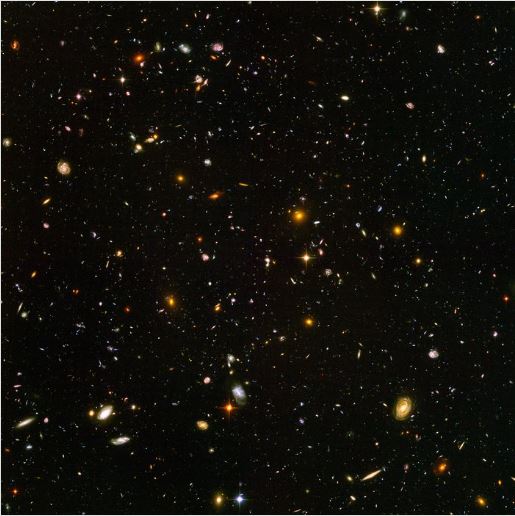
Many years ago, the school I was then at had the privilege of having noted astrophysicist, Mario Livio—he of Hubble Telescope fame—come and address the entire Upper School about his work at the Space Telescope Institute at Johns Hopkins University.  His address was about the many wonders Hubble had revealed about the nature of the universe, and on one of his slides, he displayed this image:

He explained that this is what is known as an ultra-deep field image and that the points of light that look like individual stars are in reality entire galaxies, each containing hundreds of millions, if not billions, of individual stars.  He then when on to share that the image we were looking at represented only 1 degree of the night sky, and that if we were to rotate the telescope through a full 360 degrees—and he slowly, deliberately turned his body through an entire rotation to emphasize his point—we would observe that what is in that image would be observed in every single degree. What’s more, he punctuated, that was with rotating the space telescope along only one axis! In short, he summed up, “we live in a universe of uncountable numbers of stars with uncountable numbers of worlds, each its own potential haven for life.”

The audience was spellbound, and the Q&A that followed, lively.  But what I remember most about that day was later in the afternoon, as my AP biology students filtered into the room, I asked them what they had thought about Dr. Livio’s lecture, and Serene Mirza replied, staring at me with this look of total bewilderment:

He was awesome, Mr. Brock.  But I have to confess, hearing him and seeing that image…well, it made me wonder: Why we are even bothering having class today? What’s the point of studying any of the stuff we’ve been learning? If the universe is that vast, can anything be relevant? Can any of us be relevant?

The short answer to her question, of course, is “no.”  My student was totally correct in her observation, and as journalist, Oliver Burkeman puts it, “it’s useful to begin this stage of our journey [about time] with a blunt but unexpectedly liberating truth: that what you do with your life doesn’t matter all that much—and when it comes to how you’re using your finite time, the universe absolutely could not care less” (p. 208).1  The basic truth is that at a fundamental level, all any of us are are consumers of food and oxygen and producers of urine and carbon dioxide—just like every other vertebrate on the planet.  Indeed, as I start the year with my Advanced Biology class, I point out that we are even more basic than that; that we basically consist of electrons transiting from one atomic orbital to another.

And if you think of all the countless humans who have consumed their food and oxygen and produced their urine and carbon dioxide, who have had their electrons transit and then left no trace of themselves whatsoever…well, you get the idea.  We have zero cosmic significance as a species, let alone as individual members of that species.

Yet there seems to be this deeply rooted psychological urge, bordering on biological need, to believe that what we do with our discrete unique lives should somehow matter, should make a significant difference in the proverbial grand scheme of things, and in fact, there is a term in psychology for this belief: egocentricity bias.  What’s more, when we think about it from an evolutionary standpoint, this bias makes perfectly good sense because if each of us had a genuine sense of our own irrelevance, we might not struggle as hard to survive and reproduce.  We need to think highly of ourselves in order to propagate the species.

It is also true that it is not a certainty easy to swallow.  As essayist Katherine May points out:

Some ideas are too big to take in once, and completely.  Believing in the [irrelevance] of my place on earth—radically and deeply accepting it to be true—is something I can do only in fits and starts.  It is in itself an exercise in mindfulness.  I remind myself of its force, but the belief soon seeps away.  I remind myself again.  It drifts off with the tide.  This does nothing to diminish the power of the next realization, and the next.  I am willing to do it over and over again, throughout my life.  I am willing to accept it may never actually stick (p. 234).

Yet there is a value to it sticking, even if only a little, because “to remember how little you matter, on a cosmic scale, can feel like putting down a heavy burden that most of use didn’t realize we were carrying in the first place” (p. 210).  When you let go of the idea that you must somehow make your life matter, “you’re freed to consider the possibility that many of the things you’re already doing with [your life] are more meaningful than you’d supposed—and that until now, you’d subconsciously been devaluing them, on the grounds that they weren’t ‘significant’ enough” (p. 212; original emphasis).  Thus:

From this new perspective, it becomes possible to see that preparing nutritious meals for your children might matter as much as anything could ever matter, even if you won’t be winning any cooking awards [and] that virtually any career might be a worthwhile way to spend a working life, if it makes things slightly better for those it serves (p. 213).

The truth is that the majority of us live modestly meaningful lives and that even those who make it into the pages of our history live, at best, slightly more significant ones.  Think about it.  Our knowledge of the Pharaohs of Egypt or the Mayan Kings or the Xia Dynasty is already extremely limited, and 10,000 years from now even that little will most probably have faded into oblivion.  And in as little on the cosmic scale as a million years from now…?! As the poet, Shelley, once wisely wrote:

My name is Ozymandias, King of Kings;
Look on my Works, ye Mighty, and despair!
Nothing beside remains. Round the decay
Of that colossal Wreck, boundless and bare
The lone and level sands stretch far away.

However, there is one way in which every single human who lives, has ever lived, and ever will live has deeply meaningful and lasting significance, and here is where the educator in me stirs.  As I teach my seniors, every single one of us participates in an intricate web of ecological—as well as sociological—relationships, each of us a nexus point, and every single action we take as individuals generates waves that ripple out throughout that web. 

The food you eat and the soap you bathe with? They determine the microbial populations that inhabit your body, which in turn contribute to the quality of your health….  Where you purchase those and other items? It impacts the livelihoods of those in the supply chain, which in turn contributes to the stability of your neighborhood….  How often you drive? That governs the amount of carbon dioxide you contribute to a changing climate, which in turn alters the weather you experience as it manipulates the jet stream….

I could clearly go on indefinitely, but that is why I always end the school year with my seniors the same way.  Throughout the year, they have had to write “Issues in Science” essays about how some of the biological ideas we have studied have the potential to impact society at large (e.g. since energy transformation in living systems never stops, how do we define death?2) and so after our last unit of the year—the environmental science one where I have to teach them just how badly humans have screwed the planet up—I inform them on the very last day of class that I am assigning them their final “Issues in Science” topic. 

My speech pretty much goes like this:

Today, I am assigning you your last Issues in Science paper—pause to allow for the looks of shock, consternation, and anger to appear on their faces—Relax, you’re not writing this paper for me.  No, this is an essay you are going to write with your lives—with the decisions you make and the actions you take—I’m just the messenger making you aware of the topic for it.  And I won’t be grading this essay; the universe will.  A universe which, as we have learned this year, grades on one scale and one scale only:  pass/fail. What’s more, if you think I’ve been a demanding grader!—pause to let that one sink in; there are some chuckles and knowing smiles—You are now among some of the most knowledgeable people on the planet, and knowledge as we know is power, which makes you among some of the most powerful people on the planet as well.  Hence, your final Issues topic is this:  What will you do with your power?

Or as I may now have to phrase it:  What will you do with your modestly meaningful life?

To which, all of us, I would ask the same.

If you’re reading this, you know what I’ve done so far with mine.

1Unless otherwise indicated, all quotes are from Burkeman’s Four Thousand Weeks.

2Read Carl Zimmer’s Life’s Edge if you want to see just how challenging defining life or death truly is; the legal definition alone has changed more than once in my lifetime.

Author’s Note: “A Modestly Meaningful Life” is the last in my series on time and education. Be sure to check out: “The Clock Is Always Ticking…,” “Managing ‘Now’,” and “A Time for Every Purpose.”

References

Burkeman, O. (2021) Four Thousand Weeks: Time Management for Mortals. New York: Farrar, Straus and Giroux. May, K. (2020) Wintering: The Power of Rest and Retreat in Difficult Times.  New York: Riverhead Books.

A Time for Every Purpose

Change will not stop happening.
The only part we can control is our response.

—Katherine May

The Navajo people learned a long time ago
that winter is the ultimate test of applied faith.

–Rex Lee Jim

As I mentioned in The Clock is Always Ticking…, I have been reading two books about time, and while I have obviously focused so far these past couple of posts on journalist, Oliver Burkeman’s thoughts about our modern misunderstandings about time, I want to turn now to the one that is about a distinct type of time in our lives.  But because the content of both books have informed my thinking equally—even when writing primarily about Burkeman’s ideas—I want to allow him to set the stage:

The reason time feels like such a struggle is that we’re constantly attempting to master it—to lever ourselves into a position of dominance and control over our unfolding lives so that we might finally feel safe and secure, and no longer vulnerable to events…. [And] this dream of somehow one day getting the upper hand in our relationship with time is the most forgivable of human delusions because the alternative is so unsettling.  But unfortunately, it’s the alternative that’s true: the struggle is doomed to fail…. So insecurity and vulnerability are the default state—because in each of the moments that you inescapably are, anything could happen, from an urgent email that scuppers your plans for the morning to a bereavement that shakes your world to its foundation (B, pp. 215-217).1

That last example of inevitable change is what essayist, Katherine May would call an instance of “wintering”—those periods of brokenness and crisis where a life felt emptied of meaning forces us to find “the courage to stare down the worst parts of our experience and commit to healing them the best we can” (M, p. 120).  It can be a time of great sorrow and discomfort, and since “everybody winters at one time or another” (M, p. 10), I want to join May in exploring some of its properties—especially because winters play such a crucial role in both our individual and collective lives.

For starters, May wisely points out, “however it arrives, wintering is usually involuntary, lonely, and deeply painful,” and that is why like actual winter, it is often perceived as simply a period of endurance—“nows” that are best gotten through as quickly as possible and soon, hopefully, forgotten.  But, she reminds us, “when everything is broken, everything is also up for grabs.  That’s the gift of winter:  it’s irresistible.  Change will happen in its wake, whether we like it or not [and] we can come out of it wearing a different coat”—which is why “amid the transformation of winter—the unwelcome change—is an abundance of life” that provides the foundation for the chance for growth.  Hence, “winter is not the death of the life cycle, but its crucible” (M, p. 11, 121, 67, & 14). 

Our time in the crucible, though, confronts us with one of life’s more painful realities, and that is that “our lives, thanks to their finitude, are inevitably full of activities we’re doing [and people we’re knowing] for the very last time” (B, p. 132).  The brokenness of relationship lies at the heart of all wintering, and that is what can make our winters feel so excruciatingly long and disheartening.  Yet even out of this brokenness, there lies the potential for learning because since any specific experience might be the last of that kind:

We should therefore try to treat every such experience with the reverence we’d show if [we knew] it were the final instance.  And indeed there’s a sense in which every moment of life is a “last time.”  It arrives; you’ll never get it again—and once it’s passed, your remaining supply of moments will be one smaller than before (B, p. 133; my emphasis).

Which is why May challenges us to pay attention to our wintering:

We must stop believing that these times in our lives are somehow silly, a failure of nerve, a lack of will power.  We must stop trying to ignore them or dispose of them.  They are real, and they are asking something of us.  We must learn to invite winter in.  We may never choose to winter, but we can choose how (p. 13; original emphasis).

Therefore,

More than any other season, winter requires a kind of metronome that ticks away its darkest beats, giving us a melody to follow into spring.  The year will move on no matter what, but by paying attention to it, feeling its beat, and noticing the moments of transition—perhaps even taking time to think about what we want from the next phase in the year—we can get the measure of it (M, pp. 115-116).

Only by attending to our winters, she argues, can we recognize the newly forming roots within us, waiting to spring forth, and only by attending to our winters can we perceive the earlier buds we formed prior to it that will blossom us back to full life.

In addition, she emphasizes, “when you start tuning in to winter, you realize that we live through a thousand winters in our lives—some big, some small” (M, p. 117)—and that as one lives through each of them, “you begin to acquire what has become the least fashionable but perhaps most consequential of superpowers: patience” (B, p. 171).  Because each of us learns that we cannot force the pace of our winters, and our “reward for surrendering the fantasy of controlling the pace of reality is to achieve, at last, a real sense of purchase on that reality” (B, p. 177).  Wintering, May insists, is how we discover who we fully are.

She also believes it “offers us a cyclical metaphor for life, one in which the energies of spring arrive again and again, nurtured by the deep retreat of winter.”  She wants to contest our modern “habit of imagining our lives to be linear, a long march from birth to death” as a “brutal untruth” because “life meanders like a path through the woods.  We have seasons when we flourish and seasons when the leaves fall from us, revealing our bare bones.  Given time, they grow again” (M, p. 68).

Of course, the paradox is that life is both cyclical and linear, and that is why I have found the writing of both Burkeman and May so compelling and so intertwined.  As we spiral through our “nows,” we generate our meanings by what we choose to attend to and what we choose to neglect, and in so doing, we are reminded of “the sheer astonishingness of being” (B, p. 65; original emphasis), of having any time—any life—at all.  In fact, “when you turn your attention to the fact that you’re in a position to have an irritating [or painful experience such as wintering] in the first place, matters are liable to look very different indeed” (B, p. 67; original emphasis).  The miracle is that any of us are here at all.

I realize at this juncture, many readers may be wondering what does any of this have to do with education and its improvement—the proclaimed purpose of this entire project—and my short response is that our students experience winters just like we do and that one of the properties of an authentically engaged teacher (elaborated on in Chapter 2) is generating appropriately intimate rapport with them.  As teachers, we must recognize the wintering times in the children under our care, aid them in navigating them and passing on the wisdom from our own winters when appropriate through that rapport. 

But most importantly, we must remember to avoid the terrible habit so deeply ingrained in our culture of:

Looking at other people’s misfortunes and feeling certain that they brought them upon themselves in a way that you never would.  This isn’t just an unkind attitude.  It does us harm, because it keeps us from learning that disasters do indeed happen and how we can adapt when they do.  It stops us from reaching out to those who are suffering.  And when our own disaster comes, it forces us into a humiliated retreat, as we try to hunt down mistakes that we never made in the first place or wrongheaded attitudes that we never held (M, p. 122).

We must never judge a student’s winter, and it is our responsibility as authentically engaged teachers to use our rapport to help them avoid judging themselves as well.  As the adults in the room, we know firsthand wintering is already challenging enough without unnecessary and ill-conceived blaming and shaming, and so we need to aid our students whenever possible in breaking the terrible habit of always seeking fault.  Most of the time there simply isn’t any; manure just happens, and we need to support them in embracing this fundamental truth.

We can also support them through their winters in our capacity as co-learners because at the heart of wintering is the problem of the human condition: we can imagine things otherwise.  Both Burkeman and May directly address this issue, but I like how May writes about it better:

As I walk, I remind myself of the words of Alan Watts: “To hold your breath is to lose your breath.” In the Wisdom of Insecurity, Watts makes the case that always convinces me, but which I always seem to forget: that life is, by its very nature, uncontrollable.  That we should stop trying to finalize our comfort and security, and instead find a radical acceptance of the endless, unpredictable change that is the very essence of this life.  Our suffering, he says, comes from the fight we put up against this fundamental truth” (M, pp. 232-233).

I love those words “the case that always convinces me, but which I always seem to forget.”  It is so tempting to want to control—especially during our winters—and by modelling our own struggle to remember one of life’s fundamental truths, sharing it with our students, seeking to learn “radical acceptance” together, we teach and empower them to do more than make it through their winters:

We teach and empower them to journey through every season of their lives.

1Because I am quoting from both Burkeman’s and May’s work, I am using last initials for an abbreviated citation system to keep the read smoother.

Author’s Note: “A Time for Every Purpose” is the third in my series of posts on time and education. Be sure to check out “The Clock Is Always Ticking…” and “Managing ‘Now’,” and “A Modestly Meaningful Life.”

References

Burkeman, O. (2021) Four Thousand Weeks: Time Management for Mortals. New York: Farrar, Straus and Giroux.

May, K. (2020) Wintering: The Power of Rest and Retreat in Difficult Times.  New York: Riverhead Books.

Managing “Now”

Do not rule over imaginary kingdoms
of endlessly proliferating possibilities.

—Geshe Shawopa

The real measurement of any time management technique
is whether or not it helps you neglect the right things.

—Oliver Burkeman

Today, I want to continue exploring our understanding of how we experience time and its implications for education by suggesting that if all you have is “now,” then what you pay attention to in your “now” takes on enormous consequence.  As journalist, Oliver Burkeman points out, “your experience of being alive consists of nothing other than the sum of everything to which you pay attention” (p. 91), and therefore the choices you make about the focus of your attention quite literally define who you are and what is important, meaningful, and significant to you.  Indeed, “what you pay attention to will define, for you, what reality is” (p. 91).1

Here, though, is where life in the digital age has gotten highly problematic.  The on-line world of apps and social media are “essentially a giant machine for persuading you to make wrong choices about what to do with your attention—and therefore with your finite life—by getting you to care about things you didn’t want to care about [in the first place]” (p. 94), and since this persuasion process is deliberately baked-in to the system, “all the feuds and fake news and public shamings on social media aren’t a flaw from the perspective of the platform owners; they’re an integral part of the business model” (p. 95).  Combine this fact with certain problematic hard-wired features of our pesky brains and the limbic system, and the reality so many of us live in today has become twisted and misshapen, almost malignant.  As Burkeman eloquently sums it up:

Because the attention economy is designed to prioritize whatever’s most compelling—instead of whatever’s most true, or most useful—it systematically distorts the picture of the world we carry in our heads at all times…so it’s not simply that our devices distract us from more important matters.  It’s that they change how we’re defining ‘important matters’ in the first place (p. 96).

Something that as a classroom teacher, I can say that I have witnessed firsthand.  A recent example comes from this past school year when I watched students whose academic records suggested that studying in the library would be a far better use of their free periods consume that time instead, on a daily basis, making TikTok videos—because the videos are now the “important matters” for these children and not their education. I could go on, but I have already written extensively in Chapter 9 about the impact of technology on teaching and learning and the steps we need to be taking in education to counteract its negative impacts; so I invite those interested in a deeper dive into this topic read that chapter. 

Here, I bring up the issue of what our children are paying attention to because having spent an entire year in Zoom school and hybrid classes—with all the consequent damage we now know it caused—I would argue that there are some additional steps we need to be taking in education right now to repair what’s important in our students’ lives.  For one thing, we need to prioritize activities in the physical world over the digital world in our classrooms because learning “in real life” engages more higher order thinking centers in the brain, generates more creative thought, and produces more effective problem solving. “In real life” enables us as educators to redirect student attention to what genuinely matters and to engage them in critiquing what doesn’t.

We also need to prioritize synchronous, collaborative activities involving direct student interaction in our classrooms because they nurture and develop the empathy, communication, and negation skills so desperately absent from the digital world but so critical for grappling with truly important matters. If individuals do not know how to engage directly and productively with one another in the real world, we have no hope of solving the many crises facing it and us, and it is, in fact, a lack of empathy, communication, and negotian skills that is helping foment the enormous political divisions in this country:

A society in thrall to [individualism], as ours is, ends up desynchronizing itself, [and since] grassroots politics—the world of meetings, rallies, protests, and get-out-the-vote operations—are among the most important coordinated activities that a desynchronized population finds it difficult to get around to doing, the result is a vacuum of collective action, which gets filled by autocratic leaders, who thrive on the mass support of people who are otherwise disconnected—alienated from one another, stuck at home on the couch, a captive audience for televised propaganda (pp. 199-200).

Recent years have shown how dangerously close we have come to flirting with totalitarianism in this country, and the simple truth right now is that our society is in genuine danger of “coming apart at the hinges” as the old cliché goes.  Unless we wrangle the on-line world and dramatically reduce—if not eliminate—its toxicity, we will not…no, cannot maintain a stable society, and if we do not teach our children what is truly important and how to pay attention to it—modeling those behaviors in our own lives as well—then I fear that I may find myself, like the prophet, Jeremiah, authoring my own Lamentations one day.

In other words, if we do not all start properly managing our “now,” choosing the right things to neglect and teaching our children to do likewise, we may not have a “next.”

1All material quoted in this posting are taken from Burkeman’s Four Thousand Weeks.

Author’s Note: “Managing ‘Now’ ” is the second in my series of posts about time and education. Be sure to check out “The Clock Is Always Ticking…,” “A Time for Every Purpose,” and “A Modestly Meaningful Life.

References

Borenstein, S. (April 30, 2022) Brainstorming Dampened in Video Meetings, Study Shows.  The Baltimore Sun.

Burkeman, O. (2021) Four Thousand Weeks: Time Management for Mortals. New York: Farrar, Straus and Giroux.

May, K. (2020) Wintering: The Power of Rest and Retreat in Difficult Times.  New York: Riverhead Books.

The Clock Is Always Ticking…

Arguably, time management is all life is.
—Oliver Burkeman

As a classroom teacher, it is not uncommon for me to overhear some of my students say from time-to-time “How I wish it were Friday!”  Other popular variations include “I can’t wait for Spring Break” or “Only (fill-in-the-number) days before summer.”  And whenever I hear one of them express this desire for time to go faster, I always reply with the gentle admonishment “You shouldn’t wish your life away”—to which the response is almost always a rolling of the eyes and an “oh, Mr. Brock!”

But once, one of my students actually listened, and the reason I know that she listened was because when she wrote me a letter her senior year, thanking me for being her teacher, she told me that the most important thing she had ever learned from me was the time in 9th grade when I had said to one of her friends not to wish her life away.  The words had struck a chord and stuck with her, and she shared that ever since that time, whenever she found herself starting to wish for the day or week or some other timeframe to be over, she would deliberately stop and remind herself not to wish her life away—to remain in the moment and appreciate the “now.”

I share this reminiscence because I have recently read two books in which the concept of time is the central theme—one about how we use it; one about a type of it—and they both brought to mind the memory of Casey because in reading them, I have come to realize that she might be right all those years ago: that the most important lesson I may have ever taught her (or any of my other students) is not to wish life away. 

Or to elaborate a little further, to have a healthier understanding of time and its role in our lives than most of us in today’s world do.  It starts, according to journalist Oliver Burkeman, with the recognition that our perception of time in modernity is basically broken.  As he puts it, prior to modernity:

There was no need to think of time as something abstract and separate from life: you milked the cows when they needed to be milked and harvested crops when it was harvesttime, and anybody who tried to impose an external schedule on any of that—for example, by doing a month’s milking in a single day to get it out of the way, or by trying to make the harvest come sooner—would rightly have been considered a lunatic (p. 20).

However, with the rise of industrialization, people started to conceive of time as a “thing,” a resource that we could each somehow possess and manipulate, and when perceived this way, the reality of time confronts us with the reality of finitude—that the time I “possess” is confined by definition to the brevity of my lifespan.  The consequent fear, Burkeman argues, causes:

Most of us [to] invest a lot of energy, one way or another, in trying to avoid fully experiencing the reality in which we find ourselves…The details differ from person to person, but the kernel is the same.  We recoil from the notion that this is it—that this life, with all its flaws and inescapable vulnerabilities, its extreme brevity, and our limited influence over how it unfolds, is the only one we’ll get a shot at (p. 29; original emphasis).

In fact, that “extreme brevity” is the source of the title for Burkeman’s book.  “Four Thousand Weeks” is roughly the amount of time an individual living to 80 has, and since a little over 1300 of those weeks will be spent sleeping (a biological fact I’m not sure even Burkeman has factored into his thinking), the amount of time for doing anything in this world is brief indeed! What all this means for the practicalities of life is worth quoting Burkeman extensively because he puts it so eloquently.  For starters, it means owning that in a very real way, each of us is our time, that “that’s how completely our limited times defines us…[It] isn’t just one among various things we have to cope with; rather, it’s the thing that defines us as humans, before we start coping with anything at all” (p. 59).  And since we are our time, “every decision to use a portion of time on anything represents the sacrifice of all the other ways in which you could have spent time, but didn’t” (p. 33). 

Furthermore, “since hard choices are unavoidable [when making such decisions], what matters is learning to make them consciously, deciding what to focus on and what to neglect, rather than letting them get made by default” (p. 32).  Thus, properly grasping the finitude of our choices “means standing firm in the face of FOMO, the ‘fear of missing out,’ because you come to realize that missing out on something—indeed, on almost everything—is basically guaranteed” (p. 33), and that includes having to say “no” to doing things that you do, in fact, want to do.  As essayist, Katherine May, puts it: “the problem with ‘everything’ is that it ends up looking an awful lot like nothing: just one long haze of frantic activity with all the meaning sheared away” (p. 19).

Here’s where the educator in me kicks in: not a single one of us can do it all—including most especially even all the things we find actual value in doing—and yet this is not a message we proactively teach our children.  Indeed, in the college prep world where I work, we frankly teach students the exact opposite.  We encourage every student to take the most rigorous course load while playing a varsity sport, while engaging in community service, while running six clubs, while maintaining a YouTube channel while….  You get the picture.  It’s all about the resume for the college application process, and we wonder why so many of our students struggle with anxiety, depression, and burn-out.

Now, I understand and appreciate that we don’t want to place too many limits on our children’s exploration of the world too soon, to close too many doors on opportunities for future livelihoods before they even grasp such livelihoods exist.  But what Burkeman challenges me to challenge my fellow educators is that helping students learn to make deliberate choices between all the things that they want to do—to confront at least some of their finitude—is to help prepare them for the realities of adulthood which they will experience soon enough and to provide space for better health.  The message “you can be anything you want to be” is not only a lie; it can be mentally and physical dangerous as an individual drives themselves to try.  We need to stop teaching it and teach instead “you will have chances to be a variety of things in this world, and we want to help you begin to decide which of these choices you might finally invest yourself in to spend your limited time.”

Of course, the “be anything” myth is not the only delusion our modern misunderstanding of time generates.  According to Burkeman, there is a second delusion we have today that is also the result of this misunderstanding of time as some kind of “thing” we can possess, and that is that we can somehow manage and control the future.  As he points out, the future simply doesn’t exist.  We can’t somehow step outside of time to manipulate it; hence, all we have is the immediate present as we are experiencing it.  We can, of course, make plans for, say, the next three hours of our experience.  But “even if you do end up getting the full three hours, precisely in line with your expectations, you won’t know this for sure until the point at which those hours have passed into history.  You only ever get to feel certain about the future once it’s already turned into the past” (pp. 117-118).  Simply put, “you can’t know that things will turn out all right.  The struggle for certainty is an intrinsically hopeless one” (p. 119; original emphasis), and therefore, “it’s not merely a matter of spending each day ‘as if’ it were your last, as the cliché has it.  The point is that it always actually might be.  I can’t entirely depend upon a single moment of the future” (p. 61).

Of course, it is obviously not possible to function without making some plans about a possible future.  If I want to eat dinner later this evening, I must generate a grocery list and then execute it.  But as Burkeman reminds us:

The real problem isn’t planning.  It’s that we take our plans to be something they aren’t.  What we forget, or can’t bear to confront, is that, in the words of the American meditation teacher Joseph Goldstein, “a plan is just a thought.”  We treat our plans as though they are a lasso, thrown from the present around the future, in order to bring it under our command.  But all a plan is—all it could ever possibly be—is a present-moment statement of intent.  It’s an expression of your current thoughts about how you’d ideally like to deploy your modest influence over the future.  The future, of course, is under no obligation to comply (p. 123).

Again, the educator in me kicks in, and I feel the tension in Burkeman’s words.  On the one hand, planning and goal setting are critical skills we must teach our children to do; on the other hand, I have seen students become so invested in a particular plan (e.g. gaining admission to a certain college or university) that when the future fails to comply, they experience crushing emotional devastation.  The fundamental truth—as a wrote more about in my Letter to the Class of 2022—is that the corollary to “the future is under no obligation to comply” is that “life is just messy.”  Resilience is as critical a skill as planning, and therefore, as I argue in more detail in Chapter 6, we must as educators deliberately provide chances for our students to have their plans fail in our presence, where we can provide the immediate support and care to teach them how to cope.  Small scale failures of the future’s compliance can nurture successfully handling the devastating failures of its compliance.

Which leads me back to my own immediate “now” and another reflection that Burkeman’s ideas about time trigger in me:  if all you have is now, then there is no ultimate “here”—no final destination—to arrive at someday.  Yet how often is our message in education (and parenting) one of arrival? Get the necessary grades in high school so that you can get into a good college…go to that college so that you can get a high paying job…climb the stages of your job to create a career…use your career to have and support a family…play games of mental stimulation with your toddler to get them into the right pre-school….  It seems that a dominant lesson we teach in our society is that your life will have meaning…eventually. 

However, this “obsession with extracting the greatest future value out of our time blinds us to the reality that, in fact, the moment of truth is always now—that life is nothing but a succession of present moments, culminating in death…and that therefore you had better stop postponing the ‘real meaning’ of your existence into the future, and throw yourself into life now” (pp. 135-136).  Now granted, Burkeman’s words are intended primarily for an adult audience, and the realities of human development require a structured timeline and planning to achieve functional adulting.  But I have watched 8-year-olds in Meeting for Worship at my Quaker School sit still in mindful silence for thirty minutes, and the pedagogical approach I present in Chapters Four and Five can cause students to be fully invested in the learning moment.  So it is possible to stop postponing real meaning into the future in educational settings and enable students to be in their “now.”

But when we do that, we need to keep in mind that what everyone is paying attention to in that “now” is that “now”—your perception defines it—and in today’s “attention economy,” those of us in the classroom are finding ourselves fighting what often feels like a losing battle for our students’ attention. 

However, I will leave that battle for another time (witticism intended), and until then, I hope you keep successfully finding your own real meaning in your own “now.”

Author’s Note: “The Clock Is Always Ticking…” is the first in my series about time and education. Be sure to look for “Managing ‘Now’,” “A Time for Every Purpose,” and “A Modestly Meaningful Life.”

References

Burkeman, O. (2021) Four Thousand Weeks: Time Management for Mortals. New York: Farrar, Straus and Giroux.

May, K. (2020) Wintering: The Power of Rest and Retreat in Difficult Times.  New York: Riverhead Books.