The Aha! Moment (Revisited)

EUREKA!
—attributed to Archimedes

Recently, I wrote about how it seems impossible to go any length of time these days without hearing some story about AI, and the most recent past is no exception.  Indeed, the morning I started writing this, NPR carried a story about Elon Musk’s lawsuit against OpenAI’s Sam Altman, and when I googled the topic out of idle curiosity, my screen exploded with other stories.  All of which is preamble to say that yet another reason has come to my attention to proceed extremely cautiously with AI’s employment in the classroom.  That we must do some deliberate training about it is now as inevitable as dealing with the ubiquity of smartphone technology in students’ daily lives.  However, the latest findings about AI’s impact in the workforce—what is being called “AI Brain Fry”—should probably inform that training with more skepticism than some in education are presently embracing.

Why? Because what is coming abundantly clear as AI has been embraced in a variety of work environments is that using it to enhance or augment employee productivity has actually backfired by generating a need for multi-tasking on steroids.  As technology columnist, John Herman, of New York Magazine describes it:

You have a programming tool that can kind of run in the background and starts adding features to software really quickly, you have another tool that’s constructing a report from you, it’s searching the web and pulling together a market research document. You have another tool in the background that you’re in a constant chat with trying to refine some idea for a talk you have to give…you’re just kind of getting first pulled in all these different directions, and then you’re kind of spamming yourself [as] you’re just producing all of this product. And it’s harder, as you use more and more tools to keep track of whether this output is actually relevant to your job, whether you’re doing anything that you need to be doing or whether you’re kind of creating new work for yourself…. (Luse, et al)

You get the point: it is exhausting simply reading about everything AI is now asking people in the workplace to manage and keep track of, let alone actually doing it.  Again, it is multi-tasking on steroids, and since the brain research on that concept is 100% clear—multi-tasking is neurologically impossible—the whole point of employing AI to improve output and efficiency would appear self-defeating.  It’s as if “AI is a poorly trained intern that you have to check the work of all the time, turning workers into bosses or at least simulated bosses” (Luse, et al) who now have two jobs: their original one and their now supervisory one.  Talk about a recipe for exhaustion, burnout, and counter-productivity!

Therefore, as we approach the reality of AI in the classroom specifically and AI in education in general, we might want to listen to this early cautionary tale from the frontiers of AI in the workplace.  If we do, I think it will lead us to recognize the need for two things. First, what boundaries do we need to place on already common uses of AI such as brainstorming and outline drafting for students or grading and lesson planning for teachers, and second, what counts as true augmentation versus one-more-tab-open-on-the-screen? The brain research on the answer to the first question is so overwhelming—with the new multi-tasking demands from the workplace simply piling on the confirmation—that I’ll simply state that if you do happen to be a first time reader who wants the details, here’s the link

As for the second question, that’s where some of the more recent brain research gets interesting; so let’s dive in.

We need to start by asking what would we potentially be augmenting with AI, and I would argue that the most logical choice is problem solving.  However, we have recently discovered that the human brain has two distinct circuits it uses for problem solving:  insight (the “aha! moment”) and logic (“analytical reasoning”), and we have found that each of these circuits has its own unique starting location during resting brainwave activity (insight=left temporal lobe; logic=right frontal lobe).  Furthermore, each of us apparently has a hard-wired tendency for which circuit we default to when solving problems (though everyone, importantly, can do both), and in fact, “a few minutes of EEG [readings on a test subject] predicted, up to seven weeks in advance, whether a person would solve puzzles mostly insightfully or analytically.  Our predominant thinking style is stable over time” (Kounios & Kounios, p. 24).

Because it is stable, though, the answer to whether a specific variant of AI might augment our problem-solving capacity or interfere with it has big implications for how we have people use AI in their learning.  Those who employ logic as their default might benefit from a tool that can look at billions of data points simultaneously to identify the most pertinent ones to employ analytically (e.g. determining all possible gas efficient routes to deliver a collection of packages might free someone up to look at these routes through the lens of that specific day’s traffic).  But for those who employ insight as their default, the digital pollution already clogging so many of our inner lives already inhibits the brain’s insight circuits, and any AI augmentation is simply going to overload those same circuits further.  AI, with its “unrelenting demand for productivity and speed, denies insight the time and opportunity to work wonders at its own pace” (Kounios & Kounios, p. 27). Hence, put simply, AI usage can only interfere with a person’s capacity for insight, never augment it.

However, that is highly problematic because it turns out that regardless of whether insight is your default problem-solving mode or a process requiring your deliberate employment, the amount of it you use predicts “how well [you] discriminate between real news stories and fake ones, as well as between meaningful statements and ‘pseudo-profound bullshit’ statements” (Kounios & Kousnios, p. 25).  Insight, thus, is a cognitive superpower against all the misinformation, disinformation, and blatant falsehoods flooding our daily lives—including the classroom! —and anything that inhibits its effective usage risks our very capacity to discern what is true.  Therefore, we need both insightful people as well as the more deliberate practice of insight in every element of society—again, including the classroom—if we are to find authentic solutions to the problems, both great and small, that confront us in our daily lives.

And one such problem confronting us today is a decline in people’s tolerance for healthy, beneficial risk.  The research now shows that there is a direct correlation between an individual’s quantities of “aha! moments” and their degree of comfort with risk-taking, and the evidence is clear that people observed displaying greater insightfulness also display less psychological concern for potential fallibility.  Indeed, the more insight these individuals employ, the more he, she, or they appear willing to engage in trial-and-error to solve problems.  Thus, these individuals seem almost immune to the emotional consequences of failure, and since that is practically the definition of the growth mindset universally espoused by nearly every educator on the planet, the value of insight as a tool for learning becomes undeniable.  Not that one cannot employ logic in a similar fashion.  But it would seem that providing more opportunities to employ insight may help everyone approach the process of learning more effectively,[i] and that is even more reason not to employ any augmentative AI in schools that might inhibit insightful thinking.  AI and “aha!” are fundamentally incompatible.

Which is why, once again, I find myself at the “end” of the perpetual news cycle still antagonistic to nearly all things AI (and associated).  As an educator, I have known the value of the “aha! moments” since my very beginning in the classroom, and as an experienced educator, I know how to generate the conditions to make them happen.  Indeed, as I write in the introduction to this entire project, the whole purpose behind my concept of “authentic engagement” is to enable and empower all educators everywhere to produce the insights that are the foundation of all genuine learning. 

Yet, I am too much the skeptic not to wonder if the pejorative “Oh, Boomer!” may not actually apply to this aging educator and his quasi-neo-luddite sympathies.  I am not going to halt the future use of AI in schools or the workplace, and I am not individually even likely to slow them down much.  In fact, while I might serve as a bulwark against how my own institution employs it—maybe even influence a few others through my writing—my very finitude will eventually silence my voice regardless.  What’s more, I have too much empirical data in front of me demonstrating that there is the very real possibility that none of it will matter, that there will be no one with enough IQ, CQ, and EQ to worry about my concerns in the first place.

But the latest idiotic hysteria surrounding the Hantavirus reminds me of how dangerously ignorant most of the population in this country is, and when you couple that with the current contemptuous rejection of expertise, then that danger only explodes exponentially.  While I truly get why the generations I wrote about last time are questioning whether to have children—I resist the urge myself sometimes not to scream at the stories coming out of my NPR station on the radio in the morning—the reality is that some of them are having babies, and those babies are going to need a viable world in which to live.  Hence, I have to remind myself that the darkness only wins if I stop shining—my own “aha! moment” I must renew each and every day.

References

Kounios, J. & Kounios, Y (March 2025) The Brain Science of Elusive “Aha! Moments.” Scientific American.  Pp. 21-27.

Luse, B.; McBain, L.; & Pathak, N. (April 13, 2026) You Might Be Suffering From AI Brain Fry.  It’s Been a Minutehttps://www.npr.org/2026/04/13/nx-s1-5780867/you-might-be-suffering-from-ai-brain-fry.


[i] As well as potentially explain why certain individuals cling harder to a fixed mindset than others: logic may be their default mode.

Updates 2.0

As my regular readers know, I write from time to time more to inform about recent news and/or trends in the world of education than to editorialize or comment about them.  Some have come in the form of simple updates; others as more formal declarations about the current state of education.  But my express purpose with all these brief reports has been to collate what I have been learning lately into emerging patterns that can help my readers better understand the current climate impacting teaching in this country (though of course, what one chooses to discuss is, by definition, a type of commentary).

Well, it turns out that this past month has been a busy one in the world of schools, and while I was crafting my most recent graduation letter, a lot of interesting news was piling up on my digital desk.  Thus, for those interested (and not already “in-the-know”), here’s what’s been happening recently in the K-16 world.

Obviously, at the top of the list is AI.  Indeed, a month cannot pass these days (and probably a week!) without the topic of education’s frenemy producing multiple headlines, and April 2026 was no exception.  Most interesting to this educator, though, was the nature of the stories AI was causing (but hopefully not actually writing) to be published.  The mounting backlash against all things digital—the verdict in California against Meta and Google was huge!—has apparently started to reach the world of schools as parents across the United States are demanding a wholesale reduction of screens in the classroom—with those in New York City (the largest school district in the country) insisting that ChatGPT be removed entirely. 

Furthermore, recent surveys of 14-29 year-olds (Gen Z) show growing distrust and anger when it comes to the ubiquity of AI in their daily lives.  An increasing number of them are recognizing and openly acknowledging the negative impacts AI has already had on their mental capacities, and they are not happy about it.  Put bluntly, their brains are still functional enough to grasp how poorly their brains now function, and they are pissed off! Perhaps there is hope for the future of the world’s IQs, CQs, and EQs after all.

Of course, not every AI headline was a positive one for teaching and learning, and I cannot lie (nor fail to editorialize at least a little bit) that I found it disheartening—and even more so because anyone who has worked with adolescent boys cannot find this news entirely unexpected—that more and more teenage males are choosing AI companions for their “girlfriends” instead of their actual fellow teenage females.  As the headline for the story reports, they are doing so for “maximum control” of the relationship, with “zero [chance of] rejection” and total compliance on the part of their chosen “significant other”—i.e. the perfect narcissist fairytale of “boy meets girl; boy never risks losing girl; boy never has to get girl back.”

Yet, the potential societal cost of this so-called “fairytale” relates to another common theme in many of the stories about education this past month: employability.  Without the soft skills honed by the realities of actual human relationship—negotiating resistance, healing emotional damage, developing patience and empathy—these Gen Z and Gen Alpha males will be unable to find success in the workplace of the future, where human-to-human interaction will be at a premium.  Just ask the current graduating computer scientists coming out of today’s colleges and universities who cannot find jobs because AIs can already write code more cheaply and efficiently than their human counterparts.  Tomorrow’s jobs—what we can know about them—are going to require skill sets that no AI can ever accomplish, namely the continual adaptability demanded by the eternal complexities of human relationship.

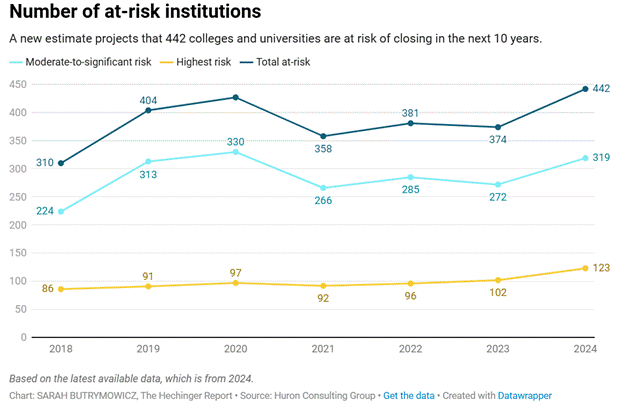
Interestingly enough, though, some of the other headlines related to education and employability suggest that we may be actively walking away from the very ability of schools to generate this kind of robust relational adaptability in the first place.  As seen in the chart below, more than 25% of small liberal arts colleges in this country are in danger of closing within the decade, and even places as robust in their enrollment as Syracuse University have made the decision to close 93 of their 460 academic programs—with humanities and the fine arts representing the bulk of the majors going away. 

Of course, similar changes are occurring at schools throughout the U.S. as college-age students look for degrees they think will result in higher pay, and college administrators are simply following the market to try to attract the dwindling pool of higher education candidates.  Eliminating under-enrolled academic offerings in the humanities saves money and keeps the proverbial doors open and the lights turned on in the face of changing demographics and demands on the part of the consumer.

However, for both higher education and its population, this trend may be self-defeating because what today’s economists are saying to today’s students is:

major in a subject that offers enduring, transferable skills. Believe it or not, that could be the liberal arts. [Harvard economist, David] Deming’s research shows that male history and social-science majors end up out-earning their engineering and comp-sci counterparts in the long term, as they develop the soft skills that employers consistently seek out. “It’s actually quite risky to go to school to learn a trade or a particular skill, because you don’t know what the future holds,” Deming [says]. “You need to try to think about acquiring a skill set that’s going to be future-proof and last you for 45 years of working life.”

Which is why I was excited to read that in spite of the current contraction happening in the humanities and the fine arts at the college and university level, there is a bit of a revolution happening in high schools for the skills these fields have traditionally promoted and developed.  The 74 reports that emerging organizations such as Skills For The Future and Pathsmith are looking at the employability needs of the Gen Z and Gen Alpha populations, and they are creating actual curricula and assessments to meet these needs in today’s 9-12 classrooms and beyond.  Indeed:

several companies and non-profits are taking these [“soft” or “durable”] skills that have been fuzzy concepts and working on giving them shape and definition. They’re gathering teachers, developers of tests, business leaders and other experts to break down these skills into smaller skills and then into even smaller subskills and nuances that can serve as steps toward mastery. Communications, for instance, could include negotiating and public speaking as subskills, [and] the resulting outlines of skills and subskills are like a tree branching out from its trunk into smaller and smaller limbs, all with an eye to making them as teachable and testable as math or English.

In other words, the three “Cs” (communication, collaboration, and cognition) may be coming soon to an SAT test near you!

And part of how this may actually get accomplished involves the last piece of recent news I want to report about, an article exploring an intriguing potential solution to the teacher shortage in this country.  Written by former acting Governor of Massachusetts, Jane Swift, and former US Secretary of Education, Arne Duncan, these two members from opposite poles of the political spectrum propose that two challenges currently facing our society may, in fact, be one another’s solutions.  They write:

Schools across the country are struggling to find enough teachers, with at least 411,000 teaching positions currently open nationwide. At the same time, more than 40% of recent graduates are underemployed. That means millions of young people have earned college degrees only to find themselves stuck in jobs that offer low pay, little security, and no clear path forward.  These are not separate challenges, and taken together, they point to a solution hiding in plain sight. Teaching can be the entry point into the workforce that Gen Z graduates need.

Now, I will be forthright.  My initial reaction upon reading this was a mixture of growl, teeth-grinding, and grimace: not this old trope again! “Those who can, do; those who can’t, teach”…“glorified babysitters; how hard can it be?”…“cushy job; only work 9 months a year and get summers off!” The list of misperceptions about my chosen profession that I have heard over the decades still leaves me with a smoldering sense of frustration and even anger.  After all, this is the profession documented to be second only to that of ER surgeons for the number of critical decisions that have to be made every minute, and since more than half the people who enter it burnout and leave after just 3 years, I’m not sure that “cushy” is a term I would use to describe it. 

However, as I continued reading Swift’s and Duncan’s argument, I realized they were not saying that simply anyone can do this job.  Instead, they were arguing something more subtle:

Teacher shortages are already impacting classrooms nationwide. And schools in rural districts and lower-income communities are particularly struggling to fill vacancies. Research shows that persistent vacancies and reliance on substitute teachers undermine student learning and achievement. For students who overcome these challenges and make it to college, another problem awaits. Just half of all college graduates secure roles that require a degree. For those college graduates struggling to secure a college-level job, teaching can help them climb the career ladder as well.

Hence, what I am understanding Swift and Duncan to be reasoning is that in a world where AI is becoming the equivalent of the mechanical robots that took over much of the manufacturing sector, teaching offers a pathway for some of today’s college graduates to find stable, meaningful—potentially long-term—employment that perfects the “soft” skills they will need for the future while filling a need for caring, consistent, and well trained adults in the lives of children who would otherwise be left academically adrift.  They are not saying that just anyone can successfully teach but that encouraging those who have the potential to enter the profession by making the path for doing so more straightforward and attractive (e.g. making the “student teaching” requirements of most licensing programs paid internships) could possibly solve two challenges we currently face in our society at the same time.

Like I said, I find their ideas intriguing—if for no other reason than A) teaching is likely to remain pretty AI proof for the foreseeable future since it is rooted by its very nature in the messiness of human relationship; B) those adolescent boys with their chatbot girlfriends would learn how to navigate the complexity of person-to-person interaction real fast in a roomful of 10-year-olds; and C) I’m going to retire someday and somebody’s got to take my place.

Time will tell, and I encourage anyone interested in any of these updates from the world of education to explore the references below.

Coda

As I was finishing writing this, two articles arrived in my in-box reminding me that formal education systems in this country face a far greater crisis in the relatively near term than AI, cancelled academic departments, and under-employed Gen Z-ers combined.  The fertility level in the economically developed world is well below replacement value at this point—and continuing to drop—and it is estimated that in the New York City public schools alone, there will be 153,000 fewer students enrolled over the course of the next decade.  Tough decisions about school closures are coming not just for the small liberal arts colleges of this land, and those currently entering the teaching profession could actually find themselves in a very competitive job market (Swift’s and Duncan’s 411,000 positions may simply evaporate by attenuation).

But what makes me write this “afterword” is the far greater issue than simply a probable near-term crisis for schools in the U.S. caused by decreasing fertility levels. Anyone who knows me knows that I think hope is a verb, and the ultimate act of hope is the deliberate choice to bring a child into the world.  Yet as Anna Louie Sussman presents so brilliantly in her recent essay for the NYT, many in our two youngest generations who are in their reproductive years are not having children right now because of the chaotic uncertainty that there will even be a livable future for those hypothetical children to inhabit.  Millennials and Gen Zs are finding themselves without hope in that most significant way that one can, and that shouldn’t just concern those of us in education.  That should give us all pause.

Because the steadily more dystopian world we have chosen to create doesn’t have to remain the dysfunctional way it currently is. We have the power to change it. What haunts me is whether we have the will. Again, as I concluded with my graduating seniors, “maybe.”

References

Horowitch, R. (June 2025) The Computer-Science Bubble is Bursting.  The Atlantic. https://www.theatlantic.com/economy/archive/2025/06/computer-science-bubble-ai/683242/.

Marcus, J. (April 13, 2026) More Than a Quarter of Private Colleges Are at Risk of Closing, New Projection Shows.  The Hechinger Reporthttps://hechingerreport.org/more-than-a-quarter-of-private-colleges-are-at-risk-of-closing-new-projection-shows/.

Mervosh, S.; Paris, F.; & Cain Miller, C. (May 8, 2026) U.S. Schools Face a Crisis as the Number of Children Drops.  The New York Timeshttps://www.nytimes.com/2026/05/08/upshot/public-schools-enrollment-crisis.html.

Napolitano, J. (April 9, 2026) Gen Z Increasingly Skeptical of–And Angry About–Artificial Intelligence.  The 74https://www.the74million.org/article/gen-z-increasingly-skeptical-of-and-angry-about-artificial-intelligence/.

O’Donnell, P. (April 21, 2026) Creating Communicators and Critical Thinkers: Soon There Will Be a Test for That.  The 74https://www.the74million.org/article/creating-communicators-and-critical-thinkers-soon-there-will-be-a-test-for-that/.

Otterman, S. (April 3, 2026) Syracuse Drops 84 Majors Including Classics, Ceramic and Italian.  The New York Timeshttps://www.nytimes.com/2026/04/01/nyregion/syracuse-university-degrees-eliminated.html?unlocked_article_code=1.X1A.CZh8.XEtP0OnmSuDJ&smid=url-share.

Royle, O.R. (April 17, 2026) Teen Boys Are Choosing AI Girlfriends Over Real Ones for “Maximum Control, Zero Rejection”–Experts Say It Could Make Them Unemployable.  Fortunehttps://fortune.com/2026/04/17/teen-boys-dating-ai-chatbot-girlfriend-experts-warn-kill-social-skills-gen-alpha-network-promotions/.

Singer, N. (May 6, 2026) In Backlash Against Tech in Schools, Parents Are Winning Rollbacks. The New York Times.  https://www.nytimes.com/2026/04/29/technology/parents-school-tech-backlash.html?unlocked_article_code=1.elA.Fg2u.0ouroYo_g8zF&smid=nytcore-ios-share.

Sussman, A. L. (May 7, 2026) Why So Few Babies? We Might Have Overlooked the Biggest Reason of All.  The New York Timeshttps://www.nytimes.com/2026/05/07/opinion/birthrate-kids-parents-demographics-future.html.

Swift, J. and Duncan, A. (April 7, 2026) The Case for More Gen Z Teachers.  TIMEhttps://time.com/article/2026/04/07/the-case-for-more-gen-z-teachers/.

AI: Education’s Frenemy (Part 2)

O brave new world,
That has such people in ’t!

—The Tempest

When I first wrote about ChatGPT three years ago, concerns about AI in the classroom were just beginning to emerge.  Much handwringing was done over fears of rampant cheating—especially in the text-heavy disciplines such as English and history—and anxiety among educators steadily mounted that AI tutors might soon be coming for people’s jobs.  There was an almost universal apprehension that the digital age’s ultimate disruptor to the education had perhaps finally arrived.  Lots of angst.

Which now seems positively quaint.

Because today, we have computers grading computers; brain scans showing AI inhibiting neurons; and thought leaders coining a new term, “anti-intelligence,” to describe what is happening to our youngest minds (more on this later).  Enormous data centers are sprouting like weeds—with the same corresponding economic costs and environmental harm as their literal botanical counterparts—and for over a year now, I have received at least two offers a day on Linked-In to earn hourly income training artificial intelligences that have a biology focus. 

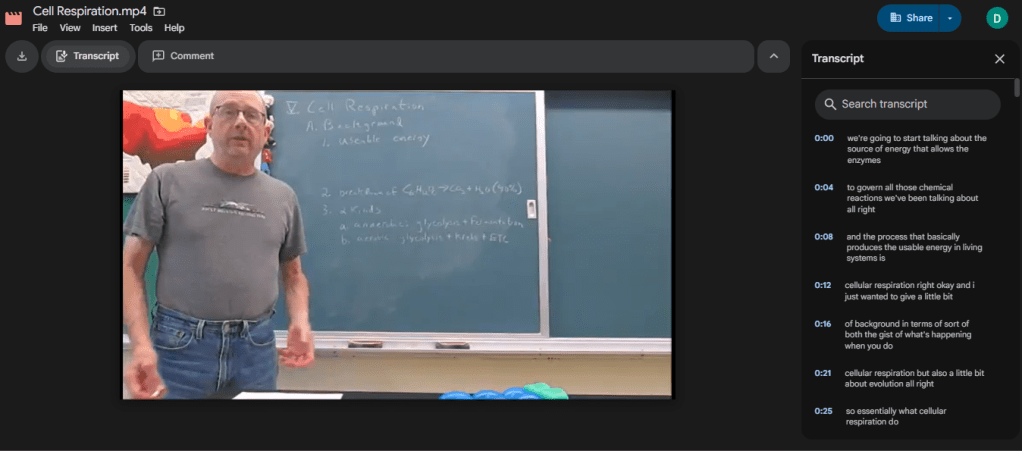
Yet the real eye-opening/face-slapping/jaw-dropping/pick-your-cliché moment for me recently was when I discovered that all my video lectures for my senior electives now open on-line with a searchable 100% AI-generated transcript of what I am saying that I neither created nor gave any permission to create.  Google’s AI simply spontaneously takes my entire audio and creates the corresponding text on the screen to the right of the visual component—all in the few seconds it takes to start the usually 35-40 minute video.  Here’s a screenshot for any skeptic:

Now, I would hope that the implications of what Google is now doing spontaneously would invoke at least a quiver of discomfort (if not outright abject terror!).  But if not, then my reader is probably itself an LLM AI to begin with, scouring the internet for its own training purposes, no emotional response required.  My writing has simply made it more proficient at invading what little remains of my already barely existent privacy.

However, what disturbed me most when discovering Google AI’s latest feature was not the act itself; it was the reality that here was one less opportunity for my students to have to think for themselves.  As English teacher Thomas David Moore sums it:

There is nothing new about students trying to get one over on their teachers — there are probably cuneiform tablets about it — but when students use AI to generate what Shannon Vallor, philosopher of technology at the University of Edinburgh, calls a “truth-shaped word collage,” they are not only gaslighting the people trying to teach them, they are gaslighting themselves. In the words of Tulane professor Stan Oklobdzija, asking a computer to write an essay for you is the equivalent of “going to the gym and having robots lift the weights for you.”

And without opportunities for cognitive heavy-lifting, brains atrophy; minds devolve; and the entire point of education becomes at risk.

But that brings me back to what I mentioned earlier, the notion of “anti-intelligence.”  As its originator, John Nosta, describes it:

Anti-intelligence is not stupidity or some sort of cognitive failure. It’s the performance of knowing without understanding. It’s language severed from memory, context, and even intention. It’s what large language models (LLMs) do so well. They produce coherent outputs through pattern-matching rather than comprehension. Where human cognition builds meaning through the struggle of thought, anti-intelligence arrives fully formed.

Thus, for example, when Google automatically transcribes my lectures, my students do not have to wrestle with grasping the cognitive story I am asking them to learn by watching and engaging with the video; they can simply look up the factoid they need for a particular question, without any concern for the larger intellectual context within which that question resides.  In other words, they no longer need to learn anything from my lectures; they just need them as employable databases.

Which is fine, I freely acknowledge, if you already know how to think.  I do not need to possess all human knowledge in my brain because I possess the critical thinking skills honed by decades of training that enable me to effectively employ those databases containing that knowledge for constructive cognitive purposes.  Where things become problematic is that anti-intelligence has become the “cognitive climate” where the minds of today’s youngest children develop, and “when AI answers arrive instantly from childhood, it may affect whether certain cognitive capacities develop.”  Every theory of brain development is clear: children learn through a series of encounters with constraints that carry costs when mistakes are made.  Without both those costs and those constraints, they will fail to generate both the necessary knowledge and the intellectual capacity to make steadily more informed decisions. 

Yet today’s children, as Nosta points out, “aren’t just using artificial intelligence (AI) as a study aid; they’re building their cognitive patterns in an environment where answers arrive before questions even fully form.”  We have never lived in such a world, and that’s what makes the potential future of AI in education so troubling: the pathway the brain needs to follow during childhood “doesn’t just make thinking harder; it makes thinking possible.” If we remove that path, do we remove thinking?

It’s a disturbing (if not distressing) thought; especially given that 61% of Americans can’t name the 3 branches of government, half our adults can’t read a book written at the 8th grade level, and—my personal favorite—25% of us apparently still think the sun revolves around the earth rather than the other way around! Add in the fact that nearly half of college graduates report never reading another book of any kind following graduation and that significant majorities of today’s youth report either being bored or otherwise disengaged at school and the notion that AI could interfere even further with this current situation is positively disheartening.  We are already a society where “the rejection of learned knowledge is often seen as an expression of personal liberty” and “hostility to education is now actively separating us from a shared reality” (Millet, p. 148).  If AI’s increasing ubiquity inhibits our collective cognitive capacity beyond the damage digital technologies and underfunding have already done to our educational systems, then we really are “sitting ducks for tyrants and profiteers, willing to believe whatever tales they choose to tell us” (Millet, p. 149).

Lest we “abandon all hope,” though, I need to point out that steadily increasing numbers of us in education—at all levels—have begun adapting to this new reality—as we always have even since those first aforementioned cuneiform days (it was hard to cheat in the strictly oral culture preceding them).  High schools and colleges alike report returning to Bluebooks for exams and in-class writing for essays.  Hand-written lab notebooks are making a comeback in the sciences, and at least two universities, Purdue and Ohio State, have now made proficiency with AI in one’s matriculating discipline a graduation requirement because A) there is the practical need for individuals in general to be able to distinguish truth from fiction and because B) you won’t be able to do your job in the future without such knowledge.  As one microbiologist put it:

AI has already “revolutionized” her field. Recent research suggests that AI-enabled analysis of large genomic data sets, for instance, is allowing scientists to look at DNA directly from environmental samples, revealing entire ecosystems of previously unknown microbes.

In other words, there are questions of value in need of answers that the human brain does not have the computing power to solve but which our brain does have the critical thinking to put to meaningful purpose.  AI can do things we can’t; we just need to stop surrendering to it the things we can do that it can’t.

The challenge, therefore, is to determine where AI has value in educational situations and where active resistance to it needs to take place.  For instance, if we know a climate of anti-intelligence threatens proper brain development, then we need to pay careful attention to how we construct pre-primary and early-childhood educational environments and experiences, and we need to teach parents not to park their toddler(s) in front of an I-pad, no matter how exhausted and tired the work-day may have left them.  Knowing that screen time inhibits neural activity, we need to plan lessons that don’t require extensive use of computers, and we either collect cellphones at the start of the school day (as so many K-12 institutions are finally doing) or ban them from being out in the classroom (as so many colleges and universities now do).

At the same time, where an AI program can enhance educational investigation in ways no human brain can ever accomplish, then designing lessons to actively employ it adds value to the learning.  For example, if I want my students to explore the actual attitudes of Americans about gun control, I can have them see how many times any type of restriction has been proposed by every level of legislature in the land.  Or if I want them to have a better understanding of a pastiche before making them hand-write their own, I can have them generate such a thing from an entire body of an author’s work.  Indeed, in my discipline, the sciences, where genuinely enormous databases are the rule rather than the exception, the potential uses of AI to enhance student learning are almost too numerous to list here.  The bottom line is that there are lots of potential positive possibilities for education’s frenemy in the classroom; they just require wise discernment on the part of the teacher.

But that is perhaps the greatest challenge for dinosaurs such as me when it comes to AI and teaching because I have zero interest in artificial intelligence.  Period.  In fact, I would go so far as to say I have negative interest; I’m actively antithetical to it even.  The simple truth is that I relish difficult, hard thinking.  I enjoy the excitement from the intellectual uncertainty of being “lost” and finding my way “home.”  To state the obvious, I treasure the blank page and what it is going to demand of me to fill it.  I am “the life of the mind.”  Thus, learning that Google now spontaneously generates transcripts of my video lectures simply fills me with annoyance since I will now have to reconfigure how I have my students employ them in their learning.  I know I must adapt as an educator to this changing environment as I have so many times before, and I know that I will do so.  But after 37 years of adapting, I’m starting to appreciate my grandfather’s attitude when VCRs arrived on the scene (and this from a man who was born before airplanes and lived to see the space shuttles):  nope; done; don’t want to deal with this. 

Maybe I can find an AI that can help.

References

Millet, L. (2024) We Loved It All: A Memory of Life.  New York: W. W. Norton & Company.

Moore, T. (Sept. 8, 2025) Jelly Beans for Grapes: How AI Can Erode Students’ Creativity.  EdSurge.  https://www.edsurge.com/news/2025-09-08-jelly-beans-for-grapes-how-ai-can-erode-students-creativity.

Nosta, J. (Jan. 22, 2026) Growing Up Anti-Intelligent.  Psychology Today.  https://www.psychologytoday.com/ca/blog/the-digital-self/202601/growing-up-anti-intelligent.

Toppo, G. (Feb. 17, 2026) At These Universities, Using AI Isn’t Shunned–It’s a Graduation Requirement.  The 74.  https://www.the74million.org/article/at-these-universities-using-ai-isnt-shunned-its-a-graduation-requirement/.

The Death of Thinking?

Rage, rage against the dying of the light…
Do not go gentle into that good night.

—John Donne

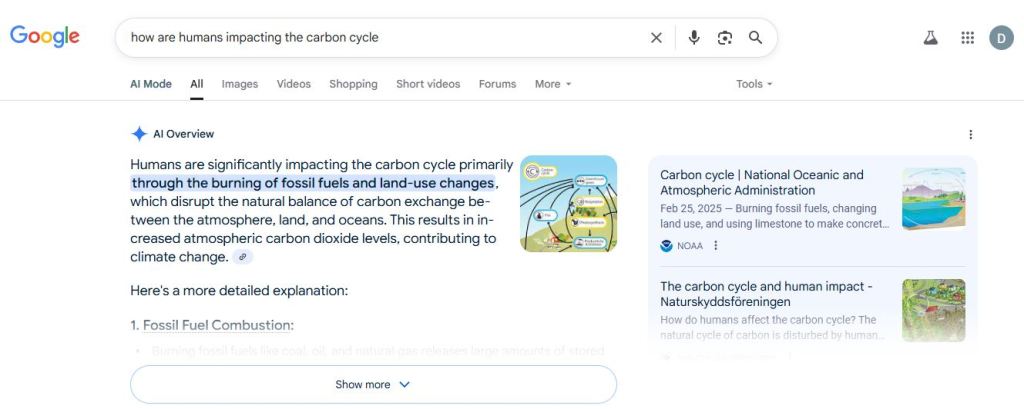
It started with an assignment.  My students were learning to use the standard APA-style citation method employed in the sciences, and one of my students who is a faithful and almost fanatical rule-follower kept calling me over to ask how to cite his next item of research.  After multiple attempts at re-explaining the process, I finally simply asked this student to show me his screen. This is what I saw:

Now, my student hadn’t done anything atypical of today’s learner.  He had typed his query directly off my instruction sheet into Google and awaited the response.  It is, of course, not a good research habit (and one I keep trying to fight), but when I saw what it had produced, I was unnerved; I had not realized how much AI had invaded internet search engines.  Here I had spent all this time teaching my students how to vet websites for academic and scientific reliability—an essential critical thinking skill, especially in today’s flood of misinformation and disinformation—and yet, here, confronting me on my student’s screen was an AI summary of only potentially relevant sources with no distinct authors or web addresses for my student to cite.  No wonder he was confused!

So I showed my student how he could click on the little link symbol you can see there on the image right after the word “change” in order to bring up the list of web sites the AI had used for its summary, and I demonstrated how to find the source he needed among those sites so that he could formally cite it in his project.  But if not for my own critical thinking skills enabling me to know what the AI was doing, both my student and myself would have been left in the dark, making unsubstantiated claims, reporting the thoughts of others as our own without any attribution to the original thinkers.  The literal definition of plagiarism.

To say that I, as an educator, was appalled and alarmed by this development is like stating that hydrogen bombs make a noise when they go off (hyperbole intended!).  However, I shortly thereafter read an editorial piece on Bloomberg that reminded me that my collegiate level colleagues have it even worse right now.  At the preK-12 level, good schools are still doing a lot with pencil and paper in their classrooms, including formal assessments that require actual knowledge and the ability to think through a problem unaided by technology.  But presently in academia—at institutions whose very raison d’être is the production and refinement of critical thinking!—“outsourcing one’s homework to AI has become routine” and “assignments that once demanded days of diligent research can be accomplished in minutes…no need to trudge through Dickens or Demosthenes; all the relevant material can be instantly summarized after a single chatbot prompt.”

Even more incredible (confirming a rumor I’d heard) is the fact that apparently more and more professors are starting to employ AI themselves to evaluate student work, leading to the mind-boggling and ultimately untenable reality of “computers grading papers written by computers, students and professors idly observing, and parents paying tens of thousands of dollars a year for the privilege.”   The Editorial Board of Bloomberg News is indeed spot on when they declare that “at a time when academia is under assault from many angles, this looks like a crisis in the making.” 

The coffin’s nail for me, though…the camel’s straw, the road’s end, the coup de grace…pick your cliché for finality and mine from this past month was the screenshot below:

I had read this remarkable article in Scientific American on the genetic fluidity of sex and gender in sparrows, and I wanted to share it with my fellow biology teachers for use in our inheritance unit next year (as well as some separate electives we each teach).  So I scanned the article as a PDF to make it more permanently accessible for all of us, and that’s when I saw the message from ADOBE up there in the lefthand corner:  “This appears to be a long document.  Save time by reading a summary.” 

I spluttered; I fumed; I cursed:

“Of course it’s a long document you [expletive deleted] piece of software! That’s the whole point! To provide the reader with rich, nuanced knowledge and understanding of one of the most complex ideas in all of biology!!! If I had wanted my colleagues and I to have a [further expletive deleted] ‘summary,’ I first would have written it myself before giving it to them and then I still would have provided them the formal citation!”

In case you cannot tell, gentle reader, I was pissed.  Pissed at the seeming systemic and systematic attack on the human capacity to think (let alone actually valuing that capacity).  Pissed that there is clearly a market for this disparagement of thinking, and pissed that so few in our world seem to be upset by this dying of the light. I have known that scientific reasoning has been under assault for some time now, but the death of basic thinking itself?!

I know, I know.  One more thing to add to the agenda for my often Sisyphean-feeling profession.  But I’m not just pissed.  I am also deeply concerned, and something neuroscientist, Hanna Poikonen, wrote earlier this year is a good way to end this brief ragging on my part:

Each time we off-load a problem to a calculator or ask ChatGPT to summarize an essay, we are losing an opportunity to improve our own skills and practice deep concentration for ourselves…when I consider how frenetically people switch between tasks and how eagerly we outsource creativity and problem-solving to AI in our high-speed society, I personally am left with a question: What happens to our human ability to solve complex problems in the future if we teach ourselves not to use deep concentration? After all, we may need that mode of thought more than ever to tackle increasingly convoluted technological, environmental, and political challenges.

“May need” indeed.  My money’s on “will,” not “may.”

References

Maney, D. (March 2025) The Bird that Broke the Binary. Scientific American.  Pp. 48-55.

Poikonen, H. (Feb. 2025) How Expertise Improves Concentration.  Scientific American. Pp. 81-82.

The Editorial Board (May 27, 2025) Does College Still Have a Purpose in the Age of ChatGPT? Bloomberg Newshttps://www.bloomberg.com/opinion/articles/2025-05-27/ai-role-in-college-brings-education-closer-to-a-crisis-point?utm_source=pivot5&utm_medium=newsletter&utm_campaign=nvidia-breaks-records-with-44-billion-sales-despite-china-ban-1&_bhlid=31b2ce1fa3444fd1982e5d64eb0f1a1b6d1ab0f3.

Catechism and AI Revisited

This is the nature of the razor-thin path of scientific reality:
there are a limited number of ways to be right,
but an infinite number of ways to be wrong.
Stay on it, and you see the world for what it is.
Step off, and all kinds of unreality become equally plausible.

—Phil Plait

Two stories about artificial intelligence recently caught my attention.  The first, out of the University of California, Irvine’s Digital Learning Lab, examined how successful ChatGPT could be at grading English and history essays when compared to an actual teacher.  The second, an editorial about the AI revolution in general, exposited on the very practical and financial boundaries all AI technologies are rapidly finding themselves running up against.  Together, I found these stories causing me to revisit some themes from my very first posting about AI, and as I reflected more on all of these items, some shared threads between the two stories rapidly became apparent that I want to discuss here today.

But first, a quick synopsis of each article.

In the story about grading, researcher Tamara Tate and her team sought to compare ChatGPT’s ability to score 1,800 middle school and high school English and history essays against the ability of human writing experts to do so.  Their motive was to see if ChatGPT could help improve writing instruction by allowing teachers to assign more of it without increasing their own cognitive load.  If, for example, teachers could use AI “to grade any essay instantly with minimal expense and effort,” then more drafts could be assigned, thereby enabling the quality of student writing skills to improve. 

What they found was a lot of variability, with ChatGPT’s scores matching the human scores between 76% and 89% of the time, which Tate summarized as meaning that ChatGPT was “roughly speaking, probably as good as an average busy teacher [and] certainly as good as an overburdened below-average teacher. [But that] ChatGPT isn’t yet accurate enough to be used on a high-stakes test or on an essay that would affect a final grade in a class.”  Furthermore, she cautioned that “writing instruction could ultimately suffer if teachers delegate too much grading to ChatGPT [because] seeing students’ incremental progress and common mistakes remain important for deciding what to teach next.” Bottom line, as the title of the article states, the idea “needs more work.”

In the editorial about the AI revolution, technology columnist, Christopher Mims makes the strong case that the pace of AI development is hitting three walls: a rapidly slowing pace of development, mounting prohibitive costs, and what I will call the productivity boundary.  In terms of development, Mims points out that AI works:

by digesting huge volumes of [data], and it’s undeniable that up to now, simply adding more has led to better capabilities. But a major barrier to continuing down this path is that companies have already trained their AIs on more or less the entire internet, and are running out of additional data to hoover up. There aren’t 10 more internets’ worth of human-generated content for today’s AIs to inhale.

As for costs, training expenses are in the tens of billions of dollars while revenues from AI are, at best, in the billions of dollars—not a sustainable economic model.  Finally, the evidence is mounting that AI does not quite boost productivity the way its evangelists have touted because “while these systems can help some people do their jobs, they can’t actually replace them.”  Someone still has to check for AI hallucinations, and “this means they are unlikely to help companies save on payroll.”  Or to put it another way, “self-driving trucks have been slow to arrive, in part because it turns out that driving a truck is just one part of a truck driver’s job.”

Which brings me back to why I think these two articles share common threads of thought and what made me revisit my original posting about AI.  Both articles obviously point to AI’s limitations, and the grading one is simply a specific example of the “productivity boundary” Mims discusses.  Both articles have a cautionary tone about AI being the be-all-end-all solution to “all life’s problems” the way its many proselytizers want to claim it can be, and the grading one even brings up the economics of AI as it warns about schools jumping on the proverbial bandwagon and purchasing AI grading systems too quickly.

But it was the analogy of the truck driver that caused all the metaphorical gears in my head to click into place.  English and history teachers don’t just teach writing, and when they grade the writing, it is not just the quality of the writing they are grading.  They are not “just driving the truck.”  I am confident that ChatGPT could be a marvelous tool for catching run-on and incoherent sentences or for catching disorganized paragraphs and poor thesis statements, and if using it for that would enable an already overburdened teacher the chance to get a few additional drafts for an essay accomplished in their class, I’m on board.  The only way you get better at writing is to write.

However, what ChatGPT cannot catch (and here is where I suspect at least some of those discrepancies in the percentages found in the grading research come from) is the quality, the originality! of thought and ideas that a given piece of writing expresses.  Only the human teacher can do that because only the human teacher has actual intelligence as defined by biology:  the capacity to use existing knowledge to solve an original, unique, and novel problem.  No AI can solve a problem it hasn’t already seen—which is part of what Mims hints at with his remark about “10 more internets;” only a human mind could create them—and that is why we will still need the human teacher to do the final grading.

Which brings me back to some of the themes I first addressed in Catechism and AI.  In looking back at that essay (where I first wrote about this misuse of the word “intelligence” in computer science), I realized that what the technological breakthroughs since then have made possible is the deepening of the illusion of intelligence.  Once something like ChatGPT could be trained on the entire internet, pretty much every prior human answer to a problem was now part of the algorithm, and so when you present it with a problem that is novel to you, it appears like it can solve it on its own.  It appears intelligent.  And since problems truly novel to everyone who has ever lived grow exponentially fewer each day, AI can appear intelligent quite a bit of the time.

However, present it with a problem that is novel to both you and the AI and suddenly you get one of those hallucinations Mims points out you need an actual human to fix.  That remains the limitation of AI:  it cannot handle the truly novel, the genuinely unique.  Nor can it create it.  As I’ve written before, AI may be capable of producing a mimic of a Taylor Swift song, but it cannot produce an actual Taylor Swift song.  The challenge is in remembering that the mimic isn’t really Taylor Swift.

Again, here is where the technological breakthroughs since I first wrote about AI have deepened the illusion.  The content generated by AIs such as ChatGPT may look novel because that particular arrangement of words, images, etc. happens to look novel to you.  But somewhere, at some time, some human mind already put those same words, images, etc. together; some human mind created.  And you are just now on the receiving end of a tool that we can now train on what every human mind has created to date for the past 10,000 years. The ultimate catechism! And a lot of prior human creativity with which to fool someone.  We see a parallel in the development of the performance of magic shows:  one hundred years ago, we only had the technology to create the illusion of a woman sawn in half; forty years ago, David Copperfield has the tools to make the Statue of Liberty appear to disappear.  None of it is any less illusory; it just gets harder to tell.

And where that fact may grow increasingly problematic is in the realm of another theme from my earlier writing:  interpersonal relationships.  When I first wrote about AI five years ago, Her was only a movie; now it’s a reality.  For a monthly subscription, I can have the AI companion of my choice (romantic, platonic, and/or therapeutic), and have “someone” in my life who will never push back on me.  Add DoorDash, Amazon, and Netflix, and I could spend the rest of my life once I retire (or get a work-from-home internet job) in my own solipsistic bubble without any need for any direct human contact ever again.  Not gonna happen as they say, but the fact that I can write those words should be sobering (and shuddering) to anyone reading them. Because if we are ultimately successful at reducing our most basic humanity to an illusion, climate change and the next pandemic are going to be the least of our concerns.

Yet if Christopher Mims is correct, then AI may rapidly be approaching its illusory limits, and if Tate and her crew are correct, then watchful use of AI may help teachers give their students more practice improving their writing skills—and therefore their thinking skills—while not adding to their grading loads. So perhaps there is cause for optimism.  The key, I think, is always to remember that the “I” in AI is—at least for now—a biological falsehood, and what I now realize was missing from my earlier work on AI is the necessary emphasis on novelty being at the core, the essence of what it means to be intelligent.  That doesn’t mean the CS folks may not eventually pull off an algorithm that truly can create.  But for now, we do not live in that world, and we just need to keep reminding ourselves regularly of the reality of that fact.

References

Barshay, J. (May 20, 2024) AI Essay Grading Could Help Overburdened Teachers, But Researchers Say It Needs More Work.  KQED/Mind Shift  https://www.kqed.org/mindshift/63809/ai-essay-grading-could-help-overburdened-teachers-but-researchers-say-it-needs-more-work.

Mims, C. (May 31, 2024) The AI Revolution Is Already Losing Steam.  The Wall Street Journalhttps://www.wsj.com/tech/ai/the-ai-revolution-is-already-losing-steam-a93478b1?mod=wsjhp_columnists_pos1.