The Death of Thinking?

Rage, rage against the dying of the light…
Do not go gentle into that good night.

—John Donne

It started with an assignment.  My students were learning to use the standard APA-style citation method employed in the sciences, and one of my students who is a faithful and almost fanatical rule-follower kept calling me over to ask how to cite his next item of research.  After multiple attempts at re-explaining the process, I finally simply asked this student to show me his screen. This is what I saw:
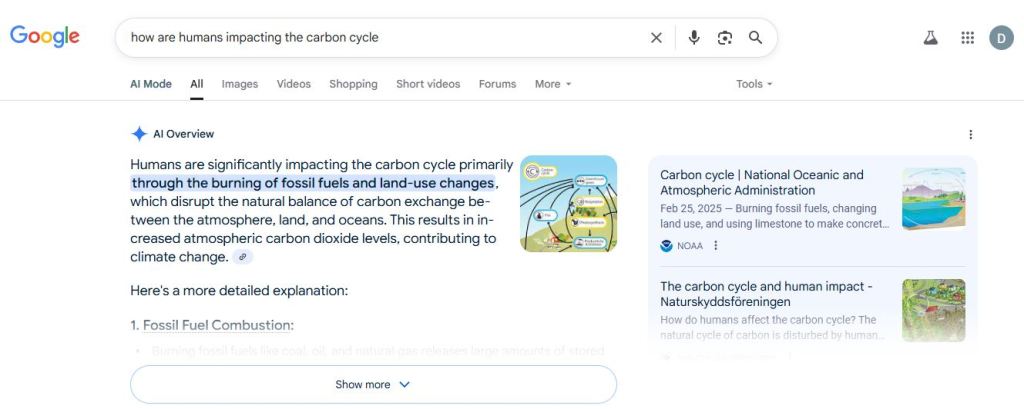
Now, my student hadn’t done anything atypical of today’s learner.  He had typed his query directly off my instruction sheet into Google and awaited the response.  It is, of course, not a good research habit (and one I keep trying to fight), but when I saw what it had produced, I was unnerved; I had not realized how much AI had invaded internet search engines.  Here I had spent all this time teaching my students how to vet websites for academic and scientific reliability—an essential critical thinking skill, especially in today’s flood of misinformation and disinformation—and yet, here, confronting me on my student’s screen was an AI summary of only potentially relevant sources with no distinct authors or web addresses for my student to cite.  No wonder he was confused!

So I showed my student how he could click on the little link symbol you can see there on the image right after the word “change” in order to bring up the list of web sites the AI had used for its summary, and I demonstrated how to find the source he needed among those sites so that he could formally cite it in his project.  But if not for my own critical thinking skills enabling me to know what the AI was doing, both my student and myself would have been left in the dark, making unsubstantiated claims, reporting the thoughts of others as our own without any attribution to the original thinkers.  The literal definition of plagiarism.

To say that I, as an educator, was appalled and alarmed by this development is like stating that hydrogen bombs make a noise when they go off (hyperbole intended!).  However, I shortly thereafter read an editorial piece on Bloomberg that reminded me that my collegiate level colleagues have it even worse right now.  At the preK-12 level, good schools are still doing a lot with pencil and paper in their classrooms, including formal assessments that require actual knowledge and the ability to think through a problem unaided by technology.  But presently in academia—at institutions whose very raison d’être is the production and refinement of critical thinking!—“outsourcing one’s homework to AI has become routine” and “assignments that once demanded days of diligent research can be accomplished in minutes…no need to trudge through Dickens or Demosthenes; all the relevant material can be instantly summarized after a single chatbot prompt.”

Even more incredible (confirming a rumor I’d heard) is the fact that apparently more and more professors are starting to employ AI themselves to evaluate student work, leading to the mind-boggling and ultimately untenable reality of “computers grading papers written by computers, students and professors idly observing, and parents paying tens of thousands of dollars a year for the privilege.”   The Editorial Board of Bloomberg News is indeed spot on when they declare that “at a time when academia is under assault from many angles, this looks like a crisis in the making.” 

The coffin’s nail for me, though…the camel’s straw, the road’s end, the coup de grace…pick your cliché for finality and mine from this past month was the screenshot below:
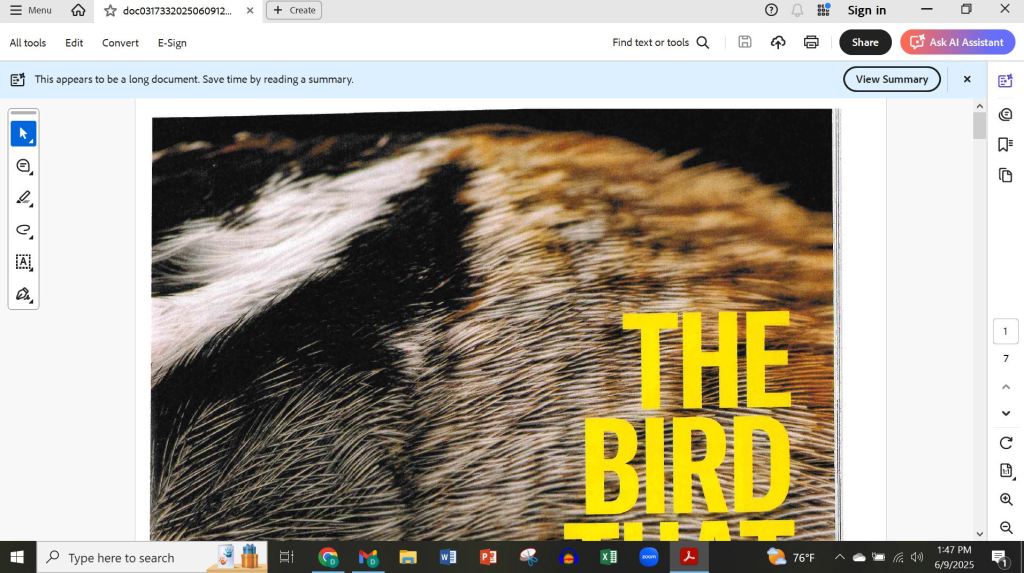
I had read this remarkable article in Scientific American on the genetic fluidity of sex and gender in sparrows, and I wanted to share it with my fellow biology teachers for use in our inheritance unit next year (as well as some separate electives we each teach).  So I scanned the article as a PDF to make it more permanently accessible for all of us, and that’s when I saw the message from ADOBE up there in the lefthand corner:  “This appears to be a long document.  Save time by reading a summary.” 

I spluttered; I fumed; I cursed:

“Of course it’s a long document you [expletive deleted] piece of software! That’s the whole point! To provide the reader with rich, nuanced knowledge and understanding of one of the most complex ideas in all of biology!!! If I had wanted my colleagues and I to have a [further expletive deleted] ‘summary,’ I first would have written it myself before giving it to them and then I still would have provided them the formal citation!”

In case you cannot tell, gentle reader, I was pissed.  Pissed at the seeming systemic and systematic attack on the human capacity to think (let alone actually valuing that capacity).  Pissed that there is clearly a market for this disparagement of thinking, and pissed that so few in our world seem to be upset by this dying of the light. I have known that scientific reasoning has been under assault for some time now, but the death of basic thinking itself?!

I know, I know.  One more thing to add to the agenda for my often Sisyphean-feeling profession.  But I’m not just pissed.  I am also deeply concerned, and something neuroscientist, Hanna Poikonen, wrote earlier this year is a good way to end this brief ragging on my part:

Each time we off-load a problem to a calculator or ask ChatGPT to summarize an essay, we are losing an opportunity to improve our own skills and practice deep concentration for ourselves…when I consider how frenetically people switch between tasks and how eagerly we outsource creativity and problem-solving to AI in our high-speed society, I personally am left with a question: What happens to our human ability to solve complex problems in the future if we teach ourselves not to use deep concentration? After all, we may need that mode of thought more than ever to tackle increasingly convoluted technological, environmental, and political challenges.

“May need” indeed.  My money’s on “will,” not “may.”

References

Maney, D. (March 2025) The Bird that Broke the Binary. Scientific American.  Pp. 48-55.

Poikonen, H. (Feb. 2025) How Expertise Improves Concentration.  Scientific American. Pp. 81-82.

The Editorial Board (May 27, 2025) Does College Still Have a Purpose in the Age of ChatGPT? Bloomberg Newshttps://www.bloomberg.com/opinion/articles/2025-05-27/ai-role-in-college-brings-education-closer-to-a-crisis-point?utm_source=pivot5&utm_medium=newsletter&utm_campaign=nvidia-breaks-records-with-44-billion-sales-despite-china-ban-1&_bhlid=31b2ce1fa3444fd1982e5d64eb0f1a1b6d1ab0f3.

Catechism and AI Revisited

This is the nature of the razor-thin path of scientific reality:
there are a limited number of ways to be right,
but an infinite number of ways to be wrong.
Stay on it, and you see the world for what it is.
Step off, and all kinds of unreality become equally plausible.

—Phil Plait

Two stories about artificial intelligence recently caught my attention.  The first, out of the University of California, Irvine’s Digital Learning Lab, examined how successful ChatGPT could be at grading English and history essays when compared to an actual teacher.  The second, an editorial about the AI revolution in general, exposited on the very practical and financial boundaries all AI technologies are rapidly finding themselves running up against.  Together, I found these stories causing me to revisit some themes from my very first posting about AI, and as I reflected more on all of these items, some shared threads between the two stories rapidly became apparent that I want to discuss here today.

But first, a quick synopsis of each article.

In the story about grading, researcher Tamara Tate and her team sought to compare ChatGPT’s ability to score 1,800 middle school and high school English and history essays against the ability of human writing experts to do so.  Their motive was to see if ChatGPT could help improve writing instruction by allowing teachers to assign more of it without increasing their own cognitive load.  If, for example, teachers could use AI “to grade any essay instantly with minimal expense and effort,” then more drafts could be assigned, thereby enabling the quality of student writing skills to improve. 

What they found was a lot of variability, with ChatGPT’s scores matching the human scores between 76% and 89% of the time, which Tate summarized as meaning that ChatGPT was “roughly speaking, probably as good as an average busy teacher [and] certainly as good as an overburdened below-average teacher. [But that] ChatGPT isn’t yet accurate enough to be used on a high-stakes test or on an essay that would affect a final grade in a class.”  Furthermore, she cautioned that “writing instruction could ultimately suffer if teachers delegate too much grading to ChatGPT [because] seeing students’ incremental progress and common mistakes remain important for deciding what to teach next.” Bottom line, as the title of the article states, the idea “needs more work.”

In the editorial about the AI revolution, technology columnist, Christopher Mims makes the strong case that the pace of AI development is hitting three walls: a rapidly slowing pace of development, mounting prohibitive costs, and what I will call the productivity boundary.  In terms of development, Mims points out that AI works:

by digesting huge volumes of [data], and it’s undeniable that up to now, simply adding more has led to better capabilities. But a major barrier to continuing down this path is that companies have already trained their AIs on more or less the entire internet, and are running out of additional data to hoover up. There aren’t 10 more internets’ worth of human-generated content for today’s AIs to inhale.

As for costs, training expenses are in the tens of billions of dollars while revenues from AI are, at best, in the billions of dollars—not a sustainable economic model.  Finally, the evidence is mounting that AI does not quite boost productivity the way its evangelists have touted because “while these systems can help some people do their jobs, they can’t actually replace them.”  Someone still has to check for AI hallucinations, and “this means they are unlikely to help companies save on payroll.”  Or to put it another way, “self-driving trucks have been slow to arrive, in part because it turns out that driving a truck is just one part of a truck driver’s job.”

Which brings me back to why I think these two articles share common threads of thought and what made me revisit my original posting about AI.  Both articles obviously point to AI’s limitations, and the grading one is simply a specific example of the “productivity boundary” Mims discusses.  Both articles have a cautionary tone about AI being the be-all-end-all solution to “all life’s problems” the way its many proselytizers want to claim it can be, and the grading one even brings up the economics of AI as it warns about schools jumping on the proverbial bandwagon and purchasing AI grading systems too quickly.

But it was the analogy of the truck driver that caused all the metaphorical gears in my head to click into place.  English and history teachers don’t just teach writing, and when they grade the writing, it is not just the quality of the writing they are grading.  They are not “just driving the truck.”  I am confident that ChatGPT could be a marvelous tool for catching run-on and incoherent sentences or for catching disorganized paragraphs and poor thesis statements, and if using it for that would enable an already overburdened teacher the chance to get a few additional drafts for an essay accomplished in their class, I’m on board.  The only way you get better at writing is to write.

However, what ChatGPT cannot catch (and here is where I suspect at least some of those discrepancies in the percentages found in the grading research come from) is the quality, the originality! of thought and ideas that a given piece of writing expresses.  Only the human teacher can do that because only the human teacher has actual intelligence as defined by biology:  the capacity to use existing knowledge to solve an original, unique, and novel problem.  No AI can solve a problem it hasn’t already seen—which is part of what Mims hints at with his remark about “10 more internets;” only a human mind could create them—and that is why we will still need the human teacher to do the final grading.

Which brings me back to some of the themes I first addressed in Catechism and AI.  In looking back at that essay (where I first wrote about this misuse of the word “intelligence” in computer science), I realized that what the technological breakthroughs since then have made possible is the deepening of the illusion of intelligence.  Once something like ChatGPT could be trained on the entire internet, pretty much every prior human answer to a problem was now part of the algorithm, and so when you present it with a problem that is novel to you, it appears like it can solve it on its own.  It appears intelligent.  And since problems truly novel to everyone who has ever lived grow exponentially fewer each day, AI can appear intelligent quite a bit of the time.

However, present it with a problem that is novel to both you and the AI and suddenly you get one of those hallucinations Mims points out you need an actual human to fix.  That remains the limitation of AI:  it cannot handle the truly novel, the genuinely unique.  Nor can it create it.  As I’ve written before, AI may be capable of producing a mimic of a Taylor Swift song, but it cannot produce an actual Taylor Swift song.  The challenge is in remembering that the mimic isn’t really Taylor Swift.

Again, here is where the technological breakthroughs since I first wrote about AI have deepened the illusion.  The content generated by AIs such as ChatGPT may look novel because that particular arrangement of words, images, etc. happens to look novel to you.  But somewhere, at some time, some human mind already put those same words, images, etc. together; some human mind created.  And you are just now on the receiving end of a tool that we can now train on what every human mind has created to date for the past 10,000 years. The ultimate catechism! And a lot of prior human creativity with which to fool someone.  We see a parallel in the development of the performance of magic shows:  one hundred years ago, we only had the technology to create the illusion of a woman sawn in half; forty years ago, David Copperfield has the tools to make the Statue of Liberty appear to disappear.  None of it is any less illusory; it just gets harder to tell.

And where that fact may grow increasingly problematic is in the realm of another theme from my earlier writing:  interpersonal relationships.  When I first wrote about AI five years ago, Her was only a movie; now it’s a reality.  For a monthly subscription, I can have the AI companion of my choice (romantic, platonic, and/or therapeutic), and have “someone” in my life who will never push back on me.  Add DoorDash, Amazon, and Netflix, and I could spend the rest of my life once I retire (or get a work-from-home internet job) in my own solipsistic bubble without any need for any direct human contact ever again.  Not gonna happen as they say, but the fact that I can write those words should be sobering (and shuddering) to anyone reading them. Because if we are ultimately successful at reducing our most basic humanity to an illusion, climate change and the next pandemic are going to be the least of our concerns.

Yet if Christopher Mims is correct, then AI may rapidly be approaching its illusory limits, and if Tate and her crew are correct, then watchful use of AI may help teachers give their students more practice improving their writing skills—and therefore their thinking skills—while not adding to their grading loads. So perhaps there is cause for optimism.  The key, I think, is always to remember that the “I” in AI is—at least for now—a biological falsehood, and what I now realize was missing from my earlier work on AI is the necessary emphasis on novelty being at the core, the essence of what it means to be intelligent.  That doesn’t mean the CS folks may not eventually pull off an algorithm that truly can create.  But for now, we do not live in that world, and we just need to keep reminding ourselves regularly of the reality of that fact.

References

Barshay, J. (May 20, 2024) AI Essay Grading Could Help Overburdened Teachers, But Researchers Say It Needs More Work.  KQED/Mind Shift  https://www.kqed.org/mindshift/63809/ai-essay-grading-could-help-overburdened-teachers-but-researchers-say-it-needs-more-work.

Mims, C. (May 31, 2024) The AI Revolution Is Already Losing Steam.  The Wall Street Journalhttps://www.wsj.com/tech/ai/the-ai-revolution-is-already-losing-steam-a93478b1?mod=wsjhp_columnists_pos1.