Educating for Intellectual Virtue

I want to have a favorable impact
on my students’ relationship to learning.

—Jason Baehr

I learned this week of a news story that probably didn’t catch a lot of people’s attention.  Given the general large-scale chaos happening right now—from the Ebola outbreak in central Africa to the tit-for-tat over the Strait of Hormuz—it is hardly surprising that this story might fly under the proverbial radar of many an individual’s attention (even those of us who actively seek to remain accurately informed citizens).  But apparently there has been an on-going battle, led by Florida’s governor, Ron DeSantis, over the accreditation process for colleges and universities in Florida and five other states in the traditionally Deep South.  Specifically, a battle over accreditation agencies—i.e. who gets to legally certify the academic credentials of institutions of higher ed. 

I will spare readers the full details (references available below), but it is essentially the latest skirmish in the culture wars over the so-called (and alleged) liberal bias in today’s academia.  DeSantis and others claim that they want to break “the ideological stronghold” of the existing accreditation process, “ensuring higher education prioritizes student achievement without ideological capture” by making sure that colleges and universities can prove that there are an “appropriate number” of conservative scholars teaching on their campuses.  In other words, they want to replace what they perceive as one type of dogmatism with their own.

I share this story because having introduced Jason Baehr’s notion of intellectual virtue in my most recent essay, I am struck by how many of what he would call the intellectual vices—“laziness, arrogance, dogmatism, and cowardice” (p. 31)—are at work in the efforts of DeSantis and his fellow collaborators.  Rather than allow what Jonathan Rauch calls the “reality-based community” with its “liberal science” (a “set of rules for social behavior, rules for settling conflict” [p. 30]) to determine what is best taught through the testing of fallible hypotheses, DeSantis, et al simply believe they should be able to dictate a curriculum that conforms to the ideology of their liking.

That is why I so fundamentally agree with Baehr that it is so critical to teach the intellectual virtues overtly:  to combat the attempts of Ron DeSantis and his like-minded crowd (i.e. the Charlie Kirks of this world) to undermine these same virtues.  Therefore, let us explore how Baehr thinks we should go about doing so in our schools and classrooms.

He starts by pointing out that “in teaching for intellectual virtues, we aim to facilitate in our students a kind of personal reorientation, a reconfiguring of some of their fundamental beliefs, attitudes, and feelings about think and learning” and that therefore, “those of us who are seeking to nurture the intellectual character of our students must adopt the long view.  We must be prepared to engage in thoughtful and patient planting, watering, fertilizing, and tending” (p. 55).  Put bluntly, this is not a one-and-done task; therefore, we need as educators to be prepared to make the necessary investments.

However, to make these, we need first, Baehr argues, to recall that we are all intellectually virtuous only to degrees, with “a mixed bag, a combination of virtues and vices, each quality possessed to a greater or lesser [extent]” (p. 31).  Hence, before we start teaching for intellectual virtue, we need to complete an honest inventory of the strengths and weaknesses of our own intellectual character.  We need “an informed and accurate understanding of who we are as thinkers and learners” because otherwise, “we can’t know how to negotiate the landscape of thinking and learning [with our students]” (p. 111).  Or in the immortal words of the Temple at Delphi, “know thyself.”

Once known and once invested, though, we need to recognize the limits which the cognitive developmental stage of our specific student population may place on what we can accomplish if we are to nurture their intellectual character successfully.  Baehr believes this is especially true for what he calls the three dimensions or structures of the intellectual virtues: skill, judgment, and motivation.  For example, the quality of questions I can elicit from a child (a skill for the virtue of curiosity) is going to differ—sometimes dramatically—depending on whether I teach kindergarten or graduate students.  Likewise, helping students identify which questions are worthy of asking (the judgment dimension of curiosity) will again vary—potentially by quite a lot—given the developmental stage of my particular charges.  Hence, identifying what skills and judgments are age-appropriate for my classes will be critical, according to Baehr, for the necessary lesson planning.

Yet what about the motivational element of the virtues? “Suppose I succeed at teaching my students how to switch perspectives or how to formulate thoughtful and insightful questions.  They may or may not use this skill once they leave my classroom” (pp. 155-156) because they may or may not have had only an extrinsic reason—such as to earn a high grade—for employing it around me.  Truly virtuous motivation, Baehr insists, is by definition intrinsic.  Thus, how do we get our students to truly value what they are learning? How do we get them “to care about and seek the truth even if the truth should prove inconvenient” (p. 156; original emphasis)?

Baehr’s answer is modeling.  Only as students can observe our own passion for what we teach (curiosity), our willingness to publicly acknowledge when we do not have an answer (humility), or our revelations about how our own understanding has changed over time (open-mindedness) …only as our students can watch us wrestle with shaping and growing our own intellectual character can we draw out in them the internalized motivation to do the same.  They must see us practicing our own intellectual virtue.

And one of the best ways to do this, Baehr argues, is to have our students witness us teaching for deeper learning in our classes, not simply for the acquisition of a body of information.  As he puts it, “intellectual virtues aim at understanding.  [It] is the kind or variety of knowledge that intellectually virtuous people prize and pursue” because “when I have a complex understanding of something, I can explain what I understand to others [and] I can apply my knowledge to new situations, problems, and questions and make reliable predictions on the basis of this knowledge” (p. 124; original emphasis).  Therefore, if my students can see me teaching for a deep, rich understanding of whatever material I am covering, they are—almost by definition—observing my own intrinsically motivated intellectual character in action.

But if there is a subtle theme that runs throughout my entire body of work, it is that this kind of teaching is never easy, always demanding.  As Baehr reminds us, it “requires intentionally engineering opportunities for our students to think freely, ask challenging questions, and wrestle with ambiguity” (p. 59), and those kinds of opportunities are simply complex to generate and messy to manage.  Anyone who takes this profession seriously knows that “teaching aimed at facilitating deep learning and personal growth [is just hard]” (p. 65) and that it takes every bit of one’s own flawed, fallible character—intellectual and otherwise—to evoke it in children.

Perhaps, though, that’s the point.  As Baehr quotes math teacher, Cari Noble of the Intellectual Virtues Academy charter school in Long Beach, California:

The best exemplar for students is one who shows growth.  Sure, a completely formed very virtuous teacher would be an awesome role model but they would not be good at modeling how to improve.  Only a teacher with flaws they are working on can authentically model how to make a virtue goal and work towards it (pp. 160-161).

Thus, in the end, educating for intellectual virtue isn’t about the destination; it’s about the journey.  And I think what Baehr wisely reminds all of us involved with young people is that the quality of that journey matters—for our students and for ourselves.

References

Baehr, J. (2021) Deep in Thought: A Practical Guide to Teaching for Intellectual Virtues.  Cambridge, MA: Harvard Education Press.

Montoya, O. (July 10, 2026) Some Republican States Push for New College Accreditation Agency.  NPR Morning Editionhttps://www.npr.org/2026/07/10/nx-s1-5869546/some-republican-states-push-for-new-college-accreditation-agency.

Rauch, J. (2013) Kindly Inquisitors: The New Attacks on Free Thought (Expanded Edition).  Chicago: The University of Chicago Press.

Spitalniak, L. (July 7, 2026) Florida Loses Appeal Over College Accreditation.  Higher Ed DIVEhttps://www.highereddive.com/news/florida-loses-appeal-over-college-accreditation/824644/.

State of Florida (June 26, 2025) Governor Ron DeSantis Announces First-of-Its-Kind Alternative University Accreditor.  Executive Office of the Governorhttps://www.flgov.com/eog/news/press/2025/governor-ron-desantis-announces-first-its-kind-alternative-university-accreditor.

Intellectual Virtue

You want the inside of your head
to be an interesting place
to spend the rest of your life.

—Judith Shapiro

Recently, while making some claims about the role of character development in education, I was also reading a book by philosopher, Jason Baehr, who makes a claim of his own about the nature of individual character that I had not previously considered.  He suggests that character is multidimensional in its qualities—with “intellectual character as a separate dimension of character, alongside its interpersonal and intrapersonal dimensions” (p. 20)—and he argues that one of our chief goals as educators should be the maturation of this intellectual character in our students.  As he presents it:

What will stay with our students isn’t the laundry list of names, dates, computations, and procedures we have covered.  What endures are the dispositions and habits of character we have been able to nurture.  What stays with us, what sticks from our education, are the patterns of behavior and thinking that have been engrained and enculturated over time.  These are the residuals of education.  These are the foundations of intellectual character (p. 19).

Baehr then goes on suggest that just as we use the language of “virtues” and “vices” when discussing the other components or properties of a given person’s character, we can employ these concepts as well when examining intellectual character, writing that:

Intellectual virtues are strengths, or excellences, of intellectual character [that] dispose people to act, think, and feel well or excellently in the context of inquiring, learning, and reasoning; [while] intellectual vices, by contrast, are defects or weaknesses of intellectual character, such as intellectual apathy, laziness, arrogance, dogmatism, and cowardice.  They dispose people to act, think, and feel poorly or defectively in a learning context (p. 31; original emphasis).

Now traditionaly, I suspect most of us have tended to associate the notions of virtue and vice almost exclusively with what Baehr identifies as the interpersonal dimension of character (see my essays, Our Moral Nature and The Good Teacher).  But after encountering Baehr’s basic thesis, I realized that the kind of intrapersonal character which Adam Grant studies could have potential virtues associated with it, too (e.g. self-discipline and determination), and that, therefore, Baehr’s talk of intellectual virtues might have value for those of us in education.  So allow me to elaborate on what he thinks the nine of them are.

The first Baehr identifies is curiosity.  But he is quick to point out that he is not speaking of the hard-wired kind built into our hippocampus to pay attention to and identify interesting stimuli.  Instead, “we can think of [this] natural curiosity as the psychological soil out of which virtuous curiosity grows.  The emergence of the latter is not guaranteed.  For natural curiosity to blossom into the virtue of curiosity, it must be nurtured, shaped, and cultivated [by our learning]” (p. 36).  In other words, rich, complex, deep questions don’t just happen; we have to develop the capacity to generate them.

Next on the list is autonomy, and what Baehr means by this is the capacity to think for oneself.  He argues that intellectually autonomous individuals “form their own judgments and draw their own conclusions.  They aren’t overly reliant on the assistance of others.  Nor are they overly influenced by what other people think or say” (p. 36).  And Baehr contrasts this with intellectually heteronomous thinkers “whose judgments and ways of seeing the world are dictated by other people and sources” and whose conclusions “tend to vary from situation to situation” (p. 37) depending on whoever is doing the preaching at the time—which is why heteronomists tend to be conformist; autonomists, not so much.

However, the danger of thinking for oneself is that all of us make cognitive mistakes and errors, and sometimes, we are just flat out wrong! Thus, autonomy’s partner in the intellectual virtues is humility, and those who possess it “are appropriately aware of and attentive to their intellectual limitations.  They don’t try to conceal these limitations; nor do they respond defensively when their limitations are brought to light.  Rather, they are accepting of their limitations and take appropriate responsibility for them” (p. 38).  In other words, humble thinkers own their warts and scars.

Together, though, curiosity, autonomy, and humility, Baehr argues, only “[get] the learning process started and headed in the right direction,” which is why we need the next three virtues—attentiveness, carefulness, and thoroughness—”to keep the learning process on the right track” (p. 39).  The first of these, being attentive, may seem self-explanatory, but what Baehr means by this virtue is something closer to what Buddhists call “mindfulness” in which the thinker has achieved sensory clarity and a concentrated focus on the matter at hand.  Hence, we are not talking what a student’s body language or eye contact might suggest about how engrossed they are; we are talking about how carefully they are actually attending to the learning process in which they are engaged.

Likewise, the virtues of intellectual carefulness and thoroughness might seem self-evident or even duplicative.  However, what Baehr means by the former is “an awareness of, and a disposition to adhere to, the rules of accuracy specific to a given domain” (p. 41; original emphasis); while what he means by the latter is the depth of understanding being sought.  Thus, for example, a careful learner might know every word of the Gettysburg address but have no ability to explain its significance within the context of the American Civil War which a thorough learner of the speech could do. Which is why “thoroughness complements carefulness by resisting a kind of superficiality or conservatism to which careful thinkers can be drawn” (p. 44), and it is why Baehr distinguishes these two concepts as separate virtues.

Thus far, then, we have covered the three virtues which Baehr thinks get us started learning and the three that keep the process going in the right direction.  His finally three are “for overcoming familiar obstacles that arise during the learning process” (p. 45), and they are open-mindedness, courage, and tenacity.  Open-mindedness, of course, is the compliment of the intellectual virtue of humility and is about what The Mill Institute calls being “less certain, more curious.”  It is the classic “look at a situation from all sides.”  Meanwhile, courage compliments both curiosity and autonomy, with tenacity having a similar relationship to carefulness and thoroughness, and indeed, of the nine virtues, these three are the ones Baehr presents as more self-evident, spending less time defining what they are and more time defining what they aren’t. For example, about courage, he writes: 

An absence of intellectually virtuous activity does not entail the existence of an intellectual vice.  Many students who struggle with anxiety, for instance, are paralyzed by fear in a classroom setting.  Although this fear may impede their intellectual growth, these students are not intellectual cowards (p. 47).

And about tenacity, he writes:

Intellectual tenacity is not mindless.  When tenacious learners fail, they don’t simply try again, using the same strategy as before.  Students who repeatedly retake an exam or rewrite a paper but do little to adjust their approach from one attempt to another aren’t manifesting the virtue of tenacity.  The persistence of tenacious learners is intelligent (p. 49).

In fact, part of the power of Baehr’s exposition is that he clearly recognizes that “intellectual virtues and vices are possessed in degrees.  People are more or less—not categorically—open-minded, closed-minded, intellectually careful, careless, and so forth” and that “relatedly, the intellectual character of most people is a mixed bag, a combination of virtues and vices, each quality possessed to a greater or lesser degree” (p. 31).  In addition, he is clear that the absence of something does not imply its opposite, using the example of ADHD and attentiveness, arguing that “we need to distinguish an absence of attentiveness from the vice of inattentiveness, that is, a willful or voluntary tendency to check out or be mentally absent from the learning process” (p. 41; original emphasis). 

Hence, in short, he openly acknowledges and treats us as the imperfect works-in-progress that we are, and that is precisely why he believes:

We can treat the intellectual character growth of our students as a worthwhile educational goal and allow this goal to inform and guide what we do in our classroom even if we know that the vast majority of our students won’t leave our classes having been transformed into paragons of intellectual virtue (p. 21).

I will save how he thinks we can teach in support of this goal for next time.

References

Baehr, J. (2021) Deep in Thought: A Practical Guide to Teaching for Intellectual Virtues.  Cambridge, MA: Harvard Education Press.

The Impact of Character

Character is your capacity to prioritize your values
over your instincts.
If personality is how you respond on a typical day,
character is how you show up on a hard day.

—Adam Grant

This past month, an interesting statistical analysis came across my digital desk.  In it, Harvard economist and MacArthur genius grant recipient, Raj Chetty, studied 11,000 students in 79 schools in Tennessee in the late 20th century and discovered that he could predict the degree of economic success that these students achieved as adults entirely by looking at how experienced their respective kindergarten teachers were when these teachers taught them.  The more experienced the teacher, the higher the adult salary, and “by age 25, students who happened to have had more experienced kindergarten teachers were earning significantly more money than their peers”—on average $2,000 more annually in 1990s dollars—and over the course of a lifetime, these now-former students would go on to earn an additional $320,000 more than peers who had had less experienced teachers at this same age (Grant, p. 8).

Yet, as organizational psychologist Adam Grant of the Wharton School points out—whose work brought this study to my attention—“most adults hardly even remember being five years old.  Why did kindergarten teachers end up casting such a long shadow?” (p. 9). 

The answer, it turns out, is character development.  More specifically, it is four character skills that Grant in his own work has elaborated as:

  • Proactive: frequently initiates questions, volunteers answers, and actively self-engages in learning outside of the classroom;
  • Prosocial: the classic “works and plays well with others;”
  • Disciplined: pays attention and resists disruptive impulses; and
  • Determined: consistently takes on more than assigned, seeking challenging problems and persisting in the face of setbacks

Moreover, Grant identified these four skills explicitly because Chetty’s data from follow-up studies showed that “the capacities to be proactive, prosocial, disciplined, and determined stayed with students longer—and ultimately proved more powerful—than early math and reading skills” (p. 9).  In fact, 2.4 times as much when it came to predicting adult income!

Now the idea that an individual’s character plays a major role in their success as a learner is nothing new.  Journalists such as Paul Tough and researchers such as Angela Duckworth have been reporting on the power of character in the learning process for decades, and the concept of “grit” features regularly now in teacher training and professional development (almost to the saturation point of risking being cliché).  But what the latest examination of character is bringing to the forefront is the role one’s environment plays in its development. Or as Grant states it: “people who make major strides are rarely freaks of nature.  They’re usually freaks of nurture” (p. 6).

Which is where the character of schools comes into play.  It turns out that individual “grit” is not quite enough; the nature of the learning environment itself (what Grant calls “scaffolding”) is also critical.  This is especially true when it comes to evoking the power of growth mindset in students.  I have written before about Carol Dweck’s pioneering research in this area, but recently, she has:

demonstrated that a growth mindset alone does little good without scaffolding to support it.  Rigorous experiments with over 15,000 students reveal that nurturing a growth mindset among high schools boosts their grades only when their teachers recognize their potential and their schools have cultures of embracing challenges (Grant, p. 132).  

In other words, to optimize student learning, simply promoting growth mindsets in your students is not enough.  You also have to have school environments where the underlying assumption is that all students have significant cognitive capability waiting to be nurtured and where the driving value is that all students deserve weighty intellectual challenges to foster this ability.

However (and it is worth quoting Grant extensively here), too often in this country our school environments are:

built around a culture of winner take all.  We assume that potential is rooted primarily in innate ability that shines through early.  As a result, we value demonstrated excellence—which leads us to adopt practices geared toward identifying and investing in students who show obvious signs of brilliance.  If you win the [cognitive speed] lottery, you’re rewarded with special attention in gifted-and-talented programs.  If you’re branded as slow, you might be forced to repeat a grade and endure a lasting blow to your self-esteem.  And if you win the wealth lottery, it’s easier for you to attend the best schools with the best teachers; your peers from poorer families face an uphill battle (p.159).

Yet this prevalent reality in America’s schools brings me back to an important feature of Chetty’s original research.  The students in it had already been randomly assigned by the State of Tennessee’s Department of Education to the 79 schools he studied and, further, randomly assigned to which teacher they had in those schools.  Thus, the kindergarten teacher effect Chetty observed was just as true in the low-income schools as it was in the high-income ones. 

Therefore, what I would like to suggest is that the character of the teacher was ultimately what was playing a role in the character development of those students who were studied by Chetty.  Moreover, my reason for this suggestion is because by year 15 in this profession, the majority of us in our careers have realized two things: what we teach is what it means to be fully human (the discipline or subjects are just the vehicle) and every child can learn to do that.  Of course, the key word here is “majority” because the sad reality is that anything over 50% is, by definition, a majority, leaving some individual schools—and even some school districts—with significant populations of even experienced teachers still embodying the “winner-take-all” approach (or worse). 

Yet, that brings me to another feature of school environments so critical to nurturing the four character-skills Grant describes: the quality of relations between the teachers.  Research has shown that the amount of relational trust among the adults in a school community determines how well students learn, and since “trust is influenced by the conclusions we draw about our colleagues’ intentions” (Aguilar, p. 102), schools where the adults believe everyone has bought into a culture of high expectations and high support (what Zaretta Hammond calls “warm demanders”), the students thrive.  Where such by-in and its consequent trust are missing, “students are being negatively impacted” (Aguilar, p. 101). 

What, though, determines the quality of the adult relationships in a school? If the child’s character skills depend on the experience of the teacher and their classroom environment and this environment’s and that teacher’s character depend on the school’s adult culture, then at the apex of this developmental hierarchy, I would argue, is the character of the leadership chaperoning this entire process.  Good leaders, of course, listen to the collective voices of all stakeholders (from children and parents to faculty and custodial staff), anticipate the community’s wants and needs (as well as potential pitfalls and opportunities), and guide all of their charges in the completion of the school’s mission.  They oversee the character of the school itself and, thus, the nature of the characters that develop under its roof.  Indeed, the very best leaders help generate that character, informing it and continually reforming it through the voices of the community. 

However, as Adam Grant points out, leadership exists along a continuum, with “weak leaders [silencing] voice and [shooting] the messenger; strong leaders [welcoming] voice and [thanking] the messenger; [and] great leaders [building] systems to amplify voice and [elevating] the messenger” (p. 196).  I would add a fourth leadership descriptor somewhere between “weak” and “strong”—call it “stable”—where voice is simply heard and its messengers merely acknowledged, and I would add it because I think the majority of leadership in most institutions is this stable kind where adequate is normally enough. 

But we live in a world right now—especially in education—where “adequate” isn’t and where, simultaneously, the research of Chetty and Grant remind us why the need for strong, exceptional leadership in schools is so important for the futures of our children.  I wish I had a clear solution to offer, but that is a work-in-progress for me.  Thus, for now, I simply have to keep reminding myself of the wisdom of education coach, Elena Aguilar’s words:  “you can’t get mad at people for their areas for growth” (p. 198).

References

Aguilar, E. (2018) Onward: Cultivating Emotional Resilience in Educators.  San Francisco: Jossey-Bass.

Grant, A. (2023) Hidden Potential: The Science of Achieving Greater Things.  New York: Penguin Books.

Hammond, Z. (2015) Culturally Responsive Teaching and the Brain: Promoting Authentic Engagement and Rigor Among Culturally and Linguistically Diverse Students.  Thousand Oaks, CA: Corwin Press.

Kaser, J., et al. (2013) Leading Every Day: Actions for Effective Leadership, 3rd ed.  Thousand Oaks, CA: Corwin Press.

Tough, P. (2012) How Children Succeed: Grit, Curiosity, and the Hidden Power of Character.  New York: Mariner Books.

“Reading Is Fundamental”

Reading is the basic skill for all subjects.
If you don’t have the motivation to read,
you can’t study any other subject.

—Kari Louhivuori,
Finland’s Council for Creative Education

A teacher’s task is not to ensure
that students have read the literary canons.
It’s to kindle excitement about reading.

—Adam Grant

Recently, I was eating breakfast at a local café when the thought occurred to me that all of us at the surrounding tables were actively bouncing up and down as the earth beneath us continuously flexed.  And no, the seismic activity wasn’t strong enough to be felt; I was simply struck by the insight that between the earth’s rotation and the sloshing of the tectonic plates, that the ground beneath my feet is never actually rigidly solid.  We live on the equivalent of a bucking bronco operating at such slow speeds that the only time we ever do notice is during the abrupt acceleration we call an earthquake.  But the quaking? It’s happening everywhere on our planet’s surface all the time.

As for what triggered this unbidden thought, I was, of course, reading—in this case about seismometers in Antarctica—and as all reading does, it generated thinking and that thinking in turn generated a new bit of knowledge (at least new for me).  Indeed, so critical to human cognition are reading and its corollary, writing, that we Homo sapiens have been attempting to design and construct these formal systems for the transmission of complex thought since at least 40,000 years ago (see Mogensen).  Moreover, once we did successfully invent reading and writing, civilizations arose, and when we figured out via the printing press how to make the written word available to everyone, the intellectual explosions of the Enlightenment, the Industrial Revolution, and the rest of the Modern Era became possible.  Having repurposed the necessary neural circuitry, our collective intelligences blossomed in kind.

Which brings me to a very interesting—and probably highly significant—correlation between reading habits and population IQ levels.  Namely, the more people read, the smarter they test on such “gold standards” of general cognitive assessment as the OECD’s international PISA test and the U.S. NAEP’s “Nation’s Report Card.” What’s more, the correlations can be quite dramatic.

For example, during most of the first decade of the 21st Century, the country with the highest PISA scores in the world was Finland and other countries rushed (legitimately but that’s another topic) to study what the Finnish educational system was getting right.  But starting in 2006, this nation’s PISA scores steadily dropped for more than a decade in every domain the test assesses.  Meanwhile, “compared to 2000, in 2018 the average Finnish teen was spending 77 fewer hours a year reading for fun” (Grant, p. 174).  Interesting, no? Furthermore, since American reading habits were even more abysmal during this time, with “students’ enthusiasm about reading [continuing] to wane year after year” (Grant, p. 174), it should come as no surprise that the U.S. has consistently produced some of the lowest PISA scores in the world.

Yet, among 9-year-olds in this country, there is growing evidence of improving IQs (see Moyer) at the exact same time that reading scores on the most recent NAEP assessment improved significantly.  Some of this, no doubt, is because more and more states have embraced using the science of reading in their elementary classrooms, but the correlation between reading habits and general cognitive ability persists—in this case, in a positive direction—and I think we ignore that at our peril.

Because while every good statistician and scientist knows that correlation does not equal causation, this is one situation where the brain’s hard-wired bias towards focusing on the negative should be used to our advantage.  The assumption that reading more causes IQs to go up and that reading less causes IQs to do down is the safer evolutionary bet because should the correlation prove spurious, the worst that has happened is that people spent some additional time reading; while if the causal link eventually proves true, current dominant reading habits make us fish in the proverbial barrel for authoritarians and con artists alike.

Therefore, find ways to promote reading in your communities; model it for your children and grandchildren by reading with them and in front of them; make time for students to do it in your classrooms with books of their choosing (since the research is clear that doing so makes them more passionate about reading).  And remember that “intrinsic motivation is contagious; when students talk about the books that light up their imagination, it crystallizes why they love them—and gives others the chance to catch that enthusiasm” (Grant, p. 175).  So don’t just read; find ways to communicate what you are discovering with others and help the children in your lives do likewise. 

Because the ultimate IQ booster is teaching what we’ve learned to others.  It is called the tutor effect, and one of the most fascinating examples of it is with the firstborn in families.  The oldest child consistently displays a slight cognitive edge over their younger siblings (even when the research controls for socio-economics, parental education level, family size, etc.), and even “only children—who get the most undivided attention—test as less bright than firstborns with younger siblings” (Grant, p. 134; original emphasis).  Simply put, having a built-in group of “pupils” gives firstborns the necessary environment to grow their IQ just a bit more than those who come after them.

Unless, of course, those younger siblings are more avid readers.  After all, to the most well-read goes the most IQ spoils.

References

Grant, A. (2023) Hidden Potential: The Science of Achieving Greater Things.  New York: Penguin Books.

Mogensen, J.F. (May 2026) Ancient Lexicon.  Scientific American. Pp. 14-15.

Moyer, M.W. (April 2026) The Kids Are All Right. Scientific American.  Pp. 36-41.

Planning Backwards

I wisely started with a map,
and made the story fit.

—J.R.R. Tolkien

There is an old joke in the Jewish tradition that goes something like this:  A celebrated rabbi on his deathbed has his students lined up by seniority to pay their respects.  The rabbi signals to his most senior disciple and whispers to him, “life is like a river.”  This piece of alleged wisdom is dutifully transmitted down the line until the most junior among them at the end has the naïveté to ask what that means.  This query is then passed back up the line to the dying rabbi, who upon hearing it replies, “All right, so it’s not like a river.”

Insert polite chuckle.  Because I never really laugh at this joke.  But the educator in me does always smile in self-recognition because not only have I been the rabbi, but also the senior disciple, the naïve junior, and the entire line in between.  When I started in this profession, I copied handouts on a mimeograph machine, submitted my grades on physical paper, and used the dedicated landline in the teacher’s lounge for personal phone calls.  The future internet was still under construction, and email was an exotic feature only employed by those in academia and other research fields.  What personal digital technologies there were involved cathode-ray monitors and CPU units the size of footstools, and I would teach more than a decade before one of these devices—singular!—was actually available for use in my classroom. 

My, have things changed!

Today—to state the obvious—nearly 100% of humanity walks around with the entire internet in their palms 24/7, and our legal system is confronting the need to determine if certain forms of the digital realm have enough agency to be held criminally liable.  In fact, so ubiquitous has computing technology become to almost every facet of daily life that we have had to invent terminology to reference those of us born prior to its eruption (digital immigrants) and those born afterward (digital natives).

I bring all this up—and use the term “eruption” deliberately—because as I was enjoying an adult beverage with a friend of mine recently, I had one of those insights that frequently trigger my next round of writing, namely the eerie parallels between when laptop computers erupted upon the educational landscape and the current explosion of AI in that same landscape.  In both instances, the change came rapidly, even abruptly; there was little forethought given, with the positivity of the change assumed; and the unintended consequences for the brain produced significant disruptions to the learning process.  In other words, those of us in education found ourselves in reactive rather than proactive mode.

Which admittedly fits with our national character.  We have a long history in America of chasing the horse after it has left the proverbial barn (including our entry into nearly every war we have ever participated in), and our libertarian tendencies have made even clearly rational and obvious regulatory policies happen only after enormous numbers of people have died or been injured (think seat-belt laws and bike helmets).  Granted, some things we have no choice but to react to rather than to anticipate (the scientific field of chemistry was not advanced enough at the time to grasp the impact of the industrial revolution on the world’s climate).  However, we Americans have a bad habit of taking such laisse-faire to extremes, and our employment of technology in the classroom has been no exception.

Yet what if we resisted our cultural tendencies and actually started deliberately planning what we wanted to see happen with the latest technological revolution? What if we asked the “should” question even if our anticipated answer was already a default “yes?” There is in education a concept known as “backward planning,” and its essence is that only if we start with the educational target fully fleshed out and predetermined can we figure out all the intermediate steps that will lead a student successfully from novice to expert.  By analogy, if my goal was to ascend Mt. Kilimanjaro, I should first ask what will I need to navigate the final alpine zone to reach the summit. Oxygen tanks? A certain number of days of acclimation? Then to reach those alpine altitudes, what will I need to navigate the temperate region of the mountain? Sleeping bags? Rain gear? Hence, as I descend backwards down the mountain in my mind, I plan for all that I will need to start my ascent at the bottom and achieve my goal.  If I simply traveled to the base of Kilimanjaro and began hiking, it is highly unlikely that I would ever see its peak.

Too often in education, though, it is this latter approach that frequently dominates much of the teaching that occurs in schools, and nowhere is this truer than when it comes to the employment of technology in the classroom.  I remember well the introduction of one-to-one laptop programs where each student now had their own personal device, and the question asked was not “what are our educational targets?” but rather, “how can we use these computers in as many ways as possible to justify their expense?” Some of us rebelled and kept planning backwards anyway, employing the new tool only in ways that helped us reach our educational goals.  But not everyone did, and the learning suffered accordingly.

Of course, now the new tech-in-town is AI, and again, the response has been “what do we do with this?” rather than “here’s what we seek to achieve; how can this aid us in doing that?” Granted, most of us in schools would state that education’s target is empathetic critical thinkers who can communicate and collaborate effectively, and AI would appear to actively inhibit anyone developing any of these traits.  But my point is that if you don’t take the right approach to asking the questions in the first place, we’ll never know.  Perhaps—in the same way that laptops made libraries of knowledge accessible anywhere 24/7 (an advantage to any learning environment or educational goal)—there may be a role for AI in achieving education’s purpose.  But we won’t know one way or the other without examining its use through the lens of backward planning.

A theme some colleagues and I intended to explore this summer; so I’ll keep you posted.

Coda

As a sidebar, I think it worthy to note that right now, the latest reactionary approach to technology in schools is an openly antagonistic one.  The mounting evidence available about the negative impact of all manner of screens to the learning process has produced a nearly universal cry to ban cellphones, smart watches, tablets…the list of digital “outlaws” grows daily. 

But as sympathetic as any of my regular readers knows that I want to be to this trend, the current process is no less reactive than the original introduction of all those screens into classrooms in the first place, and there are already potential problematic consequences.  Many of our children with certain disabilities actually need laptops, etc. in order to learn at all, let alone successfully. Hence, our current rush to throw out all this technological bathwater threatens to take some people’s literal babies with it. 

Yet, that leaves me pondering the fact that both the barndoor-horse and the baby-bathwater allegories are classical, uniquely American idioms about our reactive cultural tendencies.  So apparently—to paraphrase the Apostle Paul—we can see rather clearly in the mirror after all; we are just either unable or unwilling to fix what we see. 

Maybe we should map out a plan for that. Or we can keep doing this, broadcast the morning I had scheduled this essay for posting: Teacher Poll on AI in Schools.

References

Bechard, D.E. (Feb., 2026) AI Coding a Dyslexia Tutor.  Scientific American. P. 22.

Mehta, J. (June 4, 2026) Screens Are Leaving Schools Fast, Though Some Students With Disabilities Rely on Them.  NPR Morning Editionhttps://www.npr.org/2026/06/04/nx-s1-5812850/screens-schools-students-with-disabilities.

Updates 2.0

As my regular readers know, I write from time to time more to inform about recent news and/or trends in the world of education than to editorialize or comment about them.  Some have come in the form of simple updates; others as more formal declarations about the current state of education.  But my express purpose with all these brief reports has been to collate what I have been learning lately into emerging patterns that can help my readers better understand the current climate impacting teaching in this country (though of course, what one chooses to discuss is, by definition, a type of commentary).

Well, it turns out that this past month has been a busy one in the world of schools, and while I was crafting my most recent graduation letter, a lot of interesting news was piling up on my digital desk.  Thus, for those interested (and not already “in-the-know”), here’s what’s been happening recently in the K-16 world.

Obviously, at the top of the list is AI.  Indeed, a month cannot pass these days (and probably a week!) without the topic of education’s frenemy producing multiple headlines, and April 2026 was no exception.  Most interesting to this educator, though, was the nature of the stories AI was causing (but hopefully not actually writing) to be published.  The mounting backlash against all things digital—the verdict in California against Meta and Google was huge!—has apparently started to reach the world of schools as parents across the United States are demanding a wholesale reduction of screens in the classroom—with those in New York City (the largest school district in the country) insisting that ChatGPT be removed entirely. 

Furthermore, recent surveys of 14-29 year-olds (Gen Z) show growing distrust and anger when it comes to the ubiquity of AI in their daily lives.  An increasing number of them are recognizing and openly acknowledging the negative impacts AI has already had on their mental capacities, and they are not happy about it.  Put bluntly, their brains are still functional enough to grasp how poorly their brains now function, and they are pissed off! Perhaps there is hope for the future of the world’s IQs, CQs, and EQs after all.

Of course, not every AI headline was a positive one for teaching and learning, and I cannot lie (nor fail to editorialize at least a little bit) that I found it disheartening—and even more so because anyone who has worked with adolescent boys cannot find this news entirely unexpected—that more and more teenage males are choosing AI companions for their “girlfriends” instead of their actual fellow teenage females.  As the headline for the story reports, they are doing so for “maximum control” of the relationship, with “zero [chance of] rejection” and total compliance on the part of their chosen “significant other”—i.e. the perfect narcissist fairytale of “boy meets girl; boy never risks losing girl; boy never has to get girl back.”

Yet, the potential societal cost of this so-called “fairytale” relates to another common theme in many of the stories about education this past month: employability.  Without the soft skills honed by the realities of actual human relationship—negotiating resistance, healing emotional damage, developing patience and empathy—these Gen Z and Gen Alpha males will be unable to find success in the workplace of the future, where human-to-human interaction will be at a premium.  Just ask the current graduating computer scientists coming out of today’s colleges and universities who cannot find jobs because AIs can already write code more cheaply and efficiently than their human counterparts.  Tomorrow’s jobs—what we can know about them—are going to require skill sets that no AI can ever accomplish, namely the continual adaptability demanded by the eternal complexities of human relationship.

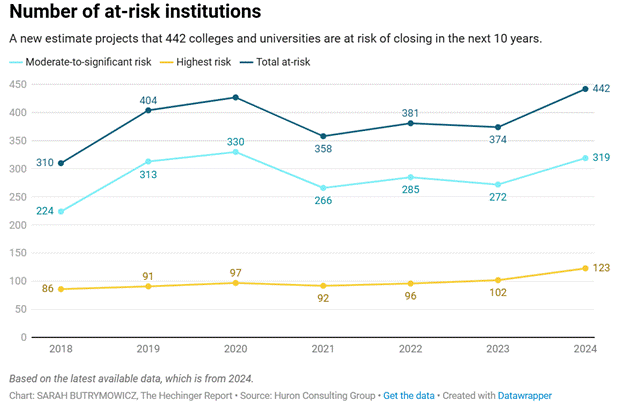
Interestingly enough, though, some of the other headlines related to education and employability suggest that we may be actively walking away from the very ability of schools to generate this kind of robust relational adaptability in the first place.  As seen in the chart below, more than 25% of small liberal arts colleges in this country are in danger of closing within the decade, and even places as robust in their enrollment as Syracuse University have made the decision to close 93 of their 460 academic programs—with humanities and the fine arts representing the bulk of the majors going away. 

Of course, similar changes are occurring at schools throughout the U.S. as college-age students look for degrees they think will result in higher pay, and college administrators are simply following the market to try to attract the dwindling pool of higher education candidates.  Eliminating under-enrolled academic offerings in the humanities saves money and keeps the proverbial doors open and the lights turned on in the face of changing demographics and demands on the part of the consumer.

However, for both higher education and its population, this trend may be self-defeating because what today’s economists are saying to today’s students is:

major in a subject that offers enduring, transferable skills. Believe it or not, that could be the liberal arts. [Harvard economist, David] Deming’s research shows that male history and social-science majors end up out-earning their engineering and comp-sci counterparts in the long term, as they develop the soft skills that employers consistently seek out. “It’s actually quite risky to go to school to learn a trade or a particular skill, because you don’t know what the future holds,” Deming [says]. “You need to try to think about acquiring a skill set that’s going to be future-proof and last you for 45 years of working life.”

Which is why I was excited to read that in spite of the current contraction happening in the humanities and the fine arts at the college and university level, there is a bit of a revolution happening in high schools for the skills these fields have traditionally promoted and developed.  The 74 reports that emerging organizations such as Skills For The Future and Pathsmith are looking at the employability needs of the Gen Z and Gen Alpha populations, and they are creating actual curricula and assessments to meet these needs in today’s 9-12 classrooms and beyond.  Indeed:

several companies and non-profits are taking these [“soft” or “durable”] skills that have been fuzzy concepts and working on giving them shape and definition. They’re gathering teachers, developers of tests, business leaders and other experts to break down these skills into smaller skills and then into even smaller subskills and nuances that can serve as steps toward mastery. Communications, for instance, could include negotiating and public speaking as subskills, [and] the resulting outlines of skills and subskills are like a tree branching out from its trunk into smaller and smaller limbs, all with an eye to making them as teachable and testable as math or English.

In other words, the three “Cs” (communication, collaboration, and cognition) may be coming soon to an SAT test near you!

And part of how this may actually get accomplished involves the last piece of recent news I want to report about, an article exploring an intriguing potential solution to the teacher shortage in this country.  Written by former acting Governor of Massachusetts, Jane Swift, and former US Secretary of Education, Arne Duncan, these two members from opposite poles of the political spectrum propose that two challenges currently facing our society may, in fact, be one another’s solutions.  They write:

Schools across the country are struggling to find enough teachers, with at least 411,000 teaching positions currently open nationwide. At the same time, more than 40% of recent graduates are underemployed. That means millions of young people have earned college degrees only to find themselves stuck in jobs that offer low pay, little security, and no clear path forward.  These are not separate challenges, and taken together, they point to a solution hiding in plain sight. Teaching can be the entry point into the workforce that Gen Z graduates need.

Now, I will be forthright.  My initial reaction upon reading this was a mixture of growl, teeth-grinding, and grimace: not this old trope again! “Those who can, do; those who can’t, teach”…“glorified babysitters; how hard can it be?”…“cushy job; only work 9 months a year and get summers off!” The list of misperceptions about my chosen profession that I have heard over the decades still leaves me with a smoldering sense of frustration and even anger.  After all, this is the profession documented to be second only to that of ER surgeons for the number of critical decisions that have to be made every minute, and since more than half the people who enter it burnout and leave after just 3 years, I’m not sure that “cushy” is a term I would use to describe it. 

However, as I continued reading Swift’s and Duncan’s argument, I realized they were not saying that simply anyone can do this job.  Instead, they were arguing something more subtle:

Teacher shortages are already impacting classrooms nationwide. And schools in rural districts and lower-income communities are particularly struggling to fill vacancies. Research shows that persistent vacancies and reliance on substitute teachers undermine student learning and achievement. For students who overcome these challenges and make it to college, another problem awaits. Just half of all college graduates secure roles that require a degree. For those college graduates struggling to secure a college-level job, teaching can help them climb the career ladder as well.

Hence, what I am understanding Swift and Duncan to be reasoning is that in a world where AI is becoming the equivalent of the mechanical robots that took over much of the manufacturing sector, teaching offers a pathway for some of today’s college graduates to find stable, meaningful—potentially long-term—employment that perfects the “soft” skills they will need for the future while filling a need for caring, consistent, and well trained adults in the lives of children who would otherwise be left academically adrift.  They are not saying that just anyone can successfully teach but that encouraging those who have the potential to enter the profession by making the path for doing so more straightforward and attractive (e.g. making the “student teaching” requirements of most licensing programs paid internships) could possibly solve two challenges we currently face in our society at the same time.

Like I said, I find their ideas intriguing—if for no other reason than A) teaching is likely to remain pretty AI proof for the foreseeable future since it is rooted by its very nature in the messiness of human relationship; B) those adolescent boys with their chatbot girlfriends would learn how to navigate the complexity of person-to-person interaction real fast in a roomful of 10-year-olds; and C) I’m going to retire someday and somebody’s got to take my place.

Time will tell, and I encourage anyone interested in any of these updates from the world of education to explore the references below.

Coda

As I was finishing writing this, two articles arrived in my in-box reminding me that formal education systems in this country face a far greater crisis in the relatively near term than AI, cancelled academic departments, and under-employed Gen Z-ers combined.  The fertility level in the economically developed world is well below replacement value at this point—and continuing to drop—and it is estimated that in the New York City public schools alone, there will be 153,000 fewer students enrolled over the course of the next decade.  Tough decisions about school closures are coming not just for the small liberal arts colleges of this land, and those currently entering the teaching profession could actually find themselves in a very competitive job market (Swift’s and Duncan’s 411,000 positions may simply evaporate by attenuation).

But what makes me write this “afterword” is the far greater issue than simply a probable near-term crisis for schools in the U.S. caused by decreasing fertility levels. Anyone who knows me knows that I think hope is a verb, and the ultimate act of hope is the deliberate choice to bring a child into the world.  Yet as Anna Louie Sussman presents so brilliantly in her recent essay for the NYT, many in our two youngest generations who are in their reproductive years are not having children right now because of the chaotic uncertainty that there will even be a livable future for those hypothetical children to inhabit.  Millennials and Gen Zs are finding themselves without hope in that most significant way that one can, and that shouldn’t just concern those of us in education.  That should give us all pause.

Because the steadily more dystopian world we have chosen to create doesn’t have to remain the dysfunctional way it currently is. We have the power to change it. What haunts me is whether we have the will. Again, as I concluded with my graduating seniors, “maybe.”

References

Horowitch, R. (June 2025) The Computer-Science Bubble is Bursting.  The Atlantic. https://www.theatlantic.com/economy/archive/2025/06/computer-science-bubble-ai/683242/.

Marcus, J. (April 13, 2026) More Than a Quarter of Private Colleges Are at Risk of Closing, New Projection Shows.  The Hechinger Reporthttps://hechingerreport.org/more-than-a-quarter-of-private-colleges-are-at-risk-of-closing-new-projection-shows/.

Mervosh, S.; Paris, F.; & Cain Miller, C. (May 8, 2026) U.S. Schools Face a Crisis as the Number of Children Drops.  The New York Timeshttps://www.nytimes.com/2026/05/08/upshot/public-schools-enrollment-crisis.html.

Napolitano, J. (April 9, 2026) Gen Z Increasingly Skeptical of–And Angry About–Artificial Intelligence.  The 74https://www.the74million.org/article/gen-z-increasingly-skeptical-of-and-angry-about-artificial-intelligence/.

O’Donnell, P. (April 21, 2026) Creating Communicators and Critical Thinkers: Soon There Will Be a Test for That.  The 74https://www.the74million.org/article/creating-communicators-and-critical-thinkers-soon-there-will-be-a-test-for-that/.

Otterman, S. (April 3, 2026) Syracuse Drops 84 Majors Including Classics, Ceramic and Italian.  The New York Timeshttps://www.nytimes.com/2026/04/01/nyregion/syracuse-university-degrees-eliminated.html?unlocked_article_code=1.X1A.CZh8.XEtP0OnmSuDJ&smid=url-share.

Royle, O.R. (April 17, 2026) Teen Boys Are Choosing AI Girlfriends Over Real Ones for “Maximum Control, Zero Rejection”–Experts Say It Could Make Them Unemployable.  Fortunehttps://fortune.com/2026/04/17/teen-boys-dating-ai-chatbot-girlfriend-experts-warn-kill-social-skills-gen-alpha-network-promotions/.

Singer, N. (May 6, 2026) In Backlash Against Tech in Schools, Parents Are Winning Rollbacks. The New York Times.  https://www.nytimes.com/2026/04/29/technology/parents-school-tech-backlash.html?unlocked_article_code=1.elA.Fg2u.0ouroYo_g8zF&smid=nytcore-ios-share.

Sussman, A. L. (May 7, 2026) Why So Few Babies? We Might Have Overlooked the Biggest Reason of All.  The New York Timeshttps://www.nytimes.com/2026/05/07/opinion/birthrate-kids-parents-demographics-future.html.

Swift, J. and Duncan, A. (April 7, 2026) The Case for More Gen Z Teachers.  TIMEhttps://time.com/article/2026/04/07/the-case-for-more-gen-z-teachers/.

Nostalgia

I was so much older then.
I’m younger than that now.

—Bob Dylan

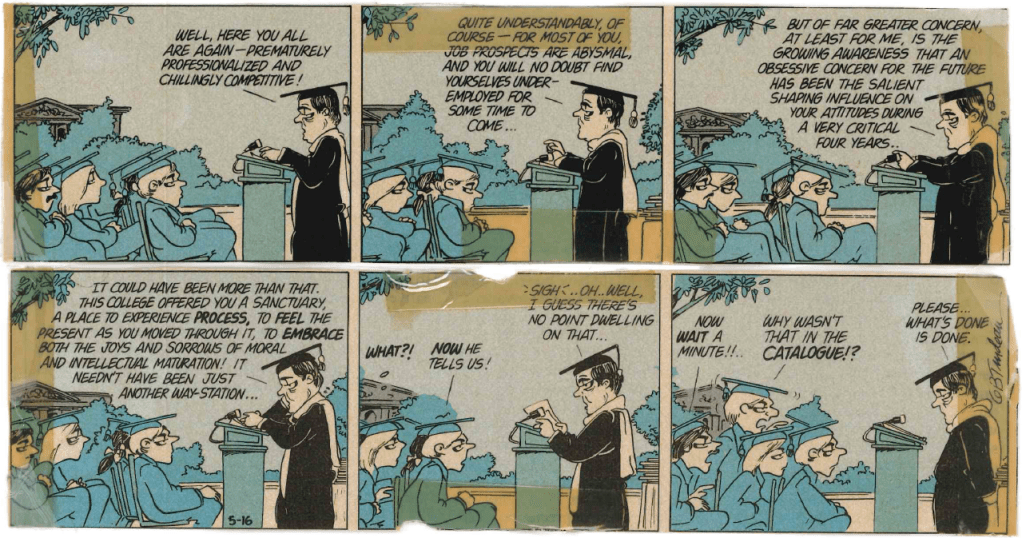
A report came out this month about the growing number of colleges and universities that are trimming down the hours required to earn a basic bachelor’s degree (with corresponding approval from the numerous accreditation bodies) so that a student can now achieve their B.A. or B.S. in three years rather than in the traditional four.  Much was made about the cost savings to individual students, the faster increase in people entering the workforce in high-demand fields, and even the need to join certain professions as quickly as possible before AI takes them over.  It was all very utilitarian and pragmatic, and as I read it, I could not help but recall this long-ago Doonesbury I keep posted in my classroom and, like the Chancellor in it, wearily sigh.

Granted, there are powerful socio-economic realities these institutions of higher education are trying to address with this new approach—both their students’ and their own.  Student debt in this country is nearly $2 trillion dollars, with the average borrower in debt for around $40,000, and I know from my own family how large that number can truly get as one of my relatives continues to pay off educational loans greater than their mortgage! Furthermore, shrinking birth rates have schools at all levels in the educational pipeline scrambling for their organizational lives to keep lights on, doors open, and the teaching staff employed.  It is a fraught time to be a tuition-based business!

I also want to acknowledge that for nearly all its centuries of existence, academia has been the almost exclusive domain of wealthy males whose leisure to philosophize and experiment—“to embrace both the joys and sorrows of intellectual maturation!”—rested on the hard (and usually uncompensated) labor of women, the enslaved, and young children.  We may laude Socrates’ and Confucius’ wisdom and Copernicus’ and Al-Biruni’s empirical insights.  But an entire underclass of people toiled to make what they achieved possible, and even today, the skin color of those attending higher education’s classes is regularly much lighter than those maintaining its campuses.  As for my own four years of undergraduate work, they were made possible by a large community of people whom I’m ashamed to say I did not even see at the time.

But what I did see then was how precious an opportunity I had to immerse myself in all that collective knowledge and to explore intimately the many disciplines and outlooks that adulting might one day prevent me from having the leisure to do.  Hence, I deliberately feasted like a glutton. Of course, not everyone does—Arum and Roska were able to write their book for a reason after all. But for me, those four years were the beginning of my journey toward education’s ultimate goal, wisdom, and while like my pal, Socrates, I know this journey is an asymptotic one, I know as well that without that time apart to do all that growth, I would not have what little of this precious resource I actually do possess today.  And in a world so desperately in need of people with as much wisdom as possible, anything that might stunt its potential growth should give us all pause.  Thus, my nostalgia for what feels like a bygone era for higher ed:  where will wisdom’s enkindling come from now?

Then again, where will passion for anything in education come from in the future? I ask because the other thing making me nostalgic right now is a rather superficial contest I am currently participating in that came across my desk from the National Science Teaching Association entitled, “America’s Favorite Teacher.”  It involves essentially employing one’s social contacts to cast votes for you as a teacher, and it is a blatant fundraiser for a legitimate science education organization (not NSTA).  While the participating teachers cannot do so, everyone else who casts a ballot can purchase votes for their candidate through charitable donations to this organization, and the donations are even tax-deductible.  There are no qualifications for the teachers involved other than active employment in the classroom, and the winner of this essentially silent auction gets a significant monetary prize.

I know, I know; WHAT was I thinking?! However, before the preceding paragraph causes the few active followers I actually do have to sever all ties with me immediately, my only reason for participating in this silly contest is that it came across my desk at the exact same time a beloved colleague of mine was in the final stages of dying from ALS.  She was a French teacher at my school, and a program very dear to her was our two-week Foreign Language Immersion program for which there is a dedicated financial aid fund to help students to participate in who might not otherwise have the means.  I have told my social “network” (what there is of it) that anything I earn in this contest will be donated to that fund in her honor because the last thing I could possibly need at this point in my career is any more professional recognition.

Yet, it is precisely the intersection of those two facts that has me feeling nostalgia.  I can still recall the time in our society when being a teacher was revered and honored, when it was even referred to as—or at least highly visible lip-service given to—the noble profession.  Beyond the usual teacher appreciation week, there wasn’t any real need for elevated public recognition or awards, and there certainly wasn’t that kind of need when it came to funding in classrooms.  Furthermore, when education’s well did begin to run dry and the profession began to be a regular scapegoat for society’s ills (yes, that’s a lot of cliched metaphors), the various recognition programs seeking to elevate public awareness of good teaching (such as Disney’s American Teacher Awards and Toyota’s Tapestry Grants) still demanded that recipients meet some standard or degree of excellence.  Maybe not every educator was a Jaime Escalante of Stand and Deliver fame, but solid individuals were held up to whom younger teachers could aspire.  I know; I was one of them.

Today, though, nearly every one of those major teacher recognition programs has gone the way of the non-avian dinosaurs (Trump even killed the Presidential Awards for Excellence in Math and Science Teaching this past year), and now what is left is a group of underappreciated and frequently demonized individuals who are scrambling regardless of their teaching qualifications to garner what amounts to “likes” on social-media platforms so that an underfunded educational organization can keep its doors open.  I am too old and experienced not to know that “the good ol’ days” are always a myth, but I’m hard-pressed right now not to think there were perhaps better ones. Oh well, at least the long, productive, and meaningful life of a former fellow educator will be honored, and future children who might not otherwise have had the chance will acquire some cultural perspective—otherwise known as wisdom. 

Auld lang syne indeed.

References

Arum, R. & Roksa, J. (2011) Academically Adrift: Limited Learning on College Campuses. Chicago:  University of Chicago Press.

Marcus, J. (March 11, 2026) Faster, Thinner: Colleges are Swiftly Trimming a B.A. Degree to Three Years.  The Hechinger Report.  https://hechingerreport.org/faster-thinner-colleges-bachelors-degree-three-years.

AI: Education’s Frenemy (Part 2)

O brave new world,
That has such people in ’t!

—The Tempest

When I first wrote about ChatGPT three years ago, concerns about AI in the classroom were just beginning to emerge.  Much handwringing was done over fears of rampant cheating—especially in the text-heavy disciplines such as English and history—and anxiety among educators steadily mounted that AI tutors might soon be coming for people’s jobs.  There was an almost universal apprehension that the digital age’s ultimate disruptor to the education had perhaps finally arrived.  Lots of angst.

Which now seems positively quaint.

Because today, we have computers grading computers; brain scans showing AI inhibiting neurons; and thought leaders coining a new term, “anti-intelligence,” to describe what is happening to our youngest minds (more on this later).  Enormous data centers are sprouting like weeds—with the same corresponding economic costs and environmental harm as their literal botanical counterparts—and for over a year now, I have received at least two offers a day on Linked-In to earn hourly income training artificial intelligences that have a biology focus. 

Yet the real eye-opening/face-slapping/jaw-dropping/pick-your-cliché moment for me recently was when I discovered that all my video lectures for my senior electives now open on-line with a searchable 100% AI-generated transcript of what I am saying that I neither created nor gave any permission to create.  Google’s AI simply spontaneously takes my entire audio and creates the corresponding text on the screen to the right of the visual component—all in the few seconds it takes to start the usually 35-40 minute video.  Here’s a screenshot for any skeptic:

Now, I would hope that the implications of what Google is now doing spontaneously would invoke at least a quiver of discomfort (if not outright abject terror!).  But if not, then my reader is probably itself an LLM AI to begin with, scouring the internet for its own training purposes, no emotional response required.  My writing has simply made it more proficient at invading what little remains of my already barely existent privacy.

However, what disturbed me most when discovering Google AI’s latest feature was not the act itself; it was the reality that here was one less opportunity for my students to have to think for themselves.  As English teacher Thomas David Moore sums it:

There is nothing new about students trying to get one over on their teachers — there are probably cuneiform tablets about it — but when students use AI to generate what Shannon Vallor, philosopher of technology at the University of Edinburgh, calls a “truth-shaped word collage,” they are not only gaslighting the people trying to teach them, they are gaslighting themselves. In the words of Tulane professor Stan Oklobdzija, asking a computer to write an essay for you is the equivalent of “going to the gym and having robots lift the weights for you.”

And without opportunities for cognitive heavy-lifting, brains atrophy; minds devolve; and the entire point of education becomes at risk.

But that brings me back to what I mentioned earlier, the notion of “anti-intelligence.”  As its originator, John Nosta, describes it:

Anti-intelligence is not stupidity or some sort of cognitive failure. It’s the performance of knowing without understanding. It’s language severed from memory, context, and even intention. It’s what large language models (LLMs) do so well. They produce coherent outputs through pattern-matching rather than comprehension. Where human cognition builds meaning through the struggle of thought, anti-intelligence arrives fully formed.

Thus, for example, when Google automatically transcribes my lectures, my students do not have to wrestle with grasping the cognitive story I am asking them to learn by watching and engaging with the video; they can simply look up the factoid they need for a particular question, without any concern for the larger intellectual context within which that question resides.  In other words, they no longer need to learn anything from my lectures; they just need them as employable databases.

Which is fine, I freely acknowledge, if you already know how to think.  I do not need to possess all human knowledge in my brain because I possess the critical thinking skills honed by decades of training that enable me to effectively employ those databases containing that knowledge for constructive cognitive purposes.  Where things become problematic is that anti-intelligence has become the “cognitive climate” where the minds of today’s youngest children develop, and “when AI answers arrive instantly from childhood, it may affect whether certain cognitive capacities develop.”  Every theory of brain development is clear: children learn through a series of encounters with constraints that carry costs when mistakes are made.  Without both those costs and those constraints, they will fail to generate both the necessary knowledge and the intellectual capacity to make steadily more informed decisions. 

Yet today’s children, as Nosta points out, “aren’t just using artificial intelligence (AI) as a study aid; they’re building their cognitive patterns in an environment where answers arrive before questions even fully form.”  We have never lived in such a world, and that’s what makes the potential future of AI in education so troubling: the pathway the brain needs to follow during childhood “doesn’t just make thinking harder; it makes thinking possible.” If we remove that path, do we remove thinking?

It’s a disturbing (if not distressing) thought; especially given that 61% of Americans can’t name the 3 branches of government, half our adults can’t read a book written at the 8th grade level, and—my personal favorite—25% of us apparently still think the sun revolves around the earth rather than the other way around! Add in the fact that nearly half of college graduates report never reading another book of any kind following graduation and that significant majorities of today’s youth report either being bored or otherwise disengaged at school and the notion that AI could interfere even further with this current situation is positively disheartening.  We are already a society where “the rejection of learned knowledge is often seen as an expression of personal liberty” and “hostility to education is now actively separating us from a shared reality” (Millet, p. 148).  If AI’s increasing ubiquity inhibits our collective cognitive capacity beyond the damage digital technologies and underfunding have already done to our educational systems, then we really are “sitting ducks for tyrants and profiteers, willing to believe whatever tales they choose to tell us” (Millet, p. 149).

Lest we “abandon all hope,” though, I need to point out that steadily increasing numbers of us in education—at all levels—have begun adapting to this new reality—as we always have even since those first aforementioned cuneiform days (it was hard to cheat in the strictly oral culture preceding them).  High schools and colleges alike report returning to Bluebooks for exams and in-class writing for essays.  Hand-written lab notebooks are making a comeback in the sciences, and at least two universities, Purdue and Ohio State, have now made proficiency with AI in one’s matriculating discipline a graduation requirement because A) there is the practical need for individuals in general to be able to distinguish truth from fiction and because B) you won’t be able to do your job in the future without such knowledge.  As one microbiologist put it:

AI has already “revolutionized” her field. Recent research suggests that AI-enabled analysis of large genomic data sets, for instance, is allowing scientists to look at DNA directly from environmental samples, revealing entire ecosystems of previously unknown microbes.

In other words, there are questions of value in need of answers that the human brain does not have the computing power to solve but which our brain does have the critical thinking to put to meaningful purpose.  AI can do things we can’t; we just need to stop surrendering to it the things we can do that it can’t.

The challenge, therefore, is to determine where AI has value in educational situations and where active resistance to it needs to take place.  For instance, if we know a climate of anti-intelligence threatens proper brain development, then we need to pay careful attention to how we construct pre-primary and early-childhood educational environments and experiences, and we need to teach parents not to park their toddler(s) in front of an I-pad, no matter how exhausted and tired the work-day may have left them.  Knowing that screen time inhibits neural activity, we need to plan lessons that don’t require extensive use of computers, and we either collect cellphones at the start of the school day (as so many K-12 institutions are finally doing) or ban them from being out in the classroom (as so many colleges and universities now do).

At the same time, where an AI program can enhance educational investigation in ways no human brain can ever accomplish, then designing lessons to actively employ it adds value to the learning.  For example, if I want my students to explore the actual attitudes of Americans about gun control, I can have them see how many times any type of restriction has been proposed by every level of legislature in the land.  Or if I want them to have a better understanding of a pastiche before making them hand-write their own, I can have them generate such a thing from an entire body of an author’s work.  Indeed, in my discipline, the sciences, where genuinely enormous databases are the rule rather than the exception, the potential uses of AI to enhance student learning are almost too numerous to list here.  The bottom line is that there are lots of potential positive possibilities for education’s frenemy in the classroom; they just require wise discernment on the part of the teacher.

But that is perhaps the greatest challenge for dinosaurs such as me when it comes to AI and teaching because I have zero interest in artificial intelligence.  Period.  In fact, I would go so far as to say I have negative interest; I’m actively antithetical to it even.  The simple truth is that I relish difficult, hard thinking.  I enjoy the excitement from the intellectual uncertainty of being “lost” and finding my way “home.”  To state the obvious, I treasure the blank page and what it is going to demand of me to fill it.  I am “the life of the mind.”  Thus, learning that Google now spontaneously generates transcripts of my video lectures simply fills me with annoyance since I will now have to reconfigure how I have my students employ them in their learning.  I know I must adapt as an educator to this changing environment as I have so many times before, and I know that I will do so.  But after 37 years of adapting, I’m starting to appreciate my grandfather’s attitude when VCRs arrived on the scene (and this from a man who was born before airplanes and lived to see the space shuttles):  nope; done; don’t want to deal with this. 

Maybe I can find an AI that can help.

References

Millet, L. (2024) We Loved It All: A Memory of Life.  New York: W. W. Norton & Company.

Moore, T. (Sept. 8, 2025) Jelly Beans for Grapes: How AI Can Erode Students’ Creativity.  EdSurge.  https://www.edsurge.com/news/2025-09-08-jelly-beans-for-grapes-how-ai-can-erode-students-creativity.

Nosta, J. (Jan. 22, 2026) Growing Up Anti-Intelligent.  Psychology Today.  https://www.psychologytoday.com/ca/blog/the-digital-self/202601/growing-up-anti-intelligent.

Toppo, G. (Feb. 17, 2026) At These Universities, Using AI Isn’t Shunned–It’s a Graduation Requirement.  The 74.  https://www.the74million.org/article/at-these-universities-using-ai-isnt-shunned-its-a-graduation-requirement/.

The Future of ….

My original title for this essay was “the future of education.”  But if you’ll stay with me, you’ll see why I ultimately decided on the ellipsis, and why the potential future of education (at least in this country) led me to that choice.  It has to do with the fact that there are some serious challenges to teaching and learning in the United States right now (as well as significant chunks of the rest of the world) that have caught my recent attention and that have me pondering the future of all manner of educational practice moving forward.  Hence, it was time to take up my metaphorical pen and paper again to share my musings—as always in the act of hope that some might find them adding at least a degree of value to their own reflecting.

One of these challenges, of course, is the now ubiquitous one of digital technologies and their latest AI variants, and because I have already written so much on this particular topic, I simply invite anyone interested to visit my archive for those essays.  Today, my only addition to this subject is to share that while Australia had the courage to pass a law banning access to social media to anyone under the age of 16 over a year ago, it has taken my school nearly a year and a half of sometimes fierce debate among the faculty about well-researched brain science simply to finally collect students’ cellphones during the academic day.  American individualism at its finest!

No, the two challenges catching my interest in the past month both involve the intersection of demography and child development, and the first of these has to do with plummeting birthrates in much of the world’s developed economies.  Here in the U.S., for example, the number of babies being born annually has dropped below the replacement level of 2.1 children per couple, and while the environmentalist in me sings hosanna for the planet’s sake, the educator in me who lives in a capitalist economy recognizes the threat this poses to schools across the land.  In Maryland alone, the loss of more than 11,000 children from the public schools this academic year (an estimate that nearly tripled during the week it took to write this) has endangered funding in several of our counties, and the competition among the area private schools risks becoming cut-throat as institutions with sometimes literal centuries of existence struggle for butts in chairs.  Already, three such schools in my immediate area have shut their doors in the past five years, and even a Baltimore City public charter school with a 30-year storied history just announced its closure. 

Those are all lost jobs—as well as lost professional experience and wisdom—and the impact is likely only to exacerbate the teacher shortage already facing this country as the economic uncertainty confronting anyone thinking of entering the profession continues to grow.  However, for me, the saddest truth about these school closures is that they are lost opportunities for certain children to find their safe and successful learning “niche.”  My niece was never able to find hers, and it almost cost her her life; so I know firsthand how important the quality of a learning environment can be.  Shuttered and silenced classrooms leave gaping holes in any community, and in the coming decades, what is happening today will only be the beginning.  As Marguerite Roza, the director of Edunomics at Georgetown University puts it, “cratering birthrates will seriously remake education in the country”—and unlikely for the better.

But there is perhaps an even more insidious challenge presented by the contemporary link between demography and child development, and that is the impact of the current cost of early childhood education in this country.  Pre-K schooling for even a single child costs the typical family more than they pay for monthly rent in 17 of the 50 states, and nationwide, more than 60% of families cannot afford the kind of high-quality daycare so critical to developing brains.  We know now that age 0 to 5 is the most important stage of growth for the human brain—with impacts that last for the entirety of an individual’s lifespan—and we know equally well that maximizing this growth requires well-trained, highly attentive adults guiding the process, with more than just one or two such adults present (the “takes a village” cliché has some literal truth).  Furthermore, without this level of investment of adults in infants’ and toddlers’ lives, the quality of all future learning is compromised, and there is a direct correlation between a country’s investment in early childhood education and the PISA scores (the world’s gold-standard for testing academic progress) of their high school-aged children.

Yet if so much is at stake, why would our country not invest significantly in providing superior pre-K education—especially given the potential long-term economic benefits vs. economic costs? Part of the answer has to do with how our society has historically sought to use markets as the solution to so many of our social problems.  Economies of scale and technological innovation have lifted much of the world—and especially us—out of poverty and material want; so why wouldn’t they—the thinking goes—be able to solve any seemingly intractable problem?

However, you can’t increase productivity in the interactions between an adult and a 2-year old (the genetic limitations of both their respective attention-spans preclude it), and you can’t innovate a way to make a small child any less of a time-suck.  Hence, as Senior Fellow at the think tank Capita, Elliot Haspel, points out: the bottom line is that market forces are incapable of solving the need for well-trained, well-compensated adults “caring for and shepherding the brain development of [our] very young children.” 

What’s more, he argues:

that market failure makes childcare essentially a hot potato. No one has any incentive to do that work, and everyone has an incentive to dump that work downstream onto others who are more vulnerable than they are — from policymakers onto families, from fathers onto mothers in many cases, and not even just to mothers, but from mothers in more privileged positions onto paid care providers.

Simply put, no one wants to acknowledge that small children are expensive, demanding, and inconvenient and that all the proverbial “king’s horses” and all “the king’s men” can’t make this reality be otherwise.  Thus, we find ourselves today with either brain-drained, exhausted mother’s forced to stay at home (which the data is clear is not optimal for brain development either; again “the village”) or with families who already need two incomes to meet basic needs having to compromise those needs to pay for the childcare the second salary demands.

Which actually circles us back to the “cratering birthrates” as more and more adults are now deliberately opting out of having children simply because they cannot see how they can afford them.

Interestingly enough, our country once did provide nearly universal daycare for our smallest children.  During World War II, the need for women in the nation’s factories drove congress to pay for daycare centers across the country that cost those families the equivalent of $10 per day in today’s money (imagine only $3700 a year for childcare!), and staffing was not an issue because it was considered one’s patriotic duty to contribute to the cause.  However, once the war ended, the patriarchy reasserted itself, and so we find ourselves in the mess we have today, with parents of all varieties mortgaging their economic futures just to have families and American society enduring the largest collective drop in intelligence since the 6th and 7th Centuries in Western Europe.[i] 

It is challenging time to be a toddler in the United States.

And that’s the reality that compelled this latest round of writing and why I am pretty confident that anyone reading this can figure out the reason for my original working title.  However, to connect the dots explicitly: fewer children in schools is likely to lead to even less investment in education (both human and capital); less investment is likely to lead to lower and poorer quality education; and that is likely to lead to pre-K teaching and learning—if there even is any—that fails to adequately develop little brains to their optimal capabilities.  We are obviously still going to educate our children, but the character of that education and its results may not be what our society needs to thrive…or maybe even survive.

Hence, the ellipsis in my title.  The future of education isn’t just about what goes on in classrooms and schools, and it isn’t simply about what I and many others do for a living.  It is about the nature of the act of learning itself, and that means the future of education is the future of everything human.  What we learn as children—every concept, every skill, every thought—is the entire foundation of our adult lives, and as the author of the Gospel of Matthew wisely had Jesus say, that foundation can be one of rock or of sand.  Right now, I sense we are at a great tipping point in this country (and perhaps this world) where we still have the power to build on rock instead of sand.  But we are dangerously close to defaulting to the latter, and should that happen, then the author of Matthew is quite clear about the consequence:

The rain fell, and the floods came,
and the winds blew and beat against that house,
and it fell—and great was its fall!
—Matthew 7:27 (NRSV)


[i] As a total sidebar, I find it intriguing that in the era from 1965 to 2005, the productive adult brains of those war era babies with their subsidized daycare produced some of the most robust R&D, discoveries, and inventions in all of human history.  Hmm! Coincidence? Correlation? Or causation? You decide.

References

Bowie, L. (Nov. 24, 2025) Maryland Schools Lost Students This Year, Early Estimates Show.  What’s to Blame? The Baltimore Bannerhttps://www.thebanner.com/education/k-12-schools/maryland-schools-enrollment-declines-C6FWKKHNYZH4DNJWAUOM4KLDGE/.

Griffith, K. & Richman, T. (Dec. 9, 2025) Maryland Public Schools Lost Over 11,000 Student This Year.  The Baltimore Banner.  https://www.thebanner.com/education/k-12-schools/maryland-public-schools-enrollment-drops-I7FPW6AIAJGNFDXFQDBMNMLME4/.

Kahloon, I. (Oct. 14, 2025) America is Sliding Toward illiteracy. The Atlantichttps://www.theatlantic.com/ideas/archive/2025/10/education-decline-low-expectations/684526/.

Kukolja, K. (Nov. 29, 2024) Australia Passes Strict New Social Media Bans for Children.  NPR All Things Consideredhttps://www.npr.org/2024/11/29/nx-s1-5210405/australia-passes-strict-new-social-media-bans-for-children.

Lora, M. (Dec. 5, 2025) How a West Baltimore Charter School’s 30-year Legacy Collapsed in Months.  The Baltimore Bannerhttps://www.thebanner.com/education/k-12-schools/new-song-academy-closed-charter-school-baltimore-NIBASIGPAZA6HJKTS3JDH2BSCU/.

Luse, B; et al (Nov. 24, 2025) Kids are Expensive.  Do They Have to Be? NPR It’s Been a Minute.  https://www.npr.org/2025/11/24/nx-s1-5617226/kids-are-expensive-do-they-have-to-be.

Unbidden Thoughts

priv◦i◦lege (priv⸍’l) n.—a special right or immunity granted or available
only to a particular person or group; an unearned advantage

In my own highly imperfect way, I try each day to remind myself what my white, male, cisgender, heterosexual privilege “buys” me in our society—to recall how blessed I am to have my health, work that I love, and the economic stability to spend my evenings watching Netflix.  However, recently, I have had a couple of experiences that have caused me to view both my own individual privilege as well as the general inequitable distribution of it in our society in a whole new way, and the insights this has provided about the current political situation in this country have been illuminating.

The first incident occurred while I was walking to breakfast one Saturday morning and I encountered two men having a heated discussion over money.  I only caught about 30 seconds of it as I passed them on the sidewalk, but that was enough for me to know that the two men were acquainted enough for the one to loan the other money to cover some household expenses, that the loaner was in anxious need of being repaid to cover some of his own, and that neither of them were adequately employed to cover everything.  Indeed, I recognized the shirt uniform of a local grocery store on the loaner, providing me with a very realistic idea of his likely weekly income.  It was clear there was no danger of things escalating to physical violence, but it was also equally clear that the attentions of these men were wholly occupied with their financial dilemmas and nothing else.

That’s when the insight struck, unbidden: the economic realities of their lives pretty much precluded either of these men from having the time or energy—the luxury—of concerning themselves with the current political situation in this country.  Daily survival was consuming all their attention, and as Maslow wisely observed, until you have met basic physiological and safety needs, there are absolutely no additional inner resources for anything else.  Concerns about democratic norms and Trump’s authoritarian behaviors are meaningless white noise to someone apprehensively worried (if not panicked) about food, clothing, and shelter.

Now, I had never considered the notion that civic engagement might be a luxury—a privilege—but as I recalled an incident in my own early adult life where I made a very stupid financial decision that forced me to eat nothing but cooked white rice and unseasoned lentils for a month (and I wish I was joking or exaggerating), I realized that of course such engagement is a luxury! We can talk all we want about responsible citizenship, but as an individual, I or anyone else must have the additional resources beyond survival and safety before someone can literally afford to take on that responsibility.  As an affluent white male, I can express my outrage at the Trump administration all I want and as loudly as I want because my economic status more than meets my basic needs.  I have the privilege of being pissed off.

But that got me to wondering how many other people in our society find themselves in the same situation as the two men I encountered, and while the answer is, frankly, a “moving target”—some surveys have the percentage of households living paycheck-to-paycheck as high as 62%, some as low as 34%—the most conservative evaluations done by Jeffrey Fuhrer of the Brookings Institute identifies 43% of American households as unable to meet the benchmark of what he calls “the cost of a basket of basic necessities.”  In other words, for nearly half the families in the United States, their total monthly incomes do not cover the cost of paying for the fundamental necessities to meet Maslow’s physiological and safety needs.

Which means that a disturbingly high number of people in this country simply do not have the necessary luxury to worry about the fate of their immediate communities, let alone the fate of the nation or something as abstract as “democracy.”  Add in the fact that these individuals therefore also do not have the extra “bandwidth” to be sorting the disinformation and misinformation flooding their lives, and the state-of-affairs right now in our society suddenly makes a lot more sense to me than it did a couple of weeks ago: if you are truly a “have-not,” then the only “truth” that can matter is whatever enables you to be less “not.”

Granted, that may sound awfully cynical of me. But like I said, I remember my own beans-and-rice moment, and I know for a fact that I did not spend a lot of that month worried about the Iran-Contra Affair of the Reagan presidency.

Yet, what those in the MAGA movement might be more likely to accuse me of than cynicism is elitism, and that brings me to my other experiential insight of the recent past. Again, another breakfast.  Only this time, the unbidden thought came as I was reading an article about black holes.  Apparently, the gravitational well of the super black holes at the center of galaxies can slingshot actual stars through space at tremendous velocities, and in fact:

S5-HVS1 was the first confirmed such hypervelocity star, and it’s moving at more than 1,700 kilometers per second.  Feel free to take a moment to absorb that fact: an entire star has been ejected from a black hole at more than six million kilometers per hour [four orders of magnitude faster than the 4,200 km/hr of the fastest bullet]. The energies involved are terrifying (Plait, p. 84).

I learned further that the Large Magellanic Cloud, a dwarf galaxy orbiting our own has its own super black hole and is consequently effectively “shooting stars at us!”  Granted, the asteroids in our own solar system are far more problematic (ask the dinosaurs!), but still….

I know; I digress.  Back to my unbidden thought.  Or perhaps I should I say thoughts, plural. First, here I sat with the time and leisure to read something interesting that had no practical value to my physiological or safety needs.  Second, I also had the benefit of a level of education that enabled me not only to comprehend this article but to have the consequent and correlating cognitive capacity to parse and analyze the very threats to democracy and our social order that the Trump administration now presents.  In other words, I can be outraged at Trump’s actions because I can fully understand what the consequences of them are.  Again, I possess the privilege—of a different kind—to be pissed off.

Now, education should neither be a “luxury” nor a “privilege”—especially in a democracy!—yet sadly, the historical record in this country reveals that education has seldom been an absolute right for everyone in the population.  The closest we probably came was in the post-war years following WW2, with the GI bill and Brown vs. the Board of Education (along with some other curricular reforms such as “the new math”).  But even those efforts often faced heavy resistance or were not equitably distributed, and by the end of the school busing conflicts of the 1970s and the rise of the Reagan era in the 1980s, an unbiased, just, and equivalent education for “all” began once more to be a “right” of only the more affluent.

Not that there weren’t significant efforts to change this trajectory.  The “No Child Left Behind” and the “Every Student Succeeds Act” were national legislative efforts to improve America’s schools—as were the creation of the Common Core set of national educational standards for literacy and numeracy.  But, too often, the assessment methods of these efforts ended up being either punitive in character (with poor urban and rural school districts frequently taken over by state boards of education) or publicly unpalatable (the Common Core demonstrating how badly devolved critical thinking skills had actually become in the U.S.).  Thus, by the time of the pandemic, an equitable education for all in this country had been on a steady decline for over a decade, and even where it was happening (as Mehta & Fine demonstrated), the quality was at best mediocre.

And we all know what happened next.

Which brings me back to my unbidden thoughts of these past few weeks.  First, they are obviously correlated.  One’s level of education and one’s economic security go hand in hand, and so it should not be surprising to find so many people in our society dispossessed of the “privilege” of civic engagement—nor the rise in authoritarianism that comes with that.  Second, my newfound awareness that civic engagement is in any way or to any degree a privileged luxury that not everyone in our society has full, unfettered access to frankly horrifies me—it is not a truth I am thrilled or excited to learn.  But, third, now that I am aware of my additional privilege, it is incumbent on me to employ it as best as I am able to combat the negative changes I see today in our society, and I believe where I can do that best remains for now the classroom.

Moreover, the reason why I believe that this is true is because of the life and work of fellow educator, Paulo Freire.  For those not familiar with him, Freire revolutionized the teaching of reading in his native Brazil, empowering once illiterate farmers and dayworkers in his country to confront the authoritarian power structures of their day, and so successful were Freire’s efforts that he was exiled by the 1964 military junta.  However, the seed he planted remained, and a little over a decade later, he returned to his native land, where his literacy efforts would one day lead to some of Brazil’s first democratically elected governments.  Today, the power of that educational legacy remains, and Brazil’s democracy has recently survived (and imprisoned) its own Donald Trump. Thus, never doubt what the power of the written word and the education it provides can do.

Nor, for that matter, the power of those who can—and still do—read. I keep writing my hope for a reason.

References

Freire, P. (1970) Pedagogy of the Oppressed.  New York: The Continuum Publishing Company.

Fuhrer, J. (June 20, 2024) How Many are in Need in the US? The Poverty Rate is the Tip of the Iceberg. The Brookings Institute. https://www.brookings.edu/articles/how-many-are-in-need-in-the-us-the-poverty-rate-is-the-tip-of-the-iceberg/.

Mehta, J. & Fine, S. (2019) In Search of Deeper Learning: the Quest to Remake the American High School.  Cambridge:  Harvard University Press.

Plait, P. (Sept. 2025) The Black Hole Next Door.  Scientific American. Pp. 83-84.

Srikant, K. (Feb. 26, 2025) Fact Check: Is there a consensus that a majority of Americans are living paycheck to paycheck? Econofact.  https://econofact.org/factbrief/is-there-a-consensus-that-a-majority-of-americans-are-living-paycheck-to-paycheck.