The Future of ….

My original title for this essay was “the future of education.”  But if you’ll stay with me, you’ll see why I ultimately decided on the ellipsis, and why the potential future of education (at least in this country) led me to that choice.  It has to do with the fact that there are some serious challenges to teaching and learning in the United States right now (as well as significant chunks of the rest of the world) that have caught my recent attention and that have me pondering the future of all manner of educational practice moving forward.  Hence, it was time to take up my metaphorical pen and paper again to share my musings—as always in the act of hope that some might find them adding at least a degree of value to their own reflecting.

One of these challenges, of course, is the now ubiquitous one of digital technologies and their latest AI variants, and because I have already written so much on this particular topic, I simply invite anyone interested to visit my archive for those essays.  Today, my only addition to this subject is to share that while Australia had the courage to pass a law banning access to social media to anyone under the age of 16 over a year ago, it has taken my school nearly a year and a half of sometimes fierce debate among the faculty about well-researched brain science simply to finally collect students’ cellphones during the academic day.  American individualism at its finest!

No, the two challenges catching my interest in the past month both involve the intersection of demography and child development, and the first of these has to do with plummeting birthrates in much of the world’s developed economies.  Here in the U.S., for example, the number of babies being born annually has dropped below the replacement level of 2.1 children per couple, and while the environmentalist in me sings hosanna for the planet’s sake, the educator in me who lives in a capitalist economy recognizes the threat this poses to schools across the land.  In Maryland alone, the loss of more than 11,000 children from the public schools this academic year (an estimate that nearly tripled during the week it took to write this) has endangered funding in several of our counties, and the competition among the area private schools risks becoming cut-throat as institutions with sometimes literal centuries of existence struggle for butts in chairs.  Already, three such schools in my immediate area have shut their doors in the past five years, and even a Baltimore City public charter school with a 30-year storied history just announced its closure. 

Those are all lost jobs—as well as lost professional experience and wisdom—and the impact is likely only to exacerbate the teacher shortage already facing this country as the economic uncertainty confronting anyone thinking of entering the profession continues to grow.  However, for me, the saddest truth about these school closures is that they are lost opportunities for certain children to find their safe and successful learning “niche.”  My niece was never able to find hers, and it almost cost her her life; so I know firsthand how important the quality of a learning environment can be.  Shuttered and silenced classrooms leave gaping holes in any community, and in the coming decades, what is happening today will only be the beginning.  As Marguerite Roza, the director of Edunomics at Georgetown University puts it, “cratering birthrates will seriously remake education in the country”—and unlikely for the better.

But there is perhaps an even more insidious challenge presented by the contemporary link between demography and child development, and that is the impact of the current cost of early childhood education in this country.  Pre-K schooling for even a single child costs the typical family more than they pay for monthly rent in 17 of the 50 states, and nationwide, more than 60% of families cannot afford the kind of high-quality daycare so critical to developing brains.  We know now that age 0 to 5 is the most important stage of growth for the human brain—with impacts that last for the entirety of an individual’s lifespan—and we know equally well that maximizing this growth requires well-trained, highly attentive adults guiding the process, with more than just one or two such adults present (the “takes a village” cliché has some literal truth).  Furthermore, without this level of investment of adults in infants’ and toddlers’ lives, the quality of all future learning is compromised, and there is a direct correlation between a country’s investment in early childhood education and the PISA scores (the world’s gold-standard for testing academic progress) of their high school-aged children.

Yet if so much is at stake, why would our country not invest significantly in providing superior pre-K education—especially given the potential long-term economic benefits vs. economic costs? Part of the answer has to do with how our society has historically sought to use markets as the solution to so many of our social problems.  Economies of scale and technological innovation have lifted much of the world—and especially us—out of poverty and material want; so why wouldn’t they—the thinking goes—be able to solve any seemingly intractable problem?

However, you can’t increase productivity in the interactions between an adult and a 2-year old (the genetic limitations of both their respective attention-spans preclude it), and you can’t innovate a way to make a small child any less of a time-suck.  Hence, as Senior Fellow at the think tank Capita, Elliot Haspel, points out: the bottom line is that market forces are incapable of solving the need for well-trained, well-compensated adults “caring for and shepherding the brain development of [our] very young children.” 

What’s more, he argues:

that market failure makes childcare essentially a hot potato. No one has any incentive to do that work, and everyone has an incentive to dump that work downstream onto others who are more vulnerable than they are — from policymakers onto families, from fathers onto mothers in many cases, and not even just to mothers, but from mothers in more privileged positions onto paid care providers.

Simply put, no one wants to acknowledge that small children are expensive, demanding, and inconvenient and that all the proverbial “king’s horses” and all “the king’s men” can’t make this reality be otherwise.  Thus, we find ourselves today with either brain-drained, exhausted mother’s forced to stay at home (which the data is clear is not optimal for brain development either; again “the village”) or with families who already need two incomes to meet basic needs having to compromise those needs to pay for the childcare the second salary demands.

Which actually circles us back to the “cratering birthrates” as more and more adults are now deliberately opting out of having children simply because they cannot see how they can afford them.

Interestingly enough, our country once did provide nearly universal daycare for our smallest children.  During World War II, the need for women in the nation’s factories drove congress to pay for daycare centers across the country that cost those families the equivalent of $10 per day in today’s money (imagine only $3700 a year for childcare!), and staffing was not an issue because it was considered one’s patriotic duty to contribute to the cause.  However, once the war ended, the patriarchy reasserted itself, and so we find ourselves in the mess we have today, with parents of all varieties mortgaging their economic futures just to have families and American society enduring the largest collective drop in intelligence since the 6th and 7th Centuries in Western Europe.[i] 

It is challenging time to be a toddler in the United States.

And that’s the reality that compelled this latest round of writing and why I am pretty confident that anyone reading this can figure out the reason for my original working title.  However, to connect the dots explicitly: fewer children in schools is likely to lead to even less investment in education (both human and capital); less investment is likely to lead to lower and poorer quality education; and that is likely to lead to pre-K teaching and learning—if there even is any—that fails to adequately develop little brains to their optimal capabilities.  We are obviously still going to educate our children, but the character of that education and its results may not be what our society needs to thrive…or maybe even survive.

Hence, the ellipsis in my title.  The future of education isn’t just about what goes on in classrooms and schools, and it isn’t simply about what I and many others do for a living.  It is about the nature of the act of learning itself, and that means the future of education is the future of everything human.  What we learn as children—every concept, every skill, every thought—is the entire foundation of our adult lives, and as the author of the Gospel of Matthew wisely had Jesus say, that foundation can be one of rock or of sand.  Right now, I sense we are at a great tipping point in this country (and perhaps this world) where we still have the power to build on rock instead of sand.  But we are dangerously close to defaulting to the latter, and should that happen, then the author of Matthew is quite clear about the consequence:

The rain fell, and the floods came,
and the winds blew and beat against that house,
and it fell—and great was its fall!
—Matthew 7:27 (NRSV)


[i] As a total sidebar, I find it intriguing that in the era from 1965 to 2005, the productive adult brains of those war era babies with their subsidized daycare produced some of the most robust R&D, discoveries, and inventions in all of human history.  Hmm! Coincidence? Correlation? Or causation? You decide.

References

Bowie, L. (Nov. 24, 2025) Maryland Schools Lost Students This Year, Early Estimates Show.  What’s to Blame? The Baltimore Bannerhttps://www.thebanner.com/education/k-12-schools/maryland-schools-enrollment-declines-C6FWKKHNYZH4DNJWAUOM4KLDGE/.

Griffith, K. & Richman, T. (Dec. 9, 2025) Maryland Public Schools Lost Over 11,000 Student This Year.  The Baltimore Banner.  https://www.thebanner.com/education/k-12-schools/maryland-public-schools-enrollment-drops-I7FPW6AIAJGNFDXFQDBMNMLME4/.

Kahloon, I. (Oct. 14, 2025) America is Sliding Toward illiteracy. The Atlantichttps://www.theatlantic.com/ideas/archive/2025/10/education-decline-low-expectations/684526/.

Kukolja, K. (Nov. 29, 2024) Australia Passes Strict New Social Media Bans for Children.  NPR All Things Consideredhttps://www.npr.org/2024/11/29/nx-s1-5210405/australia-passes-strict-new-social-media-bans-for-children.

Lora, M. (Dec. 5, 2025) How a West Baltimore Charter School’s 30-year Legacy Collapsed in Months.  The Baltimore Bannerhttps://www.thebanner.com/education/k-12-schools/new-song-academy-closed-charter-school-baltimore-NIBASIGPAZA6HJKTS3JDH2BSCU/.

Luse, B; et al (Nov. 24, 2025) Kids are Expensive.  Do They Have to Be? NPR It’s Been a Minute.  https://www.npr.org/2025/11/24/nx-s1-5617226/kids-are-expensive-do-they-have-to-be.

A Matter of Scale

To exist is to participate in an endless cycle
of neither creation nor destruction,
but redistribution.

—Zuyva Sevilla

I form light and create darkness.
I make weal and create woe.
I the Lord do all these things.

—Isaiah 45:7

In the late 1970s, videographers Charles and Ray Eames filmed a short, 9-minute  documentary exploring what it might be like to experience reality at a variety of different scales, from the subatomic to the cosmological.  This now iconic (and apparently trademarked) video, the Powers of Ten™, would become the gold standard in many a science classroom for teaching about the concept of magnitude, and for the tiny fraction of my readers who were never exposed to it during their school years or whose memories recall it only vaguely, I recommend a brief pause here to take a short cognitive detour to watch it before continuing.

Because “scale” very much informs this posting’s essay.

It started with the article I mentioned last time about black holes and the accelerating rogue stars shooting across interstellar space at 400 times the speed of a bullet.  Reading that, I couldn’t help but wonder at the enormous dimensions of time and distance this research was hinting at, and I also couldn’t help but think about how absolutely amazing it was that we have the time and resources to know such things and how absolutely utterly irrelevant this knowledge was, is, or ever shall be to the survival of any human that has, does, or will live. 

Unless, of course, we’ve not been looking at quite the right quadrant in the night sky with our telescopes.  Then, one of these hypersonic suns may very well plow into our solar system unbeknownst to us, instantly reducing every quark of matter from Mars to the Kuiper Belt into pure plasma.

But that’s sort of the whole point: everything we experience involves a degree of scale, and the character of that scale can change in less than the wink of an eye.  Take the kind of privilege I wrote about in Unbidden Thoughts:  while differences in economic status may impact how likely one is to engage in proactive civic action (i.e. I have the wealth to fight against Trump), widen the gap of that status enough and suddenly you have the storming of the Bastille—or in our case, potentially, the new, unfinished White House ballroom.  Or—using my other example of privilege from that essay—increase the degree of illiteracy enough in this country and all the AI in the world can’t prevent the consequent financial collapse (go read economist Paul Krugman’s substack if you want the terrifying details).

The bottom line is that matters of scale are all around us, and it behooves us (I know; a very “me” verb) to identify them, pay attention to them, and—ultimately—choose how they will guide our actions.  For example, at the scale of the Big Bang, the very process of evolution that led to an organism capable of understanding its own origin as a species is irrelevant and empty of all meaning:  our mere 80-year organized structure of atoms does not last long enough in a 15-billion-year sequence to count as even a fleeting moment. 

Heck, simply from the perspective of the Voyager probe’s famous “pale blue dot,” astronomer, Carl Sagan reminds us:

Look again at that dot. That’s here. That’s home. That’s us. On it everyone you love, everyone you know, everyone you ever heard of, every human being who ever was, lived out their lives. The aggregate of our joy and suffering, thousands of confident religions, ideologies, and economic doctrines, every hunter and forager, every hero and coward, every creator and destroyer of civilization, every king and peasant, every young couple in love, every mother and father, hopeful child, inventor and explorer, every teacher of morals, every corrupt politician, every “superstar,” every “supreme leader,” every saint and sinner in the history of our species lived there—on a mote of dust suspended in a sunbeam.

However, simply because we are an organism who can possess such a breadth of awareness does not mean that we can actually live at such scales.  At the very least, basic biological needs prohibit it—you have to eat, you have to sleep, and you have to excrete; all very immediate requirements of one’s attention.  Yet, precisely because we can possess a sense of scale well beyond these things, humans have a bad habit of forgetting the dimensions at which we truly do operate, insisting on striving for what is ultimately unattainable and making ourselves miserable in the process: like anyone, I can have a modestly meaningful life, but nothing I nor anyone else ever does will last at the scale our minds are capable of envisioning.

Acceptance, though, of this fundamental truth about our finite nature needn’t result in the anguished cry of Shelley’s Ozymandias—something my adolescent charges regularly and consistently forget as they persist in their belief that every test, every grade, every performance must somehow have life-altering consequence.  I can inform them all I want that when they are my age, they will not remember this academic moment at all, and that the brain science is clear that real learning only follows equally authentic failure.  But they possess neither the fully wired pre-frontal cortex nor the sheer quantity of dunder-headed adult moments to truly comprehend—let alone embrace!—what I am saying to them.  EVERYTHING means EVERYTHING to a teenager, and at best, I can hope that some of my offered adult outlook gets remembered at some future “Ah ha! THAT’s what he was talking about!” moment.

Yet this adolescent preoccupation with the “drama of it all” is, itself, a matter of scale.  And a very age appropriate one, too.  In fact, while I recall being as theatrical in my magnification of the state-of-affairs as the next teenager, the only two actual formal assessments (i.e. tests) I remember from my high school years are the Anatomy final at the end of my Junior year and the AP English exam at the end of my Senior one.  What’s more, the reason I remember these specifically has nothing to do with the weight of their impact on my life but because both situations involved highly intense emotions. In the case of the Anatomy exam, my best friend at the time had convinced me to see the midnight opening of The Empire Stikes Back, where we picked up a couple of the girls standing in line, and so I didn’t start studying for a 7:30 a.m. exam until 3:30 that morning. Meanwhile, at the conclusion of the AP English exam, one of my fellow classmates marched over to me and snarled in a voice drowning in vitriol, “THAT had to be hard even for YOU!”

As for the material content of either test? Nada.

Thus, at age 62 and counting, I am left with a fun, playful memory from my youth along with a somewhat painful, searing one—both of which simply reside with all the other electronic files buzzing around my synapse from a lifetime of emotionally intense experiences.  Again, a matter of scale: is the “I” my brain creates each moment simply the sum-total of my memories? Or are my memories simply a subset of what my brain uses to create “me?” Am I my fate or is my fate my doing? Or is it, perhaps, a little of both-and?

I ponder these things right now because in addition to reading about black holes and literal shooting stars I have also been reading some more Oliver Burkeman (whose work is dedicated to encouraging people to live at realistic scales and who has to have a playfully mischievous sense of irony that it will only take 4 weeks). And I have been doing all this reading while simultaneously living with the anxieties of the college admission’s process manifesting in most of my classes, a government shut-down (thankfully over for a while) that is leaving my neighbors threatened with starvation and no health care, and ICE agents terrorizing whole populations throughout the United States.  Add in the most stunningly beautiful fall foliage seen here in the mid-Atlantic in my memory, one of the best set-building crews my former colleague and I have ever had for the fall Musical, and my gratitude for meaningful employment, a secure domicile, and financial security and…OMGg! So many different magnitudes of scale for the brain to cope with that I can practically feel the cortisol and dopamine sloshing around inside my skull in mutual antagonism!

But again, that’s the point.  We all live at different scales all the time, and while the knowledge of genocides in Darfur, the Congo, and Gaza leave me simply depressed because there is little, directly, that I can do about them, I can ease my seniors’ distress about the next chapter of their lives; I can donate to my local foodbanks and organizations that fight injustice; and I can steward my gifts and my talents to impact my immediate world constructively.  I can engage in hope.

Which leads me to one final thought related to exploring Burkeman’s efforts to do likewise.  It was interesting to read his 28 essays (one for each day in a month) because while some of them brought fresh insights into how to handle the finitude of being human, others evoked moments of “been there; done that; already know it.”  And that got me to thinking about one of the most important scales of all for the individual: aging.  It turns out— I continue to learn—that some of life’s most significant understandings just come with growing older, and the extra twelve years I have on Burkeman are just enough for me to have found some of his ideas bemusing—in the same way I look at my current students and have to shake my head sometimes with a smile on my face, thinking “You’ll get it…eventually” while simultaneously feeling blessed to have seen so many former of them into adulthood to know that they do.

It is, after all, just a matter of scale.

References

Burkeman, O. (2024) Meditations for Mortals: Four Weeks to Embrace Your Limitations and Make Time for What Counts.  New York: Farrar, Straus and Giroux.

Plait, P. (Sept. 2025) The Black Hole Next Door.  Scientific American. Pp. 83-84.

Sagan, C. (1994) https://www.planetary.org/worlds/pale-blue-dot.

Srikant, K. (Feb. 26, 2025) Fact Check: Is there a consensus that a majority of Americans are living paycheck to paycheck? Econofact.https://econofact.org/factbrief/is-there-a-consensus-that-a-majority-of-americans-are-living-paycheck-to-paycheck.

Unbidden Thoughts

priv◦i◦lege (priv⸍’l) n.—a special right or immunity granted or available
only to a particular person or group; an unearned advantage

In my own highly imperfect way, I try each day to remind myself what my white, male, cisgender, heterosexual privilege “buys” me in our society—to recall how blessed I am to have my health, work that I love, and the economic stability to spend my evenings watching Netflix.  However, recently, I have had a couple of experiences that have caused me to view both my own individual privilege as well as the general inequitable distribution of it in our society in a whole new way, and the insights this has provided about the current political situation in this country have been illuminating.

The first incident occurred while I was walking to breakfast one Saturday morning and I encountered two men having a heated discussion over money.  I only caught about 30 seconds of it as I passed them on the sidewalk, but that was enough for me to know that the two men were acquainted enough for the one to loan the other money to cover some household expenses, that the loaner was in anxious need of being repaid to cover some of his own, and that neither of them were adequately employed to cover everything.  Indeed, I recognized the shirt uniform of a local grocery store on the loaner, providing me with a very realistic idea of his likely weekly income.  It was clear there was no danger of things escalating to physical violence, but it was also equally clear that the attentions of these men were wholly occupied with their financial dilemmas and nothing else.

That’s when the insight struck, unbidden: the economic realities of their lives pretty much precluded either of these men from having the time or energy—the luxury—of concerning themselves with the current political situation in this country.  Daily survival was consuming all their attention, and as Maslow wisely observed, until you have met basic physiological and safety needs, there are absolutely no additional inner resources for anything else.  Concerns about democratic norms and Trump’s authoritarian behaviors are meaningless white noise to someone apprehensively worried (if not panicked) about food, clothing, and shelter.

Now, I had never considered the notion that civic engagement might be a luxury—a privilege—but as I recalled an incident in my own early adult life where I made a very stupid financial decision that forced me to eat nothing but cooked white rice and unseasoned lentils for a month (and I wish I was joking or exaggerating), I realized that of course such engagement is a luxury! We can talk all we want about responsible citizenship, but as an individual, I or anyone else must have the additional resources beyond survival and safety before someone can literally afford to take on that responsibility.  As an affluent white male, I can express my outrage at the Trump administration all I want and as loudly as I want because my economic status more than meets my basic needs.  I have the privilege of being pissed off.

But that got me to wondering how many other people in our society find themselves in the same situation as the two men I encountered, and while the answer is, frankly, a “moving target”—some surveys have the percentage of households living paycheck-to-paycheck as high as 62%, some as low as 34%—the most conservative evaluations done by Jeffrey Fuhrer of the Brookings Institute identifies 43% of American households as unable to meet the benchmark of what he calls “the cost of a basket of basic necessities.”  In other words, for nearly half the families in the United States, their total monthly incomes do not cover the cost of paying for the fundamental necessities to meet Maslow’s physiological and safety needs.

Which means that a disturbingly high number of people in this country simply do not have the necessary luxury to worry about the fate of their immediate communities, let alone the fate of the nation or something as abstract as “democracy.”  Add in the fact that these individuals therefore also do not have the extra “bandwidth” to be sorting the disinformation and misinformation flooding their lives, and the state-of-affairs right now in our society suddenly makes a lot more sense to me than it did a couple of weeks ago: if you are truly a “have-not,” then the only “truth” that can matter is whatever enables you to be less “not.”

Granted, that may sound awfully cynical of me. But like I said, I remember my own beans-and-rice moment, and I know for a fact that I did not spend a lot of that month worried about the Iran-Contra Affair of the Reagan presidency.

Yet, what those in the MAGA movement might be more likely to accuse me of than cynicism is elitism, and that brings me to my other experiential insight of the recent past. Again, another breakfast.  Only this time, the unbidden thought came as I was reading an article about black holes.  Apparently, the gravitational well of the super black holes at the center of galaxies can slingshot actual stars through space at tremendous velocities, and in fact:

S5-HVS1 was the first confirmed such hypervelocity star, and it’s moving at more than 1,700 kilometers per second.  Feel free to take a moment to absorb that fact: an entire star has been ejected from a black hole at more than six million kilometers per hour [four orders of magnitude faster than the 4,200 km/hr of the fastest bullet]. The energies involved are terrifying (Plait, p. 84).

I learned further that the Large Magellanic Cloud, a dwarf galaxy orbiting our own has its own super black hole and is consequently effectively “shooting stars at us!”  Granted, the asteroids in our own solar system are far more problematic (ask the dinosaurs!), but still….

I know; I digress.  Back to my unbidden thought.  Or perhaps I should I say thoughts, plural. First, here I sat with the time and leisure to read something interesting that had no practical value to my physiological or safety needs.  Second, I also had the benefit of a level of education that enabled me not only to comprehend this article but to have the consequent and correlating cognitive capacity to parse and analyze the very threats to democracy and our social order that the Trump administration now presents.  In other words, I can be outraged at Trump’s actions because I can fully understand what the consequences of them are.  Again, I possess the privilege—of a different kind—to be pissed off.

Now, education should neither be a “luxury” nor a “privilege”—especially in a democracy!—yet sadly, the historical record in this country reveals that education has seldom been an absolute right for everyone in the population.  The closest we probably came was in the post-war years following WW2, with the GI bill and Brown vs. the Board of Education (along with some other curricular reforms such as “the new math”).  But even those efforts often faced heavy resistance or were not equitably distributed, and by the end of the school busing conflicts of the 1970s and the rise of the Reagan era in the 1980s, an unbiased, just, and equivalent education for “all” began once more to be a “right” of only the more affluent.

Not that there weren’t significant efforts to change this trajectory.  The “No Child Left Behind” and the “Every Student Succeeds Act” were national legislative efforts to improve America’s schools—as were the creation of the Common Core set of national educational standards for literacy and numeracy.  But, too often, the assessment methods of these efforts ended up being either punitive in character (with poor urban and rural school districts frequently taken over by state boards of education) or publicly unpalatable (the Common Core demonstrating how badly devolved critical thinking skills had actually become in the U.S.).  Thus, by the time of the pandemic, an equitable education for all in this country had been on a steady decline for over a decade, and even where it was happening (as Mehta & Fine demonstrated), the quality was at best mediocre.

And we all know what happened next.

Which brings me back to my unbidden thoughts of these past few weeks.  First, they are obviously correlated.  One’s level of education and one’s economic security go hand in hand, and so it should not be surprising to find so many people in our society dispossessed of the “privilege” of civic engagement—nor the rise in authoritarianism that comes with that.  Second, my newfound awareness that civic engagement is in any way or to any degree a privileged luxury that not everyone in our society has full, unfettered access to frankly horrifies me—it is not a truth I am thrilled or excited to learn.  But, third, now that I am aware of my additional privilege, it is incumbent on me to employ it as best as I am able to combat the negative changes I see today in our society, and I believe where I can do that best remains for now the classroom.

Moreover, the reason why I believe that this is true is because of the life and work of fellow educator, Paulo Freire.  For those not familiar with him, Freire revolutionized the teaching of reading in his native Brazil, empowering once illiterate farmers and dayworkers in his country to confront the authoritarian power structures of their day, and so successful were Freire’s efforts that he was exiled by the 1964 military junta.  However, the seed he planted remained, and a little over a decade later, he returned to his native land, where his literacy efforts would one day lead to some of Brazil’s first democratically elected governments.  Today, the power of that educational legacy remains, and Brazil’s democracy has recently survived (and imprisoned) its own Donald Trump. Thus, never doubt what the power of the written word and the education it provides can do.

Nor, for that matter, the power of those who can—and still do—read. I keep writing my hope for a reason.

References

Freire, P. (1970) Pedagogy of the Oppressed.  New York: The Continuum Publishing Company.

Fuhrer, J. (June 20, 2024) How Many are in Need in the US? The Poverty Rate is the Tip of the Iceberg. The Brookings Institute. https://www.brookings.edu/articles/how-many-are-in-need-in-the-us-the-poverty-rate-is-the-tip-of-the-iceberg/.

Mehta, J. & Fine, S. (2019) In Search of Deeper Learning: the Quest to Remake the American High School.  Cambridge:  Harvard University Press.

Plait, P. (Sept. 2025) The Black Hole Next Door.  Scientific American. Pp. 83-84.

Srikant, K. (Feb. 26, 2025) Fact Check: Is there a consensus that a majority of Americans are living paycheck to paycheck? Econofact.  https://econofact.org/factbrief/is-there-a-consensus-that-a-majority-of-americans-are-living-paycheck-to-paycheck.

Rebuilding the Inner Life

Change your thoughts and you change your world.
—Norman Vincent Peale

Smile, breathe, go slowly.
—Thich Nhat Hanh

In my most recent essay, Flailing to Thrive, I left off suggesting that I think there might be one more thing we could be doing as a society to address the struggles that males in our culture have been documented dealing with lately. I can now share that my motive for my pause is that this “one other thing” doesn’t just involve the sorts of focused interventions I discussed in that essay.  Instead, what I think we could be addressing as a society to benefit our boys and young men as they grow up would also benefit our girls and young women as well.  Specifically, I think we need to change how we socialize all our children as they mature. 

For example, despite all humans being equally capable of experiencing the full range of possible emotions, we regularly teach our children otherwise “through the gendered use of language.”  From an early age, our children learn “that certain emotions are more acceptable for girls than for boys and that women talk more about their feelings,” and studies have shown that significant numbers of mothers are “more likely to use emotional language when speaking with four-year-old daughters than with sons that age.” (Agarwal, p. 75). Consequently, a number of adult males in our society struggle with the healthy expression and processing of certain emotions, and this, in fact, is one of the reasons why men have the higher rates of suicide discussed last time and why dedicated intervention programs targeted just for men have needed development.

However, the “genderfication” of emotions is only a tiny subset of the role the affective domain has played in our socialization process.  For millennia in Western culture, there has been a bifurcation between the so-called “rational” and the so-called “emotional,” and ever since Heraclitus stepped into his river and Zeno found his paradox, the latter has been severely denigrated (along with the gender that has historically been most associated with it).  Oh, there have been intellectual moments of rebellion—the Epicureans, the Medieval mystics, the German & English Romantics of the 19th Century—but for over 2,500 years in our society, reason has been affirmed the supreme ruler of the cognitive domain and men declared its primary purveyor.

Or at least this was the case until recent neuroscience—with its fMRI scans—came along and dismantled this whole paradigm entirely.  For instance, we’ve known now for almost two decades that the brain does not engage in any kind of bifurcation of the “rational” versus the “emotional.”  Something as strictly analytical as the equation 2+2=4 has an emotive component to it, and even the darkest of grief has its ratiocinative side.  As I like to phrase it for my students, “every thought has a feeling; every feeling has a thought.”

Today, though, we are actually able to observe the neural networks involved in all this brain processing, and what that is revealing is revealing for this discussion.  To understand how, let us take a brief detour and familiarize ourselves with three of the most important of these networks.  One (and the one you are employing the most right this very moment) is the Executive Control Network or ECN.  This network enables each of us to pay attention to a specific task at hand (e.g.. reading this essay), to identify and employ the necessary rules (e.g. the syntax and grammar of reading), and to manage the behaviors needed for successful completion of this task (e.g. control of eyeball movements and body posture). 

The ECN then alternates with the Default Mode Network or DMN, which is the part of your brain most active when you are simply staring off into space. The DMN is what you employ when you are reflecting without any deliberate intent, and it is responsible for the creative problem-solving process (the so-called “Ah, ha!” or “Eureka!” moment). Indeed, as the person writing this essay, I am regularly drifting off to await my DMN to generate my next sentence or paragraph.

Which brings me to the Salience Network or SN.  This portion of our brain literally keeps us alive (heart pumping, lungs breathing, etc.) and generates the necessary emotional states—both simple and complex—required for survival as a member of a social species.  Yet the SN is also fully integrated into both the ECN and DMN, serving as the active switching mechanism between the two. What that means is that what we frequently think of as the “real” work of the brain—generating ideas, solving problems, learning, etc.—actually involves the very system of the brain that keeps us alive…including our emotional states.  Hence, as neuroscientist Mary Helen Immordino-Yang puts it, “emotions, rather than interfering with clear-headed thinking, drive clear-headed thinking—thinking that is rational, responsive to circumstances and morally aware” (p. 51; original emphasis).

What that means for how we socialize our children is profound.  Whenever we “genderfy” emotions and/or perpetuate the “rational vs. emotional” bifurcation myth, we interfere with how robustly the brain connects its SN circuits to both the ECN and DMN, and the link between this interference and an increased vulnerability to mental illness—especially in teens—is starting to be well documented.  Individuals who get “stuck” in their ECN due to weak SN connections are more prone to the different types of anxiety disorders; while individuals who get “stuck” in the DMN are more likely to experience clinical depression.  Either way, how we socialize our children around their emotional experiences directly impacts their brain development and how effectively their brains function; so being a bit more deliberative about it as caregivers and avoiding all manner of emotional “genderfication” would benefit all involved.

Especially in today’s digital wasteland of a cognitive environment. There, according to MIT theoretical physicist, Alan Lightman, we have trashed the ecology of our inner lives as badly as we have the ecology of the natural world, and we have done so for quite some time now. He, like Oliver Burkeman, attributes this to how we have blended our frenzied obsession with managing time with the ever-present technologies we allow to hold our attentions 24/7, and he insists that unlike the actual planet—where we have begun to acknowledge our harm and are even starting some interventions to repair things—the damage to our inner lives remains hidden from our view, unrecognized and unaddressed.

Now, in full disclosure, I have not read Lightman’s In Praise of Wasting Time, where he presents his arguments and offers suggestions for remediating the problem.  I am relying instead on remarks he said in his interview with Rick Steves.  But this notion that we have polluted our inner lives as badly as we have polluted our outer ones resonated so deeply with me from my work with today’s adolescents that I felt compelled to share.  Particularly because that is what the process of socialization does: it informs the construction of the inner life we each employ to generate our public life.  Thus, if we are dumping social media’s toxic waste there and poisoning the atmosphere with “genderfication” and AI generated contaminants, we are risking socializing our children to build inner lives—in both our boys and our girls—that are fundamentally dysfunctional.

Moreover, for over a dozen years now, we have seen what that does to people’s public lives in our society.  Just this past month, I had the misfortune of witnessing a man and a woman on a public street in a relatively posh part of town scream invectives at each other over a harmless traffic error, a situation that rapidly escalated to language shouted aloud which I would be ashamed to say in the privacy of my own head.  What’s more, I felt actual shame when—rather than risk intervening to help de-escalate what was happening—I sped up my pace to walk away from the scene as rapidly as possible because in the back of my head was the thought: “what if one of these idiots pulls out a gun?” Such is the world our collectively polluted inner lives has produced.

So what are we to do about all this? If you’re a parent or guardian, get your child off of screens.  More importantly, get yourself off your screens.  Stare off into space and clean up some of the litter in your own inner life.  Think about your word choices when it comes to emotions and model what healthy emoting and emotional processing looks like.  Be your best self as much as possible (and generous when you inevitably are not).  If you are an educational institution, ban smart phones of any kind from your classrooms if not your entire campus and deliberately teach emotional intelligence in your curriculum.  More and more schools have started to realize they need to do both but we are still far short of a critical mass.  Finally, if you are a fellow educator—committed to authentic engagement with your students—remember that hope is a verb: if we do not work determinedly to keep illuminating the darkness, then (to paraphrase John Donne) the not-so-good night wins.

Coda

I have written variants of the preceding paragraph so often now that I feel like one of those old scratched LPs where the needle keeps going over the same groove again and again—i.e. the proverbial broken record.  However, I also know that if I remain silent, if I do not repeat myself however many times it takes, then I am not actively hoping the way I fundamentally believe we are all called to do.  Which leads me to close this essay with a Haitian proverb that recently crossed my path: “Beyond mountains, there are mountains.”  Or as Miley Cyrus once sang, “it’s the climb.”

References

Agarwal, P. (Feb. 2025) Emotions Are Not Gendered.  Scientific American.  Pp. 74-75.

Immordino-Yang, M.H. (Feb. 2025) Growing the Adolescent Mind.  Scientific American.  Pp. 48-55.

Steves, R. (May 17, 2025) Program 683a: English Country Gardens; On Becoming a Gardener; In Praise of Wasting Time.  Travel with Rick Steveshttps://www.ricksteves.com/watch-read-listen/audio/radio.

A Letter to the Class of 2025

I was raised, if your heart’s beating, you play.
—Gary Woodland

Dear Members of the Class of 2025,

Several years ago, when I first started my project to help improve education in this country, I wrote a letter to my graduating seniors in the midst of the worst of the pandemic’s lockdowns and posted it for them to read from the isolation of their homes.  I spoke a lot about the generative power of truth and the corrosive power of lies, challenging them to build a better world than the one they were inheriting, reminding them that “hope” is a verb, and today, variations on those themes have now featured prominently in every letter I have written to each graduating class ever since.  This one will not be an exception.

Part of the reason for that, of course, is because moments of closure in our lives, milestones that mark the end of one journey and the start of another…they just naturally lend themselves to recalling the needs and demands, the ideals that inform every journey.  It’s why all commencement addresses fundamentally sound the same:  use your potential wisely; pack appropriately for the trip; stop and reflect from time to time; remember to love and be loved; and…here are three life lessons to aid you on your way!

Put simply, these moments of closure remind those of us older than you of similar times in our own lives, and because we care, we just want to provision you with some final wisdom for the road—to prepare you for the occassions of darkness we know inevitably await you. I know.  Pretty heavy stuff for such a celebratory occasion.  But like my letter to the class of 2020, I find myself writing once more during a time of tremendous turmoil, with a petulant child trying to tear it all down because he never learned how to work and play well with others, and thus, I find myself needing to be a little more overt about those “three life lessons.”

One of which is (and extremely appropriate to our current situation): avoid “magical thinking.”  This is the term anthropologists use to refer to ritualistic behaviors done with the intent of somehow modifying something over which one has no actual control (e.g. if we sacrifice this goat, the rumbling volcano will not erupt).  But, in today’s broader parlance, it can also refer to thoughts or deeds that simply ignore this lack of control.  They can be as harmless as the superstitions behind game-day rituals before a sporting event or as devastating as the delusion that tariffs will cause corporations to abandon their investments to rebuild in the United States.  However, the consequence of any magical thinking is always the same: engaging in actions that cannot have any actual bearing on reality.

Not that the actions themselves do not have consequences.  The goat is dead; the “lucky” jersey must be washed; markets tumble.  But the intent behind the actions remains no less disconnected from their ultimate impact, and it is this intent that can be truly hazardous. 

Which leads me to perhaps the most dangerous magical thinking of all (and “life lesson” dos!): the notion of “the Perfect Life.”  This is the misbelief that “if I just go to the right school…if I just marry the right person…if I just find the right career…if, if, if…if I just do the right things, then my life will be exactly the way I want it to be.”  It is the fantasy that you can achieve a life completely free of frustration, boredom, discomfort, and disappointment, and quite cynically, it is a fantasy that quite a few people make a LOT of money off of—especially today’s social media influencers who try to convince you that if you just follow their lead, buy their product, do as they do, etc. that all will suddenly become bliss.  Indeed, an entire medical field exists because of the magical thinking behind the notion of a Perfect Life, earning its practitioners $11.8 billion dollars in 2022 alone—and that’s not including the cosmetic industry itself.  All of them, people and companies alike, with the expressed intent of making you feel inadequate about yourself so that they can sell you something.

However, there is no such thing as the Perfect life, never has been and never will be.  Moreover, while all of us will engage in the occasional wishful thinking to cope emotionally with life’s finitude—the “if only I can get through this week, then everything will be okay” moments—it is when this wishful thinking turns into magical thinking that we run into trouble.  When “if only I…” becomes the sole, primary motivating force in your life, then you condemn yourself to a Sisyphean existence of dismay and defeat. And that’s because there will always be a next “if only I…”—some obstacle to your “final” success, some obstruction to your “ultimate” happiness—and in the meantime, you just wasted who knows how much of your finite time on this planet feeling disappointed, disillusioned, and dyspeptic.

Therefore, do not wait until you are a middle-aged, career-obsessed individual with ulcers to learn not to engage in the magical thinking of the Perfect Life.  And along the way, try to avoid Perfect Life’s cousins: “You Can Have It All” and “You Can Be Anything You Want to Be.”  No.  You cannot.  Period.  I want each of you to know (as I have written before) that you will have numerous opportunities to do a wide variety of things in this world and that, as an educator, I hope I have helped you begin to decide which of those choices you might finally find yourself investing in one day.  But you are a finite organism on a finite planet with a finite lifespan (read The Price of “Pie” if you want to see just how finite), and thus, you will have no choice but to make lasting decisions about how to spend your finitude (remembering that failure to choose is itself a choice).  You cannot have it all; you cannot do it all.  And you cannot even do everything you wish for; hence, I encourage you to make decisions along your journey that are as thoughtful and informed as they can be (knowing that you will never have all the data) and then invest yourself as best you can, remembering that life is not a “to do” list. 

Which brings me to that mandated third “life lesson” required of all commencement moments everywhere:  you always have a choice; you just have to be willing to pay the cost. Want to become a neurosurgeon? Then you will give up nearly two decades of training time that won’t be available for family and friends.  Want to have children? Then you accept the dozens of years’ worth of financial and emotional burdens required to raise them to adulthood (and often beyond).  Want a life partner? Then you need to embrace all the daily compromises that that will demand to make it happen.  The simple reality is that free will does not mean freedom from consequences; it simply means that part of any decision is determining whether it is worth the price or not.  It can be as simple as choosing to do A rather than B on a weekend afternoon, knowing that B will not get done.  Or, it can be as dramatic as quitting a job in protest, knowing that financial insecurity just became your new reality.  Regardless, as renowned psychotherapist Sheldon B. Kopp once put it, “you are free to do whatever you like.  You need only face the consequences.”

That last line, though, has to be one of the scariest ideas ever because if we join it together with the imperfect nature of our finite lives, we can find ourselves frightened that we are somehow not making the “right kind” of choices—the kinds of choices that are somehow worthy of their consequences.  Then we risk trapping ourselves in a vicious cycle of indecision where we put absolute value on each choice as if the very worth of our lives was on the line every time.  We risk becoming immobilized in the quest for so-called “best” decisions, and then life really does become “what happens while you’re busy making other plans”—in this case, about your future “best” possible choices. 

Of course, this notion of ideal choices is simply another variant of the Perfect Life form of magical thinking, and yet what makes it particularly challenging to avoid is the reality that every choice does actually have a consequence.  However, there are consequences and there are CONSEQUENCES, and unless you wish to waste a great deal of that finite life of yours “making plans” instead of living at least a modestly meaningful existence, then learning how to tell the difference is crucial.  Because one of the great fallacies (and failures) of our culture is the fact that so many of us seem to believe that we must somehow justify the simple fact that we are alive.  Too often, the message we hear is that we have “failed our potential” if we have not fundamentally transformed the world in one fashion or another.  Well, reality check:  you did not choose to be born; you simply are.  In addition, the gut-punch truth is that everyone’s final destination is the same; so the time that you are here is a gift you didn’t—and in fact couldn’t—earn and one that has no claim on you whatsoever.

Which doesn’t mean, as the golfer Gary Woodland suggests, that you don’t play.  Yes, from a certain perspective, your entire existence consists only of the consumption of oxygen, the production of carbon dioxide, and the transformation of various organic compounds; you are essentially nothing more than a chemical machine that runs, on average, for 80 years before breaking down and getting recycled into yet another chemical machine.  However, from the more nuanced perspective acknowledging both human cognition and agency, you also have the power to have a significant impact on the qualitative experience of all that chemical machinery—both your own and what surrounds you—and you have that power for the better or for the worse.  You can, to paraphrase Milton, “make of life a heaven or a hell,” and therefore how you use your finite time does matter; it just doesn’t need to have cosmic importance.

Not that you cannot (nor should not) aspire to have a lasting impact.  The New York Times columnist, David Brooks, is correct when he writes that “every society on earth has a leadership class of one sort or another [who need] sensible views about authority so that they don’t childishly rule imperiously from above—[individuals who] embrace the obligations that fall on them as leaders, to serve the country and not their own kind.”  Moreover, he is equally correct that if we want a society where everybody flourishes, we are going to need such leadership on steroids to establish better future institutions of governance (assuming we manage to survive the current imbecilic sociopath residing in the White House).  Because only when we have leaders who listen to all their fellow citizens, anticipate everyone’s needs, and guide the social change to meet them will we finally find ourselves living in a truly just and equitable society.  Maybe some of you are up to the challenge.

I know, that’s a big ask.  Right up there with fixing climate change and all the other damage that my fellow elders and I are leaving you to try to repair.  What’s more, anyone who has ever constructed anything—a Lego model, a theater set, a curriculum, even a meal—knows firsthand how much harder it is to build than to tear down.  But that’s why—again!—it is SO important not to engage in magical thinking.  When there is so much that needs fixing (and some of the repairs are truly global!), you can easily find yourself at times feeling cognitively overwhelmed and fatigued to the point of paralysis.  This is especially true in today’s 24/7 digital—for which modern psychology even has a term. It’s called “compassion fatigue,” and it can make taking any sort of action seem pointless.

However, as author and journalist, Oliver Burkeman, points out, the solution to compassion fatigue is both ridiculously simple and yet incredibly challenging (for fear of the judgement of others): embrace your finitude and pick your battles; choose which change you will seek to be and let the rest go, trusting that others will choose different battles than yours.  Indeed, one could argue that “in [our] age of attention scarcity, the greatest act of good citizenship may be learning to withdraw your attention from everything except the battles you’ve chosen to fight” (p. 36) and then giving those battles what you can.

And before you think giving what you can cannot possibly be enough to have an actual impact, I will share a small piece of my own journey.  Most reading this will know that I commute to work by walking and have done so now for nearly 30 years.  Well, there is an exercise I have one of my senior classes do where they calculate the amount of carbon dioxide released into the air from burning fossil fuels, and on a whim, I did the calculations with them a little over a year ago on how much CO2 my decision to walk rather than drive has kept out of the atmosphere.  Turns out the answer is a little over 30 metric tons, which is the equivalent of 9 football fields worth of forest.  Or to make that a visual many people reading this can understand, it is the equivalent of growing or preserving a forest occupying the entire campus of Friends School of Baltimore.  Thus, never doubt your individual power to effect positive change.  Even the smallest of decisions, enacted consistently can have profound impacts.

But that brings me to a point I try to make each year, and that is to be graceful with one another.  Each of you will make mistakes along your journey, mistakes that will impact others, including people you love.  You will bruise and be bruised because sin is real.  Yet, you have the power for compassion—to forgive yourself as well as others—and with it, you therefore have the power to restore wholeness in a broken world—the employment of which is the ultimate form of hope.

So let me leave you here with a small bit of wisdom I have passed on before, an idea in Zen Buddhism known as “Mu.”  “Mu” is the understanding that sometimes when we find ourselves with an intractable problem, that perhaps we are not asking the right question(s).  Thus, a Zen master will regularly tell a struggling disciple, “Mu”—you need a different perspective.  Therefore, I share this concept of “Mu” with you because as you make your finite choices about your finite life, deciding which consequences to pay and which limited battles to fight, you will regularly find yourself very humanly second-guessing yourself.  And in those moments, my permanent advice to you will always be, “Mu.”

Congratulations and best of luck!

References

Brooks, D. (Feb. 27, 2025) We Can Achieve Great Things.  The New York Timeshttps://www.nytimes.com/2025/02/27/opinion/government-great-progressive-abundance.html.

Burkeman, O. (2024) Meditations for Mortals.  New York: Farrar, Straus and Giroux.

Milton, J. (1667) Paradise Lost (available in multiple formats)

“It’s the Snapchat, Stupid”

Every era casts illness in its own image.
—Siddhartha Mukherjee,
The Emperor of All Maladies

During his 1992 presidential campaign, then candidate Bill Clinton is alleged to have claimed, “it’s the economy, stupid,” when addressing the perceived economic failures of the Bush, Sr. administration.  He did not, in fact, actually say it (it was a campaign talking point of his advisor, James Carville), but that has not stopped this phrase from entering our cultural lexicon and becoming a meme used ever since by both pundits and politicians alike to explain the voting patterns of the American people.  It has even been suggested as the primary reason Trump won re-election: because of how so-called “average” or “ordinary” citizens were feeling about their pocketbooks.   

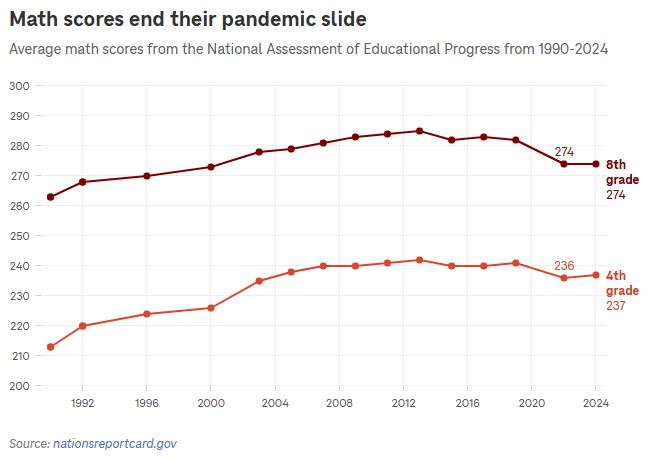
The reason, though, that this phrase has lately re-entered my working memory is because of the recent release of the results of the 2024 NAEP assessment, popularly known as “The Nation’s Report Card.”  For those not familiar with the NAEP, it is the one standardized test administered nearly universally to all 4th and 8th graders in this country since 1969 to benchmark how successfully we are teaching our children how to read and to do math. It is our one and only truly longitudinal look at how well America’s schools have succeeded at educating our children, and the 2024 report is pretty grim.  While math scores have shown some recovery from the pandemic loss, they are still lower than before the pandemic (part of a long term decline puzzling many educators), and children’s reading scores simply continued the steady decline they have been in since 2013.

Hmm.  2013.  Know what got released in late fall of 2011 and gained rapid popularity during 2012? Snapchat.  Then Vine in 2013, followed by TikTok in 2017.  In addition, during this time, the average age for a child receiving their first smartphone dropped steadily to 11.6 years-old, with children as young as 4 now having one. 

Notice a pattern here? Like the pattern in these graphs for both the math and reading scores before and after 2013?

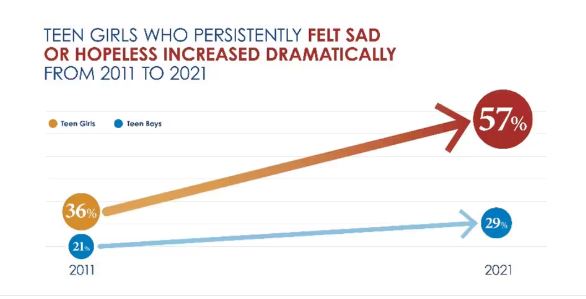
Or notice a pattern in the change in rates of teenage depression in the past decade (especially among 13 year-old girls)?

Now I am too much the scientist not to understand that correlation does not automatically mean causation.  Spurious associations are so common and readily found that there are entire websites devoted them (one of my favorites is the amount of GMO corn grown in Minnesota and the frequency of global piracy in a given year).  However, I still remember intimately the shocked dismay I felt in the fall of 2013 when the average score on an assignment I had given to my most advanced students for more than a decade abruptly dropped from the steady “C” it had been from years prior to the nearly universal “F” it was that September.  I, of course, made the necessary adjustments and interventions and have continued to do so with all my students ever since.  But the number and depth of those adaptations have steadily increased every single year to date, and I’m not anticipating this demand letting up any time soon.

Again, Hmm.  “If it looks like a duck, walks like a duck, and quacks like a duck….”  “Where there’s smoke, there’s….”  “It’s the economy….”  Cliches (and their modern equivalent, the meme) exist for a reason, and those that exist about the link between correlation and causation do so in part to remind us that sometimes we do not have the luxury of untangling the full extent of the causality in a given situation.  We need to act like it is a duck; like it is fire; like it is the economy.  Or in this case, like it is the Snapchat, etc. because the alternative risks the kind of long-term harm we are seeing in those graphs above.  Better to remove social media’s influence from our children’s lives on the likelihood that it could be disruptive to their proper mental and physical development than to wait to fully confirm (as the mounting research of Sherry Turkle, Jonathan Haidt, and others is doing) that it is.

Because if we want to witness a microcosm of a world in which daily use of social media has risen to an average of 95 minutes per person and more than 54% of people get their primary news from it, look no further than the past two weeks. As the Trump administration has deliberately sown chaos through a metaphorical fire-hose of executive actions, the consequent eruption of misinformation, disinformation, and conspiracy theories on social media among immigrants, federal employees, and foreign aid workers has all but paralyzed whole segments of our society and even our economy. We are in a societal freefall at present, and the only “parachute” is going to be calm, persistent, rational, and critical thought to separate what is truly happening from the fiction and lies so that people can persevere in their resistance to tyranny.

And remember. There is nothing more useful to a budding autocrat than an illiterate and ill-numerate population.  Hence, we had better take the necessary actions to help improve our nation’s math and reading scores and do it soon because the alternative has already arrived.

Coda

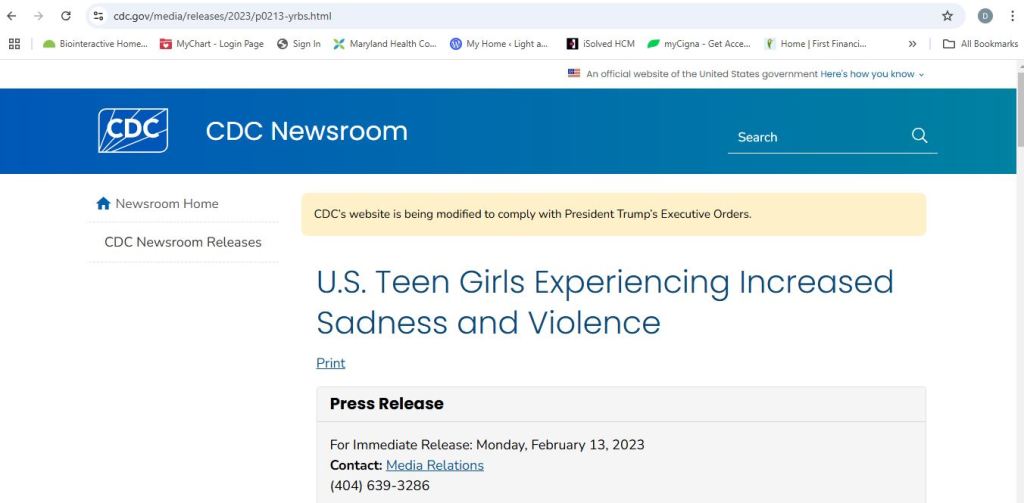
And speaking of that arrival, I got to experience an element of it firsthand while preparing this latest essay.  As my regular readers are aware, I work very hard to provide supporting reference for any statistical or factual claim I make in my writing and to cite properly all thoughts I cannot claim as uniquely my own.  However, a major source of some of that information is the federal government’s CDC and other scientific databases—all of which, as you can see from the screenshot below, are now under attack from the new administration (note the fine-print at the top about executive orders). 

Moving forward, I will continue to do my best to provide full references for anything I write, but since I often link to previous postings where the original sources of some of the citations have effectively disappeared, I ask my reader’s trust when visiting any of my earlier work that if I claimed it or quoted it, I promise the now gone website did affirm it.  

References

Ghorayshi, A. & Rabin, R.C. (Feb. 13, 2023) Teen Girls Report Record Levels of Sadness, C.D.C. Finds.  The New York Timeshttps://www.nytimes.com/2023/02/13/health/teen-girls-sadness-suicide-violence.html?searchResultPosition=1.

Haidt, J. (2024) The Anxious Generation.  New York: Penguin Press.

Singer, E. (Feb. 2, 2025) Thousands of U.S. Government Web Pages Have Been Taken Down Since Friday.  The New York Times.  https://www.nytimes.com/2025/02/02/upshot/trump-government-websites-missing-pages.html.

Turkle, S. (2017) Alone Together: Why We Expect More from Technology and Less from Each Other, 3rd Edition.  New York:  Basic Books.

Turner, C. & Mehta, J. (Jan. 29, 2025) Nearly 5 Years After Schools Closed, the Nation Gets a New Report Card.  NPR Morning Edition.  https://www.npr.org/2025/01/29/nx-s1-5270880/math-reading-covid-naep.

The Dangers of Safetyism

Education should not be intended
to make people comfortable;
it is meant to make them think.

—Hanna Holborn Gray

In the early 1980s, a Canadian historian, James Stokesbury, wrote two, one-volume histories of World War I and World War II.  They remain, in my opinion, among the best abbreviated examinations of these calamitous events, and I revisit my copies of both books when I am feeling the need for some perspective about the world they helped create and in which I have grown up and lived.  Each time I do, I find myself discovering some new theme which I had not seen on previous reads, and when I recently revisited them this past month, what struck me this time was the almost rabid isolationism of the United States at the start of both wars and its impact on their outcomes.  I was reminded yet again that we are a highly reactionary society, not an anticipatory one, and that what that can cost can literally be tens of millions of human lives.

I share this bit of personal background because in my other recent readings I have found what I think is a new form of isolationism, and I believe we may be looking at a new reactionary response rather than an anticipatory one.  And no, I do not mean the isolationism within the MAGA movement and their cult leader, Donald Trump, which are impacting the current election.  This is an isolationism at a larger scale, one that is permeating our entire society, and it is something which First Amendment attorney, Greg Lukianoff, and social psychologist, Jonathan Haidt, call “safetyism.”

What is “safetyism?” Lukianoff and Haidt define it as “a culture that allows the concept of ‘safety’ to creep so far that it equates emotional discomfort with physical danger” and does so to such a degeree that it “encourages people to systematically protect one another from the very experiences embedded in daily life that they need in order to become strong and healthy” (Coddling, p. 29).  Examples include:

  • helicopter-parenting that schedules every minute of a child’s day to ensure that said child is never without some form of adult supervision;   
  • school districts such as the one my niece and nephew attended where district policy would not allow them to enter their elementary school unless dropped off by car—even though said school was a five-minute walk from their house;
  • “the head teacher of an elementary school in East London [issuing] a rule that children must not even touch recently fallen snow, because touching could lead to snowballs” (Coddling, p. 236; original emphasis)
  • universities cancelling controversial speakers simply because some members of the campus might find them disagreeable;

Hence, at its extreme, safetyism is the notion that even ideas are physically dangerous and must therefore be regulated to prevent exposure to them.  In other words, we must find a way to isolate each and every one of us from anything that might cause pain.

Sounds crazy right? Yet Lukianoff and Haidt point out that to some degree it makes a certain twisted logic because as “we adapt to our new and improved circumstances, [we] then lower the bar for what we count as intolerable levels of discomfort and risk” (Coddling, pp. 13-14).  Modern industrial society with its medicine, abundance of food, sanitation systems, etc. has so removed us from the environment we evolved in that “coddled” isn’t even an adequate word to describe our lives today.  Yet that same modern industrial society bombards our paleolithic brains with news of inflation, school shootings, and climate change, and so our heightened feelings of fear for our safety can drive us to the crazy isolation of safetyism.

Creating some very unintended and negative consequences in the process.  As the subtitle to Coddling suggests, we have now raised an entire generation incapable of adulting; put the production of new knowledge at risk—since “to advance knowledge, we must sometimes suffer” (Kindly, p. 19); and even endangered our form of governing because “citizens of a democracy don’t suddenly develop this art on their eighteenth birthday” without many preceding years of free play and self-negotiated conflict (Coddling, p. 191).  Just as the isolationism of the 1910s and 1930s did, safetyism has put us at grave risk as a nation, and I think it is worth quoting Lukianoff and Haidt at length here:

After all, if focusing on big threats [car seats, reducing exposure to second hand smoke, etc.] produces such dividends, why not go further and make childhood as close to perfectly safe as possible? A problem with this kind of thinking is that when we attempt to produce perfectly safe systems, we almost inevitably create new and unforeseen problems.  For example, efforts to prevent financial instability by bailing out companies can lead to larger and more destructive crashes later on; efforts to protect forests by putting out small fires can allow dead wood to build up, eventually leading to catastrophic fires far worse than the sum of the smaller fires that were prevented.  Safety rules and programs—like most efforts to change complex systems—often have unintended consequences.  Sometimes these consequences are so bad that the intended beneficiaries are worse off than if nothing had been done at all…efforts to protect kids from risk by preventing them from gaining experience—such as walking to school, climbing a tree, or using sharp scissors—are different.  Such protections come with costs, as kids miss out on opportunities to learn skills, independence, and risk assessment (Coddling, p. 169).

How, though, did we get here? What has allowed safetyism to arise and to thrive? One answer Lukianoff and Haidt provide is what they call the three great “Untruths” that have taken hold in our society:  the Untruth of Fragility (“what doesn’t kill you makes you weaker”), the Untruth of Emotional Reasoning (“always trust your feelings”), and the Untruth of Us vs. Them (“life is a battle between Good people and Evil people”).  Together, Lukianoff and Haidt argue (and document), these three ideas have permeated much of the modern parenting literature, school policies pre-K thru PhD, and social media, and the consequence are large numbers of children and young adults who are not resilient, who are experiencing poor mental health, and who are permanently trapped in their own biases.

Added to that, Jonathan Rauch argues (and also documents), has been the rise over the past thirty years of what he calls the fundamentalist and humanitarian threats to research institutions of all manner.  Namely (from the first) that all knowledge of any kind is absolutely relative and therefore equal in truth value and (from the second) that since “one person’s knowledge is another’s repression” (Kindly, p. 116), we must “set up authorities empowered to weed out hurtful ideas and speech (Kindly, p. 131).  Objective truth withers and dies; new knowledge becomes impossible; and thoughtful, critically reflective individuals who might be able to challenge Lukianoff’s and Haidt’s three great Untruths become a thing of the past.

There is, of course, also the reality of the rise of social media and the consequent tribalism it has empowered that generates affirmation for the belief in the need to be safe against the “Other.”  As Lukianoff and Haidt point out:

The bottom line is that the human mind is prepared for tribalism.  Human evolution is not just the story of individuals competing with other individuals within each group; it’s also the story of groups competing with other groups—sometimes violently.  We are all descended from people who belong to groups that were consistently better at winning that competition.  Tribalism is our evolutionary endowment for banding together to prepare for intergroup conflict (Coddling, p. 58).

And when social media simultaneously provides both the intragroup identity and the intergroup conflict, you have the perfect recipe for safetyism.  In fact, Lukianoff and Haidt go so far in recognizing this reality that they actually have a term for the subgroup of Gen Z where we see this the most: iGen, the group who grew up after Steve Jobs unleashed the iPhone on the world.

So now what? This group of individuals bathed in safetyism since birth has only grown larger over time, and a strong case could be made that the whole reason for the general tenor of the last decade of election cycles is that we are losing the number of actual adults in the room.  As political scientists Steven Levitsky and Daneil Ziblatt have written, “[political] parties [have] come to view each other not as legitimate rivals but as dangerous enemies.  Losing ceases to be an accepted part of the political process and instead becomes a catastrophe” that must be protected against at all costs (Codling, p. 131).

However, there are still a few of us around adulting our way through life, and a large number of us work in education, where the task has been, remains, and will always be—as the old folk wisdom puts it—preparing the child for the road, not the road for the child.  Not that schools shouldn’t be places of safety, but as former University of Chicago president, Hanna Holborn Gray reminds us in the epigram at the start of this essay—and ALL the brain research affirms—a certain degree of discomfort is necessary for learning to take place.  Critical thinking is simply the ability to connect one’s claims to reliable evidence properly, but developing the capacity to do it involves falling and skinning one’s mental knees over and over again until you can skate logic’s constraints with ease.  Learning hurts, and there will never be any way around that.

And while it is true that we can pave a bit of a child’s road for them, it has always been utterly self-defeating to think any of us could do more than that.  Food, clothing, shelter…love, caring, empathy…medicine, education, athletics…generational wealth…we can smooth some of a child’s road for them.  But we cannot prepare them for that call in the night that a loved one has died or the diagnosis of cancer or the failure of a marriage.  Each person’s road is unique, and so we can only truly help prepare them to travel it.

What’s more, if “it [has been] foolish to think one could clear the road for one’s child [in the past], before the internet, now it’s delusional” (Codling, p. 237).  As I commented in Chapter 9, I have confronted the paradox these past 15+ years that even as my digital native students have arrived in my classroom more and more unprepared for critical thinking, I have been steadily more successful at enabling them to do so.  That I can do so, I think, is because of the subject I teach, and the how and why of that is what I will explore next time.

References

Lukianoff, G. & Haidt, J. (2018) The Coddling of the American Mind: How Good Intentions and Bad Ideas are Setting Up a Generation for Failure.  New York: Penguin Books.

Rauch, J. (2013) Kindly Inquisitors: The New Attacks on Free Thought (Expanded Edition).  Chicago: The University of Chicago Press.

Stokesbury, J. (1981) A Short History of World War I.  New York:  William and Morrow Company, Inc.

Stokesbury, J. (1980) A Short History of World War II.  New York:  William and Morrow Company, Inc.