The Future of ….

My original title for this essay was “the future of education.”  But if you’ll stay with me, you’ll see why I ultimately decided on the ellipsis, and why the potential future of education (at least in this country) led me to that choice.  It has to do with the fact that there are some serious challenges to teaching and learning in the United States right now (as well as significant chunks of the rest of the world) that have caught my recent attention and that have me pondering the future of all manner of educational practice moving forward.  Hence, it was time to take up my metaphorical pen and paper again to share my musings—as always in the act of hope that some might find them adding at least a degree of value to their own reflecting.

One of these challenges, of course, is the now ubiquitous one of digital technologies and their latest AI variants, and because I have already written so much on this particular topic, I simply invite anyone interested to visit my archive for those essays.  Today, my only addition to this subject is to share that while Australia had the courage to pass a law banning access to social media to anyone under the age of 16 over a year ago, it has taken my school nearly a year and a half of sometimes fierce debate among the faculty about well-researched brain science simply to finally collect students’ cellphones during the academic day.  American individualism at its finest!

No, the two challenges catching my interest in the past month both involve the intersection of demography and child development, and the first of these has to do with plummeting birthrates in much of the world’s developed economies.  Here in the U.S., for example, the number of babies being born annually has dropped below the replacement level of 2.1 children per couple, and while the environmentalist in me sings hosanna for the planet’s sake, the educator in me who lives in a capitalist economy recognizes the threat this poses to schools across the land.  In Maryland alone, the loss of more than 11,000 children from the public schools this academic year (an estimate that nearly tripled during the week it took to write this) has endangered funding in several of our counties, and the competition among the area private schools risks becoming cut-throat as institutions with sometimes literal centuries of existence struggle for butts in chairs.  Already, three such schools in my immediate area have shut their doors in the past five years, and even a Baltimore City public charter school with a 30-year storied history just announced its closure. 

Those are all lost jobs—as well as lost professional experience and wisdom—and the impact is likely only to exacerbate the teacher shortage already facing this country as the economic uncertainty confronting anyone thinking of entering the profession continues to grow.  However, for me, the saddest truth about these school closures is that they are lost opportunities for certain children to find their safe and successful learning “niche.”  My niece was never able to find hers, and it almost cost her her life; so I know firsthand how important the quality of a learning environment can be.  Shuttered and silenced classrooms leave gaping holes in any community, and in the coming decades, what is happening today will only be the beginning.  As Marguerite Roza, the director of Edunomics at Georgetown University puts it, “cratering birthrates will seriously remake education in the country”—and unlikely for the better.

But there is perhaps an even more insidious challenge presented by the contemporary link between demography and child development, and that is the impact of the current cost of early childhood education in this country.  Pre-K schooling for even a single child costs the typical family more than they pay for monthly rent in 17 of the 50 states, and nationwide, more than 60% of families cannot afford the kind of high-quality daycare so critical to developing brains.  We know now that age 0 to 5 is the most important stage of growth for the human brain—with impacts that last for the entirety of an individual’s lifespan—and we know equally well that maximizing this growth requires well-trained, highly attentive adults guiding the process, with more than just one or two such adults present (the “takes a village” cliché has some literal truth).  Furthermore, without this level of investment of adults in infants’ and toddlers’ lives, the quality of all future learning is compromised, and there is a direct correlation between a country’s investment in early childhood education and the PISA scores (the world’s gold-standard for testing academic progress) of their high school-aged children.

Yet if so much is at stake, why would our country not invest significantly in providing superior pre-K education—especially given the potential long-term economic benefits vs. economic costs? Part of the answer has to do with how our society has historically sought to use markets as the solution to so many of our social problems.  Economies of scale and technological innovation have lifted much of the world—and especially us—out of poverty and material want; so why wouldn’t they—the thinking goes—be able to solve any seemingly intractable problem?

However, you can’t increase productivity in the interactions between an adult and a 2-year old (the genetic limitations of both their respective attention-spans preclude it), and you can’t innovate a way to make a small child any less of a time-suck.  Hence, as Senior Fellow at the think tank Capita, Elliot Haspel, points out: the bottom line is that market forces are incapable of solving the need for well-trained, well-compensated adults “caring for and shepherding the brain development of [our] very young children.” 

What’s more, he argues:

that market failure makes childcare essentially a hot potato. No one has any incentive to do that work, and everyone has an incentive to dump that work downstream onto others who are more vulnerable than they are — from policymakers onto families, from fathers onto mothers in many cases, and not even just to mothers, but from mothers in more privileged positions onto paid care providers.

Simply put, no one wants to acknowledge that small children are expensive, demanding, and inconvenient and that all the proverbial “king’s horses” and all “the king’s men” can’t make this reality be otherwise.  Thus, we find ourselves today with either brain-drained, exhausted mother’s forced to stay at home (which the data is clear is not optimal for brain development either; again “the village”) or with families who already need two incomes to meet basic needs having to compromise those needs to pay for the childcare the second salary demands.

Which actually circles us back to the “cratering birthrates” as more and more adults are now deliberately opting out of having children simply because they cannot see how they can afford them.

Interestingly enough, our country once did provide nearly universal daycare for our smallest children.  During World War II, the need for women in the nation’s factories drove congress to pay for daycare centers across the country that cost those families the equivalent of $10 per day in today’s money (imagine only $3700 a year for childcare!), and staffing was not an issue because it was considered one’s patriotic duty to contribute to the cause.  However, once the war ended, the patriarchy reasserted itself, and so we find ourselves in the mess we have today, with parents of all varieties mortgaging their economic futures just to have families and American society enduring the largest collective drop in intelligence since the 6th and 7th Centuries in Western Europe.[i] 

It is challenging time to be a toddler in the United States.

And that’s the reality that compelled this latest round of writing and why I am pretty confident that anyone reading this can figure out the reason for my original working title.  However, to connect the dots explicitly: fewer children in schools is likely to lead to even less investment in education (both human and capital); less investment is likely to lead to lower and poorer quality education; and that is likely to lead to pre-K teaching and learning—if there even is any—that fails to adequately develop little brains to their optimal capabilities.  We are obviously still going to educate our children, but the character of that education and its results may not be what our society needs to thrive…or maybe even survive.

Hence, the ellipsis in my title.  The future of education isn’t just about what goes on in classrooms and schools, and it isn’t simply about what I and many others do for a living.  It is about the nature of the act of learning itself, and that means the future of education is the future of everything human.  What we learn as children—every concept, every skill, every thought—is the entire foundation of our adult lives, and as the author of the Gospel of Matthew wisely had Jesus say, that foundation can be one of rock or of sand.  Right now, I sense we are at a great tipping point in this country (and perhaps this world) where we still have the power to build on rock instead of sand.  But we are dangerously close to defaulting to the latter, and should that happen, then the author of Matthew is quite clear about the consequence:

The rain fell, and the floods came,
and the winds blew and beat against that house,
and it fell—and great was its fall!
—Matthew 7:27 (NRSV)


[i] As a total sidebar, I find it intriguing that in the era from 1965 to 2005, the productive adult brains of those war era babies with their subsidized daycare produced some of the most robust R&D, discoveries, and inventions in all of human history.  Hmm! Coincidence? Correlation? Or causation? You decide.

References

Bowie, L. (Nov. 24, 2025) Maryland Schools Lost Students This Year, Early Estimates Show.  What’s to Blame? The Baltimore Bannerhttps://www.thebanner.com/education/k-12-schools/maryland-schools-enrollment-declines-C6FWKKHNYZH4DNJWAUOM4KLDGE/.

Griffith, K. & Richman, T. (Dec. 9, 2025) Maryland Public Schools Lost Over 11,000 Student This Year.  The Baltimore Banner.  https://www.thebanner.com/education/k-12-schools/maryland-public-schools-enrollment-drops-I7FPW6AIAJGNFDXFQDBMNMLME4/.

Kahloon, I. (Oct. 14, 2025) America is Sliding Toward illiteracy. The Atlantichttps://www.theatlantic.com/ideas/archive/2025/10/education-decline-low-expectations/684526/.

Kukolja, K. (Nov. 29, 2024) Australia Passes Strict New Social Media Bans for Children.  NPR All Things Consideredhttps://www.npr.org/2024/11/29/nx-s1-5210405/australia-passes-strict-new-social-media-bans-for-children.

Lora, M. (Dec. 5, 2025) How a West Baltimore Charter School’s 30-year Legacy Collapsed in Months.  The Baltimore Bannerhttps://www.thebanner.com/education/k-12-schools/new-song-academy-closed-charter-school-baltimore-NIBASIGPAZA6HJKTS3JDH2BSCU/.

Luse, B; et al (Nov. 24, 2025) Kids are Expensive.  Do They Have to Be? NPR It’s Been a Minute.  https://www.npr.org/2025/11/24/nx-s1-5617226/kids-are-expensive-do-they-have-to-be.
“It’s the Snapchat, Stupid”

Every era casts illness in its own image.
—Siddhartha Mukherjee,
The Emperor of All Maladies

During his 1992 presidential campaign, then candidate Bill Clinton is alleged to have claimed, “it’s the economy, stupid,” when addressing the perceived economic failures of the Bush, Sr. administration.  He did not, in fact, actually say it (it was a campaign talking point of his advisor, James Carville), but that has not stopped this phrase from entering our cultural lexicon and becoming a meme used ever since by both pundits and politicians alike to explain the voting patterns of the American people.  It has even been suggested as the primary reason Trump won re-election: because of how so-called “average” or “ordinary” citizens were feeling about their pocketbooks.   

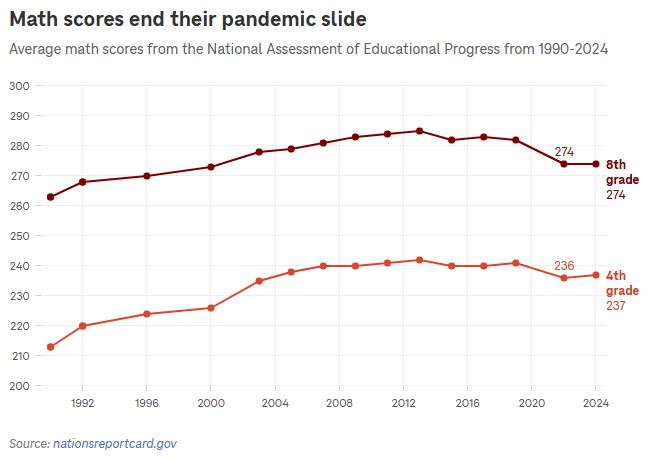
The reason, though, that this phrase has lately re-entered my working memory is because of the recent release of the results of the 2024 NAEP assessment, popularly known as “The Nation’s Report Card.”  For those not familiar with the NAEP, it is the one standardized test administered nearly universally to all 4th and 8th graders in this country since 1969 to benchmark how successfully we are teaching our children how to read and to do math. It is our one and only truly longitudinal look at how well America’s schools have succeeded at educating our children, and the 2024 report is pretty grim.  While math scores have shown some recovery from the pandemic loss, they are still lower than before the pandemic (part of a long term decline puzzling many educators), and children’s reading scores simply continued the steady decline they have been in since 2013.

Hmm.  2013.  Know what got released in late fall of 2011 and gained rapid popularity during 2012? Snapchat.  Then Vine in 2013, followed by TikTok in 2017.  In addition, during this time, the average age for a child receiving their first smartphone dropped steadily to 11.6 years-old, with children as young as 4 now having one. 

Notice a pattern here? Like the pattern in these graphs for both the math and reading scores before and after 2013?

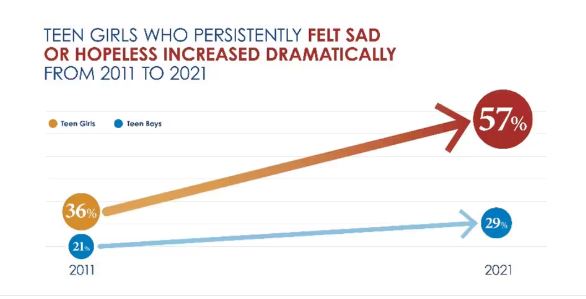
Or notice a pattern in the change in rates of teenage depression in the past decade (especially among 13 year-old girls)?

Now I am too much the scientist not to understand that correlation does not automatically mean causation.  Spurious associations are so common and readily found that there are entire websites devoted them (one of my favorites is the amount of GMO corn grown in Minnesota and the frequency of global piracy in a given year).  However, I still remember intimately the shocked dismay I felt in the fall of 2013 when the average score on an assignment I had given to my most advanced students for more than a decade abruptly dropped from the steady “C” it had been from years prior to the nearly universal “F” it was that September.  I, of course, made the necessary adjustments and interventions and have continued to do so with all my students ever since.  But the number and depth of those adaptations have steadily increased every single year to date, and I’m not anticipating this demand letting up any time soon.

Again, Hmm.  “If it looks like a duck, walks like a duck, and quacks like a duck….”  “Where there’s smoke, there’s….”  “It’s the economy….”  Cliches (and their modern equivalent, the meme) exist for a reason, and those that exist about the link between correlation and causation do so in part to remind us that sometimes we do not have the luxury of untangling the full extent of the causality in a given situation.  We need to act like it is a duck; like it is fire; like it is the economy.  Or in this case, like it is the Snapchat, etc. because the alternative risks the kind of long-term harm we are seeing in those graphs above.  Better to remove social media’s influence from our children’s lives on the likelihood that it could be disruptive to their proper mental and physical development than to wait to fully confirm (as the mounting research of Sherry Turkle, Jonathan Haidt, and others is doing) that it is.

Because if we want to witness a microcosm of a world in which daily use of social media has risen to an average of 95 minutes per person and more than 54% of people get their primary news from it, look no further than the past two weeks. As the Trump administration has deliberately sown chaos through a metaphorical fire-hose of executive actions, the consequent eruption of misinformation, disinformation, and conspiracy theories on social media among immigrants, federal employees, and foreign aid workers has all but paralyzed whole segments of our society and even our economy. We are in a societal freefall at present, and the only “parachute” is going to be calm, persistent, rational, and critical thought to separate what is truly happening from the fiction and lies so that people can persevere in their resistance to tyranny.

And remember. There is nothing more useful to a budding autocrat than an illiterate and ill-numerate population.  Hence, we had better take the necessary actions to help improve our nation’s math and reading scores and do it soon because the alternative has already arrived.

Coda

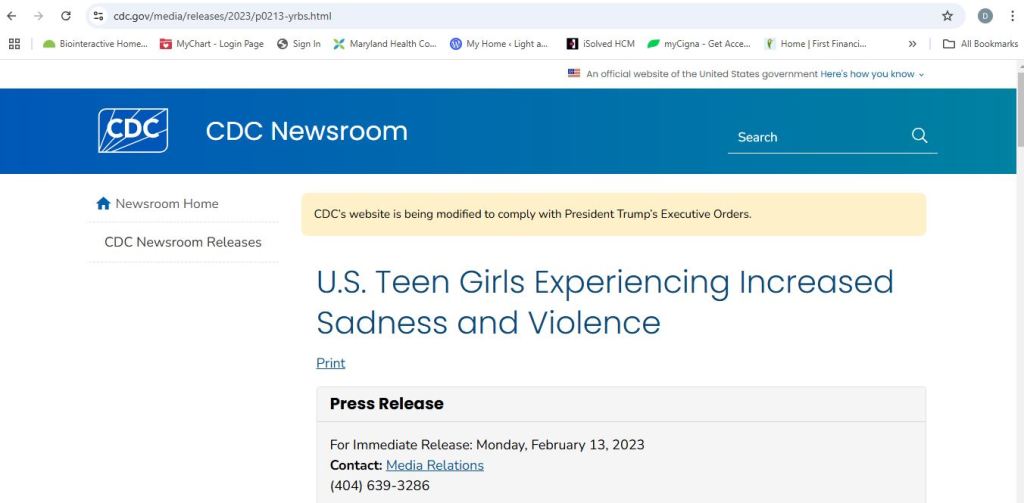
And speaking of that arrival, I got to experience an element of it firsthand while preparing this latest essay.  As my regular readers are aware, I work very hard to provide supporting reference for any statistical or factual claim I make in my writing and to cite properly all thoughts I cannot claim as uniquely my own.  However, a major source of some of that information is the federal government’s CDC and other scientific databases—all of which, as you can see from the screenshot below, are now under attack from the new administration (note the fine-print at the top about executive orders). 

Moving forward, I will continue to do my best to provide full references for anything I write, but since I often link to previous postings where the original sources of some of the citations have effectively disappeared, I ask my reader’s trust when visiting any of my earlier work that if I claimed it or quoted it, I promise the now gone website did affirm it.  

References

Ghorayshi, A. & Rabin, R.C. (Feb. 13, 2023) Teen Girls Report Record Levels of Sadness, C.D.C. Finds.  The New York Timeshttps://www.nytimes.com/2023/02/13/health/teen-girls-sadness-suicide-violence.html?searchResultPosition=1.

Haidt, J. (2024) The Anxious Generation.  New York: Penguin Press.

Singer, E. (Feb. 2, 2025) Thousands of U.S. Government Web Pages Have Been Taken Down Since Friday.  The New York Times.  https://www.nytimes.com/2025/02/02/upshot/trump-government-websites-missing-pages.html.

Turkle, S. (2017) Alone Together: Why We Expect More from Technology and Less from Each Other, 3rd Edition.  New York:  Basic Books.

Turner, C. & Mehta, J. (Jan. 29, 2025) Nearly 5 Years After Schools Closed, the Nation Gets a New Report Card.  NPR Morning Edition.  https://www.npr.org/2025/01/29/nx-s1-5270880/math-reading-covid-naep.

“It Takes a (Moral) Village…”

By oneself is wrong done,
By oneself is one defiled.
By oneself wrong is not done,
By oneself, surely, is one cleansed.
One cannot purify another;
Purity and impurity are in oneself.
The Dhammapada

On July 15, 1979, then President Jimmy Carter gave a televised address to the nation that history would come to call the “Crisis of Confidence” speech.  In it, President Carter laid out the case that our society was suffering from a malaise of self-indulgence where “too many of us now worship consumption” and “human identity is no longer defined by what one does, but by what one owns.”  He argued that as a country, we had adopted the mistaken understanding of freedom as “the right to grasp for ourselves some advantage over others,” and he astutely observed that “that path would be one of constant conflict between narrow interests ending in chaos and immobility. It is a certain route to failure.”

Well, here we are, nearly 50 years later, and as Ron Lieber of the New York Times recently pointed out, we are well on our way to that failure.  He is worth quoting extensively here:

Consider how our children feel after we’re mostly done raising and educating them. The Cooperative Institutional Research Program at the University of California, Los Angeles, surveys first-year college students every year. The percentage who named being “very well off financially” as an important goal doubled from 1967 to 2019. Those who wanted to develop a “meaningful philosophy of life” decreased by nearly half

Research by Tim Kasser and Jean Twenge showed that materialism among 12th graders increased over time, peaking in the late 1980s and early 1990s with Generation X, and then stayed at those historically high levels among millennials.  “There was a trend underway at the time Carter was making this speech, and it basically just amplifies in the next 10 years rather than being suppressed,” said Mr. Kasser, an emeritus professor of psychology at Knox College, [who] watched these developments with a sense of foreboding, because his research has shown that higher levels of materialism are associated with societal instability

And finally:

We will be tested again. Next time it may be a climate-related catastrophe, driven in part by the very patterns of consumption that Mr. Carter warned against in his speech. He called for turning down the thermostat in the winter and for 20 percent of the nation’s energy to come from solar power by 2000 — all these years later, we’ve done neither.

Which turns out to be truer than even I would have thought when I recently learned from a story in the local press of a couple paying nearly $900 for their heating bill this past month.  This for a row house in the urban heat island that is the city even in winter.  This for a place less exposed than my own three walls (I’m a duplex) and with fewer square feet.  $900.  What temperature, I thought, do you keep your house at??? For perspective, my largest heating bill ever was a little over $200.

However, putting my (self-righteous?) indignation aside, as we prepare to eulogize and bury President Carter this month, what strikes me most about his words all those years ago and the world we’ve created since is that the “village” has clearly been falling down on the job of “raising its children.”  I may agree with the words attributed to the Buddha at the start of this essay that each of us is solely accountable for our individual moral character.  Yet as I read these same words again, they remind me, too, that our moral nature is also a social construct.  There truly is no such thing as a “oneself” in utter and absolute isolation; it takes indeed a “village” to make a self.  What is more, it takes that same “village” to hold that same self individually morally accountable, and the paradox of this great truth is what our culture stumbles so badly over.

Take my discipline, for example.  Everyone is rightly concerned about the declines in language and math skills seen since (and attributable to) the pandemic. But the interventions have focused almost exclusively on tutoring and other individualist efforts when the larger cause—absenteeism—has received proportionally little attention.  “Chronic absenteeism [however] is not just bad for kids; it is bad for society. Learning is first and foremost a social endeavor, and kids learn to be part of a cohesive community by going to one every day” (Anderson & Winthrop).  In other words, unless one is an integral part of the “village,” neither “village” nor “child” can thrive.

Which is the power of ex-President Carter’s example to us following his loss to Ronald Reagn in 1980. He chose to remain part of the “village” to the day of his death, holding both himself and others accountable for their choices and their actions and the impact of these on the larger world.  With his hands, heart, and mind, he built literal villages as well as metaphorical ones, and those in turn helped raise tens of thousands out of poverty and into more participatory lives in their communities.  He fundamentally embraced the paradox of the moral character of the relationship between “village” and “child,” and the lives he touched both directly and indirectly remain the better for that. His was very much a life worthy of modelling.

Would that the same could be said of all the political leaders in our lives.

References

Anderson, J. & Winthrop, R. (Jan. 2, 2025) Giving Kids Some Autonomy Has Surprising Results. The New York Times. https://www.nytimes.com/2025/01/02/opinion/children-choices-goal-setting.html.

Carter, J. (July 15, 1979) Crisis of Confidence.  PBS American Experience. https://www.pbs.org/wgbh/americanexperience/features/carter-crisis/.

Lieber, R. (Dec. 29, 2024) Jimmy Carter Was Right About Materialism But, Alas, Wrong About Us.  The New York Times. https://www.nytimes.com/2024/12/29/your-money/jimmy-carter-legacy-materialism.html.

Prudente, T. & Gardner, H. (Jan. 5, 2025) Think Your BGE Bill is High? Rates are Rising.  The Baltimore Bannerhttps://www.thebaltimorebanner.com/community/local-news/bge-rates-maryland-utility-winter-storm-ZT4JQLC3OZCCTMHPWNAVVS2LHY/.

Updates

Regular readers know that I have three areas of interest that frequently occupy my attention: the impact of the pandemic on education, the ever evolving role of AI and technology on teaching and learning, and the strong current of anti-intellectualism in our society.  Well, this summer has been a busy one for all three of these topics; so it’s time for some updates.  We’ll start with the pandemic.

Early on, when COVID was actively disrupting all of our lives, I made some sober predictions about the cost of this disease to our children, and it saddens me to report that it turns out that things are even worse than I had prognosticated.  Teachers are now reporting that many of our littlest ones are arriving at school barely able to speak, that they are unable to remain still for brief periods, and that some do not even to know how to play with others.  Rudimentary pre-school skills such as how to hold a pencil or identify simple shapes (think circle, triangle, etc.) are missing, and caregivers of all kinds are reporting symptoms of anxiety and depression in children as young as four or five.

However, the situation appears even grimmer in our older children.  The gap in national test scores between recent and pre-pandemic scores has actually grown wider than anticipated, and “the gaps are so large that the average eighth-grade would need about nine months of additional schooling to catch up to pre-covid levels in math and about the same extra time to catch up in reading.”  The realities of human development simply do not allow for nine extra months, and so we are confronting an entire cohort of children who will be put at some degree of permanent disadvantage moving forward.  At least the little ones “only” need “2.2 more months of school to make up the reading gaps and 1.3 months for math.”

On the AI and technology front, the status of things is a little less “doom & gloom,” with interesting research about why paper remains better than screens.  The data about the advantages of handwriting versus typing when notetaking has been known for some time, but it turns out that even the simple act of reading something that is on paper versus reading the exact same thing on a screen produces better brain engagement and comprehension.  Scientists around the world have been analyzing the brains of early elementary age children with EEG and fMRI, and it turns out that “when children read on paper, there was more power in the high-frequency brainwaves” associated with higher-order cognitive function.  Why the brain acts differently between paper and screens remains a mystery, but that it does is now documented by multiple studies.

Of course, the creep factor of AI remains, with a company in China now offering to make avatars of dead loved-ones so that you can continue to “communicate” with the deceased.  But that’s a different issue for another day.  For now, “pencil & paper” are clearly winning, and those of us working with children simply need to pay attention accordingly.

Finally, it demoralizes me to have to report that the ACT has now made the science section of their exam optional and have even reduced their core exam by 44 questions, with shorter reading passages.  While I am not a fan of standardized tests, with their well-documented biases and other problematic features, I am also not a fan of dumbing things down even further in our general society than we already have.  The ACT rationalizes their decision by arguing that with this new flexibility—students can now sign up for four different varients of the exam (two of which do still include science)—that students can focus on their strengths and showcase their abilities in the best possible light while avoiding the fatigue of the longer, original exam.  But I am confident that the proverbial “bottom line” (pun intended) is simply that fewer students were signing up for the test, and that this was the organization’s way of trying to keep the dollars flowing—all at the expense of actually demanding that our children actually know something.

Well, that’s it for now.  For those of us in the classroom, important reminders of the challenges facing us as we adapt to the children in front of us (not the ones we might wish were in front of us), and for those not in the classroom, important reminders of matters impacting the society in which we all live.

Until next time.

References

Archie, A. (July 19, 2024) The Science Section of the ACT Exam Will Now Be Optional.  NPR.  https://www.npr.org/2024/07/19/nx-s1-5045587/act-exam-test-science-optional.

Barshay, J. (June 24, 2024) This Is Your Brain.  This is Your Brain on Screens.  The Hechinger Report.  https://hechingerreport.org/proof-points-neuroscience-paper-v-screens-reading/.

Feng, E. (July 11, 2024) Chinese Companies Offer to “Resurrect” Dead Loved Ones.  It Raises Questions.  NPR Morning Edition.  https://www.npr.org/2024/06/17/nx-s1-5001751/chinese-companies-offer-to-resurrect-dead-loved-ones-it-raises-questions.

Meckler, L. & Lumpkin, L. (July 23, 2024)  Four Years After COVID, Many Students Still Losing Ground.  The Washington Post.  https://www.washingtonpost.com/education/2024/07/23/covid-test-scores-learning-loss-absenteeism/.

Miller, C.C. & Mervosh, S. (July 1, 2024) The Youngest Pandemic Children Are Now in School, and Struggling.  The New York Times.  https://www.nytimes.com/interactive/2024/07/01/upshot/pandemic-children-school-performance.html.

Some Disheartening Developments

If you have raced with men on foot
and they have worn you out,
how can you compete with horses?
If you stumble in safe country,
how will you manage
in the thickets by the Jordan?

—Jeremiah 12:5

Despite what my title might suggest, today’s essay is not about the educational costs of the pandemic.  I have already written extensively about that topic (see the LoC Archives page for anyone interested), and if you want the most recent data, I suggest checking out the NYT’s article available in the references.  In fact, the only thing I will lift up about the latest findings is that we now know that all the school closings had nearly zero impact on slowing the spread of the virus; we could have kept them open and avoided nearly all of the learning damage.

No, what I want to focus on today are some recent developments in the world of education that are worth bringing to everyone’s attention because as I ended my last posting pointing out:  we are all in this together.  So here goes.

The most recent item to cross my attention was an article this past week about the expense of repairing the educational costs of the pandemic, as well as the—yet again—absence of political will to address it.  As all Marylanders (and my regular readers) know, our state has recently legislated and initiated a massive 10-year, eventually $3 billion dollars per year education reform movement called the “Blueprint for Maryland’s Future.”  In it are requirements to expand public Pre-K schooling for all children ages 3-4 and to provide all schools with high-quality and diverse educators (with an emphasis on National Board Certification).  In addition, there are requirements for preparing students for college and career readiness, more resources for low-income students, and the necessary governance and accountability programs to oversee the entire effort.

However, in a state already facing a teacher shortage of 2,000 unfilled positions and now facing a projected revenue shortfall of $255 million dollars in the coming fiscal year, teachers and educational leaders are currently being asked to triage their biggest challenges in implementing the Blueprint before the process has even started.  Here we are, in one of the richest states in the richest society in the history of humanity, and we are already shorting the necessary investment in our children because no one wants to state the obvious:  you get what you pay for, and in this case, that means additional taxation—America’s “third rail” in politics.   

Not that Maryland is alone.  The same morning that I read the Blueprint article, NPR had a story on the negative impact that losing the $190 billion dollars in pandemic emergency relief funds from the Federal government will have on schools across the nation.  As John Gies, a high school principal in rural Ohio put it, “while those pandemic dollars are running out, the problems the pandemic exploded, like missed learning and a student mental health crisis, are still here…we just really need some help from the government.”  Help that all interviewed for the story openly acknowledged is not likely to come, leaving reporter Cory Turner musing at the story’s end:

So what happens now? It seems unlikely that Congress will be in the mood to agree on even more funding for schools. Which means in the coming months, districts across the country will face some hard choices about whether they can afford to keep giving students all the help they need.

All the help they need.  Need.  Not “help-full.” Not “beneficial.” Not “useful.”  Need.  As in necessary, critical, vital to their well-being.  I know I have written before about how fundamentally anti-child our society is, but as both these news items came to my attention this past week, I was reminded once again of a quote of Barbara Kingsolver’s that bears repeating here:  “if it takes a village to raise a child, our children are knocking on a lot of doors where nobody seems to be home…where we seem to regard children as a sort of toxic-waste product: a necessary evil” (pp. 102 & 100).  Until we see our children in a different light than we currently do, then we will reap what we sow, and right now, I fear we are sowing our own dissolution.

And we seem to be doing so in more ways than one when it comes to what’s happening in the world of education.  Another recent item in my in-box was Jessica Grose’s op-ed about a middle school in California where students have employed AI technologies to manufacture false pornographic photos and short videos of their female classmates by taking head shots from existing, decidedly non-pornographic on-line photos and combining them with nude photos and videos from other sources.  Of course, the students involved then shared these digitally constructed items with others—making them a permanent part of the lives of both the victims and the victimizers (as well as violating numerous laws)—and all because these children don’t yet have pre-frontal cortices developed enough to know how truly stupid, irresponsible, and harmful they have been.  Yet legislation at any level can’t seem to get out of even committee to put guardrails on such technology, let alone simply acknowledge the danger it poses—especially the threat to our children’s very capacity to become healthy adults.

Not that all adults in children’s lives are themselves of sound and rational mind.  While we might consider as “sins of omission” the failure to adequately fund schools across this land and to protect developing minds from digital technologies that trigger the same neural pathways as cocaine does, the actions of Escambia County in Florida (home to Pensacola) most definitely could be considered “sins of commission.”  There, elected officials have taken upon themselves the “obligation” to “protect young minds” from such “dangerous material” as the following:  The American Heritage Children’s Dictionary, Webster’s Dictionary for Students, and Merriam-Webster’s Elementary Dictionary.  All of which have now been removed from every school library in the county and placed into storage along with “eight different encyclopedias, two thesauruses and five editions of The Guinness Book of World Records.”

Fortunately, some sanity still exists in Florida, and two parents in the county—yes, 2! out of a population of 322,390 as of the 2021 census—have joined in a lawsuit against the county school board to return these alleged “hazards” to their schools’ libraries.  Hopefully, as Heidi Stevens puts it, “the children of Escambia County [will soon] once again [be] allowed to look upon words.”  But even more importantly, they will hopefully be allowed to learn that “definitions are not the enemy.  Dictionaries are not the enemy. Thesauruses are not the enemy.  Encyclopedias are not the enemy.  Knowledge is not the enemy” (my emphasis).  What is the enemy is ignorance, “and it should go without saying, but apparently it doesn’t: A child is far better served looking up a word—any word—in a dictionary than typing that word into Google, where a world of images, videos and misleading garbage awaits” (Stevens).

Which brings me to my last disheartening development of the past few weeks.  This one is strictly anecdotal, but I do not think that makes what happened any less compelling.  It was during one of my scheduled meetings with my advisory, and we were playing Pictionary as a way of unwinding right before spring break.  It is a favored game of ours, and to make it a little competitive, I divide the group into two teams, with the winning team allowed to decide which confectionary treat I bake for them—which is itself an inside joke because the winning team always chooses my lemon bars—but nevertheless, they can still get quite competitive about it.

Well, on this occasion, the competition was a little more intense than usual, and both teams were trying to pick particularly challenging words for the other to draw.  Or more accurately, they were googling on their phones for challenging words to use, and when I saw the terms they were picking, I was stunned.  These are 10th graders, most of who are at least 16 years old, and they were needing an on-line search engine to find words that were part of my basic vocabulary by the time I was in 5th grade—vocabulary that I was expected to know and assessed for by the time I was 12. I knew my students of the past decade were not developing the same long-term memory storage banks as in the first two decades of my career, and I had seen the practical consequences of this reality in my classroom.  But here, that ignorance—and the degree of it!—was staring me existentially in the face in a way it never has before, and the despondency that settled over me for the rest of the day was profound.

However, it was not my final outcome, nor can it ever be.  No matter how disheartening the recent developments in schools, none of us in our society can afford to ignore them nor to be ignorant of them.  Anyone who has read my project updates since their inception in the spring of 2020 knows that I regularly use these essays in part to process the realities of teaching in the 21st Century, in part to share these realities to challenge others to action, and in part as an act of hope.  The truth is: dispelling the darkness is never easy.  But if we do not know the nature of its current character, we cannot know what type of flame to bring to the task.  Thus, if any of this essay’s revelations have sparked a response in you, I encourage you to determine how you can fan it into a fire to light your own way forward.

I will keep offering these reflections to keep fanning mine.

Coda

Since I first drafted this essay, two things have happened that bear on it.  The first is the tragic collapse of the Key Bridge into the Baltimore harbor.  In addition to the pain of the families who lost their loved-ones that morning will come the economic pain that will reverberate in my adopted home for years to come.  The region is losing $15 million dollars a day in revenue for every day the port remains closed, and even once re-opened, the impact of rerouting over 10 million cars and trucks annually will be felt for at least a decade (one woman interviewed shared that her commute is now an hour longer, and she will not be alone). The new reality is that in a state already struggling with how to pay for school reforms before this catastrophe, that $255 million shortfall is going to look like a pittance.

Yet, amidst this tragedy, I received an e-mail from a former student of mine from the class of 2010, informing me that her lab team was just selected to build the seismometers going with the astronauts to the Moon on the Artemis III mission in 2026.  She was writing to thank me (as well as another friend and former colleague), and in her own words, “you both are the most influential teachers I have had over a *very* long time spent in school, so I wanted you to be the first of my non-space community to know other than my parents. Thank you for getting me here, even if it has been a while. :)”

Now, I do not wish to suggest that these two events are even remotely on the same scale.  However, I share them because together they are intimate reminders that life’s journey is fundamentally the paradox of BOTH tragedy AND triumph, and if we spend too much time consumed with one or the other, we lose the necessary balance to navigate our “4,000 weeks” successfully.  The same is true of teaching; if I cannot find ways to harmonize the heartening with the disheartening, I lose the ability to engage authentically in the classroom.  It is a lesson worth relearning; it is a lesson worth remembering.

I suspect the same could be said of us all.

References

Grose, J. (March 2, 2024) A.I. Is Making the Sexual Exploitation of Girls Even Worse.  New York Times.  https://www.nytimes.com/2024/03/02/opinion/deepfakes-teenagers.html?smid=nytcore-ios-share&referringSource=articleShare.

Haidt, J. (March 13, 2024) End the Phone-Based Childhood Now: The Environment in Which Kids Grow Up Today is Hostile to Human Development.  The Atlantic.  https://www.theatlantic.com/technology/archive/2024/03/teen-childhood-smartphone-use-mental-health-effects/677722/.

Kingsolver, B. (1995) Somebody’s Baby.   High Tide in Tucson: Essays from Now or Never. New York: HarperCollins.

Mervosh, S.; Miller, C.; & Paris, F. (March 19, 2024) What the Data Says About Pandemic School Closures, Four Years Later.  New York Times. https://www.nytimes.com/2024/03/18/upshot/pandemic-school-closures-data.html.

Price, L. (March 20, 2024) School Leaders Outline Effort: Implementing Blueprint Law is Going to be ‘Herculean’ Task.  The Baltimore Sun, pp. 1-2.

Schmitz, R. (March 19, 2024) Standardized Test Scores for Teens in Germany are Down. Teachers aren’t Surprised.  NPR Morning Edition.  https://www.npr.org/2024/03/19/1239388574/standardized-test-scores-for-teens-in-germany-are-down-teachers-arent-surprised.

Stevens, H. (Jan. 21, 2024) Now Dictionaries? Do Better, Grown-Ups.  The Baltimore Sun (Life & Travel), p. 6.

Turner, C. (March 20, 2024) The $190 billion in Emergency Funds Given to Schools During the Pandemic is Ending.  NPR Morning Edition.https://www.npr.org/2024/03/20/1239609135/the-190-billion-in-emergency-funds-given-to-schools-during-the-pandemic-is-endin.