Unbidden Thoughts

priv◦i◦lege (priv⸍’l) n.—a special right or immunity granted or available
only to a particular person or group; an unearned advantage

In my own highly imperfect way, I try each day to remind myself what my white, male, cisgender, heterosexual privilege “buys” me in our society—to recall how blessed I am to have my health, work that I love, and the economic stability to spend my evenings watching Netflix.  However, recently, I have had a couple of experiences that have caused me to view both my own individual privilege as well as the general inequitable distribution of it in our society in a whole new way, and the insights this has provided about the current political situation in this country have been illuminating.

The first incident occurred while I was walking to breakfast one Saturday morning and I encountered two men having a heated discussion over money.  I only caught about 30 seconds of it as I passed them on the sidewalk, but that was enough for me to know that the two men were acquainted enough for the one to loan the other money to cover some household expenses, that the loaner was in anxious need of being repaid to cover some of his own, and that neither of them were adequately employed to cover everything.  Indeed, I recognized the shirt uniform of a local grocery store on the loaner, providing me with a very realistic idea of his likely weekly income.  It was clear there was no danger of things escalating to physical violence, but it was also equally clear that the attentions of these men were wholly occupied with their financial dilemmas and nothing else.

That’s when the insight struck, unbidden: the economic realities of their lives pretty much precluded either of these men from having the time or energy—the luxury—of concerning themselves with the current political situation in this country.  Daily survival was consuming all their attention, and as Maslow wisely observed, until you have met basic physiological and safety needs, there are absolutely no additional inner resources for anything else.  Concerns about democratic norms and Trump’s authoritarian behaviors are meaningless white noise to someone apprehensively worried (if not panicked) about food, clothing, and shelter.

Now, I had never considered the notion that civic engagement might be a luxury—a privilege—but as I recalled an incident in my own early adult life where I made a very stupid financial decision that forced me to eat nothing but cooked white rice and unseasoned lentils for a month (and I wish I was joking or exaggerating), I realized that of course such engagement is a luxury! We can talk all we want about responsible citizenship, but as an individual, I or anyone else must have the additional resources beyond survival and safety before someone can literally afford to take on that responsibility.  As an affluent white male, I can express my outrage at the Trump administration all I want and as loudly as I want because my economic status more than meets my basic needs.  I have the privilege of being pissed off.

But that got me to wondering how many other people in our society find themselves in the same situation as the two men I encountered, and while the answer is, frankly, a “moving target”—some surveys have the percentage of households living paycheck-to-paycheck as high as 62%, some as low as 34%—the most conservative evaluations done by Jeffrey Fuhrer of the Brookings Institute identifies 43% of American households as unable to meet the benchmark of what he calls “the cost of a basket of basic necessities.”  In other words, for nearly half the families in the United States, their total monthly incomes do not cover the cost of paying for the fundamental necessities to meet Maslow’s physiological and safety needs.

Which means that a disturbingly high number of people in this country simply do not have the necessary luxury to worry about the fate of their immediate communities, let alone the fate of the nation or something as abstract as “democracy.”  Add in the fact that these individuals therefore also do not have the extra “bandwidth” to be sorting the disinformation and misinformation flooding their lives, and the state-of-affairs right now in our society suddenly makes a lot more sense to me than it did a couple of weeks ago: if you are truly a “have-not,” then the only “truth” that can matter is whatever enables you to be less “not.”

Granted, that may sound awfully cynical of me. But like I said, I remember my own beans-and-rice moment, and I know for a fact that I did not spend a lot of that month worried about the Iran-Contra Affair of the Reagan presidency.

Yet, what those in the MAGA movement might be more likely to accuse me of than cynicism is elitism, and that brings me to my other experiential insight of the recent past. Again, another breakfast.  Only this time, the unbidden thought came as I was reading an article about black holes.  Apparently, the gravitational well of the super black holes at the center of galaxies can slingshot actual stars through space at tremendous velocities, and in fact:

S5-HVS1 was the first confirmed such hypervelocity star, and it’s moving at more than 1,700 kilometers per second.  Feel free to take a moment to absorb that fact: an entire star has been ejected from a black hole at more than six million kilometers per hour [four orders of magnitude faster than the 4,200 km/hr of the fastest bullet]. The energies involved are terrifying (Plait, p. 84).

I learned further that the Large Magellanic Cloud, a dwarf galaxy orbiting our own has its own super black hole and is consequently effectively “shooting stars at us!”  Granted, the asteroids in our own solar system are far more problematic (ask the dinosaurs!), but still….

I know; I digress.  Back to my unbidden thought.  Or perhaps I should I say thoughts, plural. First, here I sat with the time and leisure to read something interesting that had no practical value to my physiological or safety needs.  Second, I also had the benefit of a level of education that enabled me not only to comprehend this article but to have the consequent and correlating cognitive capacity to parse and analyze the very threats to democracy and our social order that the Trump administration now presents.  In other words, I can be outraged at Trump’s actions because I can fully understand what the consequences of them are.  Again, I possess the privilege—of a different kind—to be pissed off.

Now, education should neither be a “luxury” nor a “privilege”—especially in a democracy!—yet sadly, the historical record in this country reveals that education has seldom been an absolute right for everyone in the population.  The closest we probably came was in the post-war years following WW2, with the GI bill and Brown vs. the Board of Education (along with some other curricular reforms such as “the new math”).  But even those efforts often faced heavy resistance or were not equitably distributed, and by the end of the school busing conflicts of the 1970s and the rise of the Reagan era in the 1980s, an unbiased, just, and equivalent education for “all” began once more to be a “right” of only the more affluent.

Not that there weren’t significant efforts to change this trajectory.  The “No Child Left Behind” and the “Every Student Succeeds Act” were national legislative efforts to improve America’s schools—as were the creation of the Common Core set of national educational standards for literacy and numeracy.  But, too often, the assessment methods of these efforts ended up being either punitive in character (with poor urban and rural school districts frequently taken over by state boards of education) or publicly unpalatable (the Common Core demonstrating how badly devolved critical thinking skills had actually become in the U.S.).  Thus, by the time of the pandemic, an equitable education for all in this country had been on a steady decline for over a decade, and even where it was happening (as Mehta & Fine demonstrated), the quality was at best mediocre.

And we all know what happened next.

Which brings me back to my unbidden thoughts of these past few weeks.  First, they are obviously correlated.  One’s level of education and one’s economic security go hand in hand, and so it should not be surprising to find so many people in our society dispossessed of the “privilege” of civic engagement—nor the rise in authoritarianism that comes with that.  Second, my newfound awareness that civic engagement is in any way or to any degree a privileged luxury that not everyone in our society has full, unfettered access to frankly horrifies me—it is not a truth I am thrilled or excited to learn.  But, third, now that I am aware of my additional privilege, it is incumbent on me to employ it as best as I am able to combat the negative changes I see today in our society, and I believe where I can do that best remains for now the classroom.

Moreover, the reason why I believe that this is true is because of the life and work of fellow educator, Paulo Freire.  For those not familiar with him, Freire revolutionized the teaching of reading in his native Brazil, empowering once illiterate farmers and dayworkers in his country to confront the authoritarian power structures of their day, and so successful were Freire’s efforts that he was exiled by the 1964 military junta.  However, the seed he planted remained, and a little over a decade later, he returned to his native land, where his literacy efforts would one day lead to some of Brazil’s first democratically elected governments.  Today, the power of that educational legacy remains, and Brazil’s democracy has recently survived (and imprisoned) its own Donald Trump. Thus, never doubt what the power of the written word and the education it provides can do.

Nor, for that matter, the power of those who can—and still do—read. I keep writing my hope for a reason.

References

Freire, P. (1970) Pedagogy of the Oppressed.  New York: The Continuum Publishing Company.

Fuhrer, J. (June 20, 2024) How Many are in Need in the US? The Poverty Rate is the Tip of the Iceberg. The Brookings Institute. https://www.brookings.edu/articles/how-many-are-in-need-in-the-us-the-poverty-rate-is-the-tip-of-the-iceberg/.

Mehta, J. & Fine, S. (2019) In Search of Deeper Learning: the Quest to Remake the American High School.  Cambridge:  Harvard University Press.

Plait, P. (Sept. 2025) The Black Hole Next Door.  Scientific American. Pp. 83-84.

Srikant, K. (Feb. 26, 2025) Fact Check: Is there a consensus that a majority of Americans are living paycheck to paycheck? Econofact.  https://econofact.org/factbrief/is-there-a-consensus-that-a-majority-of-americans-are-living-paycheck-to-paycheck.
“It’s the Snapchat, Stupid”

Every era casts illness in its own image.
—Siddhartha Mukherjee,
The Emperor of All Maladies

During his 1992 presidential campaign, then candidate Bill Clinton is alleged to have claimed, “it’s the economy, stupid,” when addressing the perceived economic failures of the Bush, Sr. administration.  He did not, in fact, actually say it (it was a campaign talking point of his advisor, James Carville), but that has not stopped this phrase from entering our cultural lexicon and becoming a meme used ever since by both pundits and politicians alike to explain the voting patterns of the American people.  It has even been suggested as the primary reason Trump won re-election: because of how so-called “average” or “ordinary” citizens were feeling about their pocketbooks.   

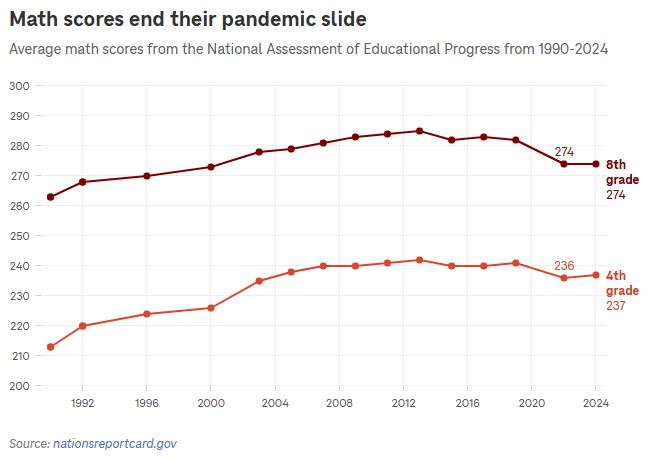
The reason, though, that this phrase has lately re-entered my working memory is because of the recent release of the results of the 2024 NAEP assessment, popularly known as “The Nation’s Report Card.”  For those not familiar with the NAEP, it is the one standardized test administered nearly universally to all 4th and 8th graders in this country since 1969 to benchmark how successfully we are teaching our children how to read and to do math. It is our one and only truly longitudinal look at how well America’s schools have succeeded at educating our children, and the 2024 report is pretty grim.  While math scores have shown some recovery from the pandemic loss, they are still lower than before the pandemic (part of a long term decline puzzling many educators), and children’s reading scores simply continued the steady decline they have been in since 2013.

Hmm.  2013.  Know what got released in late fall of 2011 and gained rapid popularity during 2012? Snapchat.  Then Vine in 2013, followed by TikTok in 2017.  In addition, during this time, the average age for a child receiving their first smartphone dropped steadily to 11.6 years-old, with children as young as 4 now having one. 

Notice a pattern here? Like the pattern in these graphs for both the math and reading scores before and after 2013?

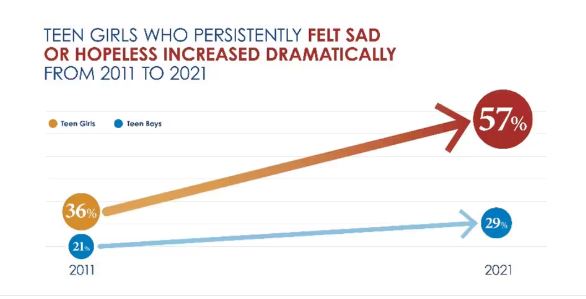
Or notice a pattern in the change in rates of teenage depression in the past decade (especially among 13 year-old girls)?

Now I am too much the scientist not to understand that correlation does not automatically mean causation.  Spurious associations are so common and readily found that there are entire websites devoted them (one of my favorites is the amount of GMO corn grown in Minnesota and the frequency of global piracy in a given year).  However, I still remember intimately the shocked dismay I felt in the fall of 2013 when the average score on an assignment I had given to my most advanced students for more than a decade abruptly dropped from the steady “C” it had been from years prior to the nearly universal “F” it was that September.  I, of course, made the necessary adjustments and interventions and have continued to do so with all my students ever since.  But the number and depth of those adaptations have steadily increased every single year to date, and I’m not anticipating this demand letting up any time soon.

Again, Hmm.  “If it looks like a duck, walks like a duck, and quacks like a duck….”  “Where there’s smoke, there’s….”  “It’s the economy….”  Cliches (and their modern equivalent, the meme) exist for a reason, and those that exist about the link between correlation and causation do so in part to remind us that sometimes we do not have the luxury of untangling the full extent of the causality in a given situation.  We need to act like it is a duck; like it is fire; like it is the economy.  Or in this case, like it is the Snapchat, etc. because the alternative risks the kind of long-term harm we are seeing in those graphs above.  Better to remove social media’s influence from our children’s lives on the likelihood that it could be disruptive to their proper mental and physical development than to wait to fully confirm (as the mounting research of Sherry Turkle, Jonathan Haidt, and others is doing) that it is.

Because if we want to witness a microcosm of a world in which daily use of social media has risen to an average of 95 minutes per person and more than 54% of people get their primary news from it, look no further than the past two weeks. As the Trump administration has deliberately sown chaos through a metaphorical fire-hose of executive actions, the consequent eruption of misinformation, disinformation, and conspiracy theories on social media among immigrants, federal employees, and foreign aid workers has all but paralyzed whole segments of our society and even our economy. We are in a societal freefall at present, and the only “parachute” is going to be calm, persistent, rational, and critical thought to separate what is truly happening from the fiction and lies so that people can persevere in their resistance to tyranny.

And remember. There is nothing more useful to a budding autocrat than an illiterate and ill-numerate population.  Hence, we had better take the necessary actions to help improve our nation’s math and reading scores and do it soon because the alternative has already arrived.

Coda

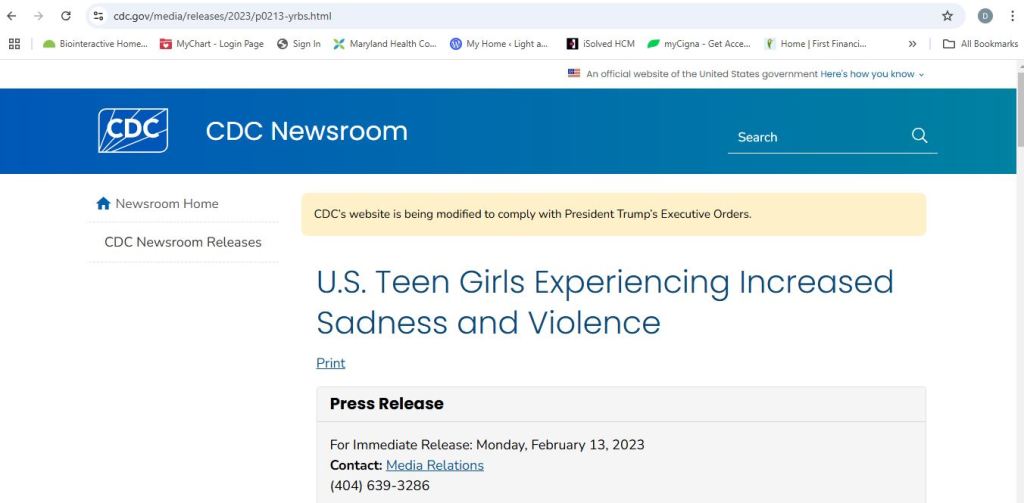
And speaking of that arrival, I got to experience an element of it firsthand while preparing this latest essay.  As my regular readers are aware, I work very hard to provide supporting reference for any statistical or factual claim I make in my writing and to cite properly all thoughts I cannot claim as uniquely my own.  However, a major source of some of that information is the federal government’s CDC and other scientific databases—all of which, as you can see from the screenshot below, are now under attack from the new administration (note the fine-print at the top about executive orders). 

Moving forward, I will continue to do my best to provide full references for anything I write, but since I often link to previous postings where the original sources of some of the citations have effectively disappeared, I ask my reader’s trust when visiting any of my earlier work that if I claimed it or quoted it, I promise the now gone website did affirm it.  

References

Ghorayshi, A. & Rabin, R.C. (Feb. 13, 2023) Teen Girls Report Record Levels of Sadness, C.D.C. Finds.  The New York Timeshttps://www.nytimes.com/2023/02/13/health/teen-girls-sadness-suicide-violence.html?searchResultPosition=1.

Haidt, J. (2024) The Anxious Generation.  New York: Penguin Press.

Singer, E. (Feb. 2, 2025) Thousands of U.S. Government Web Pages Have Been Taken Down Since Friday.  The New York Times.  https://www.nytimes.com/2025/02/02/upshot/trump-government-websites-missing-pages.html.

Turkle, S. (2017) Alone Together: Why We Expect More from Technology and Less from Each Other, 3rd Edition.  New York:  Basic Books.

Turner, C. & Mehta, J. (Jan. 29, 2025) Nearly 5 Years After Schools Closed, the Nation Gets a New Report Card.  NPR Morning Edition.  https://www.npr.org/2025/01/29/nx-s1-5270880/math-reading-covid-naep.

“It Takes a (Moral) Village…”

By oneself is wrong done,
By oneself is one defiled.
By oneself wrong is not done,
By oneself, surely, is one cleansed.
One cannot purify another;
Purity and impurity are in oneself.
The Dhammapada

On July 15, 1979, then President Jimmy Carter gave a televised address to the nation that history would come to call the “Crisis of Confidence” speech.  In it, President Carter laid out the case that our society was suffering from a malaise of self-indulgence where “too many of us now worship consumption” and “human identity is no longer defined by what one does, but by what one owns.”  He argued that as a country, we had adopted the mistaken understanding of freedom as “the right to grasp for ourselves some advantage over others,” and he astutely observed that “that path would be one of constant conflict between narrow interests ending in chaos and immobility. It is a certain route to failure.”

Well, here we are, nearly 50 years later, and as Ron Lieber of the New York Times recently pointed out, we are well on our way to that failure.  He is worth quoting extensively here:

Consider how our children feel after we’re mostly done raising and educating them. The Cooperative Institutional Research Program at the University of California, Los Angeles, surveys first-year college students every year. The percentage who named being “very well off financially” as an important goal doubled from 1967 to 2019. Those who wanted to develop a “meaningful philosophy of life” decreased by nearly half

Research by Tim Kasser and Jean Twenge showed that materialism among 12th graders increased over time, peaking in the late 1980s and early 1990s with Generation X, and then stayed at those historically high levels among millennials.  “There was a trend underway at the time Carter was making this speech, and it basically just amplifies in the next 10 years rather than being suppressed,” said Mr. Kasser, an emeritus professor of psychology at Knox College, [who] watched these developments with a sense of foreboding, because his research has shown that higher levels of materialism are associated with societal instability

And finally:

We will be tested again. Next time it may be a climate-related catastrophe, driven in part by the very patterns of consumption that Mr. Carter warned against in his speech. He called for turning down the thermostat in the winter and for 20 percent of the nation’s energy to come from solar power by 2000 — all these years later, we’ve done neither.

Which turns out to be truer than even I would have thought when I recently learned from a story in the local press of a couple paying nearly $900 for their heating bill this past month.  This for a row house in the urban heat island that is the city even in winter.  This for a place less exposed than my own three walls (I’m a duplex) and with fewer square feet.  $900.  What temperature, I thought, do you keep your house at??? For perspective, my largest heating bill ever was a little over $200.

However, putting my (self-righteous?) indignation aside, as we prepare to eulogize and bury President Carter this month, what strikes me most about his words all those years ago and the world we’ve created since is that the “village” has clearly been falling down on the job of “raising its children.”  I may agree with the words attributed to the Buddha at the start of this essay that each of us is solely accountable for our individual moral character.  Yet as I read these same words again, they remind me, too, that our moral nature is also a social construct.  There truly is no such thing as a “oneself” in utter and absolute isolation; it takes indeed a “village” to make a self.  What is more, it takes that same “village” to hold that same self individually morally accountable, and the paradox of this great truth is what our culture stumbles so badly over.

Take my discipline, for example.  Everyone is rightly concerned about the declines in language and math skills seen since (and attributable to) the pandemic. But the interventions have focused almost exclusively on tutoring and other individualist efforts when the larger cause—absenteeism—has received proportionally little attention.  “Chronic absenteeism [however] is not just bad for kids; it is bad for society. Learning is first and foremost a social endeavor, and kids learn to be part of a cohesive community by going to one every day” (Anderson & Winthrop).  In other words, unless one is an integral part of the “village,” neither “village” nor “child” can thrive.

Which is the power of ex-President Carter’s example to us following his loss to Ronald Reagn in 1980. He chose to remain part of the “village” to the day of his death, holding both himself and others accountable for their choices and their actions and the impact of these on the larger world.  With his hands, heart, and mind, he built literal villages as well as metaphorical ones, and those in turn helped raise tens of thousands out of poverty and into more participatory lives in their communities.  He fundamentally embraced the paradox of the moral character of the relationship between “village” and “child,” and the lives he touched both directly and indirectly remain the better for that. His was very much a life worthy of modelling.

Would that the same could be said of all the political leaders in our lives.

References

Anderson, J. & Winthrop, R. (Jan. 2, 2025) Giving Kids Some Autonomy Has Surprising Results. The New York Times. https://www.nytimes.com/2025/01/02/opinion/children-choices-goal-setting.html.

Carter, J. (July 15, 1979) Crisis of Confidence.  PBS American Experience. https://www.pbs.org/wgbh/americanexperience/features/carter-crisis/.

Lieber, R. (Dec. 29, 2024) Jimmy Carter Was Right About Materialism But, Alas, Wrong About Us.  The New York Times. https://www.nytimes.com/2024/12/29/your-money/jimmy-carter-legacy-materialism.html.

Prudente, T. & Gardner, H. (Jan. 5, 2025) Think Your BGE Bill is High? Rates are Rising.  The Baltimore Bannerhttps://www.thebaltimorebanner.com/community/local-news/bge-rates-maryland-utility-winter-storm-ZT4JQLC3OZCCTMHPWNAVVS2LHY/.

The New Year

We can judge our progress by the courage of our questions and the depth of our answers,
our willingness to embrace what is true rather than what feels good.

―Carl Sagan

While my experience of the new year traditionally aligns more with that of the Jewish calendar due to its chronological affiliation with the start of school each fall, the simple truth is that, technically, each day any of us wakes up is the start of the next year of our life.  In fact, for most of human existence, the chronological documentation of the passage of time was a nebulous process at best, recognizing and adapting to seasonal changes but little more than that (hunter-gatherers don’t have weekends).  However, with the rise of agrarian cultures—with their scribes and accounting systems—calendars were born, and we now have atomic clocks that lose only 1 second every 300 billion years.  Which means one might argue that each moment of “now” you experience is officially the start of a new year.

Yet, the conscious marking of another year can have value as a means for taking stock of ourselves as individuals and ourselves as a society, and when we do that here at the start of 2024, what confronts us is sobering.  Here are just some of the “highlights:”

  • We face a war of aggression and attrition in the Ukraine, with frightening parallels in our current U.S. response to that of Britain and France to the Nazi invasion of the Sudetenland in 1938—threatening democracy now as it did then—and we face a war of retaliation and revenge in Gaza that threatens to degenerate into a genocide of the Palestinian people (and these are just the armed conflicts that get all the international press). 
  • We have destabilized the planet’s climate to where once extreme weathers are now annual events—the correction of which would require the complete upheaval of our totally fossil-fuel dependent world economy—and we have generated an international migration “crisis” in response (that shouldn’t shock anyone familiar with basic organism population dynamics) as the animal, Homo sapiens, leaves untenable environments for more tenable ones.
  • We are currently engaged in a blind, headlong rush to develop AI technologies that threaten everything from jobs (both so-called “white-” as well a “blue-collar” ones) to national security to our very capacity to determine what is true versus what is false (and if we think the tech companies are suddenly going to regulate themselves, we have only to look at the $11 billion dollars they made off of our children in 2022 to dismiss thatmagical thinking”).
  • What’s more, here in this country, we have an avowed authoritarian indicted with 91 felony charges running for President, aided by power seekers willing to “burn the village down to save it,” who is the front-runner for his party’s nomination and who joins all the other authoritarians he so admires, posing the greatest risks to democracy since the Second World War.

Add in a population so polarized by social media and “cancel culture” (both from the Right and the Left) and we have a society ripe for civil conflict.  Indeed, for those of us who know our American history, the last time this country was this divided over its values—unable to compromise and to govern (with actual physical threats being made in our chambers of power)—it was the year 1860.  Also, a Presidential election year. And arguably the most important election year in our nation’s history.  Until maybe now.  Is 2024 our next 1860?

As always, I look at this question through the lens of an educator as well as that of a citizen, and for the past couple of years, through work I have done as a teacher fellow with the Mill Institute (whose mission statement might best be summarized as “less certain, more curious”), I have worked with others in the profession to identify key features of constructive dialogue around contentious issues and to develop methods for nurturing such dialogue in schools.  Like others before us, we have recognized that most value disagreements involve well-intentioned positions on both sides and that demonizing the other reduces their story and oversimplifies ones’ own, resulting in the diminishment of everyone.  Thus, finding ways to engage students and educators alike in practicing these two tenents has been the focus of our work (and we have developed a number of training resources for anyone interested).

But what has come out of this work for me regarding this essay’s primary topic is the awareness of two dilemmas.  The first is that—as former Stanford dean, Julie Lythcott-Haims, puts it—“we’re in desperate need of humans who can grapple openly with ideas, and disagree, as reasonable people will, without villainizing each other,” and yet developmentally, “today’s adolescents aren’t making it all the way” to this capacity for “adulting” because the cultural bubble of social media promotes a rigid understanding of right and wrong.  The reality is that you never have to listen to the other person anymore, never entertain any truth claim their position might have on you, because you can simply scream your own sense of rightness (and righteousness) on these platforms instead.  Hence, dilemma number one for me is whether we have the necessary critical mass of individuals in our society capable of the constructive dialoguing we will need to prevent a repeat of 1860.

The other dilemma for me, though, is that the value’s contest of 1860 forces the acknowledgment that some conflicts in values are beyond dialogue.  The impasse over slavery did not allow for a constructive compromise; there is no possible positive spin on slavery.  One part of our society held and defended an utterly abhorrent set of values and were prepared to kill and to die for them.  When values become that diametrically opposed, the resolution, I fear, boils down to power—as it did for four of the ugliest years of our nation’s history—and I am left wondering whether today’s culture wars have not reached that same equivalent point.

However, I remain committed to paradoxical thinking—to “both/and”—and if the young person who wrote about his generation’s developmental conundrum was capable of the necessary self-diagnosis to change his own personal growth path, I have optimism for others to do likewise (especially if exposed to the training available through the Mill Institute as well a similar organizations committed to constructive change).  Moreover, if the people of Poland can use their demographic power to peacefully overturn the illiberal values of their country’s authoritarian leadership—interestingly enough for our own 2024 election, mainly over laws outlawing abortion—then perhaps our society can successfully resist the illiberalism threatening our own historical ideals. 

The choice in the New Year is ours.

References

Bensinger, K. (Dec. 21, 2023) Troll Army for Trump Spins Online.  The Baltimore Sunhttps://digitaledition.baltimoresun.com/html5/desktop/production/default.aspx?&edid=b0dd69b9-e81e-4555-beba-da94f444f1f2.

Gottlieb, Z. (Dec. 10, 2023) Listen Up. The Closing of the Teenage Mind is Almost Complete.  The Los Angeles Timeshttps://www.latimes.com/opinion/story/2023-12-10/los-angeles-high-school-cancel-culture-free-speech.

Harvard School of Public Health (Dec. 27, 2023) Social Media Platforms Generate Billions in Annual Ad Revenue from U.S. Youth.  https://www.hsph.harvard.edu/news/press-releases/social-media-platforms-generate-billions-in-annual-ad-revenue-from-u-s-youth/.

Schmitz, R. (Dec. 11, 2023) Poland Elects New Prime Minister, Ending Right-wing Party’s Rule.  NPRhttps://www.npr.org/2023/12/11/1218635775/poland-elects-new-prime-minister-ending-right-wing-partys-rule.