The State of Engagement

How we spend our days, is, of course,
how we spend our lives.

—Annie Dillard

As anyone reading my most recent essay will recall, one of the major factors Harvard Researchers Jal Mehta and Sarah Fine identified as inhibiting deeper learning in America’s schools is student disengagement.  Children today, especially adolescents, have difficulty seeing the point of school, and as authors Jenny Anderson and Rebecca Winthrop point out in their book, The Disengaged Teen, who can blame them:  “kids witness the world around them—wars, social injustice, climate change, disinformation, technology that can write novels and counsel on heartache—and wonder why on earth they have to learn the Pythagorean theorem” (p. xiii).[i]  Include the fact that only 4% of them report experiencing the deeper learning discussed in my last essay (or the deeper teaching promoted by this project), and life in schools can seem not only pointless but mind-numbingly dull as well (which might explain why 75% of them report cheating regularly). 

The simple truth is that:

[Our] young people, hungry to learn and grow, overwhelmingly associate school with apathy and stress.  Trapped in buildings that feel like prisons (teens’ words, not ours), they are stressed out by a weird combination of competitive pressures and insufficient stimulation, and they develop a frustration that fuels a pervasive lack of meaning in their daily existence (p. xiv).

Indeed, sixty percent of young people today report having no sense of meaning or purpose in their lives, and 44% of those ages 18-25 report feeling that they do not actually matter to another person!

That’s terrifying.  What’s more, it should alert every fully grown adult in our society to the realities of today’s youth and set everyone on a course to rectify this situation.  But how? In a world where many of those same fully grown adults are experiencing almost as much ennui, dismay, and hopelessness as their children, how do we bring meaning, purpose, and caring back into young peoples’ lives?

One possible answer is what Anderson and Winthrop propose in their book.  These authors rightly observe that it is not literal disengagement that is happening in our children’s lives but rather the mode of engagement they are participating in that is impacting how they perceive both school and themselves.  These authors go on to identify and describe four such modes—Passenger, Achiever, Resistor, and Explorer—and they make the case for the superiority of the last of these modes (an argument resembling Mehta’s and Fine’s for deeper learning). They finish by providing insights for how to help children transition from any of the other three modes into the Explorer (with parents are their target audience).

However, while primary caregivers may be who this book is aimed at, the educator in me found some useful insights as well.  Hence, let us take a deeper dive into Anderson’s and Winthrop’s discussion, starting with the Passenger.  This mode, of course, is the dominant one in today’s schools.  “It is the most common mode of engagement, with almost 50 percent of young people from sixth to twelfth grade saying their learning experiences at school inspire coasting” (p. 31), and the sad reality is that being in this mode may “make Passengers possibly the most rational learners we have:  They are responding to an under- or overwhelming environment by doing what they have control over.  They check out” (p. 37).  Hence, like the “treaties” Mehta and Fine refer to in their work, these are the students who agree to do the class assignments in exchange for teachers not micromanaging their every move, and in return for this minimal investment, adequate progress gets made toward graduation and the eventual release from perceived “imprisonment.”

Where this approach to school gets problematic, though, is that “too much surface-level learning means Passengers develop poor learning habits and miss out on the myriad benefits that come from digging in and taking risks with their learning.  Students in this mode are ‘wasting their time developmentally’ when it comes to building good learning skills” (p. 32), and that means they risk entering adulthood without the necessary cognitive toolkit to do everything from successful adulting to gaining full employment in a knowledge economy.

Which is why, Anderson and Winthrop point out, so many parents push for—and schools typically reward—the Achiever mode, the one where every stereotype of the “ideal” student resides.  Children in this mode are the ones with the well-honed executive function and materials management skills.  They are the ones who complete every assignment (and all extra credit opportunities), who have resumes of extra-curriculars at least a page long (single-spaced), and who take every accelerated or College Board AP class they can fit into their already over-booked schedules.  They are the students for whom teachers write glowing, hyperbole-filled letters of recommendation, and they are the ones who never see the inside of the assistant principal’s office (that’s the disciplinary one for the uninitiated).

These are also the children who have complete emotional meltdowns when the grade isn’t at least 95%.  Perfectionism is the danger lurking for individuals in this mode of engagement, and resilience is not a strength they are likely to develop.  Achievers seldom have a sense of their own agency, and as a result, “all kids operating in Achiever mode are missing something: a level of self-awareness and proactivity that could help them be brave, take risks, and think about their own interests and goals in the education process, not just the goals that teachers and schools set for them” (p. 81). 

Furthermore—and for obvious reasons—creativity is also a challenge for the Achiever, leaving them with stunted CQs and little capacity for reflective critiquing.  That’s problematic because “when we fail to reflect, we miss the chance to notice that [perhaps] our strategies aren’t working.  [Thus,] rather than adjust, we [risk doubling] down and [working] harder at something that doesn’t work at all” (p. 183).  Achievers will find gainful employment and manage adulthood, but they risk living stunted lives, forever chasing the next accomplishment, never satisfied with the “now.”

Yet they will live lives (as will their fellow Passengers).  The danger of the third mode of engagement that Anderson and Winthrop explore, the Resistor mode, is that they might not.  In this mode, children do everything the term implies:  they consistently and regularly misbehave in school; they are often chronically absent; they participate in high-risk activities outside of school; and they are the ones who live in the Assistant Principal’s office.  These are the students with strong negative reputations among the faculty, and therein lies the problem (and true threat) this mode poses for a child who is stuck in it: namely that “too often when kids are resisting, adults see them as problem children rather than children with problems” (p.88).  It then becomes all too easy for a young person to internalize the message adults are sending—that they are their problems—and that is an identity that can kill.  Hence, it behooves all the adults in the life of a Resister to remember that, like Passengers, their choices are often quite rational ones for coping with overwhelming problems (if I’m starving, then stealing food makes a lot of sense) and that is why, as the founders of an organization devoted to helping children transition out of Resistor mode put it, “our greatest task is to buy students time to grow into themselves without giving up on them” (p. 103).

To grow into one’s self, though, requires acquiring a sense of identity that possesses agency, and therefore, “to find an identity, you actually have to look for it, you have to explore” (p. 120).  That is Anderson’s and Winthrop’s fourth and final mode of engagement, the Explorer, and students in this mode are the ones who are truly thriving.  They are the ones engaged in Mehta’s and Fine’s deeper learning, the ones generating novel and creative ideas and taking healthy risks.  They are the ones using their agency to stand for something, fall down, and then learn how to get back up again.  Hence, children in Explorer mode are discovering how to be their authentic selves. 

More importantly, though, is the fact that “when young people are engaged in [even] one part of their lives [in this way]—a class or an extracurricular activity—it spills over to other areas” (p. 47).  Indeed:

when students are interested in something, their ability to persist with cognitively repetitive and exhausting tasks doubles.  For example, students [in one study] spent time on a difficult but mind-numbing task and were then given a short break to read or write about something that interested them.  When presented with another boring and taxing task, their persistence was boosted by 30 percent because they were “replenished” by the interesting thing.  Their energy did not run out; it was refueled (p. 50).

In other words, Explorers keep exploring.

Which brings me to what I think of as “aiding and abetting.”  The reality, Anderson and Winthrop point out, is that everyone spends varying amounts of time in all four of the modes of engagement presented here, and they do so throughout their entire learning lives.  Each of us can and does pivot from one to another (sometimes spending years in a particular mode, sometimes experiencing all four in the same 24 hours). Thus, what I find myself asking in a world where 44% of 18-25 year-olds don’t think they matter to anyone else is this: how do we help children identify the mode they are in; how do we help them transition more effectively from one to another; and how do we help them spend as much time in Explorer mode as possible?

The answer for parents, it turns out, (and the challenge) is to talk more with their teenage children.  “Discussion is to adolescent develop what cuddles are to infants: foundational to building healthy brains” (p. 141), and the data across all OECD countries is clear:  when parents asked several times per week what their child did at school, math scores of these same children went up 16% points—even after accounting for differences in the socio-economic status of the households.  Thus, if you are a parent, the proverbial bottom line for helping your child manage their journey through their various modes of engagement is to speak with them regularly.

And don’t just ask “how was your day?”  Anderson and Winthrop devote an entire chapter to the kinds of language and questions parents can ask to open up the conversation with their teenage child rather than close it down (e.g. “what did you learn in science today?” or “teach me about what you did in history”), and while space here does not permit a full elaboration of all they have to educate about this aspect of parenting, the gist of their message is clear:  “talk to them about what they learn at school and what is happening in their lives, cheer on their academic pursuits, and help them get through hard times.  This, much more than direct homework help, helps teens grow” (p. 142).  Or as one of the parents (and a fellow educator) said when interviewed about his own successful work with his own daughter:  “Notice. Ask. Play. Iterate.  Do it again.” (p. 153).

That last advice sounds a lot like what goes on in a classroom, and thus it helps inform the challenges for schools to answer my “aiding and abetting” questions.  First, schools need to be much more intentional about teaching students how to navigate the ways they are engaging in school because “when schools don’t create any space for powerful reflection, they undervalue the imagining network and the development need for adolescents to begin making meaning of what they are doing” (p. 197).  Second, schools and the educators that compose them need to perceive themselves more as gardeners than as carpenters because:

rigorous research across multiple countries shows that in classrooms where teachers support students’ agentic engagement, kids get better grades and do better on tests.  This is compared to classrooms in the same schools where teachers do not provide an environment that lets kids explore (p. 110; original emphasis).

Third, since “we want young people to spend their days learning well” (p. xxv), what we need to be spending more time on in schools is teaching children how to learn well and not simply assuming they will somehow absorb this “how” through some sort of intellectual osmosis.  The brain science on this is clear (see Medina; Dehaene; and/or Brown, et al just to scratch the surface).  Those of us in schools just need to start paying meticulous and deliberate (and deliberative) attention to this science.

Yet that may point to the greatest challenge of all for schools and parents alike: the willingness to let children fail.  Anyone who has trained athletically knows that to build muscle, you first have to tear it down, and “to build the muscles of an Explorer, young people need to practice trying things, falling down, reflecting on why they fell, and getting back up and trying again.  That is how any child learns to ride a bike” (p. 70), and it is how anyone learns anything deeply. 

Including how one learns resilience.  As Anderson and Winthrop point out, “we can do hard things because we have done hard things” (p. 252) only if we have, in fact, engaged in hard things! Granted:

we want kids who can get to the right answer.  But we also want kids who know why it is the best answer among a sea of possibilities.  We want kids who are adaptable and can explore hard questions in complex environments.  They need [difficult challenges where failure is an authentic option] if things are to feel meaningful and joyful, leading to emotional engagement, which so many lack, busy as they are [simply] completing tasks (p. 198).

Therefore, what ALL the adults in young peoples’ lives need to be doing is helping our children manage their stress, not extinguish it.  Because only then will we help them become the grown-ups they needed us to be when they become our age, and only then will they live bravely in “a messy world [where] to learn well is an essential ingredient to what it means to live well” (p. 260).

Coda

If all the brain science to date could be summarized in a single phrase, Anderson and Winthrop do it nicely when they write that “brains develop the way they are used” (p. 99).  Or as the author of Curious, Ian Leslie puts it: “curiosity is contagious. So is incuriosity.”  Which is why I was so deeply disturbed recently to learn about a new school in Austin, Texas called Alpha School where:

students spend a total of just two hours a day on subjects like reading and math, using A.I.-driven software [and then] the remaining hours rely on A.I. and an adult ‘guide,’ not a teacher, to help students develop practical skills in areas such as entrepreneurship, public speaking and financial literacy (Salhotra).

Worse, this school is the flagship for a movement that includes the Miami-Dade County Public Schools (the nation’s third-largest district) where, as I actively write these words, they are “introducing Google chatbots for more than 105,000 high schoolers” (Salhotra).

Now any regular reader knows my thoughts on AI, social media, and technology in general.  But after the MIT study released this summer demonstrating that ChatGPT actually inhibits thinking (see Lemonade), the notion that entire schools risk making their charges deliberately dumber (and by design!) is horrifying.  Furthermore, what ties this unfolding educational movement to the topic of this essay is that we know (again from the brain science as well as the catastrophe of the pandemic) that learning is a social process.  We know as well that “a mind-bending amount of research shows that the best predictor of life satisfaction is the quality of relationships we have” (p. 191). Thus, how the so-called educators behind this Alpha movement can reconcile what they are doing with the realities of what it means to be fully human explains, to me, a LOT of the experience of those 44% of 18-25 year-olds I keep referencing.    

Put plainly, Annie Dillard’s epigram at the start of this essay is one of life’s fundamental truths, and if you spend the majority of your day in school with an AI, then you spend the majority of your learning life with an AI. Since a similar failed experiment involving computers and education has already played out multiple times over the past few decades, you would think those of us in schools would have learned better by now. Moreover, for those who believe you can have an actual relationship with an AI and thereby meet the social conditions necessary for successful education, there is already the soulless anguish of the 44%—a number that will only grow bigger if the Alpha Schools of this world succeed.

We, in education, can and must do better.

References

Anderson, J. & Winthrop, R. (2025) The Disengaged Teen: Helping Kids Learn Better, Feel Better, and Live Better.  New York: Crown Publishing Group.

Brown, P.; Roediger III, H.; & McDaniel, M. (2014) Make It Stick: The Science of Successful Learning.  Cambridge: Harvard University Press.

Dehaene, S. (2020) How We Learn: Why Brains Learn Better Than Any Machine…for Now. New York: Penguin Books.

Leslie, I. (2014) Curious: The Desire to Know and Why Your Future Depends on It. New York: Basic Books.

Medina, J. (2018) Attack of the Teenage Brain. Arlington, VA: ASCD Books.

Medina, J. (2014) Brain Rules: 12 Principles for Surviving and Thriving at Work, Home, and School.  Seattle:  Pear Press.

Salhotra, P. (July 27, 2025) A.I.-Driven Education: Founded in Texas and Coming to a School Near You.  The New York Times.  https://www.nytimes.com/2025/07/27/us/politics/ai-alpha-school-austin-texas.html?unlocked_article_code=1.cE8.fbGD.JPscHXYtIEf7&smid=url-share.


[i] Unless indicated otherwise, all quotes in this posting are from The Disengaged Teen.
Deeper Learning

The problem with schools isn’t that they are no longer what they once were;
the problem is that they are precisely what they once were.

—Roland Barth

As mentioned in my most recent essay, I spent a portion of my summer reading the research of Jal Mehta and Sarah Fine of the Harvard Graduate School of Education, and in their work, they explore the status of what they call “deep learning” in America’s public high schools.  They characterize “deep learning” as having three fundamental properties:  mastery, identity, and creativity, and they elaborate on these properties as follows:

Mastery because you cannot learn something deeply without building up considerable skill and knowledge in that domain; identity because it is hard to become deeply learned at anything without becoming identified with the domain; and creativity because moving from taking in someone else’s ideas to developing your own is a big part of what makes learning “deep” (p. 299).

Or as educator David Perkins marvelously summarizes it: “playing the whole game at the junior level.”

Mehta and Fine also describe in their work that the classrooms where deep learning is taking place are spaces where “students had real choices, learning by doing was the norm, there was time to explore matters in depth, and students were welcomed as producers rather than receivers of knowledge” (p. 5).  They then describe teachers successfully generating this kind of learning as individuals with strong links between their sense of self and their sense of purpose, educators who:

sought to empower their students; they wanted them to be able to approach both their fields and other life situations as people who could act on the world and not simply have the world act on them.  While their hopes for their students as people came first, they cared about their students through their disciplines or subjects (p. 351; original emphasis).

However, while looking for these aspirational qualities of deep learning in nearly 100 schools scattered across the country and across the socioeconomic spectrum—ranging from progressive charter to International Baccalaureate to traditional comprehensive—what they actually found was not a lot of deep learning.  Over the six years of their research, more than 300 interviews of administrators, teachers, and students, and over 750 hours of classroom observations, what they found was that the long-standing model for learning still dominated:  teacher as transmitter; pupil as recipient.  Indeed, “in classroom after classroom, students were not being challenged to think.  Roughly speaking, about 4 out of 5 classrooms we visited featured tasks that were in the bottom half of Bloom’s taxonomy” (pp. 24-25), and it was clear that performance was valued over learning—with “treaties” between the students and teachers where students basically did what their teachers asked and, in return, the teachers did not micromanage every aspect of student experience. 

Mehta and Fine did find examples of individual schools that did one of the three features of deep learning extremely well, and as I mentioned in Lemonade, they found individual teachers where deep learning was occurring in nearly every school.  But these individuals were consistently the isolated minority in their building, and no school was found where all three—mastery, identity, and creativity—were the governing paradigm for school life.

Which of course begs the question:  why not?

One answer discovered was inertia.  The teacher-as-transmitter learning model has been around millennia while the student-as-active-problem-solver model is only roughly a century old. Combine that with parent resistance—especially in the higher income schools where parents associate their own success with their own traditional teacher-as-transmitter learning—and there has not been a lot of political pressure to change.  In addition, with all “the state and district demands for breadth over depth and pressures for external credentialing,” what you have is a “core grammar of education that involves racing through a mass of information with few opportunities for choice or for exploring a subject in depth” (p. 249).

However, it is not only inertia that is preventing deep learning from being prevalent in our schools.  The most successful teachers providing it in their classrooms spoke of long, lonely journeys, with few role models and little mentoring.  Many had to earn enough of what my mother likes to refer to as “deviant’s credits” to enable them to buck the system, and Mehta and Fine are clear that “our most successful examples had to buffer themselves from external pressures” to conform (p. 44).  Add in the reality that “there is no world where a supervisor would watch 15 minutes of a surgery or a trial and make consequential decisions about a doctor’s or lawyer’s professional performance” (p. 395), and the absence of general respect for the profession leaves little external motivation to take that long, lonely journey to becoming a deeper learning educator.

Nor is that journey a simple one even for those who do undertake it.  Part of what Mehta and Fine identified in their research was that when examining the traits of the most effective teachers they observed, there was no “one-size-fits-all.”  Each deep learning teacher had struggled through discovering their purpose as educators in their own unique way and had their own individual understandings of how to “play the whole game at the junior level.” Hence, examples of deep learning educators seldom contained any overlapping features beyond the fact that each had embedded becoming a teacher into their sense of identity. Or to put it another way, in deep and important ways, each of these teachers was the curriculum in their respective classes.  Which, as the authors note, tends to frustrate those in education who are seeking best practices or simple technical solutions to confront the problem of deep learning’s absence from America’s schools.

Yet lest we put all this absence of deeper learning in America’s classrooms completely on the proverbial shoulders of the adults, our authors also discovered that student disengagement plays a significant role as well.  Chronic absenteeism, the allure of cellphones, the new cultural normal that in-person is optional…all contribute to the statistics that between 5th and 11th grade, the number of students reporting that they find school engaging drops from 75% to 32%, and “since students have to be at school to take the poll, even the 32% underestimates the level of disengagement, because the most disengaged have dropped out of school and are not in the data” (p. 27).  Furthermore, even when students seemingly are engaged, the lower levels of cognitive demand Mehta and Fine found in most of their classroom observations has the potential to lead to situations such as this one where:

One teacher told us that when she tried to refer to material that students had successfully answered questions about on a state science exam only three months earlier, the students not only didn’t know the content but argued that they had never seen it before! (p. 200).

Which points to something the neuroscientist in me recognizes that I’m not certain Mehta and Fine do.  They are correct when they assert that the deep understanding that comes from deep learning “requires both a significant repository of factual knowledge and the ability to use that factual knowledge to develop interpretations, arguments, and conclusions” (p. 12).  But the first portion of that claim—”a significant repository of factual knowledge”—requires a large amount of time, energy, and mental investment to get it embedded in the brain’s long-term memory (where we know from work on creativity that knowledge must reside or the brain literally won’t use it to think).  Indeed, one of the explanations frequently offered for the lack of deep learning in schools of all kinds is that students must master the basic skills and knowledge before they can engage the material more deeply.

However, Mehta and Fine rightly point out that the teachers they observed who employed deep learning “led with authentic complex tasks, and embedded within those tasks the basic skill-building needed to take on those tasks” (p. 326).  So deep learning is not antithetical to developing “a significant repository of factual knowledge.”  What is, is time.  If I’m “playing the whole game A at the junior level,” then—to paraphrase Oliver Burkeman—I’m choosing not “to play the whole game B at the junior level.”  I can’t.  As Burkeman wisely observes, any choice I make automatically precludes my other options, and therefore, the time spent to achieve deep learning in one discipline means a lack of time to achieve deep learning in another because our amount of time is finite and our brains simply work the way they do.

Hence, I will suggest that part of what may be keeping deeper learning from taking place more often in our public schools is the choices we have made about curriculum and what counts as being educated.  We can only accomplish the current breadth of disciplines at the expense of depth, and so we may need to make some challenging choices about what we want our children learning deeply if we want deeper understanding to occur in our schools—recognizing that that itself also comes with its own risks as the world of computer science is learning the hard way right now, with AI replacing the entry-level coders currently coming out of college.  Crystal balls are always cloudy, and as Harvard economist, David Deming, points out, it can actually be “quite risky to go to school to learn a trade or a particular skill, because you don’t know what the future holds.  You need to try to think about acquiring a skill set that’s going to be future-proof and last you for 45 years of working life.”

Bringing me to one final thought on why Mehta and Fine found so little deep learning in the classrooms where they visited; something they fully acknowledged right at the start of their work.  And that is the fact that:

Perhaps the most important reason that there has not been more deep learning in American schools: limited public demand for it.  The qualities associated with deep learning—thinking critically, grappling with nuance and complexity, reconsidering inherited assumptions, questioning authority, and embracing intellectual questions—are not widely embraced by the American people. (p. 38).

We are fundamentally an anti-intellectual society, and in many ways, our public schools (and a lot of our private ones) simply reflect this fact back to us.

Why, though, should we care? I know; it’s a rhetorical question.  Anyone who has read my letters to my graduating seniors knows why we should be concerned about the lack of deeper learning in our schools, and anyone who has observed the first 8 months of the Trump presidency really knows why.  But I would like to give the final word this time to Mehta and Fine, whose book went to press right toward the end of Trump’s first term in the White House and whose final words in their book are:

Perhaps the most important role [schools] play is training our future citizens.  These are people who will need to be able to tell truth from fantasy, real news from fake news; they will need to understand that climate change is real; and they will need to be able to work with people from other countries to solve the next generation of problems.  If we cannot shift from a world where learning deeply is the exception rather than the rule, more is in jeopardy than our schools.  Nothing less than our society is at stake (p. 400).

References

Barshay, J. (Aug. 4, 2025) 7 Insights About Chronic Absenteeism, A New Normal for American Schools.  The Hechinger Report.  https://hechingerreport.org/proof-points-7-insights-chronic-absenteeism/.

Board of Editors (July/Aug. 2025) Education in the U.S. Needs Facts, Not Ideologies.  Scientific American.  P. 88-89.

Horowitch, R. (June 2025) The Computer-Science Bubble is Bursting.  The Atlantic. https://www.theatlantic.com/economy/archive/2025/06/computer-science-bubble-ai/683242/.

Mehta, J. & Fine, S. (2019) In Search of Deeper Learning: the Quest to Remake the American High School.  Cambridge:  Harvard University Press.

“It’s the Snapchat, Stupid”—Part 2

Treat people as if they were what they ought to be
and you help them become what they are capable of being.

—Goethe

I have never been more afraid for America’s future in my life.
—Thomas Friedman

In the original TV series, Dragnet, the character Sgt. Joe Friday is alleged to have said “Just the facts, ma’am.”  But like Bill Clinton’s association with “it’s the economy, stupid,” it is a total fabrication.  The famed comedian, Stan Freberg, said something similar in his parody of the show, and what would now be called a meme was born, with “just the facts, ma’am” forever associated—incorrectly—with Joe Friday.  However, just as the meme connected with former President Clinton served as a useful lens for an earlier essay about education in this country, “just the facts” is an ideal one with which to start this posting; so here are just a few of the most relevant ones:

  • 40% of fourth graders today read below the basic level on the National Assessment of Educational Progress (NAEP), meaning that they “cannot grasp the sequence of events in a story.”  It is the worst performance for this grade-level in 20 years.
  • 33% of eight graders today also read below the basic level on the NAEP, meaning that they “can’t grasp the main idea of an essay or identify the different sides of a debate.”  It is the worst performance for this grade-level in the five decades since the inception of the exam.
  • In terms of reading engagement outside of school, 34% of fourth graders now report that they read only 30 minutes or less each day, and though a mere 34% of eighth graders reported reading for fun in 1984, that number has now dropped to 14% in 2023.
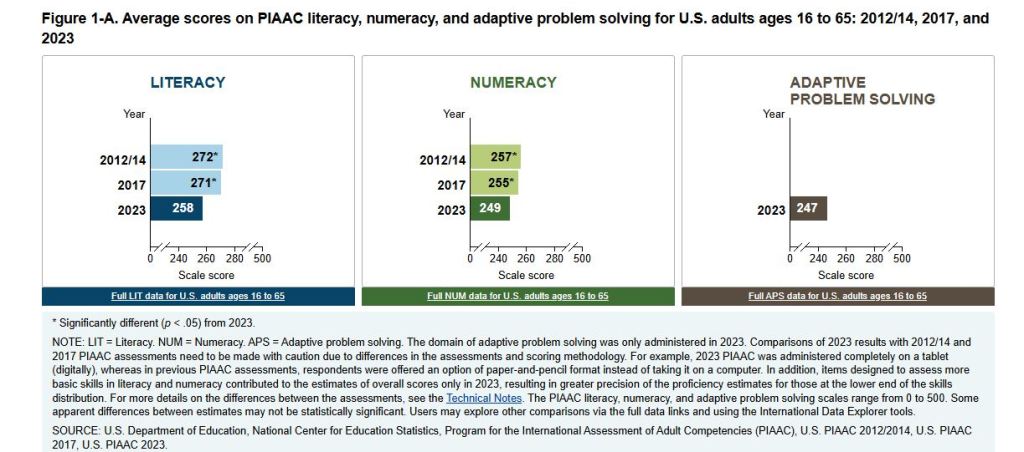
  • As for the United States’ adult population, 30% of them can only read at the level of a 10-year-old, and both numeracy and literacy levels as measured by the Program for the International Assessment of Adult Competencies have dropped consistently among those ages 16-65 (see graphic).

Now since literacy of any kind is the foundation for the ability to reason and the basis for all background knowledge needed to make good decisions in a complex world, then these facts are extremely problematic—and that is a very generous understatement.  As New York Times columnist David Brooks puts it—quoting retired generals Jim Mattis and Bing West—“if you haven’t read hundreds of books, you are functionally illiterate, and you will be incompetent, because your personal experiences alone aren’t broad enough to sustain you.”  Reading—and lots of it—is the keystone to our capacity for critical reasoning, and just as the absence of a keystone species in an ecosystem will lead to its collapse, the absence of reading in a country’s population is a recipe for the breakdown of our entire social order.

And before I am accused of hyperbole, I am already witnessing the potential for this breakdown in my own classes and have been now for over a decade.  Like Anya Galli Robertson, who teaches sociology at the University of Dayton, I too have continued to “give similar lectures, assign the same books and give the same tests that [I] always have,” and like Professor Robertson, I too have seen firsthand how “years ago, students could handle it; now they are floundering.”  Moreover, while the mental coddling I’ve written about before is definitely playing a role in this situation, the even bigger causal source for this general decline in my students’ collective IQ, CQ, and EQ is their poor reading habits.  Habits due in no small degree to the amount of screen time spent on their phones. 

Also (to quote Brooks again): 

Not just any screen time.  Actively initiating a search for information on the web may not weaken your reasoning skills. But passively scrolling TikTok or X weakens everything from your ability to process verbal information to your working memory to your ability to focus. You might as well take a sledgehammer to your skull.

Or more accurately, a broom.  To see why, a little brain science from my own classroom is in order.  Each year around this time, I have my senior anatomy class perform a series of experiments.  I give them a standard short-term memory (STM) test in the absence of their cellphones; we do a few other learning activities; then they take the exact same test a second time while grasping their phones in their hands after playing with their devices for two minutes.  Data is scored, loaded into the spreadsheets, and then we wait until the next class where we do the exact same sequence of events with a different but equivalent STM test—only this time, no phones are present at all.  Again, data is scored, and I “innocently” ask how many of them scored better the second time—to which every hand in the room rises, and I use this fact to introduce the concept of working memory.

Put simply, working memory is like a temporary storage shelf that your hippocampus uses to place items from your immediate STM that you might want to add eventually to long-term memory (LTM).  It’s a parking lot for thoughts and experiences needing evaluation as to whether they are important enough to dedicate to your LTM, and it’s why you can recall what you had for dinner last night—something that is no longer in your current STM awareness—but cannot say what you had for dinner a month ago (unless you have one of those extremely rare autobiographical memories).  Basically, your working memory still has last night’s dinner on its shelf waiting for processing while nearly every previous meal you’ve ever eaten has been swept from the shelf as not having enough significance for LTM (again, those special ones you do remember got the required import tag).

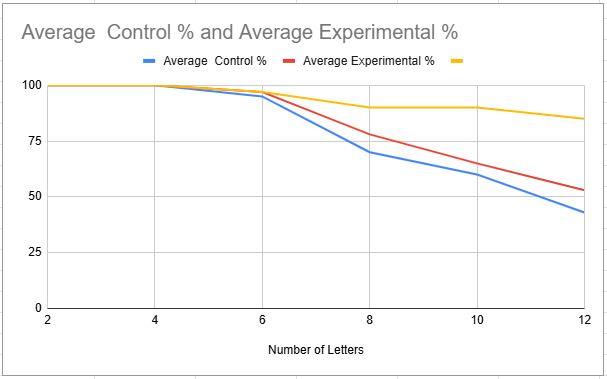
Having taught all this to my students, what I do next is bring up the graph below, and this is when their eyes all widen and why I do not, like David Brooks, have to say “so the main cause is probably screen time” (my emphasis).  The blue line represents the impact on STM of asking it to store and recall increasingly longer sequences of random letters.  It is the averaged student data from the very first STM test, and it is exactly the trend neuroscience would expect.  The yellow line represents what neuroscience says should have happened after my students took the exact same test a second time that first day (and which did happen with the second STM test).  The red line, though, is what happened when my students were holding their phones after playing with them while taking the exact same test a second time: the mere physical presence of the devices wiping their working memories clean.  Groundhog Day for the brain, every day, 365 per year.

Anyone not unnerved at least a little by this data about our devices is probably not reading this essay in the first place, but if not convinced, then, like David Brooks:

My biggest worry is that behavioral change is leading to cultural change. As we spend time on our screens, we’re abandoning a value that used to be pretty central to our culture — the idea that you should work hard to improve your capacity for wisdom and judgment all the days of your life. That education, including lifelong out-of-school learning, is really valuable.

However, as I reminded my seniors this year, let’s be generous and assume anyone reading this essay gets that our society’s changing habits about reading and learning may be endangering our very future.  Then the logical question to ask next is: how our society is handling this potential crisis?  Again, “just the facts” can be useful:

  • The Baltimore City Public Schools have had to close their tutoring program for reading remediation for 1,100 students because of the withdrawal of $418 million dollars in promised pandemic recovery funds (as a district, they will not be alone).
  • The former CEO of World Wrestling Entertainment—the “apotheosis” of demanding intellectual engagement!—has been confirmed as the next United States Secretary of Education, with the explicit charge to dismantle and destroy the entire department (the executive order was signed a month ago).
  • Harvard University has lost more than $2 billion in federal research funds for having the temerity to basically say that critical thinking matters (with additional threats to their tax-exempt status on the line).
  • And, finally, as a country, we have ceded to China the global leadership in research output in the fields of chemistry, physics, and earth & environmental science (with biology and the health sciences soon to follow due to the recent defunding of the NIH and the firing of many of their scientists).

That last fact may be the most telling one, and it is why I was sorely tempted to title this essay “The Stupidifying of America.”  Our collective education system in this country no longer produces enough “home grown” PhD scientists and engineers, as well as other levels of expertise, to meet our most basic economic needs, and the “cruel farce” that is the Trump administration is simply going to make things worse.  As Thomas Friedman points out:

Do you know what our democratic allies do with rogue states? Let’s connect some dots.  First, they don’t buy Treasury bills as much as they used to. So America has to offer them higher rates of interest to do so — which will ripple through our entire economy, from car payments to home mortgages to the cost of servicing our national debt at the expense of everything else…[Thus] bond yields keep spiking and the dollar keeps weakening — classic signs of a loss of confidence that does not have to be large to have a large impact on our whole economy…[Furthermore,] you shrink all those things — our ability to attract the world’s most energetic and entrepreneurial immigrants, which allowed us to be the world’s center for innovation; our power to draw in a disproportionate share of the world’s savings, which allowed us to live beyond our means for decades; and our reputation for upholding the rule of law — and over time you end up with an America that will be less prosperous, less respected and increasingly isolated.

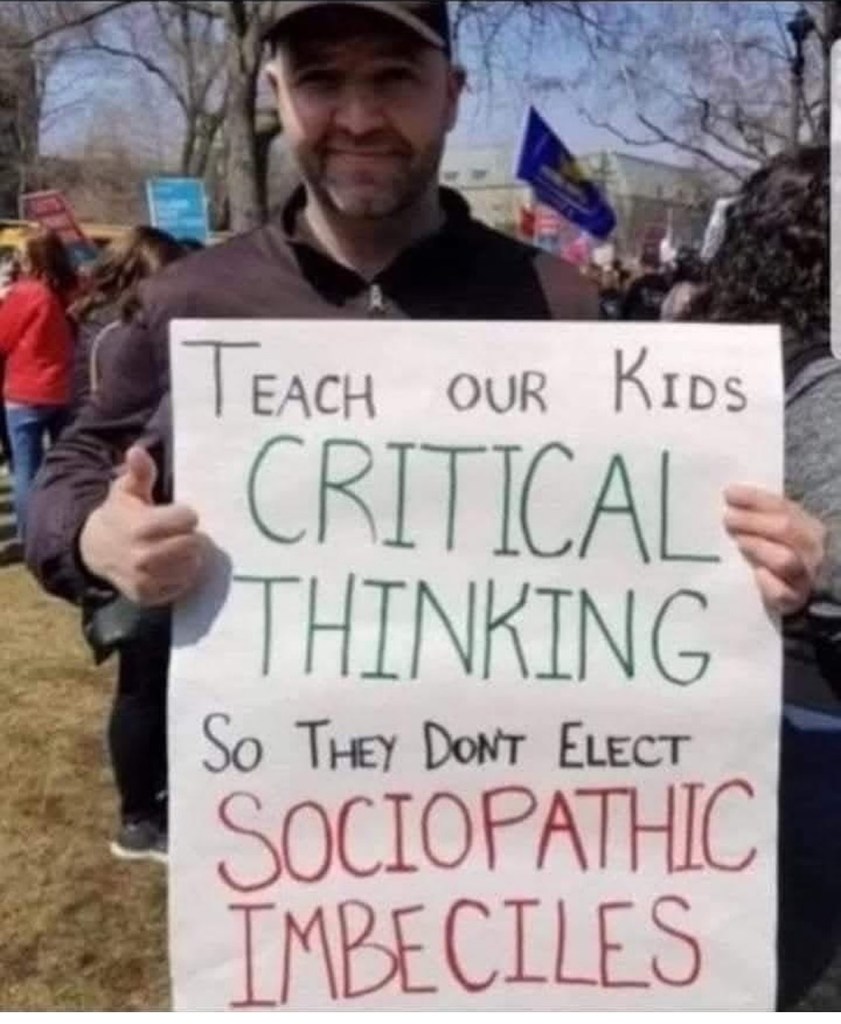
Like Friedman, I am truly frightened for our country, but like Goethe, I know what I need to do in my small corner of influence to combat the rising tide of ignorance, anti-intellectualism, and antipathy.  As the sign at one of the Hands Off protests suggests, I’ll keep teaching critical thinking to my students—in the hope that future elections might turn out for the better.

References

Bowie, L. (April 4, 2025) Baltimore Schools to Cut Tutoring and More After Trump Administration Backtracks on Funds.  The Baltimore Bannerhttps://www.thebaltimorebanner.com/education/k-12-schools/baltimore-city-schools-federal-funding-AM5PH4I6G5B3PCG66S6RC3IKDE/.

Brooks, D. (April 10, 2025) Producing Something This Stupid is the Achievement of a Lifetime.  The New York Timeshttps://www.nytimes.com/2025/04/10/opinion/education-smart-thinking-reading-tariffs.html.

Friedman, T. (April 15, 2025) I Have Never Been More Afraid for My Country’s Future.  The New York Timeshttps://www.nytimes.com/2025/04/15/opinion/trump-administration-china.html.

Lukianoff, G. & Haidt, J. (2018) The Coddling of the American Mind: How Good Intentions and Bad Ideas are Setting Up a Generation for Failure.  New York: Penguin Books.

Nation’s Report Card (2025) National Assessment of Educational Progress.  https://www.nationsreportcard.gov/.

NCES (2023) Program for the International Assessment of Adult Competencies (PIAAC).  https://nces.ed.gov/surveys/piaac/2023/national_results.asp.

Science & Safetyism

Wrong opinions and practices
gradually yield to fact and argument:
but facts and arguments,
to produce any effect on the mind,
must be brought before it.

—John Stuart Mill

As an educator, one of the challenges of the safetyism I discussed last time is the reality that my students today are not as adept at critical thinking as my students earlier in my career.  They are simply less able to connect their claims to reliable evidence properly, and no, that is not just “old fogey-ism” on my part.  I can document the extra supports and other interventions that I have needed to steadily and increasingly add over the decades to help my current students achieve what their “elders” before them once achieved semi-autonomously (because a good teacher meets their students where they’re at; not where the teacher might wish they were). 

Digital technology, of course, has played an enormous role in this new reality for me as a teacher, but in exploring Lukianoff’s and Haidt’s concept of safetyism, I have begun to realize how much my students are arriving in my classroom having never really confronted the disagreeable ideas and opinions so necessary to the development of critical thinking as an intellectual skill.  In some instances, they have never even encountered them at all! Hence, I now see that the rise of safetyism in our society has been impeding the development of my students’ critical thinking as much as their lives as digital natives has.  In both instances, they have been able to systematically avoid cognitive unpleasantries such as boredom, dissonance, and inconvenient truths and so avoid learning how to deal with such things.

How, then, do I address this reality, and why—as I implied at the end of my last posting—do I think my particular discipline has some built in advantages for doing so?  I have written before about the kind of general pedagogy I believe can promote and improve critical thinking skills (it is a major focus of this project). But today I want to address why I think that my teaching science specifically—rather than other possible academic disciplines—gives me an extra edge when it comes to defeating the educational challenges of safetyism.

 And I want to do so by turning first to someone who I am starting to think of as an intellectual kindred spirit, Jonathan Rauch.  I visited his concept of “liberal science” earlier in my writing when exploring his “constitution of knowledge.” But in reading some of his other work recently, I found that he has gotten me to “thinking about science as a set of rules for social behavior, rules for settling conflict” (p. 30) rather than simply a way of understanding the world.  He reminded me that disagreements are practically baked into a social species such as ours and that methods for resolving those conflicts inherently involve evoking claims about the truth in a particular situation.  Yet while anyone can make “three new [claims] every day before breakfast, the trouble is, they will almost always be bad [claims].  The hard part is figuring out who has a good [one]” (p. 64, original emphasis).  Hence, as Rauch reminded me, one of the most fundamental problems any society must cope with to survive is the epistemic one: the nature and limits of human knowledge.  Or as he puts it, “when is it legitimate for me to say ‘I’m right and you’re wrong!’ and to act accordingly?” (p. 35).

His own answer, of course, is only if such a claim has survived the crucible of liberal science.  Any proposition must endure repeated testing against the empirical realities of life and must have persisted repeatedly before said potential error can make any claim to a degree of truth.  For Rauch, that is the innovation and genius of the scientific process of truth determination:  not in doing away with human bias and ignorance but in channeling them.  As he argues, “the point of liberal science is not to be unprejudiced (which is impossible); the point is to recognize that your own bias might be wrong and to submit it to public checking by people who believe differently” (p. 67).  Science in Rauch’s outlook is the intellectual equivalent of natural selection, “[mimicking] the greatest liberal system of them all, the evolution of life” (p. 57).

And it is that last metaphor that has caused me to ponder whether the discipline I teach has some built-in advantages when it comes to resisting safetyism.  Because in learning science, a student in my class is inherently in conflict.  Conflict with preconceived notions.  Conflict with what the data you just collected tells you.  Conflict with the required skepticism that you could always be wrong…. 

I could go on, but the bottom line is that you cannot learn science and somehow evade the very thing safetyism seeks to prevent and avoid—conflict.  It’s not that other disciplines can’t have conflict built into them, too (and responsible, thoughtful teachers of those disciplines deliberately do so).  But having taught history, I know that one can offer a version of it where the conflict has been white washed from it, and I can imagine an English or Foreign Language class where what is read is very safe and unchallenging.  Science, however, literally cannot be taught without disrupting how a child looks at and experiences their world.

Not that science doesn’t still lose some of the battles.  As I was outlining this essay, a student was removed from one of my classes by a family upset with the demands of the course, declaring that my teaching was making their child feel emotionally uncomfortable and overwhelmed.  Ironically, this course is an elective; so the student had chosen to enroll, and I am extremely candid and forthright at the beginning of the year—with both students and parents alike—that a fundamental goal of this particular class is to create learning situation where children will intellectually fall down and that with my help, they will learn how to stand back up in the similar situations that they will encounter next year in college.  The metaphor I sometimes use is that of an academic drill sergeant but one who loves and cares, and the rationale I provide is summed up so nicely by Rauch that I may use his very words next fall:

The social system does not and never can exist which allows no harm to come to anybody.  Conflict of impulse and desire is an inescapable fact of human existence, and where there is conflict there will always be losers and wounds…The chore of a social regime is not to obliterate conflict but to manage it, so as to put it to good use while causing a minimum of hurt and abuse (p. 122).

I want all of my students prepared for adulthood and the necessary adulting that comes with that, and I know that if you never fall down, you can never learn to get back up.  My sadness for my now former student is that she was allowed to remain on the ground.

References

Lukianoff, G. & Haidt, J. (2018) The Coddling of the American Mind: How Good Intentions and Bad Ideas are Setting Up a Generation for Failure.  New York: Penguin Books.

Rauch, J. (2013) Kindly Inquisitors: The New Attacks on Free Thought (Expanded Edition).  Chicago: The University of Chicago Press.

Some Disheartening Developments

If you have raced with men on foot
and they have worn you out,
how can you compete with horses?
If you stumble in safe country,
how will you manage
in the thickets by the Jordan?

—Jeremiah 12:5

Despite what my title might suggest, today’s essay is not about the educational costs of the pandemic.  I have already written extensively about that topic (see the LoC Archives page for anyone interested), and if you want the most recent data, I suggest checking out the NYT’s article available in the references.  In fact, the only thing I will lift up about the latest findings is that we now know that all the school closings had nearly zero impact on slowing the spread of the virus; we could have kept them open and avoided nearly all of the learning damage.

No, what I want to focus on today are some recent developments in the world of education that are worth bringing to everyone’s attention because as I ended my last posting pointing out:  we are all in this together.  So here goes.

The most recent item to cross my attention was an article this past week about the expense of repairing the educational costs of the pandemic, as well as the—yet again—absence of political will to address it.  As all Marylanders (and my regular readers) know, our state has recently legislated and initiated a massive 10-year, eventually $3 billion dollars per year education reform movement called the “Blueprint for Maryland’s Future.”  In it are requirements to expand public Pre-K schooling for all children ages 3-4 and to provide all schools with high-quality and diverse educators (with an emphasis on National Board Certification).  In addition, there are requirements for preparing students for college and career readiness, more resources for low-income students, and the necessary governance and accountability programs to oversee the entire effort.

However, in a state already facing a teacher shortage of 2,000 unfilled positions and now facing a projected revenue shortfall of $255 million dollars in the coming fiscal year, teachers and educational leaders are currently being asked to triage their biggest challenges in implementing the Blueprint before the process has even started.  Here we are, in one of the richest states in the richest society in the history of humanity, and we are already shorting the necessary investment in our children because no one wants to state the obvious:  you get what you pay for, and in this case, that means additional taxation—America’s “third rail” in politics.   

Not that Maryland is alone.  The same morning that I read the Blueprint article, NPR had a story on the negative impact that losing the $190 billion dollars in pandemic emergency relief funds from the Federal government will have on schools across the nation.  As John Gies, a high school principal in rural Ohio put it, “while those pandemic dollars are running out, the problems the pandemic exploded, like missed learning and a student mental health crisis, are still here…we just really need some help from the government.”  Help that all interviewed for the story openly acknowledged is not likely to come, leaving reporter Cory Turner musing at the story’s end:

So what happens now? It seems unlikely that Congress will be in the mood to agree on even more funding for schools. Which means in the coming months, districts across the country will face some hard choices about whether they can afford to keep giving students all the help they need.

All the help they need.  Need.  Not “help-full.” Not “beneficial.” Not “useful.”  Need.  As in necessary, critical, vital to their well-being.  I know I have written before about how fundamentally anti-child our society is, but as both these news items came to my attention this past week, I was reminded once again of a quote of Barbara Kingsolver’s that bears repeating here:  “if it takes a village to raise a child, our children are knocking on a lot of doors where nobody seems to be home…where we seem to regard children as a sort of toxic-waste product: a necessary evil” (pp. 102 & 100).  Until we see our children in a different light than we currently do, then we will reap what we sow, and right now, I fear we are sowing our own dissolution.

And we seem to be doing so in more ways than one when it comes to what’s happening in the world of education.  Another recent item in my in-box was Jessica Grose’s op-ed about a middle school in California where students have employed AI technologies to manufacture false pornographic photos and short videos of their female classmates by taking head shots from existing, decidedly non-pornographic on-line photos and combining them with nude photos and videos from other sources.  Of course, the students involved then shared these digitally constructed items with others—making them a permanent part of the lives of both the victims and the victimizers (as well as violating numerous laws)—and all because these children don’t yet have pre-frontal cortices developed enough to know how truly stupid, irresponsible, and harmful they have been.  Yet legislation at any level can’t seem to get out of even committee to put guardrails on such technology, let alone simply acknowledge the danger it poses—especially the threat to our children’s very capacity to become healthy adults.

Not that all adults in children’s lives are themselves of sound and rational mind.  While we might consider as “sins of omission” the failure to adequately fund schools across this land and to protect developing minds from digital technologies that trigger the same neural pathways as cocaine does, the actions of Escambia County in Florida (home to Pensacola) most definitely could be considered “sins of commission.”  There, elected officials have taken upon themselves the “obligation” to “protect young minds” from such “dangerous material” as the following:  The American Heritage Children’s Dictionary, Webster’s Dictionary for Students, and Merriam-Webster’s Elementary Dictionary.  All of which have now been removed from every school library in the county and placed into storage along with “eight different encyclopedias, two thesauruses and five editions of The Guinness Book of World Records.”

Fortunately, some sanity still exists in Florida, and two parents in the county—yes, 2! out of a population of 322,390 as of the 2021 census—have joined in a lawsuit against the county school board to return these alleged “hazards” to their schools’ libraries.  Hopefully, as Heidi Stevens puts it, “the children of Escambia County [will soon] once again [be] allowed to look upon words.”  But even more importantly, they will hopefully be allowed to learn that “definitions are not the enemy.  Dictionaries are not the enemy. Thesauruses are not the enemy.  Encyclopedias are not the enemy.  Knowledge is not the enemy” (my emphasis).  What is the enemy is ignorance, “and it should go without saying, but apparently it doesn’t: A child is far better served looking up a word—any word—in a dictionary than typing that word into Google, where a world of images, videos and misleading garbage awaits” (Stevens).

Which brings me to my last disheartening development of the past few weeks.  This one is strictly anecdotal, but I do not think that makes what happened any less compelling.  It was during one of my scheduled meetings with my advisory, and we were playing Pictionary as a way of unwinding right before spring break.  It is a favored game of ours, and to make it a little competitive, I divide the group into two teams, with the winning team allowed to decide which confectionary treat I bake for them—which is itself an inside joke because the winning team always chooses my lemon bars—but nevertheless, they can still get quite competitive about it.

Well, on this occasion, the competition was a little more intense than usual, and both teams were trying to pick particularly challenging words for the other to draw.  Or more accurately, they were googling on their phones for challenging words to use, and when I saw the terms they were picking, I was stunned.  These are 10th graders, most of who are at least 16 years old, and they were needing an on-line search engine to find words that were part of my basic vocabulary by the time I was in 5th grade—vocabulary that I was expected to know and assessed for by the time I was 12. I knew my students of the past decade were not developing the same long-term memory storage banks as in the first two decades of my career, and I had seen the practical consequences of this reality in my classroom.  But here, that ignorance—and the degree of it!—was staring me existentially in the face in a way it never has before, and the despondency that settled over me for the rest of the day was profound.

However, it was not my final outcome, nor can it ever be.  No matter how disheartening the recent developments in schools, none of us in our society can afford to ignore them nor to be ignorant of them.  Anyone who has read my project updates since their inception in the spring of 2020 knows that I regularly use these essays in part to process the realities of teaching in the 21st Century, in part to share these realities to challenge others to action, and in part as an act of hope.  The truth is: dispelling the darkness is never easy.  But if we do not know the nature of its current character, we cannot know what type of flame to bring to the task.  Thus, if any of this essay’s revelations have sparked a response in you, I encourage you to determine how you can fan it into a fire to light your own way forward.

I will keep offering these reflections to keep fanning mine.

Coda

Since I first drafted this essay, two things have happened that bear on it.  The first is the tragic collapse of the Key Bridge into the Baltimore harbor.  In addition to the pain of the families who lost their loved-ones that morning will come the economic pain that will reverberate in my adopted home for years to come.  The region is losing $15 million dollars a day in revenue for every day the port remains closed, and even once re-opened, the impact of rerouting over 10 million cars and trucks annually will be felt for at least a decade (one woman interviewed shared that her commute is now an hour longer, and she will not be alone). The new reality is that in a state already struggling with how to pay for school reforms before this catastrophe, that $255 million shortfall is going to look like a pittance.

Yet, amidst this tragedy, I received an e-mail from a former student of mine from the class of 2010, informing me that her lab team was just selected to build the seismometers going with the astronauts to the Moon on the Artemis III mission in 2026.  She was writing to thank me (as well as another friend and former colleague), and in her own words, “you both are the most influential teachers I have had over a *very* long time spent in school, so I wanted you to be the first of my non-space community to know other than my parents. Thank you for getting me here, even if it has been a while. :)”

Now, I do not wish to suggest that these two events are even remotely on the same scale.  However, I share them because together they are intimate reminders that life’s journey is fundamentally the paradox of BOTH tragedy AND triumph, and if we spend too much time consumed with one or the other, we lose the necessary balance to navigate our “4,000 weeks” successfully.  The same is true of teaching; if I cannot find ways to harmonize the heartening with the disheartening, I lose the ability to engage authentically in the classroom.  It is a lesson worth relearning; it is a lesson worth remembering.

I suspect the same could be said of us all.

References

Grose, J. (March 2, 2024) A.I. Is Making the Sexual Exploitation of Girls Even Worse.  New York Times.  https://www.nytimes.com/2024/03/02/opinion/deepfakes-teenagers.html?smid=nytcore-ios-share&referringSource=articleShare.

Haidt, J. (March 13, 2024) End the Phone-Based Childhood Now: The Environment in Which Kids Grow Up Today is Hostile to Human Development.  The Atlantic.  https://www.theatlantic.com/technology/archive/2024/03/teen-childhood-smartphone-use-mental-health-effects/677722/.

Kingsolver, B. (1995) Somebody’s Baby.   High Tide in Tucson: Essays from Now or Never. New York: HarperCollins.

Mervosh, S.; Miller, C.; & Paris, F. (March 19, 2024) What the Data Says About Pandemic School Closures, Four Years Later.  New York Times. https://www.nytimes.com/2024/03/18/upshot/pandemic-school-closures-data.html.

Price, L. (March 20, 2024) School Leaders Outline Effort: Implementing Blueprint Law is Going to be ‘Herculean’ Task.  The Baltimore Sun, pp. 1-2.

Schmitz, R. (March 19, 2024) Standardized Test Scores for Teens in Germany are Down. Teachers aren’t Surprised.  NPR Morning Edition.  https://www.npr.org/2024/03/19/1239388574/standardized-test-scores-for-teens-in-germany-are-down-teachers-arent-surprised.

Stevens, H. (Jan. 21, 2024) Now Dictionaries? Do Better, Grown-Ups.  The Baltimore Sun (Life & Travel), p. 6.

Turner, C. (March 20, 2024) The $190 billion in Emergency Funds Given to Schools During the Pandemic is Ending.  NPR Morning Edition.https://www.npr.org/2024/03/20/1239609135/the-190-billion-in-emergency-funds-given-to-schools-during-the-pandemic-is-endin.

The Inner Journey

The sun rises and the sun sets,
and hurries back to where it rises.
The wind blows to the south and turns to the north;
round and round it goes, ever returning on its course.
What has been will be again,
what has been done will be done again;
there is nothing new under the sun.

—Ecclesiastes 1:5-6, 9 (NIV)

What are the conditions
that might make it possible for us to operate
at a modest level of prophetic inspiration,
to bring a daily beauty to our lives,
sustaining to ourselves, our students,
and our communities?

—Mary Rose O’Reilley

If you have read even elements of Part I or Part II of this project of mine or followed any of my updates since I finished the body of my e-book in the spring of 2020, you know that I have focused nearly 100% of my attention on either discussing how to improve what takes place in our classrooms or examining the very pragmatic challenges we confront in education today.  Only rarely have I addressed some of my personal motivations for why I teach or spoken about the teaching sojourn itself.

Yet I find myself struggling this school year with one of my classes in ways that I have not had to in a very long time—which is both proof-positive that you never fully master this profession and a humbling reminder of my own “work-in-progress” as an individual even after six decades of existence.  Granted, the value of so many years (both in and out of the classroom) is the insight that this is not my first time feeling utterly ineffectual with a group of students nor am I likely to fail to have some modicum of positive impact on some child under my care (I must never forget Mark!).  However, what those decades of insight also bring is the recognition that it is possible to “stay too long at the party.”  Effective teaching requires authentic engagement, and authentic engagement demands:  embracing the role of co-learner; appropriately intimate rapport; and a thorough understanding of the neuroscience of the brain.  And it doesn’t matter how good you may be at any one of them individually, without all three, the “stool” doesn’t stand and genuine learning doesn’t happen.

Which is what I find myself wrestling with right now.  I cannot seem to generate the necessary rapport to generate the necessary investment on the part of a group of my students, and what I’m not sure about at this moment is whether I’m simply dealing with a situational issue or a generational one.  If the former, I can accept a transient failure.  Those moments of loss are painful and to be fought against at all costs.  But my finitude can never be completely overcome, and I have had and will have classes where I perform inadequately in my keystone niche as the teacher.  Sin is real, and I will not succeed with every class or every child I encounter during my career. 

However, if the issue is a generational one, that gives me greater pause.  In a world where many in the younger generations openly prefer an AI chatbot for a romantic partner—and get upset when software updates alter their “significant other” (oddly enough simulating what can happen between actual human beings)—I don’t know that I have the cognitive tools to develop appropriately intimate rapport anymore.  Nor do I think I would want the tools that might be needed today. As was once wisely observed, “the ‘secrets’ of good teaching are the same as the secrets of good living:  seeing one’s self without blinking, offering hospitality to the alien other, having compassion for suffering, speaking truth to power, being present and being real” (O’Reilley, p. ix).  None of which are possible in the zombified digital realm that seems to consume today’s young (and, in fairness, many of their elders as well).

The simple truth is that I choose not to live unable to read a map, perpetually terrified of FOMO, attending to conspiracy theories, and addicted to a screen.  Yet in doing so, am I making it no longer possible to relate existentially to the realities of my students in the ways needed to develop authentic engagement’s required rapport? For example, for decades, I deliberately listened to their music because I knew the connections it could bring.  However, for the last five years, I have been unable to bring myself to do so because I cannot find the tolerance within me to expose myself to something I find totally banal and empty of all meaning.  Has my own personal journey, therefore, reached a relational wall through which I can no longer construct a door?

I wish I had an answer to that question—it is obviously part of my conundrum—yet what truly unsettles me about the current situation is the memory it stirs of my grandfather.  He and my grandmother acquired a VCR sometime in the late 1980s (the recall of how alludes me), and I remember my dad trying to show my grandfather how to program it to record TV shows.  To which my grandfather firmly declared, “NO.”  At nearly 80, he had simply reached the end of his willingness to learn yet-one-more-thing in a lifetime that had started before most homes in this country had plumbing and which had eventually witnessed humans on the moon and space probes taking pictures of Neptune.  He was done, and he was okay with being done.

Have I, I wonder, reached a similar moment in my teaching? Have I reached the point of “done” with the generation of students now entering my classroom? That is what I find myself struggling to resolve, and it is a disquieting experience as anyone who has read my work can well imagine.  On the one hand, the wisdom of Ecclesiastes reminds me not to take my challenge with this one class too seriously; as my maternal grandmother oft said, “this, too, shall pass.”  On the other hand, the wisdom of Mary Rose O’Reilley reminds me that “it’s impossible to hear a subtle call if you do not create a conscious time to listen to it” (pp. 43-44); so what might I not be hearing that I should be?

One answer, of course, is that it is perhaps my disquiet itself to which I should be listening.  The fact that I have kept trying to connect with this class, one thing after another, attempting to breathe life into what feels daily like a black hole of ennui, is probably indicative that I am not “done” in the way my grandfather once was.  If I did not care, I would not be so dissatisfied with my efforts to educate this collection of students.  Hence, maybe I need to “cut myself a little slack,” as they say, and accept that working my hardest this year is simply going to have to be the best I can do with this group for this year.

And I think I would be okay with that if not for the fact that I am not experiencing this challenge with my other courses.  I’m co-learning, rapporting, and neurosciencing just fine with my juniors and seniors, and in fact, on my course evaluation this past week for my Genetics class, one of my students—in response to my query “what is one thing you would never want me to change about this course?”—replied “you as the teacher.”  Hence, I am clearly engaging authentically with at least a subset of the population at my school; it’s just the 9th grade which is proving so intractable this year.

Which pivots me back to the generational question.  Ninth graders have been my area of expertise for nearly my entire career.  Indeed, for 14 years on the 9th Grade advisory team at my former school, my friend and Grade Dean, Paige and I would jokingly refer to ourselves as each new class’s “mom & dad.” Therefore, finding myself alienated from a group I have historically been so effective with as an educator is dispiriting and begs for an answer to “why?” that has so far alluded me this year.  I do recognize that I could simply be struggling with the learning fallout from the pandemic (this specific group would have been in Middle school throughout it), and I recognize that I may just not have fully evolved and adapted my teaching toolkit yet to meet such a need.  But that recognition doesn’t make it any easier to watch still another attempt to generate the conditions for meaningful learning in this class fall short, and I cannot avoid wondering what in this situation am I missing? And how does that “what” need to inform my future as a teacher?

The school year, of course, is not over, and I am too much the scientist not to finish collecting all the data before coming to any final conclusions.  Furthermore, those same decades of insight mentioned earlier also remind me that this is not my first time questioning whether I should still be at the “party,” and it is unlikely that it will be my last.  Again, it is when I am no longer having this internal dialogue about my capacities as a teacher that I should probably be bringing the journey to an end.

Until then, I have another lesson to plan.

References

O’Reilley, Mary Rose (1998) Radical Presence: Teaching as Contemplative Practice.  Portsmouth, NH:  Boynton/Cook Publishers.

Plait, P. (Dec. 2023) Conspiracy Theories Then and Now.  Scientific American. Pp. 80-81.

Campbell, R. M. (Dec. 2023) AI Chatbots Could Weaken National Security. Scientific American. Pp. 73-74.

The Pulse (Jan. 5, 2024) Virtual Worlds, Virtual Lives.  NPR.  https://www.npr.org/2024/01/05/1200586530/virtual-worlds-virtual-lives.