If you are here unfaithfully with us,
you are causing terrible damage.
— Jalal Al-Din Rumi
This topic is a challenging one for me. Those closest to me know that I am not the biggest fan of my half of the species and that I can tally on one hand the number of fellow males I would count among my close friends. In fact, I usually simply tolerate most of the other males in my life. I loathe the banal culture of the “locker room,” and I am so actively antagonistic to the patriarchy that I like to claim that my mother jokes that she raised two children and one feminist and that it wasn’t her daughter. Bottom line, I much prefer the company of women—to the degree that in classic couples situations where the men and women usually pair off with their respective genders, you will find me in the kitchen with the women. There is a reason I spent the majority of my teaching career at a single-sex all-girls school.
However, today I find myself once again in a fully co-ed environment where I have a professional duty to authentically engage all my students for purposes of nurturing them to become their best authentic selves, and so I read Clair Cain Miller’s article in the New York Times with a profound sense of downheartedness. I already knew that suicide rates have always been generally higher for men than for women and that those rates have increased for all young people in the past decade—much of it directly attributable to the impact of social media ([expletive deleted] Snapchat!). But to learn that the suicide rate in the population of males I work with has effectively doubled from 11 per 100,000 to 21 per 100,000 since 1968 was disturbing to say the least. That’s over 4,600 teenage boys and young men dead by their own hand in 2023 alone—a rate that only goes up as they age.
Why? What could be causing an increasing number of males—in a fundamentally patriarchal society!—to fail to thrive? Part of the answer seems to be economic. As the types of positions traditionally identified with masculinity—so-called “blue collar” jobs—have been increasingly eliminated by robots and other forms of automation, the remaining employment opportunities and those where there has been steady job growth rely more and more on the so-called “soft skills” traditionally associated in our culture with women. Which in a patriarchy can be viewed as problematic. As Tracy Dawson, a 53-year old unemployed welder from St. Clair, Missouri, made abundantly clear in a 2017 interview: “I ain’t gonna be a nurse; I don’t have the tolerance for people. I don’t want it to sound bad, but I’ve always seen a woman in the position of a nurse or some kind of health care worker. I see it as more of a woman’s touch.”
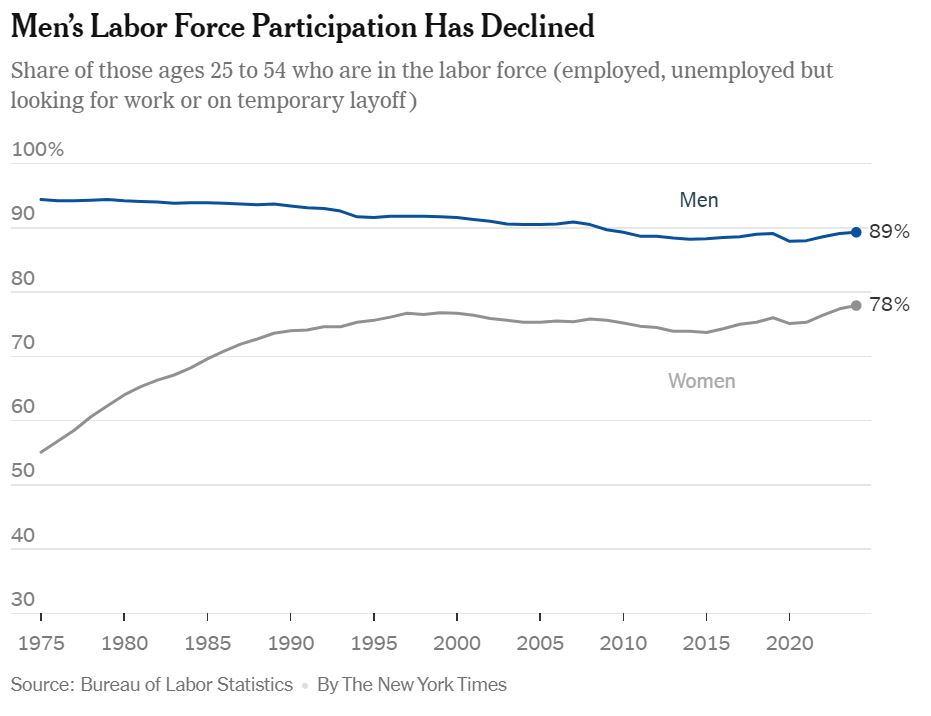
Of course, attitudes such as these have been around for a long time (pop-culture was recognizing this fact as early as the late 1970s, and Bruce Springsteen made a career out of examining them). However, Robb Willer, professor of sociology at Stanford, is blunt when he states that, today, “the contemporary American economy is not rewarding a lot of the characteristics associated with men and masculinity, and the sense is those trends will continue.” So where does that leave the Tracy Dawson’s in this world? It leaves them under- or unemployed in an increasingly shrinking part of the work-force (see chart below)—with all the consequent potential for undermining and harm to an individual’s sense of self and well-being.
Yet, underlying this employment issue and any subsequent potential changes in how men in America perceive themselves today is an even deeper root cause and one that directly impacts me as an educator. Since learning is the gateway to everything about a person’s life, any changes in educational status will impact a person’s entire existence, and the reality is that today, starting as early as kindergarten, boys are arriving in our schools less prepared than girls, both in academic readiness and their behavior. The likely reason for this is the increased focus on college-readiness that has taken over schooling in the past two decades, forcing educational institutions of all kinds to emphasize academics at earlier and earlier ages. That is something which boys, who usually mature later than girls, are less prepared to handle, and as a result, boys are not getting the same academic head start that girls now are. Furthermore, this gender gap in academic performance continues to persist in today’s schools as both sexes move up through the grade levels, resulting in women being more likely to graduate, earn higher G.P.A.s, and even go on to college. Indeed, women now outnumber men at the college and university level with 66% of female high school graduates compared to 57% of the male ones.
Again, where does this leave the young Dawson’s in this world? Well, since the link between matriculation from college and broader career prospects and higher earnings is well documented, it leaves a lot of them increasingly left behind economically, frequently still living with their parents, and ever more susceptible to the reckless ravings of an autocrat. As Jonathan Rauch articulates in his Constitution of Knowledge, these are the men who hear the perfectly authentic and valid challenge to their male privilege, look at their employment prospects and long-term financial outlook, and reply “Privilege?! What privilege?!” It is precisely because the implied social contract of the American patriarchy told them that simply being male guaranteed them a degree of status in our society that the perceived failure to deliver on that “promise” has resulted in men who will storm our capital, vote for a self-declared “dictator for one day,” and sometimes literally kill themselves out of their despondency.
So what are we, as a society, to do? The feminist in me may be tremendously excited by the data showing how far the status of women in our country has improved since my childhood (still can’t believe my own mother once could not have her own credit card!). What’s more, the educator in me still knows how far there still is to go for women to achieve true equity with men in this country (especially in the face of the patriarchy’s current pushback under the Trump administration). However, just because I personally am not a cheerleader for men does not mean I believe that they somehow do not deserve to have lives of meaning and purpose. ALL humans deserve that. Indeed, the foundational flaw of both the patriarchy and systemic racism is their refusal to believe this very thing!
However, the automation of the workplace continues unabated, and with AI, this is even going to start being true of some of the so-called “white collar” jobs. Thus, it will not just be the unemployed welders and longshoreman dealing with the ennui in their lives; it will also be the unemployed estate lawyers and radiologists confronting their lack of purpose. Which brings me full circle after my brief (but important) digression to my original question: what do we do about this?
There are at least two things in education we could do right away. The first is to consider restructuring the configuration of our early elementary classrooms when it comes to males. Just as there is data showing that single-sex classroom environments benefit middle-school aged girls in the math and science disciplines (and there are co-ed schools both public and private that segregate their populations accordingly for these classes during those years), there is data suggesting that a single-sex environment may benefit K-3 boys in terms of behavioral discipline problems, enabling them to focus better on their learning at this critical age.
Which leads to the second thing schools could be doing to address why some boys and young men are falling behind: teach and employ restorative justice practices in our schools instead of the more traditional punitive approach. The data is clear: boys are far more likely to receive punishments (and frequently harsher ones) for poor decision making than girls do—especially among children of color—and the data is equally clear that by using restorative justice techniques, teachers and administrators alike can help students better manage their emotions and behaviors and find constructive resolutions in situations of conflict. Schools that employ these practices have all shown improved academic performance, and they are safer communities for their inhabitants—again, particularly among children of color.
One additional thing I think we could be doing to address the segment of boys and young men in our population who are struggling to thrive is to reconsider what intelligences we choose to value. Historically, we have always tended to undervalue the kind of critical thinking and problem solving associated with certain jobs such as waiting tables or wiring a house—or welding. But in the recent hyper-focus on “college readiness,” practical, less traditionally academic intelligences have received progressively fewer and fewer formal supports. The vocational tech programs of my youth—we had an entire high school in my district devoted to them—have been steadily dismantled and their government funding withheld or withdrawn, to the point where we actually have a critical shortage of such labor in this country. Resurrecting the vocational tech schools of the past, as educator Mike Rose points out, would go a long way toward addressing a whole host of issues confronting our society—one of which I would like to suggest could be providing the young Dawson’s of our society with both a sustainable income (no one’s automating plumbing for the foreseeable future) AND a sense of meaning and purpose.
As for the one other thing I think might be helpful when addressing this essay’s topic, I will save that for next time.
References
CDC (2023) Suicide Among Adults Age 55 and Older, 2021. https://www.cdc.gov/nchs/products/databriefs/db483.htm#:~:text=Among%20adults%20age%2055%20and%20older%20in%202021%2C%20the%20suicide,%28age%2085%20and%20older%29.
Darling-Hammond, S. (May 18, 2023) Fostering Belonging, Transforming Schools: The Impact of Restorative Practices. Learning Policy Institute. https://learningpolicyinstitute.org/product/impact-restorative-practices-report.
Miller, C.C. (May 14, 2025) It’s Not Just a Feeling: Data Shows Boys and Young Men Are Falling Behind. The New York Times. https://www.nytimes.com/2025/05/13/upshot/boys-falling-behind-data.html.
Miller, C.C. (Jan. 4, 2017) Why Men Don’t Want the Jobs Done Mostly by Women. The New York Times. https://www.nytimes.com/2017/01/04/upshot/why-men-dont-want-the-jobs-done-mostly-by-women.html.
Rauch, J. (2021) The Constitution of Knowledge: A Defense of Truth. Washington, D.C.: Brookings Institution Press.
Rose, M. (2014) The Mind at Work: Valuing the Intelligence of the American Worker. New York: Penguin Books.
UCLA School Mental Health Project (2025) Single-Sex Education: Pros & Cons. https://smhp.psych.ucla.edu/pdfdocs/singleeduc.pdf.
 Light a Candle