A Matter of Scale

To exist is to participate in an endless cycle
of neither creation nor destruction,
but redistribution.

—Zuyva Sevilla

I form light and create darkness.
I make weal and create woe.
I the Lord do all these things.

—Isaiah 45:7

In the late 1970s, videographers Charles and Ray Eames filmed a short, 9-minute  documentary exploring what it might be like to experience reality at a variety of different scales, from the subatomic to the cosmological.  This now iconic (and apparently trademarked) video, the Powers of Ten™, would become the gold standard in many a science classroom for teaching about the concept of magnitude, and for the tiny fraction of my readers who were never exposed to it during their school years or whose memories recall it only vaguely, I recommend a brief pause here to take a short cognitive detour to watch it before continuing.

Because “scale” very much informs this posting’s essay.

It started with the article I mentioned last time about black holes and the accelerating rogue stars shooting across interstellar space at 400 times the speed of a bullet.  Reading that, I couldn’t help but wonder at the enormous dimensions of time and distance this research was hinting at, and I also couldn’t help but think about how absolutely amazing it was that we have the time and resources to know such things and how absolutely utterly irrelevant this knowledge was, is, or ever shall be to the survival of any human that has, does, or will live. 

Unless, of course, we’ve not been looking at quite the right quadrant in the night sky with our telescopes.  Then, one of these hypersonic suns may very well plow into our solar system unbeknownst to us, instantly reducing every quark of matter from Mars to the Kuiper Belt into pure plasma.

But that’s sort of the whole point: everything we experience involves a degree of scale, and the character of that scale can change in less than the wink of an eye.  Take the kind of privilege I wrote about in Unbidden Thoughts:  while differences in economic status may impact how likely one is to engage in proactive civic action (i.e. I have the wealth to fight against Trump), widen the gap of that status enough and suddenly you have the storming of the Bastille—or in our case, potentially, the new, unfinished White House ballroom.  Or—using my other example of privilege from that essay—increase the degree of illiteracy enough in this country and all the AI in the world can’t prevent the consequent financial collapse (go read economist Paul Krugman’s substack if you want the terrifying details).

The bottom line is that matters of scale are all around us, and it behooves us (I know; a very “me” verb) to identify them, pay attention to them, and—ultimately—choose how they will guide our actions.  For example, at the scale of the Big Bang, the very process of evolution that led to an organism capable of understanding its own origin as a species is irrelevant and empty of all meaning:  our mere 80-year organized structure of atoms does not last long enough in a 15-billion-year sequence to count as even a fleeting moment. 

Heck, simply from the perspective of the Voyager probe’s famous “pale blue dot,” astronomer, Carl Sagan reminds us:

Look again at that dot. That’s here. That’s home. That’s us. On it everyone you love, everyone you know, everyone you ever heard of, every human being who ever was, lived out their lives. The aggregate of our joy and suffering, thousands of confident religions, ideologies, and economic doctrines, every hunter and forager, every hero and coward, every creator and destroyer of civilization, every king and peasant, every young couple in love, every mother and father, hopeful child, inventor and explorer, every teacher of morals, every corrupt politician, every “superstar,” every “supreme leader,” every saint and sinner in the history of our species lived there—on a mote of dust suspended in a sunbeam.

However, simply because we are an organism who can possess such a breadth of awareness does not mean that we can actually live at such scales.  At the very least, basic biological needs prohibit it—you have to eat, you have to sleep, and you have to excrete; all very immediate requirements of one’s attention.  Yet, precisely because we can possess a sense of scale well beyond these things, humans have a bad habit of forgetting the dimensions at which we truly do operate, insisting on striving for what is ultimately unattainable and making ourselves miserable in the process: like anyone, I can have a modestly meaningful life, but nothing I nor anyone else ever does will last at the scale our minds are capable of envisioning.

Acceptance, though, of this fundamental truth about our finite nature needn’t result in the anguished cry of Shelley’s Ozymandias—something my adolescent charges regularly and consistently forget as they persist in their belief that every test, every grade, every performance must somehow have life-altering consequence.  I can inform them all I want that when they are my age, they will not remember this academic moment at all, and that the brain science is clear that real learning only follows equally authentic failure.  But they possess neither the fully wired pre-frontal cortex nor the sheer quantity of dunder-headed adult moments to truly comprehend—let alone embrace!—what I am saying to them.  EVERYTHING means EVERYTHING to a teenager, and at best, I can hope that some of my offered adult outlook gets remembered at some future “Ah ha! THAT’s what he was talking about!” moment.

Yet this adolescent preoccupation with the “drama of it all” is, itself, a matter of scale.  And a very age appropriate one, too.  In fact, while I recall being as theatrical in my magnification of the state-of-affairs as the next teenager, the only two actual formal assessments (i.e. tests) I remember from my high school years are the Anatomy final at the end of my Junior year and the AP English exam at the end of my Senior one.  What’s more, the reason I remember these specifically has nothing to do with the weight of their impact on my life but because both situations involved highly intense emotions. In the case of the Anatomy exam, my best friend at the time had convinced me to see the midnight opening of The Empire Stikes Back, where we picked up a couple of the girls standing in line, and so I didn’t start studying for a 7:30 a.m. exam until 3:30 that morning. Meanwhile, at the conclusion of the AP English exam, one of my fellow classmates marched over to me and snarled in a voice drowning in vitriol, “THAT had to be hard even for YOU!”

As for the material content of either test? Nada.

Thus, at age 62 and counting, I am left with a fun, playful memory from my youth along with a somewhat painful, searing one—both of which simply reside with all the other electronic files buzzing around my synapse from a lifetime of emotionally intense experiences.  Again, a matter of scale: is the “I” my brain creates each moment simply the sum-total of my memories? Or are my memories simply a subset of what my brain uses to create “me?” Am I my fate or is my fate my doing? Or is it, perhaps, a little of both-and?

I ponder these things right now because in addition to reading about black holes and literal shooting stars I have also been reading some more Oliver Burkeman (whose work is dedicated to encouraging people to live at realistic scales and who has to have a playfully mischievous sense of irony that it will only take 4 weeks). And I have been doing all this reading while simultaneously living with the anxieties of the college admission’s process manifesting in most of my classes, a government shut-down (thankfully over for a while) that is leaving my neighbors threatened with starvation and no health care, and ICE agents terrorizing whole populations throughout the United States.  Add in the most stunningly beautiful fall foliage seen here in the mid-Atlantic in my memory, one of the best set-building crews my former colleague and I have ever had for the fall Musical, and my gratitude for meaningful employment, a secure domicile, and financial security and…OMGg! So many different magnitudes of scale for the brain to cope with that I can practically feel the cortisol and dopamine sloshing around inside my skull in mutual antagonism!

But again, that’s the point.  We all live at different scales all the time, and while the knowledge of genocides in Darfur, the Congo, and Gaza leave me simply depressed because there is little, directly, that I can do about them, I can ease my seniors’ distress about the next chapter of their lives; I can donate to my local foodbanks and organizations that fight injustice; and I can steward my gifts and my talents to impact my immediate world constructively.  I can engage in hope.

Which leads me to one final thought related to exploring Burkeman’s efforts to do likewise.  It was interesting to read his 28 essays (one for each day in a month) because while some of them brought fresh insights into how to handle the finitude of being human, others evoked moments of “been there; done that; already know it.”  And that got me to thinking about one of the most important scales of all for the individual: aging.  It turns out— I continue to learn—that some of life’s most significant understandings just come with growing older, and the extra twelve years I have on Burkeman are just enough for me to have found some of his ideas bemusing—in the same way I look at my current students and have to shake my head sometimes with a smile on my face, thinking “You’ll get it…eventually” while simultaneously feeling blessed to have seen so many former of them into adulthood to know that they do.

It is, after all, just a matter of scale.

References

Burkeman, O. (2024) Meditations for Mortals: Four Weeks to Embrace Your Limitations and Make Time for What Counts.  New York: Farrar, Straus and Giroux.

Plait, P. (Sept. 2025) The Black Hole Next Door.  Scientific American. Pp. 83-84.

Sagan, C. (1994) https://www.planetary.org/worlds/pale-blue-dot.

Srikant, K. (Feb. 26, 2025) Fact Check: Is there a consensus that a majority of Americans are living paycheck to paycheck? Econofact.https://econofact.org/factbrief/is-there-a-consensus-that-a-majority-of-americans-are-living-paycheck-to-paycheck.

Unbidden Thoughts

priv◦i◦lege (priv⸍’l) n.—a special right or immunity granted or available
only to a particular person or group; an unearned advantage

In my own highly imperfect way, I try each day to remind myself what my white, male, cisgender, heterosexual privilege “buys” me in our society—to recall how blessed I am to have my health, work that I love, and the economic stability to spend my evenings watching Netflix.  However, recently, I have had a couple of experiences that have caused me to view both my own individual privilege as well as the general inequitable distribution of it in our society in a whole new way, and the insights this has provided about the current political situation in this country have been illuminating.

The first incident occurred while I was walking to breakfast one Saturday morning and I encountered two men having a heated discussion over money.  I only caught about 30 seconds of it as I passed them on the sidewalk, but that was enough for me to know that the two men were acquainted enough for the one to loan the other money to cover some household expenses, that the loaner was in anxious need of being repaid to cover some of his own, and that neither of them were adequately employed to cover everything.  Indeed, I recognized the shirt uniform of a local grocery store on the loaner, providing me with a very realistic idea of his likely weekly income.  It was clear there was no danger of things escalating to physical violence, but it was also equally clear that the attentions of these men were wholly occupied with their financial dilemmas and nothing else.

That’s when the insight struck, unbidden: the economic realities of their lives pretty much precluded either of these men from having the time or energy—the luxury—of concerning themselves with the current political situation in this country.  Daily survival was consuming all their attention, and as Maslow wisely observed, until you have met basic physiological and safety needs, there are absolutely no additional inner resources for anything else.  Concerns about democratic norms and Trump’s authoritarian behaviors are meaningless white noise to someone apprehensively worried (if not panicked) about food, clothing, and shelter.

Now, I had never considered the notion that civic engagement might be a luxury—a privilege—but as I recalled an incident in my own early adult life where I made a very stupid financial decision that forced me to eat nothing but cooked white rice and unseasoned lentils for a month (and I wish I was joking or exaggerating), I realized that of course such engagement is a luxury! We can talk all we want about responsible citizenship, but as an individual, I or anyone else must have the additional resources beyond survival and safety before someone can literally afford to take on that responsibility.  As an affluent white male, I can express my outrage at the Trump administration all I want and as loudly as I want because my economic status more than meets my basic needs.  I have the privilege of being pissed off.

But that got me to wondering how many other people in our society find themselves in the same situation as the two men I encountered, and while the answer is, frankly, a “moving target”—some surveys have the percentage of households living paycheck-to-paycheck as high as 62%, some as low as 34%—the most conservative evaluations done by Jeffrey Fuhrer of the Brookings Institute identifies 43% of American households as unable to meet the benchmark of what he calls “the cost of a basket of basic necessities.”  In other words, for nearly half the families in the United States, their total monthly incomes do not cover the cost of paying for the fundamental necessities to meet Maslow’s physiological and safety needs.

Which means that a disturbingly high number of people in this country simply do not have the necessary luxury to worry about the fate of their immediate communities, let alone the fate of the nation or something as abstract as “democracy.”  Add in the fact that these individuals therefore also do not have the extra “bandwidth” to be sorting the disinformation and misinformation flooding their lives, and the state-of-affairs right now in our society suddenly makes a lot more sense to me than it did a couple of weeks ago: if you are truly a “have-not,” then the only “truth” that can matter is whatever enables you to be less “not.”

Granted, that may sound awfully cynical of me. But like I said, I remember my own beans-and-rice moment, and I know for a fact that I did not spend a lot of that month worried about the Iran-Contra Affair of the Reagan presidency.

Yet, what those in the MAGA movement might be more likely to accuse me of than cynicism is elitism, and that brings me to my other experiential insight of the recent past. Again, another breakfast.  Only this time, the unbidden thought came as I was reading an article about black holes.  Apparently, the gravitational well of the super black holes at the center of galaxies can slingshot actual stars through space at tremendous velocities, and in fact:

S5-HVS1 was the first confirmed such hypervelocity star, and it’s moving at more than 1,700 kilometers per second.  Feel free to take a moment to absorb that fact: an entire star has been ejected from a black hole at more than six million kilometers per hour [four orders of magnitude faster than the 4,200 km/hr of the fastest bullet]. The energies involved are terrifying (Plait, p. 84).

I learned further that the Large Magellanic Cloud, a dwarf galaxy orbiting our own has its own super black hole and is consequently effectively “shooting stars at us!”  Granted, the asteroids in our own solar system are far more problematic (ask the dinosaurs!), but still….

I know; I digress.  Back to my unbidden thought.  Or perhaps I should I say thoughts, plural. First, here I sat with the time and leisure to read something interesting that had no practical value to my physiological or safety needs.  Second, I also had the benefit of a level of education that enabled me not only to comprehend this article but to have the consequent and correlating cognitive capacity to parse and analyze the very threats to democracy and our social order that the Trump administration now presents.  In other words, I can be outraged at Trump’s actions because I can fully understand what the consequences of them are.  Again, I possess the privilege—of a different kind—to be pissed off.

Now, education should neither be a “luxury” nor a “privilege”—especially in a democracy!—yet sadly, the historical record in this country reveals that education has seldom been an absolute right for everyone in the population.  The closest we probably came was in the post-war years following WW2, with the GI bill and Brown vs. the Board of Education (along with some other curricular reforms such as “the new math”).  But even those efforts often faced heavy resistance or were not equitably distributed, and by the end of the school busing conflicts of the 1970s and the rise of the Reagan era in the 1980s, an unbiased, just, and equivalent education for “all” began once more to be a “right” of only the more affluent.

Not that there weren’t significant efforts to change this trajectory.  The “No Child Left Behind” and the “Every Student Succeeds Act” were national legislative efforts to improve America’s schools—as were the creation of the Common Core set of national educational standards for literacy and numeracy.  But, too often, the assessment methods of these efforts ended up being either punitive in character (with poor urban and rural school districts frequently taken over by state boards of education) or publicly unpalatable (the Common Core demonstrating how badly devolved critical thinking skills had actually become in the U.S.).  Thus, by the time of the pandemic, an equitable education for all in this country had been on a steady decline for over a decade, and even where it was happening (as Mehta & Fine demonstrated), the quality was at best mediocre.

And we all know what happened next.

Which brings me back to my unbidden thoughts of these past few weeks.  First, they are obviously correlated.  One’s level of education and one’s economic security go hand in hand, and so it should not be surprising to find so many people in our society dispossessed of the “privilege” of civic engagement—nor the rise in authoritarianism that comes with that.  Second, my newfound awareness that civic engagement is in any way or to any degree a privileged luxury that not everyone in our society has full, unfettered access to frankly horrifies me—it is not a truth I am thrilled or excited to learn.  But, third, now that I am aware of my additional privilege, it is incumbent on me to employ it as best as I am able to combat the negative changes I see today in our society, and I believe where I can do that best remains for now the classroom.

Moreover, the reason why I believe that this is true is because of the life and work of fellow educator, Paulo Freire.  For those not familiar with him, Freire revolutionized the teaching of reading in his native Brazil, empowering once illiterate farmers and dayworkers in his country to confront the authoritarian power structures of their day, and so successful were Freire’s efforts that he was exiled by the 1964 military junta.  However, the seed he planted remained, and a little over a decade later, he returned to his native land, where his literacy efforts would one day lead to some of Brazil’s first democratically elected governments.  Today, the power of that educational legacy remains, and Brazil’s democracy has recently survived (and imprisoned) its own Donald Trump. Thus, never doubt what the power of the written word and the education it provides can do.

Nor, for that matter, the power of those who can—and still do—read. I keep writing my hope for a reason.

References

Freire, P. (1970) Pedagogy of the Oppressed.  New York: The Continuum Publishing Company.

Fuhrer, J. (June 20, 2024) How Many are in Need in the US? The Poverty Rate is the Tip of the Iceberg. The Brookings Institute. https://www.brookings.edu/articles/how-many-are-in-need-in-the-us-the-poverty-rate-is-the-tip-of-the-iceberg/.

Mehta, J. & Fine, S. (2019) In Search of Deeper Learning: the Quest to Remake the American High School.  Cambridge:  Harvard University Press.

Plait, P. (Sept. 2025) The Black Hole Next Door.  Scientific American. Pp. 83-84.

Srikant, K. (Feb. 26, 2025) Fact Check: Is there a consensus that a majority of Americans are living paycheck to paycheck? Econofact.  https://econofact.org/factbrief/is-there-a-consensus-that-a-majority-of-americans-are-living-paycheck-to-paycheck.

The Death of Thinking?

Rage, rage against the dying of the light…
Do not go gentle into that good night.

—John Donne

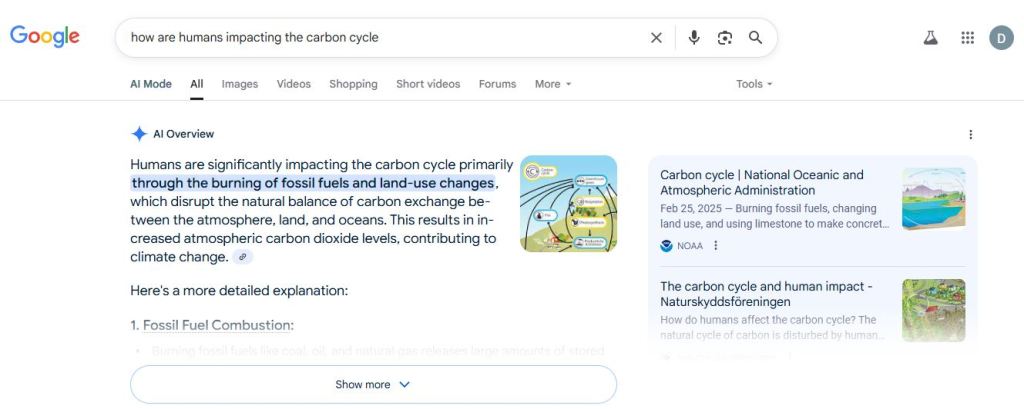
It started with an assignment.  My students were learning to use the standard APA-style citation method employed in the sciences, and one of my students who is a faithful and almost fanatical rule-follower kept calling me over to ask how to cite his next item of research.  After multiple attempts at re-explaining the process, I finally simply asked this student to show me his screen. This is what I saw:

Now, my student hadn’t done anything atypical of today’s learner.  He had typed his query directly off my instruction sheet into Google and awaited the response.  It is, of course, not a good research habit (and one I keep trying to fight), but when I saw what it had produced, I was unnerved; I had not realized how much AI had invaded internet search engines.  Here I had spent all this time teaching my students how to vet websites for academic and scientific reliability—an essential critical thinking skill, especially in today’s flood of misinformation and disinformation—and yet, here, confronting me on my student’s screen was an AI summary of only potentially relevant sources with no distinct authors or web addresses for my student to cite.  No wonder he was confused!

So I showed my student how he could click on the little link symbol you can see there on the image right after the word “change” in order to bring up the list of web sites the AI had used for its summary, and I demonstrated how to find the source he needed among those sites so that he could formally cite it in his project.  But if not for my own critical thinking skills enabling me to know what the AI was doing, both my student and myself would have been left in the dark, making unsubstantiated claims, reporting the thoughts of others as our own without any attribution to the original thinkers.  The literal definition of plagiarism.

To say that I, as an educator, was appalled and alarmed by this development is like stating that hydrogen bombs make a noise when they go off (hyperbole intended!).  However, I shortly thereafter read an editorial piece on Bloomberg that reminded me that my collegiate level colleagues have it even worse right now.  At the preK-12 level, good schools are still doing a lot with pencil and paper in their classrooms, including formal assessments that require actual knowledge and the ability to think through a problem unaided by technology.  But presently in academia—at institutions whose very raison d’être is the production and refinement of critical thinking!—“outsourcing one’s homework to AI has become routine” and “assignments that once demanded days of diligent research can be accomplished in minutes…no need to trudge through Dickens or Demosthenes; all the relevant material can be instantly summarized after a single chatbot prompt.”

Even more incredible (confirming a rumor I’d heard) is the fact that apparently more and more professors are starting to employ AI themselves to evaluate student work, leading to the mind-boggling and ultimately untenable reality of “computers grading papers written by computers, students and professors idly observing, and parents paying tens of thousands of dollars a year for the privilege.”   The Editorial Board of Bloomberg News is indeed spot on when they declare that “at a time when academia is under assault from many angles, this looks like a crisis in the making.” 

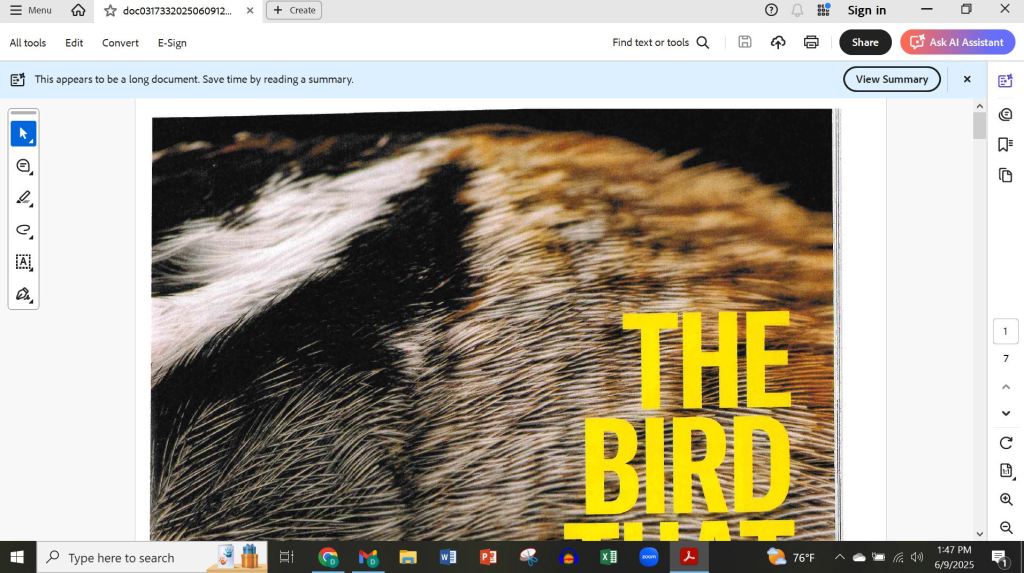
The coffin’s nail for me, though…the camel’s straw, the road’s end, the coup de grace…pick your cliché for finality and mine from this past month was the screenshot below:

I had read this remarkable article in Scientific American on the genetic fluidity of sex and gender in sparrows, and I wanted to share it with my fellow biology teachers for use in our inheritance unit next year (as well as some separate electives we each teach).  So I scanned the article as a PDF to make it more permanently accessible for all of us, and that’s when I saw the message from ADOBE up there in the lefthand corner:  “This appears to be a long document.  Save time by reading a summary.” 

I spluttered; I fumed; I cursed:

“Of course it’s a long document you [expletive deleted] piece of software! That’s the whole point! To provide the reader with rich, nuanced knowledge and understanding of one of the most complex ideas in all of biology!!! If I had wanted my colleagues and I to have a [further expletive deleted] ‘summary,’ I first would have written it myself before giving it to them and then I still would have provided them the formal citation!”

In case you cannot tell, gentle reader, I was pissed.  Pissed at the seeming systemic and systematic attack on the human capacity to think (let alone actually valuing that capacity).  Pissed that there is clearly a market for this disparagement of thinking, and pissed that so few in our world seem to be upset by this dying of the light. I have known that scientific reasoning has been under assault for some time now, but the death of basic thinking itself?!

I know, I know.  One more thing to add to the agenda for my often Sisyphean-feeling profession.  But I’m not just pissed.  I am also deeply concerned, and something neuroscientist, Hanna Poikonen, wrote earlier this year is a good way to end this brief ragging on my part:

Each time we off-load a problem to a calculator or ask ChatGPT to summarize an essay, we are losing an opportunity to improve our own skills and practice deep concentration for ourselves…when I consider how frenetically people switch between tasks and how eagerly we outsource creativity and problem-solving to AI in our high-speed society, I personally am left with a question: What happens to our human ability to solve complex problems in the future if we teach ourselves not to use deep concentration? After all, we may need that mode of thought more than ever to tackle increasingly convoluted technological, environmental, and political challenges.

“May need” indeed.  My money’s on “will,” not “may.”

References

Maney, D. (March 2025) The Bird that Broke the Binary. Scientific American.  Pp. 48-55.

Poikonen, H. (Feb. 2025) How Expertise Improves Concentration.  Scientific American. Pp. 81-82.

The Editorial Board (May 27, 2025) Does College Still Have a Purpose in the Age of ChatGPT? Bloomberg Newshttps://www.bloomberg.com/opinion/articles/2025-05-27/ai-role-in-college-brings-education-closer-to-a-crisis-point?utm_source=pivot5&utm_medium=newsletter&utm_campaign=nvidia-breaks-records-with-44-billion-sales-despite-china-ban-1&_bhlid=31b2ce1fa3444fd1982e5d64eb0f1a1b6d1ab0f3.

Flailing to Thrive

If you are here unfaithfully with us,
you are causing terrible damage.

— Jalal Al-Din Rumi

This topic is a challenging one for me.  Those closest to me know that I am not the biggest fan of my half of the species and that I can tally on one hand the number of fellow males I would count among my close friends.  In fact, I usually simply tolerate most of the other males in my life.  I loathe the banal culture of the “locker room,” and I am so actively antagonistic to the patriarchy that I like to claim that my mother jokes that she raised two children and one feminist and that it wasn’t her daughter.  Bottom line, I much prefer the company of women—to the degree that in classic couples situations where the men and women usually pair off with their respective genders, you will find me in the kitchen with the women.  There is a reason I spent the majority of my teaching career at a single-sex all-girls school.

However, today I find myself once again in a fully co-ed environment where I have a professional duty to authentically engage all my students for purposes of nurturing them to become their best authentic selves, and so I read Clair Cain Miller’s article in the New York Times with a profound sense of downheartedness.  I already knew that suicide rates have always been generally higher for men than for women and that those rates have increased for all young people in the past decade—much of it directly attributable to the impact of social media ([expletive deleted] Snapchat!).  But to learn that the suicide rate in the population of males I work with has effectively doubled from 11 per 100,000 to 21 per 100,000 since 1968 was disturbing to say the least.  That’s over 4,600 teenage boys and young men dead by their own hand in 2023 alone—a rate that only goes up as they age.

Why? What could be causing an increasing number of males—in a fundamentally patriarchal society!—to fail to thrive? Part of the answer seems to be economic.  As the types of positions traditionally identified with masculinity—so-called “blue collar” jobs—have been increasingly eliminated by robots and other forms of automation, the remaining employment opportunities and those where there has been steady job growth rely more and more on the so-called “soft skills” traditionally associated in our culture with women.  Which in a patriarchy can be viewed as problematic.  As Tracy Dawson, a 53-year old unemployed welder from St. Clair, Missouri, made abundantly clear in a 2017 interview: “I ain’t gonna be a nurse; I don’t have the tolerance for people.  I don’t want it to sound bad, but I’ve always seen a woman in the position of a nurse or some kind of health care worker. I see it as more of a woman’s touch.”

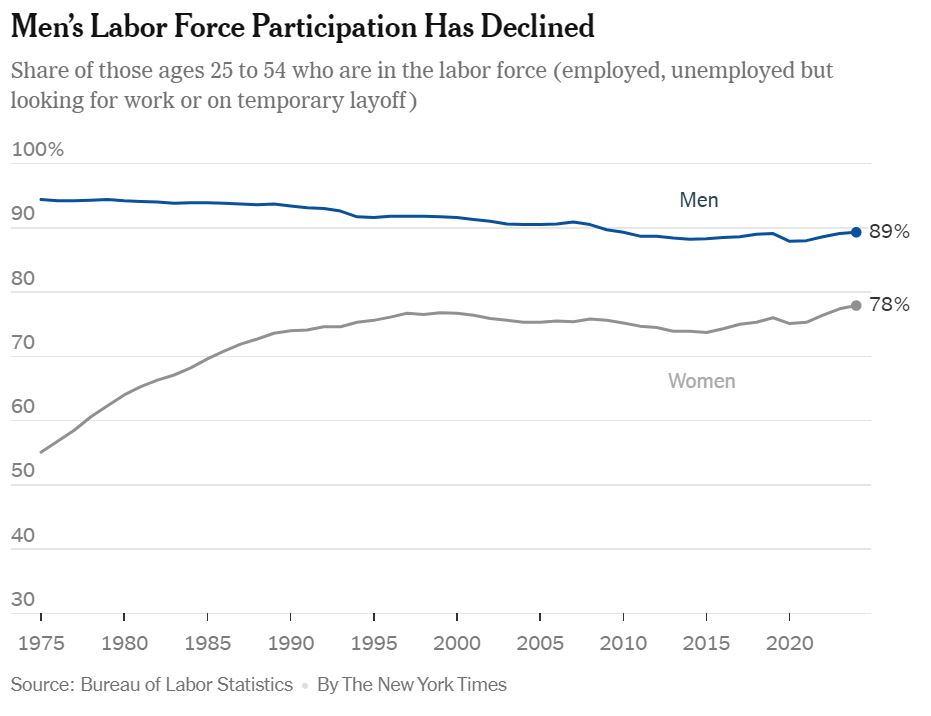
Of course, attitudes such as these have been around for a long time (pop-culture was recognizing this fact as early as the late 1970s, and Bruce Springsteen made a career out of examining them).  However, Robb Willer, professor of sociology at Stanford, is blunt when he states that, today, “the contemporary American economy is not rewarding a lot of the characteristics associated with men and masculinity, and the sense is those trends will continue.” So where does that leave the Tracy Dawson’s in this world? It leaves them under- or unemployed in an increasingly shrinking part of the work-force (see chart below)—with all the consequent potential for undermining and harm to an individual’s sense of self and well-being.

Yet, underlying this employment issue and any subsequent potential changes in how men in America perceive themselves today is an even deeper root cause and one that directly impacts me as an educator.  Since learning is the gateway to everything about a person’s life, any changes in educational status will impact a person’s entire existence, and the reality is that today, starting as early as kindergarten, boys are arriving in our schools less prepared than girls, both in academic readiness and their behavior.  The likely reason for this is the increased focus on college-readiness that has taken over schooling in the past two decades, forcing educational institutions of all kinds to emphasize academics at earlier and earlier ages.  That is something which boys, who usually mature later than girls, are less prepared to handle, and as a result, boys are not getting the same academic head start that girls now are.  Furthermore, this gender gap in academic performance continues to persist in today’s schools as both sexes move up through the grade levels, resulting in women being more likely to graduate, earn higher G.P.A.s, and even go on to college.  Indeed, women now outnumber men at the college and university level with 66% of female high school graduates compared to 57% of the male ones.

Again, where does this leave the young Dawson’s in this world? Well, since the link between matriculation from college and broader career prospects and higher earnings is well documented, it leaves a lot of them increasingly left behind economically, frequently still living with their parents, and ever more susceptible to the reckless ravings of an autocrat.  As Jonathan Rauch articulates in his Constitution of Knowledge, these are the men who hear the perfectly authentic and valid challenge to their male privilege, look at their employment prospects and long-term financial outlook, and reply “Privilege?! What privilege?!”  It is precisely because the implied social contract of the American patriarchy told them that simply being male guaranteed them a degree of status in our society that the perceived failure to deliver on that “promise” has resulted in men who will storm our capital, vote for a self-declared “dictator for one day,” and sometimes literally kill themselves out of their despondency.

So what are we, as a society, to do? The feminist in me may be tremendously excited by the data showing how far the status of women in our country has improved since my childhood (still can’t believe my own mother once could not have her own credit card!).  What’s more, the educator in me still knows how far there still is to go for women to achieve true equity with men in this country (especially in the face of the patriarchy’s current pushback under the Trump administration).  However, just because I personally am not a cheerleader for men does not mean I believe that they somehow do not deserve to have lives of meaning and purpose.  ALL humans deserve that.  Indeed, the foundational flaw of both the patriarchy and systemic racism is their refusal to believe this very thing!

However, the automation of the workplace continues unabated, and with AI, this is even going to start being true of some of the so-called “white collar” jobs.  Thus, it will not just be the unemployed welders and longshoreman dealing with the ennui in their lives; it will also be the unemployed estate lawyers and radiologists confronting their lack of purpose.  Which brings me full circle after my brief (but important) digression to my original question: what do we do about this?

There are at least two things in education we could do right away.  The first is to consider restructuring the configuration of our early elementary classrooms when it comes to males.  Just as there is data showing that single-sex classroom environments benefit middle-school aged girls in the math and science disciplines (and there are co-ed schools both public and private that segregate their populations accordingly for these classes during those years), there is data suggesting that a single-sex environment may benefit K-3 boys in terms of behavioral discipline problems, enabling them to focus better on their learning at this critical age.

Which leads to the second thing schools could be doing to address why some boys and young men are falling behind: teach and employ restorative justice practices in our schools instead of the more traditional punitive approach.  The data is clear: boys are far more likely to receive punishments (and frequently harsher ones) for poor decision making than girls do—especially among children of color—and the data is equally clear that by using restorative justice techniques, teachers and administrators alike can help students better manage their emotions and behaviors and find constructive resolutions in situations of conflict.  Schools that employ these practices have all shown improved academic performance, and they are safer communities for their inhabitants—again, particularly among children of color.

One additional thing I think we could be doing to address the segment of boys and young men in our population who are struggling to thrive is to reconsider what intelligences we choose to value.  Historically, we have always tended to undervalue the kind of critical thinking and problem solving associated with certain jobs such as waiting tables or wiring a house—or welding.  But in the recent hyper-focus on “college readiness,” practical, less traditionally academic intelligences have received progressively fewer and fewer formal supports.  The vocational tech programs of my youth—we had an entire high school in my district devoted to them—have been steadily dismantled and their government funding withheld or withdrawn, to the point where we actually have a critical shortage of such labor in this country.  Resurrecting the vocational tech schools of the past, as educator Mike Rose points out, would go a long way toward addressing a whole host of issues confronting our society—one of which I would like to suggest could be providing the young Dawson’s of our society with both a sustainable income (no one’s automating plumbing for the foreseeable future) AND a sense of meaning and purpose.

As for the one other thing I think might be helpful when addressing this essay’s topic, I will save that for next time.

References

CDC (2023) Suicide Among Adults Age 55 and Older, 2021.  https://www.cdc.gov/nchs/products/databriefs/db483.htm#:~:text=Among%20adults%20age%2055%20and%20older%20in%202021%2C%20the%20suicide,%28age%2085%20and%20older%29.

Darling-Hammond, S. (May 18, 2023) Fostering Belonging, Transforming Schools: The Impact of Restorative Practices.  Learning Policy Institutehttps://learningpolicyinstitute.org/product/impact-restorative-practices-report.

Miller, C.C. (May 14, 2025) It’s Not Just a Feeling: Data Shows Boys and Young Men Are Falling Behind.  The New York Timeshttps://www.nytimes.com/2025/05/13/upshot/boys-falling-behind-data.html.

Miller, C.C. (Jan. 4, 2017) Why Men Don’t Want the Jobs Done Mostly by Women.  The New York Times.  https://www.nytimes.com/2017/01/04/upshot/why-men-dont-want-the-jobs-done-mostly-by-women.html.

Rauch, J. (2021) The Constitution of Knowledge: A Defense of Truth. Washington, D.C.: Brookings Institution Press.

Rose, M. (2014) The Mind at Work: Valuing the Intelligence of the American Worker.  New York: Penguin Books.

UCLA School Mental Health Project (2025) Single-Sex Education: Pros & Cons. https://smhp.psych.ucla.edu/pdfdocs/singleeduc.pdf.

“It’s the Snapchat, Stupid”—Part 2

Treat people as if they were what they ought to be
and you help them become what they are capable of being.

—Goethe

I have never been more afraid for America’s future in my life.
—Thomas Friedman

In the original TV series, Dragnet, the character Sgt. Joe Friday is alleged to have said “Just the facts, ma’am.”  But like Bill Clinton’s association with “it’s the economy, stupid,” it is a total fabrication.  The famed comedian, Stan Freberg, said something similar in his parody of the show, and what would now be called a meme was born, with “just the facts, ma’am” forever associated—incorrectly—with Joe Friday.  However, just as the meme connected with former President Clinton served as a useful lens for an earlier essay about education in this country, “just the facts” is an ideal one with which to start this posting; so here are just a few of the most relevant ones:

  • 40% of fourth graders today read below the basic level on the National Assessment of Educational Progress (NAEP), meaning that they “cannot grasp the sequence of events in a story.”  It is the worst performance for this grade-level in 20 years.
  • 33% of eight graders today also read below the basic level on the NAEP, meaning that they “can’t grasp the main idea of an essay or identify the different sides of a debate.”  It is the worst performance for this grade-level in the five decades since the inception of the exam.
  • In terms of reading engagement outside of school, 34% of fourth graders now report that they read only 30 minutes or less each day, and though a mere 34% of eighth graders reported reading for fun in 1984, that number has now dropped to 14% in 2023.
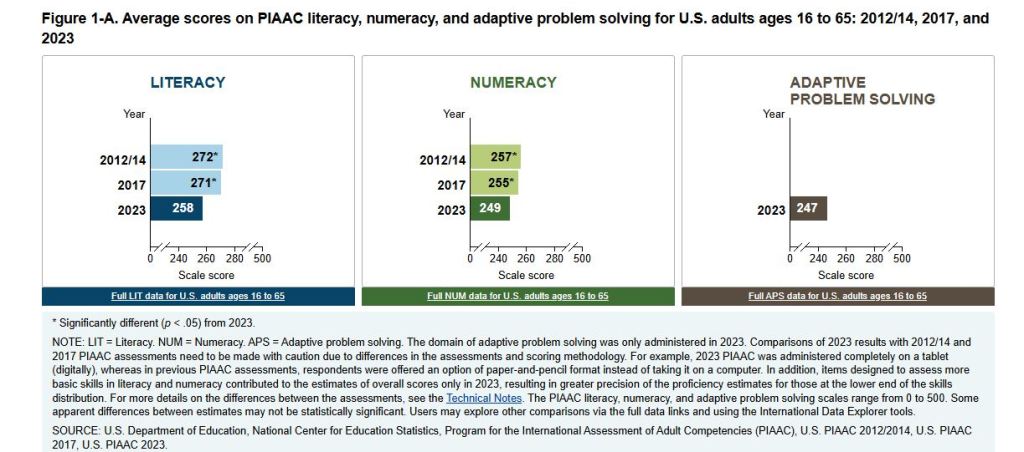
  • As for the United States’ adult population, 30% of them can only read at the level of a 10-year-old, and both numeracy and literacy levels as measured by the Program for the International Assessment of Adult Competencies have dropped consistently among those ages 16-65 (see graphic).

Now since literacy of any kind is the foundation for the ability to reason and the basis for all background knowledge needed to make good decisions in a complex world, then these facts are extremely problematic—and that is a very generous understatement.  As New York Times columnist David Brooks puts it—quoting retired generals Jim Mattis and Bing West—“if you haven’t read hundreds of books, you are functionally illiterate, and you will be incompetent, because your personal experiences alone aren’t broad enough to sustain you.”  Reading—and lots of it—is the keystone to our capacity for critical reasoning, and just as the absence of a keystone species in an ecosystem will lead to its collapse, the absence of reading in a country’s population is a recipe for the breakdown of our entire social order.

And before I am accused of hyperbole, I am already witnessing the potential for this breakdown in my own classes and have been now for over a decade.  Like Anya Galli Robertson, who teaches sociology at the University of Dayton, I too have continued to “give similar lectures, assign the same books and give the same tests that [I] always have,” and like Professor Robertson, I too have seen firsthand how “years ago, students could handle it; now they are floundering.”  Moreover, while the mental coddling I’ve written about before is definitely playing a role in this situation, the even bigger causal source for this general decline in my students’ collective IQ, CQ, and EQ is their poor reading habits.  Habits due in no small degree to the amount of screen time spent on their phones. 

Also (to quote Brooks again): 

Not just any screen time.  Actively initiating a search for information on the web may not weaken your reasoning skills. But passively scrolling TikTok or X weakens everything from your ability to process verbal information to your working memory to your ability to focus. You might as well take a sledgehammer to your skull.

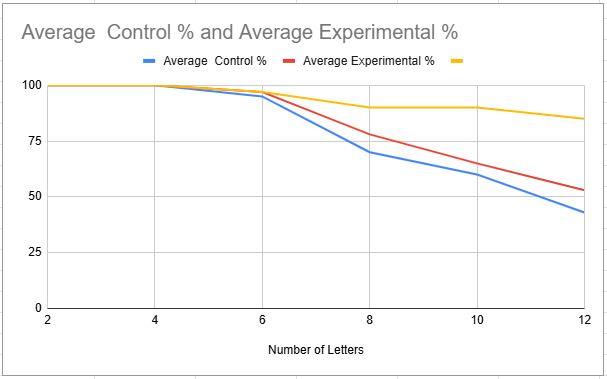
Or more accurately, a broom.  To see why, a little brain science from my own classroom is in order.  Each year around this time, I have my senior anatomy class perform a series of experiments.  I give them a standard short-term memory (STM) test in the absence of their cellphones; we do a few other learning activities; then they take the exact same test a second time while grasping their phones in their hands after playing with their devices for two minutes.  Data is scored, loaded into the spreadsheets, and then we wait until the next class where we do the exact same sequence of events with a different but equivalent STM test—only this time, no phones are present at all.  Again, data is scored, and I “innocently” ask how many of them scored better the second time—to which every hand in the room rises, and I use this fact to introduce the concept of working memory.

Put simply, working memory is like a temporary storage shelf that your hippocampus uses to place items from your immediate STM that you might want to add eventually to long-term memory (LTM).  It’s a parking lot for thoughts and experiences needing evaluation as to whether they are important enough to dedicate to your LTM, and it’s why you can recall what you had for dinner last night—something that is no longer in your current STM awareness—but cannot say what you had for dinner a month ago (unless you have one of those extremely rare autobiographical memories).  Basically, your working memory still has last night’s dinner on its shelf waiting for processing while nearly every previous meal you’ve ever eaten has been swept from the shelf as not having enough significance for LTM (again, those special ones you do remember got the required import tag).

Having taught all this to my students, what I do next is bring up the graph below, and this is when their eyes all widen and why I do not, like David Brooks, have to say “so the main cause is probably screen time” (my emphasis).  The blue line represents the impact on STM of asking it to store and recall increasingly longer sequences of random letters.  It is the averaged student data from the very first STM test, and it is exactly the trend neuroscience would expect.  The yellow line represents what neuroscience says should have happened after my students took the exact same test a second time that first day (and which did happen with the second STM test).  The red line, though, is what happened when my students were holding their phones after playing with them while taking the exact same test a second time: the mere physical presence of the devices wiping their working memories clean.  Groundhog Day for the brain, every day, 365 per year.

Anyone not unnerved at least a little by this data about our devices is probably not reading this essay in the first place, but if not convinced, then, like David Brooks:

My biggest worry is that behavioral change is leading to cultural change. As we spend time on our screens, we’re abandoning a value that used to be pretty central to our culture — the idea that you should work hard to improve your capacity for wisdom and judgment all the days of your life. That education, including lifelong out-of-school learning, is really valuable.

However, as I reminded my seniors this year, let’s be generous and assume anyone reading this essay gets that our society’s changing habits about reading and learning may be endangering our very future.  Then the logical question to ask next is: how our society is handling this potential crisis?  Again, “just the facts” can be useful:

  • The Baltimore City Public Schools have had to close their tutoring program for reading remediation for 1,100 students because of the withdrawal of $418 million dollars in promised pandemic recovery funds (as a district, they will not be alone).
  • The former CEO of World Wrestling Entertainment—the “apotheosis” of demanding intellectual engagement!—has been confirmed as the next United States Secretary of Education, with the explicit charge to dismantle and destroy the entire department (the executive order was signed a month ago).
  • Harvard University has lost more than $2 billion in federal research funds for having the temerity to basically say that critical thinking matters (with additional threats to their tax-exempt status on the line).
  • And, finally, as a country, we have ceded to China the global leadership in research output in the fields of chemistry, physics, and earth & environmental science (with biology and the health sciences soon to follow due to the recent defunding of the NIH and the firing of many of their scientists).

That last fact may be the most telling one, and it is why I was sorely tempted to title this essay “The Stupidifying of America.”  Our collective education system in this country no longer produces enough “home grown” PhD scientists and engineers, as well as other levels of expertise, to meet our most basic economic needs, and the “cruel farce” that is the Trump administration is simply going to make things worse.  As Thomas Friedman points out:

Do you know what our democratic allies do with rogue states? Let’s connect some dots.  First, they don’t buy Treasury bills as much as they used to. So America has to offer them higher rates of interest to do so — which will ripple through our entire economy, from car payments to home mortgages to the cost of servicing our national debt at the expense of everything else…[Thus] bond yields keep spiking and the dollar keeps weakening — classic signs of a loss of confidence that does not have to be large to have a large impact on our whole economy…[Furthermore,] you shrink all those things — our ability to attract the world’s most energetic and entrepreneurial immigrants, which allowed us to be the world’s center for innovation; our power to draw in a disproportionate share of the world’s savings, which allowed us to live beyond our means for decades; and our reputation for upholding the rule of law — and over time you end up with an America that will be less prosperous, less respected and increasingly isolated.

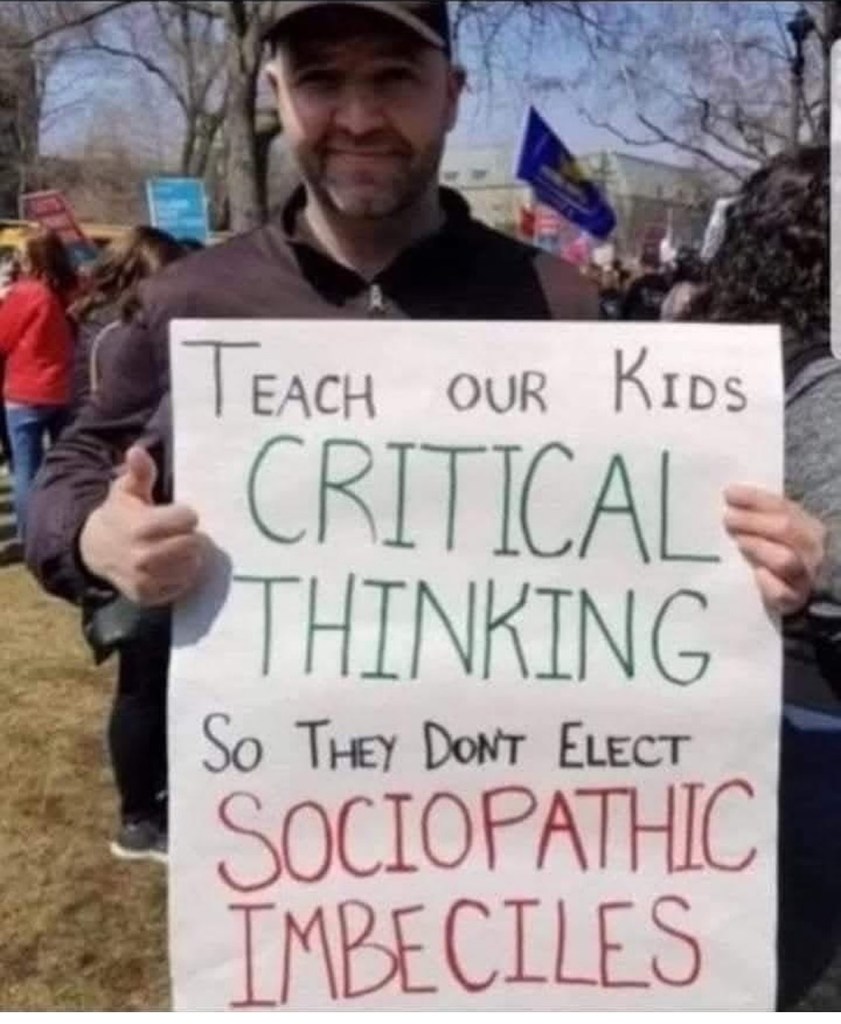
Like Friedman, I am truly frightened for our country, but like Goethe, I know what I need to do in my small corner of influence to combat the rising tide of ignorance, anti-intellectualism, and antipathy.  As the sign at one of the Hands Off protests suggests, I’ll keep teaching critical thinking to my students—in the hope that future elections might turn out for the better.

References

Bowie, L. (April 4, 2025) Baltimore Schools to Cut Tutoring and More After Trump Administration Backtracks on Funds.  The Baltimore Bannerhttps://www.thebaltimorebanner.com/education/k-12-schools/baltimore-city-schools-federal-funding-AM5PH4I6G5B3PCG66S6RC3IKDE/.

Brooks, D. (April 10, 2025) Producing Something This Stupid is the Achievement of a Lifetime.  The New York Timeshttps://www.nytimes.com/2025/04/10/opinion/education-smart-thinking-reading-tariffs.html.

Friedman, T. (April 15, 2025) I Have Never Been More Afraid for My Country’s Future.  The New York Timeshttps://www.nytimes.com/2025/04/15/opinion/trump-administration-china.html.

Lukianoff, G. & Haidt, J. (2018) The Coddling of the American Mind: How Good Intentions and Bad Ideas are Setting Up a Generation for Failure.  New York: Penguin Books.

Nation’s Report Card (2025) National Assessment of Educational Progress.  https://www.nationsreportcard.gov/.

NCES (2023) Program for the International Assessment of Adult Competencies (PIAAC).  https://nces.ed.gov/surveys/piaac/2023/national_results.asp.

The (Hand)Written Word

Every time you invent a technology,
you also invent a responsibility.

—Aza Raskin, Co-founder
Earth Species Project

As someone who does a lot of thinking, values thinking, and does quite a bit of thinking about thinking, it can be hard sometimes to look at the general state of thinking in our society and not become demoralized.  When 20% of voters believe President Biden is responsible for ending the constitutional right to abortion in this country, it can look like the conspiracy theorists have won.  When a third of those aged 18-29 are getting 100% of their “news” from TikTok, it is little wonder that half the nation remains convinced that the unemployment rate is the highest it has been in 50 years (despite being at a near record low).  And when we have people forming intimate relationships with AI companions rather than fellow human beings (at great risk to your national security it turns out), it can simply feel like it is time to toss hands in the air and start researching survivalist bunkers on-line.

Furthermore, adding fuel to all this has been one of my classes this academic year in which I have observed almost no collective intellectual growth from last September to today—something I have never witnessed in my now 35-year career.  And lest I be accused of subjective bias, I am not alone in this empirical observation; the grade-level dean and others at my school are concerned by what we have failed to see happen over the past 9 months in so many of these students’ courses.

With one exception: math.  Math classes have all seen growth—sometimes simply COVID recovery—but growth nonetheless and across the board at all levels.

Why?

My hypothesis is based on an observation.  There were, of course, individual exceptions in my class in terms of growth over the year, and when identifying what both the act of learning math and these individual growth exceptions have in common, it is one thing:  writing by hand.  My students in my biology class that grew intellectually over the year completed all their work by hand—just as they would have had no choice but to do in their math courses; you can’t readily manipulate equations on a screen.

The science behind my hypothesis is pretty solid and grows with each new study.  We have known since 2014 from research done at Princeton University that students who take notes by hand do demonstrably better on tests than student who only type their notes on a laptop.  But recently, using fMRI to perform brain scans, we are discovering what is actually different in the brain between handwriting and typing and why writing by hand is so central to better learning outcomes.  For starters, handwriting produces significantly higher levels of electrical activity across many more interconnected brain regions than typing does—perhaps most significantly in the motor cortex.  While typing and handwriting both employ movements in your hands and fingers to generate words, writing by hand demands significantly more communication between the motor cortex and visual cortex, engaging the brain more deeply as it must constantly align each finger’s position with the mental models of the letters and words being written.  Put simply, as neuropsychologist Audrey van der Meer says, “when you are typing, the same simple movement of your fingers is involved in producing every letter, whereas when you’re writing by hand, you immediately feel that the bodily feeling of producing an A is entirely different from producing a B.” 

The implications for younger children are profound.  Those, for example, who learn to trace out the alphabet by hand have significantly better and longer-lasting recognition and understanding of words, which when combined with the improvement in memory and recall handwriting produces, leads to better reading skills—the very foundation of all education.  As van der Meer puts it, “if young children are not receiving any handwriting training, which is very good brain stimulation, then their brains simply won’t reach their full potential”—with all the scary possible long-term consequences that can come from that.  It is, perhaps, why several states are passing laws to require handwriting lessons again in elementary schools and why California is going so far as to require training in cursive once more.

But it is not just the youngest who benefit from writing by hand.  Having laid a foundation of literacy through the handwritten word, older children and adults who continue this practice have a better understanding of whatever material they are studying because the act of writing by hand causes the brain to engage with said material more intensely (their brains are literally working harder at the task).  Thus, note taking with pencil, pen, or stylus (it is the physical motion that counts) leads to significantly richer, deeper learning as well as better memory formation and recall, and it is why, though I compose using a keyboard, I still always outline my thoughts for these essays by hand:

It is the only way I can assure that I am presenting my best thinking.

Which brings me back to my class that doesn’t seem to have demonstrated any collective growth this year and a world in which good thinking seems in short supply.  I have watched for over a decade now as many individuals—and especially my students—have increasingly off-loaded cognitive tasks to their digital devices (taking a picture of something, for example, rather than trying to remember it), and I am left wondering if we have not reached a critical tipping point in that process.  Yadurshana Sivashankar of the University of Waterloo in Ontario reminds us that “if we’re not actively using these areas (those involved in these cognitive tasks), then they are going to deteriorate over time, whether it’s memory or motor skills,” and my ah-ha moment with this particular class came when I recently had them correct a quiz in my presence rather than as homework.  Instead of looking back at their notes to work out what they had done wrong, nearly all of them simply googled their questions and wrote down verbatim what appeared on their screens.  It was not about learning from mistakes (or learning at all, for that matter); it was about completing a task and checking off a “to-do” box.

Well, that is something I can try to change as an educator.  Starting next year, no more off-loading.  Just a really, really big supply of paper, pencils, and pens, and a lot of higher quality thinking.  Together, we’ll all write by hand.

References

Campbell, R.M. (Dec. 2023) “AI Chatbots Could Weaken National Security.” Scientific American, pp. 73-74.

Glueck, K. & Corasaniti, N. (May 28, 2024) Eyeing Trump, but on the Fence: How Tuned-Out Voters Could Decide 2024.  The New York Timeshttps://www.nytimes.com/2024/05/28/us/politics/trump-biden-voters.html.

Hu, C. (May 2024)  Hand-on: Writing by Hand Comes with Learning Benefits.  Scientific American, p. 13.

Lambert, J. (May 11, 2024) Why Writing by Hand Beats Typing for Thinking and Learning. NPR. https://www.npr.org/sections/health-shots/2024/05/11/1250529661/handwriting-cursive-typing-schools-learning-brain.

Mueller, P. & Oppenheimer, D.  (April 23, 2014) The Pen is Mightier Than the Keyboard: Advantages of Longhand Over Laptop Note Taking.  Psychological Sciencehttps://journals.sagepub.com/doi/10.1177/0956797614524581.

Plait, P. (Dec. 2023) “Conspiracy Theories Then and Now” Scientific American, pp. 80-81.

A Letter to the Class of 2024

We are not educated for darkness.
—Constance Fitzgerald

It began in mystery, and it will end in mystery,
but a savage and beautiful country lies in between.

—Diane Ackerman

Winners play hurt.
—Vince Lombardi

Dear Members of the Class of 2024,

When essayist and author, Robert Fulghum, was once asked why all his books were so similar, he replied that he returned again and again to just a few common themes because only these were central to his thinking.  Hence, he went on to say:

If you notice phrases, ideas, and anecdotes that closely resemble those that appear elsewhere in my writing, it is not a matter of sloppy editing.  I’m repeating myself.  I’m reshuffling words in the hope that just once I might say something exactly right.  And I’m wrestling with dilemmas that are not easily resolved or easily dismissed.  I run at them again and again because I’m not finished with them.  And may never be.  Work-in-progress on a life-in-progress is what my writing is about.  And some progress in the work is enough to keep it going on (p. 30).

I share these words because I find myself once again authoring this annual letter to all of you, knowing that I still do not yet have it quite right.  And while there are only so many ways for those of us who have loved and cared for you to send you on to the next chapter in your narrative—and usually clichéd ways at that!—I, like Fulghum, feel compelled to try. 

So here goes: one final set of lessons from the heart for the soul.

To begin with, like Fulghum, I too have found certain common themes arising regularly as I have written this epistle each year, and an especially big, “elephant-in-the-living-room” one is the fact that the world your elders and I are leaving you is one hot mess—both literally and figuratively.  I do not need to itemize the details of the disasters; you get enough of that from your daily feeds.  However, it can be quite challenging not to give in to despair in the face of such dysfunction, and “too often we either submit and surrender our souls to the social consensus [that originates it], or withdraw in passive narcissism” (Radical, p. 34).  Worse, “the temptation in hard times is to become the inferno” and burn it all down in one great Götterdämmerung (Garden, p. 21; my emphasis).  Hence, in a world where—as Billy Joel once wrote—“we didn’t start the fire,” how do you find the resilience and inner resources to become an effective agent for positive change?

It starts by attending to, deeply listening to, and embracing the Stranger (what in neuroscience terms is the prefrontal cortex encountering the totally new).  Only interaction with the unfamiliar can challenge us to grow and to change, and more importantly, only interaction with the Stranger enables us to realize that “other people are not required to perform roles in one’s internal play, no matter how wise, good, or reasonable the script may seem” (Garden, p. 18).  When you gain this perspective, you realize that each of us is caught up in our own narrative and can only revise that narrative when we allow another’s narrative to enter into our own.  When that happens, suddenly the “jerk” cutting you off at the traffic light could be the parent frantically heading to the hospital with a seriously injured child, or the distant and seemingly dismissive waiter could be struggling to manage chronic pain that is in no way their fault. 

Is the “jerk” at the light probably still actually a jerk? Of course.  But once you’ve embraced the Stranger—and there will be lots of opportunities as you leave the familiar for the unknown in the coming years—you can no longer judge another with the righteous certainty you once did.  You have a more expansive, compassionate narrative guiding your life, making you a more effective agent in this world.  What’s more, since this is a graduation moment and clichés are mandatory, the cliché for this lesson is:  learn to walk a mile in someone else’s shoes; it will make you a better walker.

Granted, all this learning can be discomfiting—especially in the alien and uncharted waters where you are all next headed. As Mary Rose O’Reilley puts it, “to be stretched almost beyond where you can go is acutely painful.  One often fails and failure brings pain.  One must court doubt and despair in the process of learning anything at all” because as a neuroscientist might put it, “if your brain isn’t uncomfortable, you aren’t learning anything” (Garden, p. xii).  Or to put it another way, if you are not heavily invested in the change you wish to see, there will be no change—in you, in others, or in the world.  Hence, in a very real way, to learn is to love enough to let whatever you are loving fundamentally alter your narrative, alter who you are.

Ah! But any act of love—even the smallest—leaves us vulnerable to being wounded, opening up the possibility for darkness in our lives, and that brings me to a second theme I have found myself returning to again and again over the years:  the reality of Constance Fitzgerald’s words at the start of this letter.  Too often, we do not teach about the character of darkness, that is has a purpose and a value in our lives.  Instead, we tend to revile it or try to pretend it’s not there because confronting it can be so difficult. Yet, the simple truth is that “darkness interrogates us at the places where our knowledge of reality is most deficient, our illusions most entrenched” (Garden, pp. 70-71).  It is what “comes along to tell us we’re worshipping an inadequate object…to loosen us from the bondage of a devotion we’ve offered to an unworthy object, a false god” (Garden, p. 21).  Thus, it is only through our encounters with moments of darkness that we truly stretch who we are as a person, truly grow, and I can share from firsthand experience that it is the only path to wisdom.

However, occassionally a time of darkness will take on a life of its own, and that is when you must discover the power of wintering.  We all do it at some point in our lives, and no matter how it arrives, it is usually unexpected, isolating, and emotionally raw.  Yet, as author Katherine May puts it so eloquently:

It’s also inevitable.  We like to imagine that it’s possible for life to be one eternal summer and that we have uniquely failed to achieve that for ourselves.  We dream of an equatorial habitat, forever close to the sun, an endless unvarying high season.  But life’s not like that…Even if by some extraordinary stroke of self-control and good luck we are able to keep control of our own health and happiness for an entire lifetime, we still couldn’t avoid the winter.  Our parents would age and die; our friends would undertake minor acts of betrayal; the machinations of the world would eventually weigh against us.  Somewhere along the line…[winter will come] (p. 11).

And when it does, you must remember that it is actually the crucible for life, not its ending.  There can be no spring without the rejuvenating and healing power of winter, and “since [its] pain will come to us anyway, why not figure out how to deal with it.  It’s hard to grasp the connection between suffering and spiritual growth if we think of [living] only as a way to gain peace and tranquility” (Garden, pp. 74-75).  The proverbial bottom line is that you have to engage the world as you are at any given moment, and sometimes that means you will “play hurt.”  It is not one of the “fun” lessons of adulthood, but it is one of its more vital ones.

What’s more, as you “play”—both hurt and healthy—I hope you will begin to learn the lesson which all of you, my students, have taught me over these many years.  Experiencing both aching and healing, alienation and grace, sin and salvation throughout the coming years, you may start to notice the paradox that you actually need all of these to become fully human and that it is only out of that full humanity that you can affect the change you wish to see in the world.  The yin and yang of life is like breathing, and it is what you do with the life which this breathing makes possible that matters. Therefore, learn to breathe well and then choose what to do with the life that results in a thoughtful and self-reflective manner.

And, yes, while modern neuroscience may have demonstrated that the agency to do this choosing may simply be a cognitive illusion generated by the brain, that doesn’t mean that the character of the illusion isn’t important. As Mary Rose O’Reilley argues, “it matters what metaphors we use to describe ourselves to ourselves” (pp. 26-27), and as Norman Vincent Peale once wrote, “change your thoughts and you change your world.” Hence, as you now journey forth, I pray for each of you that you choose your individual metaphors and thoughts well. They will define you (however illusory that may be) and, consequently, they will define your impact on this world.

Finally, always remember that “somewhere there is a great mystery that wants to come live in your house and change everything” (Radical, p. 48).  Be open to it when it arrives; welcome it.  It will have much to teach you; you will have much to learn. Reject it at your peril (spoken from hard-won experience) and always remember that the obvious and predictable are not always the safest road to travel: you can get just as disoriented and lost in the familiar as you can in the unknown. Therefore, consider the road less traveled as you let your next great mystery into your life, and remember that Frost was right when it wrote all those years ago about how it can make all the difference.

Congratulations, then, and may the coming celebrations be joyous ones!

References

Fulghum, R. (1991) Uh-Oh: Some Observations from Both Side of the Refrigerator Door.  New York:  Villard Books.

May, K. (2020) Wintering: The Power of Rest and Retreat in Difficult Times.  New York: Riverhead Books.

O’Reilley, M. R. (2005) The Garden at Night: Burnout & Breakdown in the Teaching Life.  Portsmouth, NH:  Heinemann.

O’Reilley, M. R. (1998) Radical Presence: Teaching as Contemplative Practice.  Portsmouth, NH:  Heinemann.