I won’t be concluding here by revealing the meaning of life.
But I do have thoughts.
—Oliver Burkeman
It happens to me with increasing frequency, these days,
that writing takes the form of prayer.
—Lydia Millet
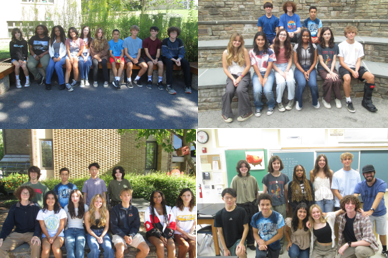
Dear Members of the Class of 2026,
Ever since I first had seniors to graduate, I have always had parting words. Sometimes it has been a collection of favorite quotes. At others, a hard-earned personal insight. Occasionally, I have spoken the traditional commencement clichés (as well as the usual words of farewell), and on more than one occasion, I have even sent some of you out into the world with a Zen koan. But then a pandemic hit, sending all of us scurrying to the isolation of our homes, denying me my usual venue for sharing these final (admittedly unsought) thoughts, and thus, the ritual of this annual letter was born.
Of course, I write to you for the same reason the institutions who have nurtured you will hold ceremonies and the families who love you will hold parties: to honor this pivotal moment in your journey. These reflective rites of passage are critical to a social species such as ours because they hold up to our collective attention the common values we share, and whether joyful (think weddings) or sad (think funerals), they remind us to take this unearned gift called life more seriously and to recall the fundamental qualities that make us human. Hence, on the road to full adulthood, remember to honor moments such as these and to be patient with your elders when they get all weepy and fawning over you in the coming months; it will be you doing the weeping and fawning one day.
Remember, too, to immerse yourself fully in your own celebrations, to participate actively in your own life. Too often, we can find ourselves so focused on the planning and execution of an event—or worse, trying to capture it—that we fail to notice our place in the moment itself. This can be especially true in today’s world of social media (where I once watched a group of my students work so hard to video a stadium-like wave they wanted to generate that they never actually made the wave itself happen). Therefore, I urge you make deliberate time to notice this important transition in which you find yourself. Try sitting still. Watch a sunrise. Journal on a page. Hike a trail. Do whatever you can to make the necessary intentional pauses required to embrace with full awareness what is happening to you “now.”
Of course, residing mindfully in the moment is an important lesson to remember your entire life, not just for times of ritual. Millennia of wisdom literature has been clear that “you can have a hundred tea ceremonies; you could even have all of them with the same people. But you can only have that ceremony, that cup of tea once. Then that stretch of time evaporates forever” (Burkeman, p. 141; original emphasis). Thus, we need to inhabit any given space and time we find ourselves in as if it could be our last because the harsh reality is that it could. Granted, this charge to live in the “now” is an ideal, never quite fully realized or truly attained. But the alternative is to walk through life reacting blindly—or at best, blurrily—(and frequently passively so) to every random or premeditated change that buffets you. Only to the degree that you can center and focus yourself fully can you proactively steer yourself successfully—and with confidence—through the inevitable challenges and roadblocks simply being alive will throw at you.
What’s more, one such difficulty already confronts you before you even step into your next chapter. The unrestrained explosion of artificial intelligence (AI) has some comparing its potential social disruption to that of the Industrial Revolution (from which one can argue we are still recovering), and you are going to spend your entire adult lives amidst this fallout. Technologists got so busy trying to see what they could do that they never bothered to ask “should they?” and now Claude, Anthropic’s most recent AI release, is capable of writing and running its own self-generated code without its original authors having full knowledge of—and therefore final say over—what Claude is actually doing with itself. The result? An AI tool that could allow any person on the planet with access to the web to hack any digital infrastructure. As Thomas Friedman puts it, “I’m really not being hyperbolic when I say that kids could deploy this by accident: ‘Honey, what did you do after school today?’ ‘Well, Mom, my friends and I took down the power grid. What’s for dinner?’ ”
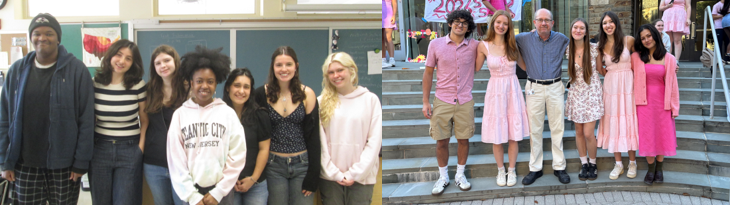
I know, I know. Way too dark a turn for what is supposed to be a pseudo-commencement speech. Those are meant to be cheery and uplifting, full of friendly advice and quirky bits of parental type wisdom. But ugly truths are no less real for being ugly, and one of the hardest ones I find myself confronting each year when I author this epistle is the seemingly ever-growing reality of just how f-ed up a world my fellow elders and I are leaving to you. Billy Joel may have been correct when he wrote about not starting the fire, but that does not excuse the many individuals who have deliberately poured gasoline on it (both literal and metaphorical). If it is true that we borrow the present from the future, then I regret to say that we will be returning damaged goods to your generation with negative interest on the loan.
However, lest you think it inevitable to succumb to the flames, allow an experienced firefighter to offer some tools for combating life’s flare-ups even if they don’t always smother them completely. First and foremost, maintain perspective. And by that, I do not mean simply be empathetic or have multiple ways of looking at a situation or try to understand the context of a what you are dealing with (all of which are good things to do). No, I mean PERSPECTIVE such as the kind told of Rabbi Simcha Bunim, who is said to have had two slips of paper in his pockets at all times, one of which contained the Hebrew phrase, “Bishvili nivra ha’olam” (“for my sake the world was created”) and the other, “V’anokhi afar v’aefer” (“I am but dust and ashes”). He navigated life allegedly removing one or the other as needed, and I have seldom encountered a higher wisdom. Your life is finite, and therefore knowing how to identify when something demands your all-in investment of everything you have to offer and when something is like a dropped scoop of your favorite ice cream lying melting on the pavement is perhaps the greatest skill you will ever acquire.
Related is the ability embodied by the famous story from the Buddhist tradition about the farmer whose horse ran away one day. For those unfamiliar with it, what happens in this tale is that a series of events follow this seeming misfortune, and with each event, the farmer’s neighbors either cry out “What terrible fortune!” or exclaim “How wonderful” depending on whether sympathy or celebration seem the appropriate response to what has happened next in the story. Yet the farmer, every single time something happens, always replies, “Maybe.” Maybe it’s terrible; maybe it’s wonderful. He alone in the story understands that we cannot know any situation’s ultimate outcome—including those where you’ve gone “all-in” and those where you’ve cut your loses—and that, thererfore, all we can ever do in life is to experience what happens (even when we are the author) and then choose how we respond. Like I said, Perspective!
The next tool I have to offer for fighting life’s fires may sound odd, but the science behind it is strong: be bored. Yes, intentional boredom is a secret superpower against the world’s conflagrations, and here’s why. For starters, it promotes your capacity for delayed gratification, which Mischel’s famous Marshmallow Test has demonstrated promotes a whole host of life-long benefits, including better health, better educational outcomes, better work satisfaction…the list is extensive! Including the fact that people with better gratification-delay have more resilience and more grit.
However, what makes boredom even more significant than these “quality of life” factors is what it does for your brain’s ability to think. In our digital age of 24/7 universally immediate appeasement of our neural reward circuits—where a dopamine rush is always only a mere click of your device away—the ability to think in a focused, conscious, deliberative fashion is rapidly joining the physical atrophy of today’s couch potatoes. Furthermore, just as we know that the body requires regular exercise and proper diet to maintain its structural and physical health (medical knowledge we only actually first recognized in the mid-1950s), so too does the brain need regular thinking about complex ideas to maintain its health as well. Hence, just as a diet of twinkies and extensive lounging are bad for the body, so is a diet of Tik Toks and AI bad for the brain. Boredom is the antidote because it forces the brain to find something interesting to think about, strengthening its mental muscles.
What’s more, all that additional thinking in the absence of all that dopamine—remember, you’re bored—creates the conditions for improving one of the most important of our three primary intelligences, creativity. We need brains with strong capacities for making previously unseen connections between purportedly unrelated ideas if we are to find solutions to our most intractable problems. And making Tik Tok videos mimicking other Tik Tok videos or asking ChatGPT to draft an essay is not going to build those kinds of brains. That’s like going to the gym and having robots lift the weights for you. Worse, it’s like going to the gym, filming the equipment and calling that a workout.[i] Only true boredom will engender an increase in creativity, and in the absence of boredom, any decrease in creativity can have very practical consequences. For example, entrepreneurship in this country (i.e. economic creativity) has been on the decline for the last four decades (dipping the most in the past 15 years),[ii] and most recently, the draconian efforts of Trump’s DOGE have guaranteed that scientific progress in the U.S. (i.e. cognitive creativity) will be lowered for decades to come. Therefore, want to save the world? Increase your boredom; both your brain and your future children will thank you for it.
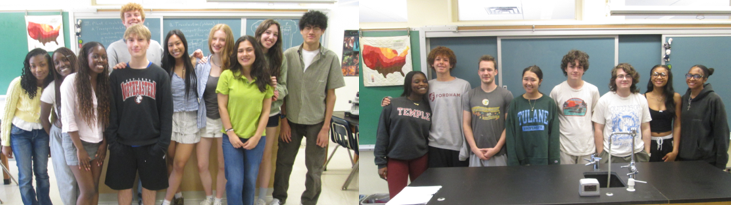
However, if you do decide to save the world, be absolutely certain to keep that perspective I spoke of earlier. Firefighting is never easy work, and after your idealism has been scorched a few times, it can be all too easy to become cynical or—worse—apathetic. The simple truth is that it just isn’t possible to confront the reality of our limited lifespans and not ask, how much can any one person truly do? Indeed, this recognition of our finitude can engender simultaneous feelings of both excess responsibility and utter inadequacy, and since—to paraphrase the philosopher Hegel—the nature of being finite is to have the seed of your passing as your essential nature (i.e. “the hour of [your] birth is the hour of [your] death”), then firefighting itself has the potential to feel pointless. If I can’t make my existence matter, why bother?
Yet “maybe our responsibility isn’t to justify ourselves before [the universe], but to embody as completely as possible the momentary expression of it that we are” (Burkemen, p. 157)—to live a modestly meaningful life. Which brings me to my final toolkit offering for this letter: the capacity to distinguish between want and need and to balance them appropriately. Not that I don’t think most of you already know the difference between the two. But we are at a juncture in your lives where illustrating how easy it is to get the two mixed up is, well, easy. Because, right now, I am confident that most of you want—maybe even desperately—to go away to college this coming fall. So much so that I’m equally confident that you have probably convinced yourself that this “want” is really a “need,” that you need to go to college. You don’t, though. Your biological survival is in no way dependent on your matriculation at an institute of higher education, and in fact, you could live the rest of your life after graduation never “cracking another book” as they used to say.
Now, if you want the kind of employment that feels emotionally purposeful and financially gainful, then, yes, you need to go to college because a basic bachelor’s degree is the required, necessary precursor to certain types of careers. Or if you want a life partner with certain qualities, then you need to date individuals who possess them, and if you want long physical health, then you need proper daily exercise and diet. Put simply for any given “want” you might have, there will always be a corresponding need, and so identifying those “wants” most important to you will enable you to identify what “needs” you will have to meet to obtain them—including if one of those “wants” is a better world than the one we currently have.
There may come a time, though, when you still have some unfulfilled “wants” but no real unfulfilled “needs”—at least as Maslow’s famous hierarchy would define them—and when that happens, you face a choice: remain discontent in the face of life’s realities, forever chasing after what eludes you, or find satisfaction in those same realities, embracing with gratitude and humility what you have already found. It will be up to you to decide, but should you find yourself at such a future juncture, before making a choice, never forget the wisdom of the farmer:
Maybe.

Congratulations and good fortune in the coming years!
References
Burkeman, O. (2024) Meditations for Mortals: Four Weeks to Embrace Your Limitations and Make Time for What Counts. New York: Farrar, Straus and Giroux.
Friedman, T. (April 7, 2026) Anthropic’s Restraint Is a Terrifying Warning Sign. The New York Times. https://www.nytimes.com/2026/04/07/opinion/anthropic-ai-claude-mythos.html.
Newport, C. (March 27, 2026) There’s a Good Reason You Can’t Concentrate. The New York Times. https://www.nytimes.com/2026/03/27/opinion/technology-mental-fitness-cognitive.html?unlocked_article_code=1.WlA.6ZKN.Zf47rdbx8Sqm&smid=nytcore-ios-share.
Stokel-Walker, C. (April 7, 2026) Scientists Invented a Fake Disease. AI Told People It Was Real. Nature. https://www.nature.com/articles/d41586-026-01100-y.
[i] Which, as a sidebar, is basically what the Marvel and DC franchises have been doing now for more than two decades—I mean how many reboots of Spiderman and Batman do we need?? As The Boss once wrote, “fifty-seven channels and nothin’ on.”
[ii] For anyone wishing to learn more about this decidedly non-partisan issue, it has been well documented by organizations as far apart on the political spectrum as The Brookings Institute and The Heritage Foundation.