
A people without understanding will come to ruin.
—Hosea 4:14
Relatively early in the major lock-downs that took place this past spring, there was a cartoon in the editorial section of the Baltimore Sun that caught my attention as an educator. It depicted a haggard looking mother speaking with a father, and in the background was a table with their children clearly engaged on their laptops in on-line learning. And the tagline for the cartoon was basically “I will never vote against funding for education again!” (I don’t remember the exact wording).
I share this humorous insight about the fundamental value the education profession has in a society—an insight I suspect many working adults and parents in this country now have as well—because in the past couple of weeks, as my own school has begun the preparation for the transition to a hybrid model of in-person and virtual learning, I have watched the underlying truth of that cartoon—the actual de-valuing of education that has long been at work in the United States—play itself out in some unanticipated and unexpected ways.
It began with my school’s decision to allow those adult members of the community at high-risk for suffering the deadly complications which this disease can produce to remain home and continue to teach virtually. An applaudable choice given that as one of our most senior faculty pointed out, “my last year of teaching shouldn’t have to be my last year.” But in making this decision while simultaneously making the commitment to hybrid learning, the administration tripped over a reality that has been at work in the field of education now for more than a decade: the greying of the profession.
Because in order to fulfill the dual commitment, new hires are necessary to provide an adult in the physical classroom for those students who elect to be at school during the class period the remote teacher is zooming in to continue to instruct. Yet, watching my computer screen during this week’s faculty meeting, I was suddenly very aware that more than half the faces I was looking at had to be at least 50 years or older, and that was potentially a lot of at-risk folks. Indeed, my principal said as much when he shared how he had not anticipated how many hybrid classes would require additional hires for coverage.
Nor is he alone in this problem. Schools nationwide have practically bled teaching staff as its many older members have simply refused to return to the classroom, quitting or retiring early rather than risk the potential exposure to COVID-19 and the dangers to health which that can bring not only to themselves but other family members as well. In fact, the bleeding has been so bad in my former home state of Missouri that the State Board of Education there has reduced the requirements for substitute teaching licensure from having at least a bachelor’s degree in any discipline to having a high school diploma and 20 hours of college credit. Several districts near where my sister and mother live have even been forced to return exclusively to distance learning for all age groups after starting the year in-person simply because they cannot staff the necessary classrooms for a hybrid model.
All of which points to a hidden crisis in this country that has been building in education relatively unseen for decades—and yet another social neglect this pandemic has glaringly revealed—and that is the mounting decline of people entering the teaching profession. Between 2005 and 2016 (the years for which we have the most complete statistics), enrollment in colleges of education dropped 23% and the number of awarded degrees dropped 15%—all during a time when degrees awarded in all other majors rose. Furthermore, those of us entering the profession from one of these other majors during this same period—my own route into the classroom—declined by 32%. Indeed, for the 2017-2018 school year, the data reveals that there was an estimated shortage of 110,000 teachers in this country, and even a casual glance at the graph below should give anyone with young children the shivers.
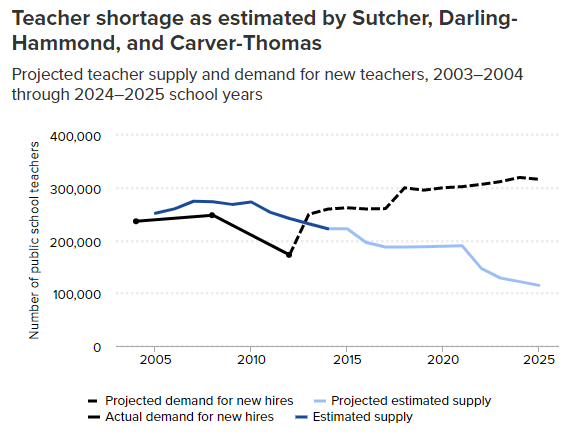
Actually, I will argue that the projections in this graph should give all of us the shivers. As I have written at numerous points in this project, our fate as a society (and perhaps as a species) hinges on the quality of education provided in our schools, and even from a strictly selfish and economic point of view, we cannot afford to remain on the path we are presently travelling. Having authentically engaged teachers in our schools first requires having the necessary number of teachers, period. High quality educators are “grown;” they do not erupt spontaneously fully made, and that kind development requires a critical mass of teachers at all the various stages of this development to support it.
But achieving that critical mass has become increasingly problematic, and that’s where I agree with Peter Greene that we have to stop calling it a shortage. As he puts it:
You can’t solve a problem starting with the wrong diagnosis. If I can’t buy a Porsche for $1.98, that doesn’t mean there’s an automobile shortage. If I can’t get a fine dining meal for a buck, that doesn’t mean there’s a food shortage. And if appropriately skilled humans don’t want to work for me under the conditions I’ve set, that doesn’t mean there’s a human shortage.
There are plenty of individuals capable of developing the necessary skill set to be effective teachers in the classroom and to grow into becoming authentically engaged educators. But as I point out in my introduction to COVID-19’s Ultimate Cost?, we continue to create working conditions in today’s school (both public and private alike) that people who possess the necessary academic, affective, and organizational talents to be good teachers are simply not willing to tolerate. It is why the average tenure for a teacher throughout my entire 30+ career has remained 3 years, and it is why anyone who stays in the profession past 5 years is considered a veteran. Again, as Greene points out, “students who could choose to become teachers are choosing not to. People who could choose to stay in the classroom are instead engaging in a slow-motion strike, an extended exodus, and our real problem is how to attract and retain those people.”
Money is one obvious part of the answer. The fact that many teachers cannot survive at a middle income economic level on their existing salaries is appalling in a nation as wealthy as ours is, for a job as important as theirs is. However, as I watch my colleagues both locally and nationally wrestle with the decisions being made about re-opening schools in the midst of what is still an on-going pandemic, I am struck by how uncomfortable so many are at being told they are essential workers—on par with EMTs, doctors, nurses, etc.—when they have never been treated like essential workers at any other point in their career. Firefighters, for example, know that they are going to be underpaid for the risks they take, but most also know that they are likely to be respected, even admired for what they do. Teachers in this country, on the other hand, have had to deal with rampant anti-intellectualism and clichés such as “Those who can, do; those who cannot, teach” for decades.
Other industrial societies revere their teachers, pay them accordingly, and recognize how challenging and demanding the profession is by making it equally challenging and demanding to become a member of it (not just anyone gets to be a teacher in countries such as Germany and Singapore!). But here in the United States, we have degraded the profession—especially in our public schools—to the point where we are facing the crisis reflected in that graph, and as I concluded in COVID-19’s Ultimate Cost?, we, our children, and our children’s children are going to pay for that choice big time.
Indeed, we already are. There is a reason that the richest, most medically advanced society on the planet has handled the pandemic as poorly as we have: 208,000 dead and growing—the ultimate price of a poorly educated populace.
References
Garcia, E. & Weiss, E. (March 26, 2019) The Teacher Shortage is Real, Large and Growing, and Worse than We Thought. Economic Policy Institute. https://www.epi.org/publication/the-teacher-shortage-is-real-large-and-growing-and-worse-than-we-thought-the-first-report-in-the-perfect-storm-in-the-teacher-labor-market-series/.
Greene, P. (Sept. 5, 2019) We Need to Stop Talking About The Teacher Shortage. Forbes. https://www.forbes.com/sites/petergreene/2019/09/05/we-need-to-stop-talking-about-the-teacher-shortage/#5404e5e8494c.
Moxley, E. (August 18, 2020) Missouri State Board of Education Lowers the Bar for Substitute Teachers Amid Pandemic Shortage. KCUR. https://www.kcur.org/education/2020-08-18/missouri-state-board-of-education-lowers-the-bar-for-substitute-teachers-amid-pandemic-shortage.
Will, M. (August 9, 2018). Enrollment Is Down at Teacher Colleges. So They’re Trying to Change. Education Week. https://www.edweek.org/ew/articles/2018/08/09/enrollment-is-down-at-teacher-colleges-so.html.

 Light a Candle
This was hard to read, but often reality is hard. We have known intuitively for some time about this growing problem. In my daughter’s graduating class from RPCS in 2016, only one of her friends pursued a degree in education. She is only one person, but I can only hope her commitment and dedication to her new profession will mirror yours. Regarding the monetary compensation, it is an absolute travesty when a starting salary for a first year engineer is higher than a teacher with 30 years of experience.
LikeLike