Every era casts illness in its own image.
—Siddhartha Mukherjee,
The Emperor of All Maladies
During his 1992 presidential campaign, then candidate Bill Clinton is alleged to have claimed, “it’s the economy, stupid,” when addressing the perceived economic failures of the Bush, Sr. administration. He did not, in fact, actually say it (it was a campaign talking point of his advisor, James Carville), but that has not stopped this phrase from entering our cultural lexicon and becoming a meme used ever since by both pundits and politicians alike to explain the voting patterns of the American people. It has even been suggested as the primary reason Trump won re-election: because of how so-called “average” or “ordinary” citizens were feeling about their pocketbooks.
The reason, though, that this phrase has lately re-entered my working memory is because of the recent release of the results of the 2024 NAEP assessment, popularly known as “The Nation’s Report Card.” For those not familiar with the NAEP, it is the one standardized test administered nearly universally to all 4th and 8th graders in this country since 1969 to benchmark how successfully we are teaching our children how to read and to do math. It is our one and only truly longitudinal look at how well America’s schools have succeeded at educating our children, and the 2024 report is pretty grim. While math scores have shown some recovery from the pandemic loss, they are still lower than before the pandemic (part of a long term decline puzzling many educators), and children’s reading scores simply continued the steady decline they have been in since 2013.
Hmm. 2013. Know what got released in late fall of 2011 and gained rapid popularity during 2012? Snapchat. Then Vine in 2013, followed by TikTok in 2017. In addition, during this time, the average age for a child receiving their first smartphone dropped steadily to 11.6 years-old, with children as young as 4 now having one.
Notice a pattern here? Like the pattern in these graphs for both the math and reading scores before and after 2013?
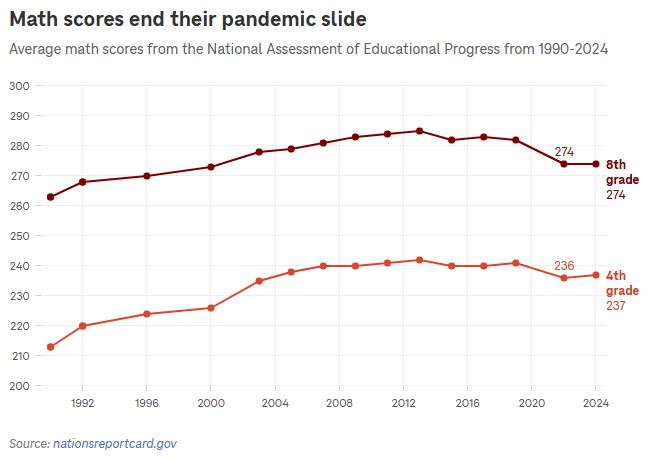

Or notice a pattern in the change in rates of teenage depression in the past decade (especially among 13 year-old girls)?
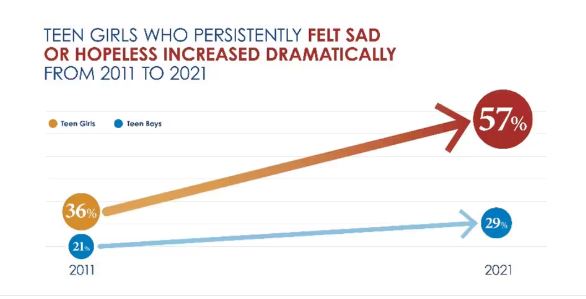
Now I am too much the scientist not to understand that correlation does not automatically mean causation. Spurious associations are so common and readily found that there are entire websites devoted them (one of my favorites is the amount of GMO corn grown in Minnesota and the frequency of global piracy in a given year). However, I still remember intimately the shocked dismay I felt in the fall of 2013 when the average score on an assignment I had given to my most advanced students for more than a decade abruptly dropped from the steady “C” it had been from years prior to the nearly universal “F” it was that September. I, of course, made the necessary adjustments and interventions and have continued to do so with all my students ever since. But the number and depth of those adaptations have steadily increased every single year to date, and I’m not anticipating this demand letting up any time soon.
Again, Hmm. “If it looks like a duck, walks like a duck, and quacks like a duck….” “Where there’s smoke, there’s….” “It’s the economy….” Cliches (and their modern equivalent, the meme) exist for a reason, and those that exist about the link between correlation and causation do so in part to remind us that sometimes we do not have the luxury of untangling the full extent of the causality in a given situation. We need to act like it is a duck; like it is fire; like it is the economy. Or in this case, like it is the Snapchat, etc. because the alternative risks the kind of long-term harm we are seeing in those graphs above. Better to remove social media’s influence from our children’s lives on the likelihood that it could be disruptive to their proper mental and physical development than to wait to fully confirm (as the mounting research of Sherry Turkle, Jonathan Haidt, and others is doing) that it is.
Because if we want to witness a microcosm of a world in which daily use of social media has risen to an average of 95 minutes per person and more than 54% of people get their primary news from it, look no further than the past two weeks. As the Trump administration has deliberately sown chaos through a metaphorical fire-hose of executive actions, the consequent eruption of misinformation, disinformation, and conspiracy theories on social media among immigrants, federal employees, and foreign aid workers has all but paralyzed whole segments of our society and even our economy. We are in a societal freefall at present, and the only “parachute” is going to be calm, persistent, rational, and critical thought to separate what is truly happening from the fiction and lies so that people can persevere in their resistance to tyranny.
And remember. There is nothing more useful to a budding autocrat than an illiterate and ill-numerate population. Hence, we had better take the necessary actions to help improve our nation’s math and reading scores and do it soon because the alternative has already arrived.
Coda
And speaking of that arrival, I got to experience an element of it firsthand while preparing this latest essay. As my regular readers are aware, I work very hard to provide supporting reference for any statistical or factual claim I make in my writing and to cite properly all thoughts I cannot claim as uniquely my own. However, a major source of some of that information is the federal government’s CDC and other scientific databases—all of which, as you can see from the screenshot below, are now under attack from the new administration (note the fine-print at the top about executive orders).
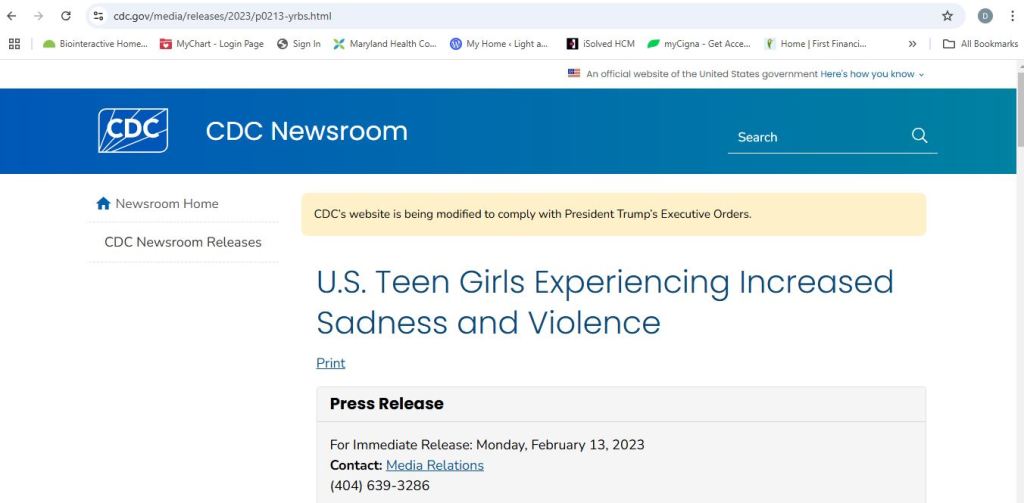
Moving forward, I will continue to do my best to provide full references for anything I write, but since I often link to previous postings where the original sources of some of the citations have effectively disappeared, I ask my reader’s trust when visiting any of my earlier work that if I claimed it or quoted it, I promise the now gone website did affirm it.
References
Ghorayshi, A. & Rabin, R.C. (Feb. 13, 2023) Teen Girls Report Record Levels of Sadness, C.D.C. Finds. The New York Times. https://www.nytimes.com/2023/02/13/health/teen-girls-sadness-suicide-violence.html?searchResultPosition=1.
Haidt, J. (2024) The Anxious Generation. New York: Penguin Press.
Singer, E. (Feb. 2, 2025) Thousands of U.S. Government Web Pages Have Been Taken Down Since Friday. The New York Times. https://www.nytimes.com/2025/02/02/upshot/trump-government-websites-missing-pages.html.
Turkle, S. (2017) Alone Together: Why We Expect More from Technology and Less from Each Other, 3rd Edition. New York: Basic Books.
Turner, C. & Mehta, J. (Jan. 29, 2025) Nearly 5 Years After Schools Closed, the Nation Gets a New Report Card. NPR Morning Edition. https://www.npr.org/2025/01/29/nx-s1-5270880/math-reading-covid-naep.

 Light a Candle