Blog Feed

Seasons

Not knowing eternity is to do evil things blindly.
—Lao Tzu

To everything there is a season and a time to every purpose under heaven.
—Ecclesiastes 3:1

To understand today’s posting, I’m going to need to teach some biology first.  Specifically, I am going to need to explain a concept that most people even with a background in biology are not always aware of—the concept of epigenetics.  This idea and its field of study explore how environmental impacts on an organism’s genetic code can be passed down through generations independent of the genetic code itself, and it is yet another stake in the heart of what for decades was considered the Central Dogma of genetics:  that a sequence of DNA codes for a specific protein which produces a specific trait.  Turns out, per usual, the truth is more complicated.

What’s more, it can also seem somewhat eerie, especially when we look at an example of epigenetics in action.  Take the common white rat.  This favorite of genetic research everywhere has a gene, called fosB, that directly impacts the nurturing behaviors of female rats with their young.  Normal rat mothers will actively groom their offspring, cuddle with them, and perform other calming, attentive behaviors that significantly support and impact their offspring’s proper development.  However, there is a mutation possible in the fosB gene that can render a rat mother perpetually anxious and inattentive toward her offspring—which if passed down through the germline makes future daughters and granddaughters, etc. anxious and inattentive as well.

So far, seems like classic inheritance, right? Inherit the normal fosB gene, and you’re an attentive, nurturing mama rat; inherit the defective fosB gene, and you’re an anxious and negligent mama rat.  Ah! But it turns out that if you take female baby rats with normal fosB genes and place them with an inattentive, neglectful mother, these rats with normal fosB genes will grow up to be anxious and distracted mothers themselves.  And so do their daughters and granddaughters even as the normal fosB gene is passed on to them!  In fact, it can take up to 8 generations of rats before this normal fosB gene starts working properly again in the mother rats.

What gives? We know that differences in environment can impact whether a specific gene is activated or not, and a classic example is the extra melanin production in human skin in response to strong exposure to UV light radiation.  But when there is less UV light, this melanin production decreases.  Change the environment; change the activation and/or activity of the gene.  With the fosB gene, though, we seem to have a situation where it is as if one time exposure to UV caused my skin to stay perpetually high in melanin and then I passed this trait down to my children, their children, and their children’s children.  Given the power of the genetic code (I look like my father for a reason), how is it possible that a one-time environmental impact can cause the impact itself to be passed on independent of the gene involved?

It turns out that our cells have two processes, methylation and acetylation, that enable them to take certain sections of our DNA and keep those sequences either permanently unavailable for expression (methylation) or always available for expression (acetylation)—basically keeping some genes “off” at all times while others are kept perpetually “on.” Which makes lots of biological sense for a complex organism such as ourselves (and our rat friends) because since we all come from a single fertilized egg, every cell of our bodies possesses every single gene, and I do not want my brain cells, for example, ever activating my digestive enzyme genes. Nor do I want the cells lining my stomach ever activating my neurotransmitter genes.  In a similar fashion, since every cell of my body is a eukaryotic cell that needs to transform energy, manufacture proteins, and other tasks common to all my cells, I want the genes for these general functions always activated.

Certain genes, though, such as the fosB gene in rats, can be either methylated or not and still others, such as the one for cortisol in the human brain, can either be acetylated or not.  Therefore, there are certain genes where their expression, their “on-off” status, is very environmentally dependent, and it turns out that this status can be passed down from one generation to the next without any actual alteration in the genetic code itself.  It is a process that is well documented but not yet fully understood, known as epigenetics, and it has revolutionized our understanding of a whole host of human traits from obesity to mental illness.

What, though, does any of this have to do with the primary focus of this project, namely education?

Well, what triggered this walk down my memory lane was hearing neuroscientist, Bessel van der Kolk, speaking with Krista Tippet and revealing that he was one of the survivors of the Dutch Winter during World War II—an event that we now know to be one of the most significant epigenetic events of the Twentieth Century.  The basics are that during the last winter of the war (1944-45), the famine conditions were so severe in the Netherlands as the retreating Nazi’s stripped the country of every resource available that any fetus conceived in the fall or early winter methylated key genes associated with metabolism to help it survive the starvation.  Any fetus, though, conceived in the late winter/early spring—and therefore benefiting from the famine relief brought by the surging Allied troops—did not. 

How do we know all of this? It turns out that when an explanation was sought by the Dutch medical system for why the children and grandchildren of the winter babies seemed to inherit all of their parents’ tendencies toward obesity, hypertension, and cardiovascular diseases while the children and grandchildren of the spring babies did not—populations that were each basically the exact same generations and so should display similar medical patterns—researchers found that the presence or absence of methylation markers appeared clearly on the DNA samples taken from each of these two groups, separated by a single environmental event.

Again, though, I can hear a reader wondering what any of this has to do with teaching and learning?

It turns out for anyone not familiar with his work that van der Kolk specializes in the impact of trauma on the mind and body, and he was conversing with Tippet about the potential impacts of the pandemic’s trauma on people.  That caused me to have one of those small epiphany moments as all the ideas of trauma, the Dutch Winter, COVID, and epigenetics coalesced into a single thought:  what epigenetic impact will the pandemic have that could potentially impact generations of humans to come?

We know, for example, that trauma of any kind has the potential to cause epigenetic changes, and in fact, part of what makes Post Traumatic Stress Disorder (PTSD) so challenging to treat is the on-going highly elevated levels of cortisol in the brain (acetylation in action!).  Moreover, while the kinds of environmental events that can trigger PTSD in individuals is not likely to cause the PTSD itself to be passed down (since the acetylation isn’t occurring in the gamete cells), the elevated cortisol from any pandemic stress a pregnant mother might be experiencing can enter her blood stream, crossing the umbilical cord to the developing fetus, where it can impact gamete cell development (something similar is what happened in the Dutch Winter).

And since cortisol levels in the brain are critical to the success or failure of the memory process (see Chapter 3), how the regulation of those genes gets passed down to future generations impacts all future teaching and learning.  Any stress induced epigenetic changes the pandemic is having on all our genomes has the potential to impact education’s effectiveness for at least a couple of generations (the great grandchildren of the winter babies displayed healthier phenotypes).  Therefore, whether the pandemic causes the mutism of a young boy challenging his Baltimore City school teacher’s attempts to teach him right now or the pandemic produces inheritable methylation and/or acetylation of key genes governing brain development in the future, the pandemic will very likely be impacting how we teach and learn for decades to come.

What’s more, I haven’t even touched upon what epigenetic changes the pandemic might be causing to genes governing an individual’s physical health and the known impact that can have on learning.  Hence, when the experts keep saying that we have no idea yet of what the long-term impacts of COVID are, we need to recognize that they are not just talking about the direct medical consequences it might have for an individual who contracted the disease.  They are talking about the unknown long term potential impacts on every single one of us for possibly generations.

Which can feel scary and overwhelming and despairing even if you are not a fellow educator facing pandemic children in the classroom right now (and might explain the behaviors of the “roaring 1920s” even if they didn’t know the biology then).  However, I would conclude by offering a note of cautious optimism:  those winter babies? They did, in fact, grow up to help rebuild Europe, and they and their children lived long enough to help form the European Union, and—in a definite piece of irony—their grandchildren lived long enough to produce the healthier great-grandchildren who are presently rioting in the streets of the Netherlands protesting the restrictions of their own “Dutch Winter” that will introduce its own set of epigenetic change. Who said nature doesn’t have a sense of humor?

The simple truth facing us at this time (and always if we have the wisdom to recognize it) is that life’s cycles transcend us, with eternity sweeping us along in its currents, and it is how we navigate this journey that ultimately matters.  Change is the only thing that is changeless, and as the generations before us had to deal with their own “winters” as best as able, so too must we deal as best we can with ours.

Remember, hope is a verb.

References

Bowie, L. (Nov. 14, 2021) “We Didn’t Ask for This.”  The Baltimore Sun.  https://digitaledition.baltimoresun.com/html5/desktop/production/default.aspx?edid=a9897f19-3d9f-4abf-9819-2260fef2a265.

Carey, N. (2012) The Epigenetics Revolution.  New York: Columbia University Press.

Nestler, E. (December, 2011) Hidden Switches in the Mind.  Scientific American.  Pp. 77-83.

Tippett, K. (Nov. 11, 2021) Bessel van der Kolk: Trauma, the Body, and 2021.   On Being. https://onbeing.org/programs/bessel-van-der-kolk-trauma-the-body-and-2021/#transcript.

Quarter 1 Grades & Comments: The Kids Are Not Quite All Right

One key reason parents will pay for a private school education is the more individualized attention teachers can pay to their child, and so for twenty-five years now, the last week of October and the first week of November have involved an annual ritual for me of writing a detailed report on every single one of my students at the end of first quarter.  The expectation for these reports is that I will provide an individualized appraisal of both the academic and social-emotional progress of each child, using observable phenomena to support my evaluation; if I were still in my public high school days, it would be the equivalent of a parent-conference night where every single one of my 120 or so students’ guardians actually showed up to have a conversation with me about their child.  “Grades & Comments” are a lot of work.

They provide, though, a great snapshot of the state of education at one’s school as you reflect on the insights provided by other colleagues (whether proofing comments as a grade-level dean or reading them as a student’s advisor), and from snapshots shared with colleagues across the land (and even around the world), the picture right now is a little bleak looking.  The physics teachers at my school, for example, report having to spend the entire first quarter remediating their junior’s and senior’s math skills simply to get to the point where they can teach the actual physics—with all the consequent loss of 8 weeks of content that otherwise would have been covered.  Colleagues from area schools who, like me, teach biology to Ninth graders have all been commiserating together that we’re on the third lab report of the year and are not seeing the growth in the mastery of experimentation skills we have observed in the past.  And my friends in the humanities are struggling mightily with reading and writing skills that are at least 4 months behind where they should be.

In fact, 97% of the teachers in the U.S. alone report observing significant learning loss among their students, and if you live in the developing world, the situation is even uglier.  The United Nations has identified at least 48 countries whose school systems are at extreme or high risk of total collapse, and most of these are in sub-Saharan Africa where the global inequities in access to education were already exacerbated.  Thus, if you are someone like 17-year-old Mathias Okwako of Uganda—who must now mine swampy soil for gold dust using mercury, a known neurotoxin he can absorb directly through his exposed skin—then your learning loss after 77 weeks out of school may be permanent.

And it’s not just traditional knowledge learning that is being lost.  Educators around the world are reporting on how immaturely so many of their students are behaving given their chronological ages, and I can certainly add my own anecdotal voice to theirs.  I have been watching my seniors this year struggle with their executive brain functioning in puzzling ways that remind me regularly of Tenth graders I’ve taught, and it wasn’t until my Homer Simpson “Doh!” moment that I recalled that the last time these seniors were in normal school was about two-thirds into their sophomore year:  in terms of the development of their social-emotional intelligence, my current seniors are Tenth graders, and it makes me somewhat anxious for them heading off to college next fall.

What’s worse is that none of the loss I have been describing is likely to rebound quickly given that in our country alone, tens of thousands of teachers and students have already had their school year significantly disrupted by the need to quarantine after testing positive for COVID.  Compound the problem with the staffing issues confronting schools today, and we’ve got a very real potential crisis in learning world-wide that could ripple through our economies and political systems for decades to come.  We are already experiencing what mere supply chain issues caused by the pandemic can do to the costs and conveniences of daily life; just imagine what would happen if there are not enough adequately educated people to create supply chains in the first place.

All of which brings me back to a point I made early on in this pandemic, and that is: we are all enduring a natural disaster, and we have got to start thinking and acting about it that way.  Just this past Friday during our professional development day, we were examining data from a safety survey our students had taken at school, and I was surprised by how many of my colleagues were so shocked by the level of trauma the survey revealed our students are still feeling.  How can so many very bright people not recognize that what we are all enduring right now is going to leave permanent scars on every single one of us?

I feel similarly perplexed at how many people don’t get that our economy is never going to be the same again, either.  Our shopping habits, our consumption habits, our job-hunting habits, our work habits…nothing is going to return to the world of 2019, and since so many of us keep failing to understand this—viewing this pandemic as it if were the common cold where the illness only temporarily disrupts life before a quick return to normal—people keep getting upset and frustrated by the “refusal” of the pandemic to allow us to get back to our previous lives, not recognizing that what is rapidly becoming an endemic disease has disrupted and changed our lives forever—whether we like that reality or not!

Which is not to say there is no hope or that healing and wellness cannot occur.  But as a society, we have got to start grappling and grasping with the new reality that what constitute hope, healing, and wellness now look different! To use an analogy from the medical field, stroke survivors can and do rebuild meaningful, fulfilling lives.  But they are not the same lives, nor are they the same people afterwards, and the same must be said of all of us who have lived through this natural disaster.

That, though, brings me back to my kids and that survey.  Along with the voices of pain from last year’s experiences, there were voices of joy at the return to in-person learning, and anyone who has paid any attention to the news this week has heard the excited voices of 6- and 7-year-olds as they have been interviewed about their vaccinations and what it can mean for seeing grandparents and having sleepovers again.  Rebuilding is happening, and learning losses are being remediated; it is simply going to take a long time and will look nothing like before.

In the meantime, my fellow educators and I must help our students learn to how to thrive in this reality.  For example, for my current seniors, the pandemic has been high school.  Lockdowns, hybrid classrooms, on-line learning, masks—these are the only high school experience they will ever have (as can equally be said of the elementary and middle school experiences of children of other ages).  It is therefore incumbent on any of us who work with children to help them all embrace and celebrate the person each of them is becoming during this time and to help them all begin to understand one of life’s eternal truths: that “now” is all any of us ever actually have; that each of us seldom truly controls what that “now” is like (our individualist delusions to the contrary); and that, therefore, whatever “now” we are experiencing is when we must be our truest, best, most authentic self because when else can we be?

Or to put it perhaps as starkly as possible, the German psychiatrist, Victor Frankl is reputed to have said to a fellow inmate digging a trench with him in a Nazi concentration camp: “this is where you’ve got to find your happiness—right here, in this trench, in this camp” (Monks of New Skete).  Because when else will you when all there is for anyone is the right now?

References

Bowie, L. (Sept. 28, 2021) More than 4,000 Maryland Public School Students Have Tested Positive for COVID.  The Baltimore Sun.  https://www.baltimoresun.com/education/bs-md-quarantine-schools-20210928-6fddt6pjc5aovokstbqr5pinmq-story.html.

Holt, L. (Nov. 4, 2021) Nashville Schools Struggling Amid Pandemic Setbacks.  NBC Nightly News.  https://www.nbcnews.com/nightly-news/video/nashville-schools-struggling-amid-pandemic-setbacks-125423685742.

Monks of New Skete (1999) In the Spirit of Happiness.  Boston: Little, Brown and Company.

Muhumuza, R. (Nov. 3, 2021) Ugandan Kids Lose Hope Amid School Closures.  The Baltimore Sun.  https://digitaledition.baltimoresun.com/html5/desktop/production/default.aspx?&edid=224347a8-0363-4361-91a9-76be8c7e642f.

Musings from Education’s Frontline

The lion has roared; who will not fear?
The Lord God has spoken, who can but prophesy?

—Amos 3:8

Should a man reach eighty, he has had eighty Septembers.
It does not seem like many, said that way.
It seems as if there are so few
each one should have been better used.

—Travis McGee

I have always appreciated that Judaism celebrates its new year in the fall.  As a teacher, autumn has been my new beginning for over 32 years now, and it is always with a smile of remembrance that I look up each morning on my pre-dawn run and see my old friend, Orion, in the southern sky.  I always know that when that particular constellation is visible, it is the time for my “deep gladness” to go to work.

I have also always appreciated that the Jewish New Year is at the time of harvest and that at the very heart of the Ten Days of Awe lies Yom Kippur, a day set deliberately aside for taking stock of oneself.  It is an opportunity for a type of self-accounting for who one has chosen to be the previous year and who one will choose to be in the year to come, and again, as a teacher, the start of the school year is my time for thinking about lessons learned from the previous year, about how I will adjust my teaching and what new ideas I will try, and about how things this year will be different.  Hence, the notion of a time for deliberate self-reflection to recall that I, too, like my students, remain a work-in-progress appeals to me.

And part of that self-reflection this fall has me simply musing about life in year two of the pandemic.  Things are certainly different in school this fall.  In-person classes have brought some much-needed joy and energy back to teaching and learning, and the difference between my zoom zombies last year and my eager, puppy-like 9th graders this year is so stark that at the end of just our first class together I had to fight back tears of happiness.  The flip side, of course, is that the return to the pace of a normal school day has challenged teachers and students alike as we have struggled to rebuild those atrophied mental (and sometimes literal) muscles, and the necessity for masks, social distancing, and now weekly COVID testing are still no less psychically wearing as perpetual reminders of what we don’t yet have back from the “before times.”  But all-in-all, at little over a month in, I don’t know any of us in schools who aren’t celebrating the difference between last year and this one.

Or I should more accurately say “at least any of us in schools here in Maryland,” where wearing masks in Pre-K thru 12 schools is mandatory and every college and university is requiring proof of vaccination to attend in-person classes.  If I am a student or teacher in Florida or Texas, I have a governor who could legitimately be charged with manslaughter for school policies that have already cost youth who are ineligible for the vaccine their lives.  If I am a student or teacher in Idaho, I am at risk of dying if I contract COVID at school from an unmasked peer because there may not be hospital space for me due to the need to ration medical care.  And if I am a student or teacher along the Gulf coast, I may not even be in school yet because two climate-change related hurricanes in little over a week have so flooded and wrecked the power-grid in my town that there is no place for me to attend.

However, regardless of where a student or teacher lives in this country, they at least all have access to some manner of education, regardless of how benign or contentious that access is.  If I am a female student or teacher in Afghanistan right now, that is no longer the case, and I am most decidedly not celebrating the difference between last school year and this one.  It took the Taliban mere days to reverse 20 years of progress, and I must confess that as someone who dedicated 23 years of my career to the education of teenage girls (and would be still if not for changes in administration), this one hits close to home.  In fact, I almost do not have words for my despair, knowing that all the data shows that the status of women in a society determine the fate of that society.  The more respect, education, and legal status women have in a society, the more that society’s economy thrives, the healthier its population is, and the more stable, uncorrupt, and democratic its government.  It is that simple, and it is why I dedicated so many years to empowering young women in the STEM fields where they have historically been under-represented.

It is also why I look at what the Taliban are doing overtly (and what so many societies do covertly) and shake my head in bewilderment.  Men denying women rights is simply shooting oneself in the foot because in such societies, the men are worse off there as well!  From a strictly self-centered pragmatic standpoint, you would think the patriarchies of the world would get a clue and start promoting the status of women because then their own collective wealth, well-being, and power would be better off and more stable if they did so.  Their behavior and choices are utterly irrational.

I know.  We are not a rational species, and if I ever needed a reminder of that, it came in our first week of school when an e-mail was sent out that the boy’s bathroom outside the 9th grade commons space was now closed due to vandalism.  Since that went counter to my experience so far of this 9th grade, I was a little puzzled until enlightenment came in the form of an NPR story.  Apparently, the latest trend in social media is to perform a “devious lick” (the latest adolescent slang for “steal”), taking a structure out of a public bathroom and posting this “triumph” on a TikTok video—with the larger the structure, the greater the social cache.  Schools across the country have apparently been having to close and repair bathrooms as soap dispensers, mirrors, sinks, and even entire urinals and toilets have been ripped from their mounts to earn “hits” and “likes” on TikTok. 

My own school is no less immune than any other to the undeveloped pre-frontal cortices of adolescent boys and the role of social media in their lives; hence, the e-mail earlier this month. What’s more, if I needed further proof than such collective idiocy that technology and social media will be our downfall, learning recently that there are Facebook pages that contribute to the recruitment for human trafficking, that there are internal documents showing that Facebook’s management knows this, and that Facebook refuses to block or take down these pages because doing so would hurt their revenue stream….well, at least the recent Senate hearings about the negative impact of Instagram on teenage mental health has forced Facebook to delay development of its new Instagram for Kids app for children under the age of regular Instagram’s use agreement. 

Granted, that’s a miniscule victory in a world where a recent study on young people’s anxiety over government inaction on climate change revealed that over half of the 10,000 sixteen- to twenty-five-year-olds interviewed across 10 countries think humanity is doomed and 40% expressed reluctance to have children themselves due to their fears about their future.  But it is a victory, and I am not sure how many of those we have left.

Which brings me to my final musing, a subject that I have been wrestling with deeply this school year as we remain grasped in the pandemic’s talons: when do we acknowledge the certainty of an injury and its inevitable loss? I keep thinking of the analogy of terminal cancer patients and the point in the battle where many make their peace, stop their treatments, and prepare for hospice.  They know the certainty of the outcome of the disease, and they own—even sometimes embrace—the reality of hat truth.  Similarly, with my students, I want them developing their agency for change, but I also don’t want them wasting that agency tilting at windmills.  When, I keep asking myself, do I teach them how they can affect positive change, and when do I teach them about the necessity to perform triage? How do I help my share of those interviewed 10,000 understand that while the irreparable damage they fear is certain and the kind of future they were taught to envision is no longer viable, that that does not mean they will have no future at all?

Moreover, how do I help them develop the tools to construct their futures in ways that enable them to work around the massive damage they inherit to construct meaningful and fulfilling lives? I do not have answers to these questions, but I know finding them is going to be critical for those of us in the classroom because otherwise, it could prove very challenging to keep hoping.  And my regular readers know that I am all about hoping!

That’s it for now, then. Such are the musings rummaging around in my head as the school year gets off to a new start—thoughts from my educational frontline to yours. For everyone out there in the classroom, stay safe and stay well!

References

Morning Edition (Sept. 17, 2021) NPR.  https://www.npr.org/programs/morning-edition/2021/09/17/1038169044/morning-edition-for-september-17-2021.

Weekend Edition (Sept. 19, 2021) NPR.  https://www.npr.org/programs/weekend-edition-sunday/2021/09/19/1038681715/weekend-edition-sunday-for-september-19-2021.

Combatting Ignorance

I do not know how to refute an incredulous stare.
—David Lewis

The Danger of Simple Solutions

We live in an ever increasingly complex and interconnected world, where our capacity as toolmakers has enabled our species to alter the actual climate of the entire planet and even the degree of wobble of the axial tilt on which the earth rotates.  Yet as discussed in my last posting, too many of us in our society are increasingly ignorant about this complexity—with the brain’s Dunning-Kruger Effect making things even worse as the degree of this ignorance contributes to how ignorant we are about our ignorance. As a result, we are witnessing a growth in uninformed populism that believes “that making policy and governing in technologically advanced, economically complex, and ethnically diverse societies isn’t all that hard, and therefore, anyone can do it” (p. xv).1

Or to put it another way, our collective ignorance about the complexity of modern life leads many of us to believe that common sense should be able to solve any problem we might find ourselves facing.  Granted, it is a cynical cliché to say that so-called “common sense” isn’t very common, but the truth is that on a day-to-day basis, what we think of as “common sense” serves us just fine.  I do not, for example, need to know or solve the formula for determining the force of friction between a tire and the road to know to slow down if it is raining while I am driving. 

However, when it comes to complicated problems (e.g. designing a tire to maximize friction in the rain):

common sense is not sufficient.  Cause and effect, the nature of evidence, and statistical frequency are far more intricate than common sense can handle.  Many of the thorniest research problems often have counterintuitive answers that by their nature defy our common sense. (Simple observation, after all, told early humans that the sun revolved around the earth, not the other way around.) (p. 54)

We may look, then, at complex problems and want simple solutions; moreover, our common sense might even appear to provide them:  if there are people starving somewhere, send them food.   But if those starving people live in a politically destabilized country such as Yemen, where delivering the food would require the costs of military intervention and potential loss of life to do so, then suddenly, the solution is not so simple.  Furthermore, when we strive for simple solutions to complex problems, the simple solution can often simply be dangerous—such as suggesting that the easily produced malarial medicine, hydroxychloroquine, protects someone from COVID-19. 

Hence, when it comes to the increasingly complex world in which we find ourselves, we need to address the problems and challenges we uncover with lots of intelligence and informed expertise—something the current educational state of much of this country’s populace makes problematic.  As Tom Nichols puts it: “the celebration of ignorance [in our society] cannot launch communications satellites, negotiate the rights of U.S. citizens overseas, or provide for effective medications, all of which are daunting tasks even the dimmest citizens now demand and take for granted” (p. 218).  Therefore, if we are to endure as a society in the face of global pandemics, the dangers of climate change, etc., we must cure at least some of our country’s collective ignorance before it’s too late.

The Journey to Date

Cures, though, require understanding a condition’s underlying pathology, and so a logical question is: how did we get to this point in the first place? Here is where I want to revisit Tom Nichols general argument and dive a little more deeply into his work.  He presents five factors—all of which are mutually reinforcing—which he believes have contributed to what he calls “the growth of willful ignorance,” and for those who would like a deeper dive into each of them, I strongly recommend his book.  But for now, I want to explore the five factors briefly to see how understanding them might point us toward a cure.

One of the challenges to curing our ignorance is a biological one, which psychologists call “confirmation bias.”  This is our brain’s tendency to “hear things the way we want to hear them” and to “reject facts we don’t like” (p. 39).  It evolved to aid our survival because privileging any data that affirms or reinforces actions that have kept a person alive so far is likely to continue keeping said person alive into the future.  To use my well-worn leopard example, if running from something brown and spotted kept an individual alive, any future data that suggests “brown and spotted” is harmless is information that person is simply going to ignore.  Even if the majority of “brown and spotted” things in this world are, in fact, good for someone and this fact can be demonstrated, the tiny minority of “brown and spotted” that is dangerous is where the brain that survived the leopard focuses its attention.  We all instinctively confirm what we already believe to be true about the world.

Which is fine when it comes to very pragmatic things such as hungry predators or food sources. But confirmation bias can get highly problematic when it comes to personal values, social constructs, and explanations about ultimate meanings.  As Nichols puts it, “we can take being wrong about the kind of bird we saw in our backyard, or who the first person was to circumnavigate the globe, but we cannot tolerate being wrong about the concepts and facts that we rely upon to govern how we live our lives” (p. 67). 

Furthermore, when facts conflict with values, values will win nearly every time. Indeed, so strong is the brain’s confirmation bias that not only will people reject the evidence right in front of them, they will even attack the source of that evidence.  As a 2015 study at Ohio State University revealed, “when exposed to scientific research that challenged their views, both liberals and conservatives reacted by doubting the science, rather than themselves” (p. 69; original emphasis).  Therefore, confirmation bias can cause us to resist even well-documented and confirmed realities about the world, rejecting these “inconvenient truths” even when they might aid our literal survival (as vaccine resistance and the COVID delta variant are making all too abundantly clear).

But an “inconvenient truth” is still a truth, right? So it should simply be a matter of finding effective ways to chip away at confirmation bias with enough persistence and evidence to combat people’s individual degrees of ignorance.

However, what if “truth” itself were up for sale? In our postmodern era, the very concept of truth has come under attack (see COVID-19, Climate Change, and Other Inconvenient Truths), and Nichols argues that the second impediment to curing our collective ignorance is the belief held by many today that “truth” is somehow at the discretion of each individual, that thoughts of any kind—whether personal belief, emotional response, or empirical data—are all equally true simply because they are an idea held by someone.  “Inconvenient truths” can then become “fake news,” and when you combine this solipsistic narcissism with confirmation bias, you get as society where:

Americans no longer distinguish the phrase “you’re wrong” from the phrase “you’re stupid.”  To disagree is to disrespect.  To correct another is to insult.  And to refuse to acknowledge all views as worthy of consideration, no matter how fantastic or inane they are, is to be close-minded” (p. 25).

Fueling such egotism is the fact that each of us today has unlimited access to a nearly infinite number and variety of thoughts of every kind.  The Internet of Everything is Nichols’ third impediment, and it is on our devices 24/7.  We are drowning in information, and because we keep our devices with us nearly 24/7—even disrupting our sleep to check in for fear of missing out—we are drowning in a cacophony of competing points of view, causing us to fall back on our confirmed biases even further.

What’s more, this sea of data triggers still another feature of our brain:  choice-overload.  It turns out that when the brain is confronted with too many choices—say brands of pasta on a grocery shelf—the mind will actively disengage and simply not make a choice—it just will not buy pasta at all.  Marketers know this research and use it when designing things such as grocery stores or big box chains, and it is why you never find all 25 of the brands of toilet paper that a quick Google search can reveal in any one store:  people’s brains just couldn’t choose.

It is also why “not only do people know less about the world around them [today], they are less interested in it” as well (p. 133).  The availability of more information than humans have ever had access to leaves brains so overwhelmed that even where we could potentially cause individuals to learn “inconvenient truths” and successfully fight their tendency for confirmation bias, their brains will tend to shut down to what is still yet more choices of information.  The result is that “alone in front of the keyboard but awash in websites, newsletters, and online groups dedicated to confirming any and every idea, the Internet has politically and intellectually mired millions of Americans in their own biases” (p. 132).

And awash we can remain because all this technology has collided with the realities of capitalism—where nearly unlimited media can become commodified.  TikTok and Instagram exist because the sharing of information can be bought and sold; FOX News and MSNBC exist because people will pay to reinforce their own echo-chambers; even relatively balanced sources of information such as NPR exist because people like me (full disclosure) are willingly to be a sustaining member.

Yet when news and information are for sale, the result is “a chaotic mess that does not inform people so much as it creates the illusion of being informed” (p. 143).  As Nichols nicely summarizes this fourth impediment to curing collective ignorance:

The problem is not that all these networks and celebrities exist, but that viewers pick and choose among them and then believe they’re informed.  The modern media, with so many options tailored to particular views, is a huge exercise in confirmation bias.  This means that American are not just poorly informed, they’re misinformed (p. 157; original emphasis).

Moreover (and the final of Nichols’ impediments), what was once a bulwark against all this misinformation and ignorance (with its insistence on simplistic solutions to life’s challenges) is no longer as functional in our society as it has been in the past.  A college education in the liberal arts was once the hallmark of a culture that respected the complexity of the problems the modern world, and while Nichols argues that it is the commodification of higher education—treating students as customers—that has led to its dysfunctionality (something I don’t feel qualified to affirm or deny), the data he shares showing this dysfunctionality is very real.  I have actually read the original University of Chicago study Nichols references (every confessedly dry word of it; it’s a slog!), and in it, Arum and Roksa tested over 100,000 undergraduates from hundreds of colleges and universities across the United states for changes in their critical thinking abilities during the time they earned their degrees.  What they found is that a little over 80% of the undergraduates they tested as freshmen and then as seniors failed to demonstrate ANY improvement in their critical thinking skills.  Nada.  Four years of so-called education, and the quality of their thinking had not changed one iota from high school.

Again, Nichols wants to blame this state-of-affairs in higher education on the “customer knows best” approach which today’s excess supply of schools use to recruit an increasingly dwindling supply of students.  He suggests that “the protective, swaddling environment of the modern university infantilizes students and thus dissolves their ability to conduct a logical and informed argument” (p. 99).  But regardless of whether he’s correct or not about the causal mechanism (again, I don’t feel qualified to comment), the fundamental truth is that higher education in this country is no longer producing a critical mass of the kinds of minds which could successfully combat the confirmation bias, “fake news,” overwhelmed brains, and media commodification that are producing the collective ignorance endangering our country.

To quote Apollo XIII astronaut, Jim Lovell: “Houston, we have a problem.”

The Cure?

How do we tackle it? How do we combat the culture of collective ignorance that imperils democracy itself?  As a citizen, a relatively obvious answer comes to mind:  regulate the social media platforms that spew the dis- and misinformation and make the equivalent of our current laws for libel and slander part of Google’s, Apple’s, and other technology’s corporate reality.  As an educator, an even more obvious answer comes to mind:  mandatory classes in media literacy and civics throughout the K-12 years, with passing a course in both becoming a national high school graduation requirement—especially given that it took the political fights over the handling of the pandemic to increase the percentage of American adults who could name the three branches of government from a ridiculous 39% in 2019 to a still pitiful 51% in 2020!

But there is a larger solution that already exists to fight our society’s collective “willful ignorance” and one which all of us who teach in any capacity—pre-K through PhD; parent, coach, or formal classroom—have full access to: we can create opportunities for failure.  Cognitive science has repeatedly shown that “learning seems to occur only if the learner pays attention, thinks, anticipates, and puts forth hypotheses at the risk of making mistakes” (Dehaene, p. 178; my emphasis).  Therefore, if we want to fight ignorance of any kind, we need only create deliberately designed occasions for learners of all ages to screw up, to make the mistake, fail at the attempt, and then to grow from the immediate, constructive, nonjudgmental feedback we provide them.  In other words, if we want someone to learn how to stand back up, we must carefully choose to trip them to fall. And do it again and again.

Yet too often, in settings both formal and informal, we have created “a culture of affirmation and self-actualization that forbids confronting children with failure” (p. 78).  We have done so, I suspect, because we have so heavily associated intellectual effort with the act of grading, the assignment of grades, and the many other forms of judgmental, fixed-mindset feedback that when we say a child has failed, we risk calling said child a failure. And since most of us who work with children know the consequent inequities such a claim can cause, there is a strong desire to avoid causing children to make mistakes of any kind. 

The science, though, is clear:  failure is the key to learning and therefore the key to curing our culture’s current infatuation with anti-rationalism.2 The challenge, then, is: can we do it in time? That’s the real crisis facing us right now “because a a stable democracy in any culture relies on the public actually understanding the implications of its own choices” (p. 231). We have large segments of our population who can’t even seem to grasp the purpose of vaccines and mask wearing during a pandemic, let alone how their consumptions habits are undermining every ecosystem on the planet. Thus, we find ourselves with hospitals that are overrun and overwhelmed; with wildfires larger than some of our States; and with election laws in the majority of states actively hindering access to voting. These are not the conditions for a stable democracy, and unless a large enough swath of our population can learn to make better choices, we face a very shaky and uncertain future as a country.

That seems a rather grim way to end matters, and frankly, I wish I could say I can offer any solutions other than to keep helping my own individual students fail successfully and to fight the battle of the ballot box with my vote.  But I do know one thing: failure of any kind always causes learning of somekind!…including what will be learned if we fail to confront the current world’s “inconvenient truths” in time.

1Author’s note:  all quotations in this essay are from the Nichols’ book unless otherwise indicated.

2 Author’s note:  since I elaborate the best-practices for how to achieve this kind of constructive failing in Chapter 6, I will leave any interested reader to turn there for more details on how we can be curing our country’s “willful ignorance.”

References

Annenberg Public Policy Center (Sept. 14, 2020) Amid Pandemic and Protests, Civics Survey Finds Americans Know More of Their Rights.  The University of Pennsylvania.  https://www.annenbergpublicpolicycenter.org/pandemic-protests-2020-civics-survey-americans-know-much-more-about-their-rights/.

Arum, R. & Roksa, J. (2011) Academically Adrift: Limited Learning on College Campuses. Chicago:  University of Chicago Press.

Dehaene, S. (2020) How We Learn: Why Brains Learn Better Than Any Machine…for Now. New York: Penguin Books.

Iyengar, S. & Lepper, M. (2000) When Choice is Demotivating: Can One Desire Too Much of a Good Things? Journal of Personality and Social Psychology. Vol. 79, No. 6, pp. 995-1006.  https://faculty.washington.edu/jdb/345/345%20Articles/Iyengar%20%26%20Lepper%20(2000).pdf.

Lewis, S. (March 2, 2021) Hydroxychloroquine, Once Touted by Trump, Should Not be Used to Prevent COVID-19, WHO Experts Say.  CBS News. https://www.cbsnews.com/news/hydroxychloroquine-not-effective-prevention-covid-19-world-health-organization-donald-trump/.

Nichols, T. (2017) The Death of Expertise: The Campaign Against Established Knowledge and Why It Matters. New York: Oxford University Press.

Pappas, S. (Sept. 25, 2018) Humans Contribute to Earth’s Wobble, Scientists Say.  Scientific American.  https://www.scientificamerican.com/article/humans-contribute-to-earth-rsquo-s-wobble-scientists-say/.

A Brain Research Update…and Why It Matters More Than Ever

The complexity of our society owes its existence
to the multiple improvements
that education brings to our cortex.

—Stanislas Dehaene

The United States is now a country obsessed
with the worship of its own ignorance.

—Tom Nichols

Anyone who has read my Introduction or followed the LaC Updates knows that I believe one of the fundamental pillars for a teacher’s authentic engagement in the classroom is a thorough grasp of what the neuroscience reveals about how human brains function.  Chapter 3, in fact, is devoted to what I consider the minimal knowledge about the brain that even the most novice educator should possess before working with children.  However, during my summer hiatus since my last posting in June, I have been deliberately catching up on the latest cognitive research, and what I have newly learned has profound implications not only for the teaching and learning process but for the current state of education in our society as well.  Hence, I invite all my readers to join me for this update on the brain and, if you are a fellow educator, to share out this information as well.

The Myth of Tabula Rasa

From previous studies (see Medina, Gazzaley/Rosen, & Seth), we already know that our immediate awareness is a projected mental model of the world generated by the brain—a “controlled hallucination”—which is tested against the data from the sensory inputs to determine its veracity.  Our brains accomplish this task through evolutionarily pre-selected algorithms employed in the various sensory cortices, and the consequence is that our immediate awareness is always living slightly in the future, “fantasizing” what the world around us might be like, constantly double-checking to see if we are correct. 

However, for the longest time, there has been a working assumption that any changes in the quality or character of this “fantasizing” (i.e. learning) was due exclusively to the input received from the environment—that the brain was a “blank slate” onto which the senses composed our knowledge (e.g. how to distinguish one face from another).  Experiments by noted Swiss psychologist, Jean Piaget, and those who followed seemed to affirm this assumption, and within the limits of their tools and methodologies, these researchers made valid conclusions from their evidence. 

But science is a process, and with the fMRI scans and other techniques available today, we now know that any understanding of the brain as a tabula rasa is a total myth. In fact, what the most recent research has revealed is that evolution has pre-loaded our brains with certain algorithms (and the parts of the cortices to process them) for modeling the world such that the brain “always starts with a set of a priori hypotheses, which are projected onto the incoming data, and from which the system selects those that are best suited to the current environment” (Dehaene, p. 26). 

Among these pre-loaded algorithms are the concept of objects, a sense of number, intuitions about probabilities, knowledge of animal autonomy, language acquisition, and facial recognition, and with them, a newborn explores the world with certain innate understandings of it already in place—meaning that just as a baby does not need to learn to see (the visual cortex just does it), neither do they need to learn “that the world is made up of objects that move coherently, occupy space, do not vanish without reason, and cannot be in two different places at the same time” (Dehaene, p. 54).  They simply employ this knowledge from birth to make accurate predictions about the objects in their immediate environment and then use this innate knowledge to learn ever more complex ideas about objects (such as what factors make an object fall or stay put). 

Therefore, what the most current cognitive data on infants demonstrates is that:

we come into the world with a vast number of possible combinations of potential thoughts.  This language of thought, endowed with abstract assumptions and grammar rules, is already in place prior to learning.  It generates a vast realm of hypotheses to be put to the test [where] our brain must act like a scientist, collecting statistical data and using them to select the best-fitting generative model (Dehaene, p. 52).

It is an understanding of the brain that borders on Platonism, suggesting that “each human baby’s brain potentially contains all the languages of the world, all the objects, all the faces….” (Dehaene, p. 52)—everything it must ever know. However, “a vast realm” is not infinite, and what other recent research shows is that learning absent some constraints simply does not exist.  All brain algorithms employ pre-loaded assumptions about what they are predicting, and our genes lay down the necessary brain architecture to guide our learning within these restrictions.  In other words, in the same way the optical cortex and its algorithms limit what can be seen—because natural selection has ruled out predicting models about UV and Infrared wavelengths since there are no sensory inputs to test them against—so too, the brain’s pre-loaded knowledge algorithms place certain limits on what we can learn—again because “from evolution, we inherit a set of fundamental rules from which we will later select those that best represent the situations and concepts that we will have to learn in our lifetime” (Dehaene, p. 79).

Yet, there are limits and then there are limits, and here is where the brain’s known plasticity comes into play.  Most of us when talking about education and learning are not talking about the kinds of learning an innate number sense is going to produce (e.g. counting).  Instead, we’re talking about things like reading and history and science, etc.—cultural things—and when it comes to these, cognitive psychologist Stanislas Dehaene is worth quoting extensively because I could not summarize the findings better:

any cultural learning must rely on the [hijacking] of a preexisting neural architecture, whose properties it [repurposes].  Education must therefore fit within the inherent limits of our neural circuitry, by taking advantage of their diversity, as well as of the extended period of neural plasticity which is characteristic of our species.… According to this hypothesis, to educate oneself is to [repurpose] one’s existing brain circuits.  Over the millennia, we have learned to make something new out of something old.  Everything we learn at school reorients a preexisting neural circuit in a new direction.  To read or calculate, children [repurpose] existing circuits that originally evolved for another use, but which, due to their plasticity, manage to adapt to a new cultural function (Dehaene, 121-122).1

Thus, for example, when we learn to compare the sizes of quantities, fMRI scans reveal that our brains grow additional neurons in the number detecting area of the cortex.  Later, when we learn the Arabic numeral system (the 1, 2, 3…most of us are familiar with), a fraction of these neurons become exclusively dedicated for this purpose, only lighting up in the scans when we are manipulating these numerals.  This pattern of repurposing our innate number detecting neurons continues such that “all of us, at any stage of the cultural construction of mathematics, from elementary school students to Fields Medal winners, continually refine the neural code of that specific brain circuit” (Dehaene, p. 127)—and only that specific brain circuit; without our brain’s pre-loaded innate number sense, mathematics as a field of knowledge would simply not exist.2

Timing is Everything

Something similar happens when we learn to read.  However, here the fMRI brain scans and other research reveal the reality of the human brain’s evolutionary limits.  We know from earlier neuroscience studies that the brain possesses not only plasticity but also preservation (see Chapter 3 for an overview), and what the recent work of Dehaene and others about reading has shown is that because of this balance, there are windows of time when the brain’s ability to reconfigure its neural networks are more open and windows of time when this process is less open.  To understand the how and why, let’s explore what happens in the brain as a person learns to read.

There are two innate brain abilities employed in the act of reading—language acquisition and facial recognition—and the way it works is that the group of neurons in the left occipital lobe of the visual cortex that evolved as the primary facial recognition circuit get repurposed to become what is essentially the brain’s letter repository.  The language centers in the left hemisphere can then use this data to assemble word recognition and apply the necessary syntax rules (acquired from learning how to speak) to generate understanding.  Thus, because we evolved to recognize faces and talk, we possess the necessary neural circuitry to hijack to invent writing and reading.  Indeed, the better a person can read, the slightly slower they recognize faces as this processing gets shifted to the right side of the visual cortex; illiterates in fact respond more intensely to faces than literates do.

Which leads us back to the plasticity/preservation challenge.  The longer an individual remains illiterate, the more the primary facial recognition neurons lock themselves into their original evolutionary purpose, making it harder and harder to repurpose them for reading.  That is why grown adults who are trying to learn to read for the very first time struggle so hard at the task and why they never becoming truly proficient at it even when they are successful.  Too much of those parts of their brains that could have been repurposed for reading have become preserved for other functions, limiting the plasticity available for performing the task.

Similarly, children with diagnosable reading difficulties also face a plasticity/preservation challenge.  While the research into the “why” is on-going, brain scans of individuals with dyslexia or comparable conditions universally show reduced activity in the left occipital cortex when exposed to words.  Something in these children is preventing their brains from repurposing the primary facial recognition circuit, and so interventions are needed to help their brains repurpose a different set of neurons before they can become successful readers—something which, again, must be done before these alternative (still unknown) neurons in the visual cortex get locked into some other purpose. 

Hence, “the conclusion is simple:  to profoundly [repurpose] our visual cortex and become excellent readers, we must take advantage of the period of maximum plasticity that early childhood offers” (Dehaene, p. 138).  Moreover, we must do so because it is just not literacy versus illiteracy that is at stake.  Someone who can read has almost double the short-term memory abilities of an adult who never attended school, and IQ increases several points for every additional year an individual’s degree of literacy improves.  How the visual cortex gets repurposed impacts the entire brain’s capacity to learn.

Avoidable Disaster?

What is true for the visual cortex and its role in reading, though, is also going to be true of objects, probabilities, and all the other innate brain circuits.  The bottom line is that learning brings multiple improvements to the entire cerebral cortex, and the implication for education of these most recent findings about innate algorithms and plasticity windows is obvious.  The brain’s malleability versus conservation flexes in different cortical locations at different times as we mature (generally declining after full adulthood is reached).  Therefore, those of us who are preK-12 teachers need to maximize the different optimum learning windows during childhood to establish the foundation and conditions for the ability for lifelong learning.

And nowhere is this truer than with those who teach our youngest children.  Any delays in the development of literacy and numeracy during their prime window in early childhood can snowball quickly, and the poor reader who reaches my high school classroom is going to be put at significant disadvantage for learning the skills of abstraction and metacognition whose prime plasticity window is adolescence—which in turn puts the quality and capacity of that individual’s adult learning even further at risk than simply being semi-literate.

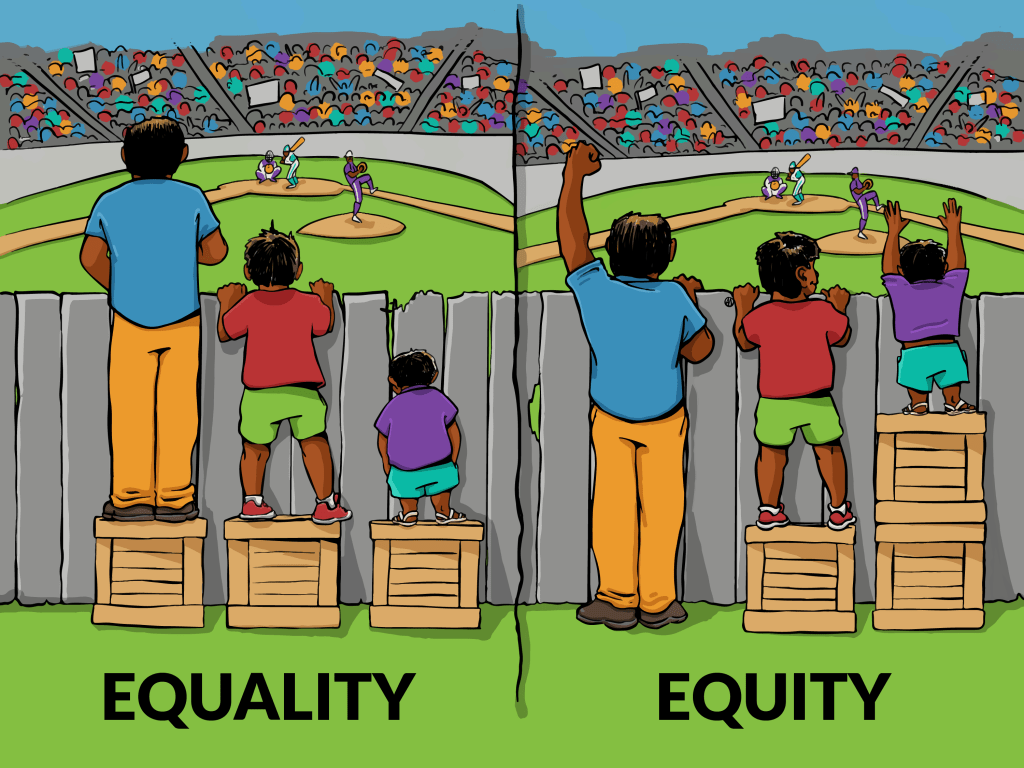
It also puts just about everything else in said person’s life at risk as well.  I have already written extensively about how failures in learning contribute to the systemic racism and its consequent costs for individuals in this country (start with Equality vs. Equity), and I how looked extensively at how the pandemic is likely to exacerbate this failure even further (start with The Tally So Far).  But it was not until I was recently reading Tom Nichols’ argument in The Death of Expertise that I began to consider the true enormity of the consequences if we fail to do what the neuroscience says to be doing in our educational systems.

Nichols, a faculty member at the U.S. Naval War College and the Harvard Extension School, claims that “we live in an age of resolute narcissism…swaddled in a sense of sullen, unfulfilled entitlement that makes self-correction and continued learning almost impossible” (p. xvi).  He argues that the typical American rejects the empirical rules of evidence, refusing to learn how to argue logically, and that consequently: “the foundational knowledge of the average American is now so low that it has crashed through the floor of ‘uninformed,’ passed ‘misinformed’ on the way down, and is now plummeting to ‘aggressively wrong.’ People don’t just believe dumb things; they actively resist further learning rather than let go of those beliefs” (pp. xx-xxi). This, he claims, not only puts at risk centuries of knowledge (antivaxxers anyone?) but undermines the very means to develop new understanding (such as how an individual’s behaviors contribute directly to climate change).  Put it all together, he states, and “we court any number of avoidable disasters” (p. xviii), not least of which is the undermining and collapse of our Republic.

Now those who have read COVID-19, Climate Change, and Other Inconvenient Truths or Breaking Bad “Habits” will already know how fundamentally sympathetic I am to Nichols’ position. I am, in fact, one of those “others” he leaves it to to explain how we got to this “age of resolute narcissism” in the first place (see The Unprepared Generation).  What’s more, I plan to take a deeper dive into Nichols’ ideas in a later post.

But currently, I want to place what he is arguing within the context of what the new brain research informs us about learning.  First, if there are boundaries—however fuzzy—on the different windows of maximum plasticity for optimizing different types of learning, then there is an overall limited window for producing brains that can avoid the dangerous ignorance at work in our society today, and once a given individual is past this window, they now possess a brain either fully capable of productive lifelong learning or one that is actively preserving what I will euphemistic dub “ignorance” neurons in its various cortices.

Second, the overwhelming weight of evidence is that for at least the past four decades, most of the learning taking place in this country’s schools (public and private!) has failed to produce a critical mass of citizens who possess brains that are high functioning.  See notes 1, 4, & 5 in the Introduction for references, but the data is clear that an overwhelmingly large number of brains leave America’s classrooms with their “ignorance” neurons firmly locked into place.

Third and finally, once the optimal windows of plasticity in a brain have closed, brains that have preserved their “ignorance” neurons run head long into the Dunning-Kruger Effect:  the condition where those less skilled and less competent remain unaware of how unskilled and incompetent they truly are—or as the authors of the original study put it, “not only do [such individuals] reach erroneous conclusions and make unfortunate choices, but their incompetence robs them of the ability to realize it” (pp. 1121-1122). 

What the neuroscience is showing us, then, is that poorly educated people possess brains that learn poorly as adults, that are limited in their capacity to change this fact, and that are not inclined to do so anyway.  Or to put it wickedly bluntly, adults with “ignorance” neurons preserved and locked in are too stupid to know how stupid they really are.  And they act accordingly. 

Conclusion

The findings of neuroscience, then, would seem to help explain the very predicament Nichols contends we find ourselves in as a society, leaving a somewhat grim forecast for our future.  But those same findings also explain why the other two pillars of authentic engagement in the classroom—appropriately intimate rapport and teacher as co-learner—generate the conditions for the kind of learning the does result in brain circuits shaped and preserved for productive lifelong success and thoughtful, engaged citizenry.  By forming caring, trusting relationships with students and modelling for them what high-quality, successful learning looks like, teachers can optimize their impact during the brain’s years of maximum plasticity to produce the kinds of metacognitively aware thinkers our society and our world so desperately need.  We need authentic engagement in our schools now more than ever.

Granted, that is easier to write than to do.  In fact, reading the National Academy’s Call to Action for Science Education this summer, it was hard not to feel a pessimistic, almost defeatist sense of déjà vu as I thought “Thirty years, and we are still tasking educators with the same undone reforms.”  When I add in my observations of the destructive damages of the pandemic and climate change, I will admit it:  I am not very confident that whatever good there is of “the complexity of our society” will survive. 

But as I remarked in My Deep Gladness, I seem constitutionally incapable of not “lighting candles against the darkness,” and if I ever need a reminder of the real potency of that light, it came in the form of an “ah ha” moment this past spring from my school’s graduation ceremony. One of my seniors, who was one of the commencement speakers, unexpectedly referenced me by name during her speech, and I found myself bewildered.  Here I had just finished the worst year of my teaching career, under horrific conditions, at a brand-new school, and I learn that somehow, I had still managed to positively touch a child’s life.  To say I was bemused and nonplussed is an understatement.

Not until I was walking home afterward, though, did the little proverbial mental lightbulb go off, and I suddenly realized not only why I work so hard to practice—however imperfectly—authentic engagement myself but why I do the same to promote it in others and address its absence in too many of our schools:  as long as there is any real learning going on somewhere, sometime, there is hope, and where there is hope, there is a future worth fighting to sustain.

Therefore, as I start to prepare for my 34th Fall working in schools, you will find me once again with my students, learning right beside them, working to show them they are loved, and—as always—following the brain science…wherever it may lead.

1Author’s note:  the original French term Dehaene uses in this passage is “recyclage,” which has slightly different connotations in French than it does in English.  So I have replaced “recycle” with a term that better corresponds to his actual meaning, which is “repurpose.”  I will use “repurpose” throughout the remainder of my discussion.

2Author’s note: as a strictly philosophical aside, the limitations created by the innate learning circuitries of the brain on the learning process has interesting potential consequences for our understanding of epistemology:  if we can only know what the evolution of our brain’s architecture allows, then any organism with an alternative architecture (birds are a good example) could at least theoretically have knowledge that not only we do not have but cannot have because we do not possess the brain architecture to generate it.  We literally could not know that we do not know.

References

Dehaene, S. (2020) How We Learn: Why Brains Learn Better Than Any Machine…for Now. New York: Penguin Books.

Gazzaley, A. & Rosen, L. (2016) The Distracted Mind: Ancient Brains in a High-Tech World. Cambridge:  The MIT Press.

Kruger, J. & Dunning, D. (Dec. 1999) “Unskilled and Unaware of it:  How Difficulties in Recognizing One’s Own Incompetence Lead to Inflated Self-Assessments” in Journal of Personality and Social Psychology, 77(6); pp. 1121-1134.

Medina, J. (2014) Brain Rules: 12 Principles for Surviving and Thriving at Work, Home, and School.  Seattle:  Pear Press.

National Academies of Sciences, Engineering, & Medicine. (2021) Call to Action for Science Education: Building Opportunity for the Future.  Washington, D.C.:  The National Academies Press.

Nichols, T. (2017) The Death of Expertise: The Campaign Against Established Knowledge and Why It Matters. New York: Oxford University Press.

Piaget, J. & Inhelder, B. (1969) The Psychology of the Child.  New York: Basic Books.

Seth, A. (Sept. 2019) “Our Inner Universes.” Scientific American; pp. 40-47.

Two Futures

We cannot blame technology for this state of affairs.
It is people who are disappointing each other.
Technology merely enables us to create a mythology
in which this does not matter.

—Sherry Turkle

An algorithm is only as open-minded and smart
as the human who built it.

—Rana el Kaliouby

Be on your guard and very careful,
for you are walking about with your own downfall.

—Sirach 13:13

Any of my regular readers already knows my strong, even impassioned, love-hate relationship with digital technologies.  I resisted owning a smartphone until 2014 because I had no desire to turn into one of the “alerts” junkies I was watching populate my life around me.  Yet, I have designed and built multiple websites since the late 1990s for the practical reason that the Internet enables me to reach an audience of greater than one.  I only finally purchased my android phone (no evil Steve Jobs for me!) because every business model on the planet just assumed that there was a miniature computer permanently attached to my fingertips and I needed to function in society.  Yet I have taught coding to my STEM students now for well over a decade for the simple truth that it engages the brain in some of the most rigorous and complex problem-solving available.  Like I said:  love-hate.

Part of the hate, though, is that the negative impact of our on-line lives on our actual lives has become well-documented.  Since the rise of digital technologies, clinical depression, loneliness, exhaustion, stress-levels, and anxiety have all seen sharp increases in the general population—especially in our youth—all directly attributable to the use of these tools.  Meanwhile, there has been a 40% decline in the markers for empathy over the past 30 years, with the corresponding rise in intolerance and bullying—again directly attributable to the use of digital technologies. There is even evidence that these devices have made us less economically productive (Homayoun). 

Furthermore, a strong argument can be made that smartphones in particular actively contributed to our poor handling of the pandemic and the size of our death toll in this country (see The Unprepared Generation Part 1 and Part 2), and I have already written elsewhere about the risks they pose to education.  Toss in a year now of “Zoom School” and “Zoom Work” where so many of us lived on our screens nearly 24/7 and is it any wonder that my sister, who is a clinical social worker who supervises case management for a large insurance company, reports between a 21-28% increase in mental health referrals in any given month from March 2020 thru May 2021?

What, though, is the causal link? Why does our use of digital technologies appear to generate so many negative consequences for so many individuals? The answer renowned computer scientist, Rana el Kaliouby, offers is this: our devices are making us functionally autistic. To understand how they do so, we simply need to recognize the fundamentally critical role that emotions and their corresponding facial expressions play in communicating successfully and meaningfully with others.  When we are on our devices, she argues, we are effectively always “face blind,” and since so essential are these non-verbal clues to human interaction “that, even before we are born, we practice our smiles in our mother’s womb” (p. 235), their total absence leaves us unable to judge or gauge how to behave appropriately in our digital exchanges—in much the way an individual suffering from autism does when interacting directly with other people.  As she summarizes:

Early in my work, I realized that when it comes to recognizing and interpreting feelings, computers are functionally autistic:  They can’t see or process emotion ‘data’ or respond to emotion cues…[therefore when employing them] without any real emotional connection, it’s easy to forget that we are talking to and about other human beings, and the absence of real-time social interaction twists and distorts our behavior.  When it comes to the digital world, our computers have trained us to behave as if we lived in a world dominated by autism, where none of us can read one another’s emotional cues” (pp. 9-10).

And since computers have become our dominant means for communication today, she concludes, we have all become functionally autistic in much of our interaction with one another.

el Kaliouby’s solution to this situation is interestingly enough, more technology.  She is one of the founding pioneers in the field of artificial emotional intelligence (Emotion AI), and her initial research was in fact to develop an algorithm that could read and process the emotions of facial expressions to aid those suffering from actual autism.  Her goal, with the help of the Autism Research Centre at Cambridge, was to develop an “emotional prothesis” similar to Google Glasses that an individual on the autism spectrum could use to process the emotional expressions of others in real time in much the same way that my corrective lenses enable me to process vision correctly.

Today, el Kaliouby heads the company, Affectiva, spun off from her research at the renowned MIT Media Lab, and she and her colleagues are producing some of the most cutting-edge algorithms for artificial emotional intelligence in the world.  Indeed, she has become a bit of an Emotion AI “evangelist” through her TED talks and work with the PBS series, NOVA, and her most recent focus is on the impact of robots in society. 

el Kaliouby recognizes that millions of current employment opportunities will either disappear or become fully automated in the near future, leaving only work that requires an person’s uniquely human EQ and CQ abilities (see Teaching Creativity).  In addition, she grasps that as robots enter more and more of our daily lives (Alexa is a primitive example), there will be an ever greater need for them to possess some rudimentary capacity for empathy (her story of getting ticked off at a literalist Alexa is one to which we can all relate!).  And, of course, being the “evangelist” that she is, el Kaliouby believes that the answer is more and better artificial emotional intelligence. 

First, she postulates that “Emotion AI will empower human beings to strengthen our uniquely human skills, the very skills that will be in great demand.  This is how we retain our EQ in a tech-driven world” (p. 269).  Second, she thinks we will have a better world when empathetic learning robots “democratize education for everyone, regardless of zip code or social or economic status;” when friendly medical avatars enable patients to ask the same questions repeatedly without feeling stupid, rushed, or judged; and when mental health providers can look for clinical signs of illness in speech patterns via smartphones because “after all, a lot of us today talk to our devices even more than we talk to our friends, family members, or health care professionals!” (p. 284).

It was reading that last that gave me pause.  It reminded me of the words of another person associated with both MIT and digital technology who is not so rosy in her outlook:  Sherry Turkle.  Turkle has asked “what are we missing in our lives together that leads us to prefer lives alone together?” (p. 285), and after reading el Kaliouby’s memoir, I’m not sure the answer isn’t what she claims, namely empathy.  However, I am not sure that she and I meand the same thing by that term. el Kaliouby may claim that “through AI, Mabu [a home health companion robot] develops empathy for the user and, using that empathy, devises the best way to interact with him or her” (p. 275).  But what is empathy? If empathy is simply a programmed behavioral response—robot recognizes an input as “angry voice;” responds with programmed soothing words as output—then all Emotion AI is doing is providing yet another technology to cater to our narcissism and isolation from one another:  as the one young woman remarked to Turkle, why wouldn’t I trade in my boyfriend for a robot if the robot always demonstrated nothing but caring behavior toward me? (pp. 7-8).

Genuine empathy is the capacity to generate within ourselves a recreation of the experience of the other person.  When I see someone tearing up in response to something unkind that I have said, my brain immediately produces a similar feeling of emotional pain within me.  I “get it;” I empathize, and out of that empathetic response, I am forced to change, to respond appropriately and seek healing.  In fact, our brains even evolved dedicated cells, “mirror neurons,” for this very process: in a social species, they were and are critical for our very survival.

Any AI, though, is never going to have this capacity.  It will only display the programmed response through its algorithm to the set of inputs it is trained to associate with that response.  And while I agree with el Kaliouby that training AI to recognize emotional inputs is value-added—having your smartphone, for example, “read” the text you are about to dash off in a fit of spite and warn you not to hit send would make the world a better place for all of us—I want to challenge that perhaps teaching individuals the mindfulness and self-reflection to think twice in the first place might be even more value-added.  Likewise, empathetic learning robots and medical avatars might improve educational and medical situations where resources are limited, but that’s a “band-aid” for such problems.  Why not invest the necessary human capital in the first place to truly solve them?

As Turkle reminds us, because of our digital technologies, “we came to ask less of each other.  We settled for less empathy, less attention, less care from human beings” (p. xxi), and if, as el Kaliouby suggests, we address these matters with Emotion AI, then do we risk potential pathologies becoming normalized? Perhaps el Kaliouby is correct:  that because digital technologies are here to stay, we will all need Emotion AI “protheses” to function in the future just as I need corrective lenses to see now.  But where will the future EQ for developing these “protheses” come from once it is only the “digital natives” with their already underdeveloped EQs to write the algorithms? Also, who’s algorithms? el Kaliouby herself cautions that because China has “access to massive amounts of data on people collected by the government in ways a democratic society would not tolerate” (p. 303), it can produce AI algorithms more rapidly and more effectively than anywhere else in the world.  What might a totalitarian Emotion AI look like?

In her work, Turkle provides an analogy between the technology that brought us sugared soda water and the technology that brought us digital devices.  We embraced both with equal abandon, she points out, and it took us over a hundred year before realizing that the former was not good for us at all and, in fact, distinctly unhealthy for us to consume.  While I am sympathetic to el Kaliouby’s program and her clear passion for it—her work on autism has the potential to transform millions of lives, and the autonomous car that could protect a driver from themselves (as well as a smartphone that could) would most definitely make the world a better place!—my fear is that from the 35,000-foot level, what Emotion AI is really giving us is simply “diet soda.”

And anyone familiar with the link between long term exposure to artificial sweeteners and a significant increase in risk for developing type 2 diabetes later in life knows that diet soda isn’t much better for us than regular.  Turkle’s analogy continues to haunt.

References

Homayoun, A. (2018) Social Media Wellness: Helping Tweens and Teens Thrive in an Unbalanced Digital World.  Thousand Oaks: Corwin Press.

el Kaliouby, R. (2021) Girl Decoded: A Scientists Quest to Reclaim Our Humanity by Bringing Emotional Intelligence to Technology.  New York: Currency.

Turkle, S. (2017) Alone Together: Why We Expect More from Technology and Less from Each Other, 3rd Edition.  New York:  Basic Books.

Teaching Creativity

I want to talk today about creativity.  Our good friend, Webster, defines it as “1. the bringing into being; originating, designing, inventing, etc. 2. the bringing about; causing.” Modern neuroscience, meanwhile, defines it as the brain’s capacity to combine previously unassociated ideas in new ways (Leslie).  But regardless of one’s specific definition for it, creativity is a critical cognitive skill for success in life, and one that Fortune 500 CEOs unanimously vote is the most important quality for leadership in any discipline.  Creativity matters.

It can also be measured and taught.  We determine an individual’s “CQ” (joining IQ and EQ as identifiable brain capacities) by taking a measure of a brain’s “fluency” (the number of ideas possessed in long term memory [LTM]) and a brain’s “flexibility” (the number of conceptual categories in LTM), and from these derive an individual’s capacity for creativity. Furthermore, like IQ and EQ, an individual’s CQ is malleable and can change over time in response to environment and training.  Hence, in the same way that we can develop and strengthen a person’s IQ and EQ, we can teach someone how to be more creative.

Yet data suggest that by the time most of us reach adulthood, our CQ levels have actually declined. What’s more, the data suggest a possible culprit for this decline:  education.  When the CQ of preschoolers is measured, 98% of them score at the “creative genius” level (relative to the others in their age group).  But by elementary school, that number drops to 30%. By high school, it is 12%, and by adulthood 2% (Scala & Wolking).  Imagine! Just 2% of today’s adults have CQ scores at the “creative genius” level. What’s going on here?

I have already written about digital technology’s impact on the declining levels of creativity we see today and its corresponding decline in entrepreneurship in this country. But that decline is across all age groups.  What I believe is driving the observed steady decline in CQ as individuals grow up in our culture is the way the vast majority of them are taught over the course of their educational careers.  As I discuss in the Introduction, the dominant paradigm in most of our educational systems is a Cartesian one, where students are “machines” to be assembled and operated to acquire predetermined properties and then graded on how well each “machine” has successfully achieved these properties in order to assign it a specific value to society.  Thus, as a student progresses through this system, each is steadily told what they are good at and what they are not good at, and the “not good” is increasingly removed from their learning, depriving them access to the additional ideas (“fluency”) and categories (“flexibility”) that inform a person’s CQ.

It is little wonder, then, that by the time even a college educated individual has completed a major (the ultimate in restricting “fluency” and “flexibility”) and earned their degree that they have lost their “creative genius” as future adults.  Which is not say that they are incapable of being creative within the limitations of what’s available in their LTM, but the key word there is “limitations.”  Most schooling in this country steadily places more and more limits on what students are allowed to learn (can everyone say “tracking?”), and therefore, by adulthood, most of those preschool “creative geniuses” have ceased to exist.  CQ’s very malleability in this case works against itself.

Furthermore, it should also come as no surprise that the impact of schooling chipping away at a person’s CQ is even worse for students of color and those in poorer communities.  After all, as I discuss in more detail in To Grade or Not to Grade, the whole point of tracking is to socialize and adapt certain designated groups to “fill low status positions” (Spener, p. 61) that not only require minimal creativity but in fact actually need low CQ in order to tolerate what is being demanded of them.  I have little doubt, for example, that it is far easier to work for Walmart or Amazon if your “fluency” and “flexibility” have been systematically stunted by classes with lower standards and expectations, and so I suspect that if we explored even the small 2% of adults identifiable as “creative geniuses,” we would still see the impact of inequity there as much as anywhere else in our society.

However, what is most worrisome to me as an educator gets back to the fact that for everyone, CQ’s malleability seems to work against itself in our current educational systems.  And the reason why I find that so worrisome is that the same CQ malleability that can work against itself in the wrong educational environment can also be said to be true of IQ in our school’s as well.  As the work of Dweck and others have shown, intelligence is highly malleable, and the impact of grading and tracking on changes in individual students’ IQs over the course of their school years (both positive and negative) is well documented (Hammond).  Therefore, not only is the predominate existing school structure in this country undermining the capacity for creativity in children and adults alike; it is undermining our capacity for cognition as well.  Add in the fact that our digital technologies are making nearly all of us functionally autistic in our EQs when it comes to interacting with one another (el Kaliouby) and our repeated failures to tackle our entrenched social problems should no longer come as a surprise to anyone: we are basically systematically building brains to fail at empathetic, creative problem solving.

But we don’t need to be.  The alternative educational paradigm presented in this project works.  When children are authentically engaged by their teachers, all the “Qs” increase; I have seen it firsthand and in myriad educational settings.  Educators who employ the co-learning, appropriately intimate rapport, and brain science elaborated on in Part I transform their students’ lives for the better and produce effective citizens who can create a more just, economically fair, and ecologically sustainable society. 

What we can no longer afford, though, is for simply individual educators to do this in the isolation of the occasional odd classroom.  We need an educational system that does it, and we need that educational system ASAP.  Time IS running out on some of the problems facing us (see It Could (Will?) Be Worse), and unless as a society we start producing fully equipped empathetic, creative problem solvers, the January 6 insurrection will be just the tip of the proverbial iceberg of what is to come in the future of this country.

Which brings me to one last thought about creativity.  In our everyday vernacular, the word has very positive associations; we think of highly creative people as value-added and creativity as something aspirational.  However, I provided Webster’s definition at the start of this post for a reason.  Creativity is simply that: “the bringing into being” or “the bringing about” of something new. What that something new actually is depends not on how large a person’s CQ is but the qualities of the “fluency” and “flexibility” that produce it.  The number of ideas and the number of categories in someone’s LTM can be enormous and their CQ off the chart—a true “creative genius”—but if those ideas and categories are those of bigotry, prejudice, hate, etc., then what that genius creates can be horrific and decimating—the Nazi’s “Final Solution” and the American “Manhattan Project” were both examples of highly creative problem solving.

Therefore, it is not going to be enough to construct an educational system that improves the “Qs.”  How the system improves them matters, too.  Teaching entrepreneurship, for example, is a great way to teach creativity, but it also a great way to teach greed.  That is why the ecological paradigm of authentic engagement presented in this project is so critical for restructuring our schools.  Otherwise, we risk producing the “technically sophisticated and highly skilled barbarians” discussed in Chapter 7—right along with the highly creative conspiracy theorists and demagogues who can threaten a democracy.

References

Dweck, C. (2016) Mindset: The New Psychology of Success.  New York:  Ballantine Books.

Hammond, Z. (2015) Culturally Responsive Teaching & the Brain. Thousand Oaks, CA: Corwin Press.

el Kaliouby, R. (2021) Girl Decoded: A Scientists Quest to Reclaim Our Humanity by Bringing Emotional Intelligence to Technology.  New York: Currency.

Leslie, I. (2014) Curious: The Desire to Know and Why Your Future Depends on It. New York: Basic Books.

Medina, J. (2014) Brain Rules: 12 Principles for Surviving and Thriving at Work, Home, and School.  Seattle:  Pear Press.

Scala, K. & Wolking, J. (2021) Innovative School Model Showcase: Entrepreneurship at Aspen Academy. NAIS Webinar. https://www.nais.org/articles/pages/member/webinars/2020-2021/nais-webinar-recording-innovative-school-model-showcase-entrepreneurship-at-aspen-academy/?utm_source=bn&utm_medium=email&utm_campaign=mc&utm_content=cip.

Spener, D. (1996) Transitional Bilingual Education and the Socialization of Immigrants. Breaking Free: The Transformative Power of Critical Pedagogy, ed. By P. Leistyna, A. Woodrum, & S. Sherblom.  Boston:  Harvard Educational Review.

Whitman, G. & Kelleher, I. (2016) Neuroteach: Brain Science and the Future of Education.  New York: Rowman & Littlefield.

April 19, 2021

For the light shines in the darkness,
and the darkness has not overcome it.

—John 1:5

It happened.  It finally happened.

I will remember Monday April 19, 2021 for the rest of my life.

For the first time in the 227 days since the start of school (and in my case, 22 months and 18 days), I taught a class totally live.  No Zoom.  No virtual.  Eleven bodies in the class; eleven bodies in the room.

Then it happened again, with another class.  And yet again, with yet another class!

I have seldom felt more gloriously and totally alive as an educator.

Of course, none of it lasted.  I was back to virtual and zooming at least one or two students into hybrid by the very next class, and in the case of my two senior courses, it was only a week before they left for their month-long work projects.  But for a total of 180 minutes the last two weeks of April, I had the chance once more to be truly authentically engaged as an educator and not have to compromise nearly everything I know about good teaching.

And that has been my greatest challenge this school year: the soul-searing compromise.  Having spent the better part of a year on sabbatical reflecting, researching, and writing about the qualities of good teaching and learning, only to find myself in a situation where it is simply not possible to practice nearly any of it…the emotional cost of my necessitated and deliberate hypocrisy has been severe.  It has made getting up each morning to enter the classroom taxing and wearing, and for the first time since very early in my career, when I was striving—not always successfully—to master my craft, I am eager for a school year to come to an end.

Nor am I alone in my feelings.  I have already written about the hiring crisis facing education today (made only worse by the pandemic).  But a year of “zoom zombies” and the exhausting concessions that hybrid teaching demands has only inflamed this crisis even further, and while my sample size is limited, I have heard quite a few colleagues declare that they simply will not return if learning is not back to in-person again this coming fall.  They won’t do it to themselves; they won’t do it to the kids.

And children everywhere have paid a price.  Just here in Maryland, failure rates among high school students have doubled in 11 of the 24 school districts in English and have doubled in 13 of them in math.  In fact, 61% of all students throughout the state are failing at least one course, and many students who were once earning “A’s” and “B’s” are now earning “C’s” and “D’s.”  Daily attendance has plummeted, with levels as low as 56% among those who were already disadvantaged even before the pandemic, and from Las Vegas, Nevada to Broward County, Florida “experts say it could take years to make up the ground that has been lost” (Bowie)—assuming it can be made up at all (see The Tally So Far).

Yet lest the doom and gloom get too dark (and my readers question my sanity, wondering how my recent joy in the classroom could cause me to appear to go there so quickly in the first place), I want to suggest that my brief return to authentic engagement with my students and my inability to be so engaged for most of this academic year is one of those both-and paradoxes that points to a larger truth that is critical not only for those of us who teach but for everyone everywhere: that life is messy.  Sometimes, like now, it is messier than at others.  But there is always something—some obstacle, some task, some relationship, some event, some natural law—something! that forces us to adapt to it and not the other way around.  Something requiring our attention that we find inconvenient or unpleasant or undesirable and that there is nothing we can do about it except deal with it because we have no control over the reality of its presence in our lives.  Life is just messy.

However, we live in a society that doesn’t like to acknowledge this fundamental truth.  Nor do we like to acknowledge its corollary:  that damage happens to all of us.  It is simply not possible to walk this journey we call life and remain undamaged.  We all bear and live with scars, and the situation with the pandemic is not going to be any different.  As a natural disaster, it is going to leave damage in its wake, and some of that damage will be irreparable.  Lives have been lost; lives have been upended; lives have been changed forever; and we are all going to have to live with that going forward.

But that’s the point.  Seeing all my students together for the first time reminded me of all the resilience, fortitude, and perseverance it has taken them and me to make it through our educational journey this past school year.  They reminded me that because life is messy and we walk through it carrying the scars from that mess with us, it is how we walk that matters.  For some, the messiness and damage of life are overwhelming, and they walk defeated and despaired.  For others, the messiness and damage of life are simply part of its challenge, and they walk effective and engaged.  My students being completely in-person reminded me that I’m trying to be part of this latter group.

What, though, causes some individuals to walk confounded by life’s messiness and damage while others don’t? It turns out that the group I aspire to be a member of possess a set of properties that psychologists now often refer to collectively as “grit,” and what is interesting to me as an educator is that we now know that grit can be taught.  Through a proper combination of deliberately induced stress (see Chapter 3) and nurtured growth-mindset (see Chapter 6), individuals can learn both to navigate and to manage the truth that life is messy and that no one lives undamaged and to do so quite effectively.  Indeed, developing grit in students has been shown to help them thrive even in the face of life’s darker realities.

Of course, the challenge for schools is that this proper combination has to involve intentional moments of failure, and because we insist as a society on grading people to rank them, such failure doesn’t sit too well with the larger community—in spite of the mountains of data that show that possession of grit is the key identifier in a child for future success.  In addition, as I have laid out in more detail in Parts One and Two of “The Unprepared Generation,” we have created a digital cultural in today’s world that actually undermines peoples’ capacity to learn grit.  Hence, we have not exactly been doing a good job in education when it comes to grit—which together with our failure to achieve science literacy in this country probably explains a lot about how badly we have coped with the virus.

Yet, if there is possibly a positive outcome from this pandemic, it may be the fact that it has forced all of us to nurture the resilience, perseverance, forbearance, delayed-gratification, etc. that are the very heart of grit. My chance to authentically engage with students again—even for only a few hours—allowed me to see the change that tells me that they have all gotten a little “grittier” these past 14 months and that they have learned how to shine their inner light a little brighter against life’s messiness and damage.  Moving forward, that can only be a good thing for everyone. 

I just wish I could have been a better teacher for them along the journey.

Coda

Or maybe I was a better teacher for them than I thought.  While writing this posting for this project, something utterly unexpected happened that I am still processing, and it involves my current seniors. 

For one of my sections, their last class of high school on their last day of high school was with me, and as I have done now for over twenty years, I closed class by thanking them for allowing me to be their teacher (it’s an elective after all) and to share my appreciation for all the hard work they had done.  I was preparing to say goodbye when the entire class abruptly sat up very straight, and one of my students who had clearly been designated the spokesperson declared “We have something for you, Mr. Brock.”  She proceeded to give me card they had all signed and gave a short speech about how grateful they were to have had me as their teacher and how positive an impact I had had on all of them, and then the entire class called out in agreement.

I was dumbfounded.  Still am.  For those who recall my story of “The Class from Hell,” well, this has been the year from hell. And much as I did while teaching that class, I have spent the past eight months feeling utterly inadequate as an educator.  It has been like revisiting those first few years of teaching where—as one fellow educator once said—“you just want to go back and apologize to all of them for the job you did.”

But those who do recall the story of “The Class from Hell” will also recall my student, John, and his evaluation letter at the end of that year in which he shared with me that I had impacted his life for the better.  I remember at the time thinking that what he was writing could not possibly be true, and I have that exact same feeling again right now about the gratitude of my current students:  it simply does not seem possible that my subpar performance as an educator under the conditions at school this past year could have made a difference for good in their lives.

Apparently, though, it did—at least to some degree—and that, I think, is the ultimate lesson my seniors have to teach all adults and why I share this final story:  as grownups, we must never forget that we are always having an impact on the children in our lives; hence, we must always remember to strive to make it as positive a one as possible. They are paying attention, and we never know when they may be watching. So we owe them our best—even when that best may feel to us like only “good enough.”

References

Bowie, L. (April 25, 2021) The Big Cost of Learning Online: The Number of Maryland Students Who Are Failing Has Soared During the Pandemic.  The Baltimore Sun. https://www.baltimoresun.com/education/bs-prem-ed-grades-failing-double-20210422-bgncuh2glna6perfw6y4ya22su-story.html.

Dweck, C. (2016) Mindset: The New Psychology of Success.  New York:  Ballantine Books.

Tough, P. (2012) How Children Succeed. Boston:  Mariner Books.

Warner, J. (April 13, 2021) Parents, Stop Talking About the “Lost” Year. The New York Times. https://www.thetimes-tribune.com/parents-stop-talking-about-the-lost-year/article_fca787d3-42bb-5bac-b063-aad59fda5a30.html.

Whitman, G. & Kelleher, I. (2016) Neuroteach: Brain Science and the Future of Education.  New York: Rowman & Littlefield.

A Letter to the Class of 2021

You may say I’m a dreamer.
But I’m not the only one.

—John Lennon

Dear Members of the Class of 2021,

Where to begin? It has been a year without precedent in our collective lifespans, and as this chapter in your educational journey draws to a close, who could have imagined that you would be approaching this milestone having lived your entire senior year enduring one of the greatest natural disasters in the history of civilization? The world you grew up in has ceased to exist entirely, and the world you will help co-create in the next phase of your life is not yet here.  The intervening months of limbo have been an eternity of endless hours on screens, a litany of lost moments and opportunities, and a crushing isolation bereft of hugs and other human contact.  It has been a time of great mourning.

Yet as you graduate, it is also a time of great celebration, and age and maturation will lead you to discover that this paradox of simultaneous grief and joy is the very heart of all moments of significant transition:  as the old saying goes, the monarch is dead; long live the monarch.  It is why we have so many ceremonies for these moments.  Weddings, funerals, commencements, retirements…they are our public opportunities to take stock of both what needs to be mourned and what needs to be celebrated, and we fill them with speeches and speakers about the stock-taking not because anyone is actually going to remember any of the words spoken but because the act itself of saying them is the punctuation mark to remind us:  this is what is important to our lives; this is what is significant; do not forget this about ourselves.

And so, in that spirit, here is my own punctuation mark for all of you.

First, I have to start by acknowledging that the world which I and the rest of your elders are handing to you is seriously broken and filled with its fair share of what my nephew (who graduates this year as well!) would call “stupid people.”  The pandemic has stripped bare the racial and economic inequities of our society, revealed the incredible lengths to which White people will go to defend and protect their privilege, and demolished any remaining cultural delusion of exceptionalism as we have allowed more people per capita to die of this plague than almost any other nation on earth.  Our elected officials who cater to their anti-intellectual constituents as well as corporate greed have failed so badly to slow the rate of human-induced climate change that what were once 500-year weather events have become annual affairs, and our over-consumption of resources as a species has initiated the first great mass extinction event on this planet since the asteroid took out nearly 100% of the dinosaurs and 75% of all other life at the time.

And what’s scary is that I could continue with this litany of brokenness for page after page.  Indeed, entire books have already been written about just how much damage and harm our species has done over the centuries—to each other as well as to the planet—and both the archeological and paleontological record are clear: this is not a uniquely Western, European Civilization thing or an Industrial Revolution thing.  Humans have been permanently altering every environment they have inhabited since we started moving out of Africa.  As environmental educator, Jennifer Klos, notes: it is perhaps we who are the ultimate invasive species.

However, I did not set out to write this letter to fill all of you with despair and a sense of despondency.  No, I open with this acknowledgement of our broken world you are inheriting because like columnist, Thomas Friedman, I want to suggest that the capacity for fixing it already lies within each and every one of you:  what Friedman calls “Mars thinking versus Texas thinking.”

Now, to understand what he means by that, I need to remind everyone that in mid-February of this year, two unrelated events happened simultaneously: the landing of NASA’s rover, Perseverance, on the surface of Mars and the extreme winter storm that utterly overwhelmed the State of Texas’ power grid.  Friedman was moderating a virtual event at the time on the impact of the wildlife trade on the likelihood of future zoonotic transfers of viruses such as COVID-19 into humans, and when the panel of experts make it abundantly clear that pandemics such as the current one could become regular events due to human encroachment into previously untouched environments, Friedman declared:  you know what the problem is? Mars thinking versus Texas thinking!

He then went on to elaborate that the kind of thinking needed to deliver Perseverance to a successful landing was the kind of creative, rational, and farsighted thinking necessary to prevent future pandemics and solve other environmental problems. Meanwhile, he argued, the kind of thinking that failed to buttress a deliberately isolated state power grid against extreme weather was the kind of shortsighted, illogical, immediate profits-driven thinking necessary to cause millions of Texans to suffer and over 100 of them to die totally preventable deaths.  We need, Friedman declared, more “Mars thinking.”

And that’s where all of you come into the picture. As Friedman suggests, we already know how to think in the ways that can fix what we have broken, and a species that can deliver a school-bus sized object 293 million miles to land on another planet can certainly come up with manufacturing processes that are nearly 100% recycled as well as socio-economic systems that are equitable for all and energy systems that do not require us consuming 40% of the photosynthesis that takes place on this planet.  Anyone and everyone is capable of “Mars thinking,” and while I’m certain none of you would have deliberately chosen to inherit the world we older generations have given you, I am equally certain that you have the capacity to choose what type of thinking you employ in your decision making to make matters aright. 

Because as individuals entering the adult world, you have the power to choose what you consume, choose whether you consume, and choose how much you consume.  You have the power to choose what resources you invest, choose whether you invest those resources, and choose how you invest them. You are even fortunate enough to live in a country where you have the power to choose whose thinking will represent you in those situations where you cannot directly involve yourselves.

Whether you decide to do all this choosing sustainably (“Mars thinking”) or unsustainably (“Texas thinking”) is up to you.

Yet as you begin to do all this choosing, there is an important reality about being human that I think Friedman misses that is critical to any of our individual and collective efforts to fix a broken world.  He presents the choice as if it were binary: “Mars thinking” OR “Texas thinking.”  But the larger truth is that we all choose BOTH “Mars thinking” AND “Texas thinking” all the time.  As the educator, Parker Palmer, reminds us, there is that of the Light and that of the Dark in each and every individual, and it is only in our owning and reconciling with our Dark selves that we can achieve the wholeness our souls need to function properly and lovingly in this world.  Or to put it another way, grace and sin are like the self’s inhaling and exhaling, and just as the body needs both to survive and potentially thrive, so too does the self to do the same.  Because as I have said in this project’s Afterward, the point of breathing is that it simply makes life possible; it is how each self then lives this life that genuinely matters.

So as you prepare to enter the larger world, always remember this fundamental truth and be graceful and forgiving at those times when you find the Dark at work in your life, recalling that exhaling also has a purpose.  But perhaps even more important, always remember that this truth of BOTH/AND applies to every other person you will ever encounter as well, and that consequently, each individual you meet throughout your entire life is their own unique story, unfolding in all its complexity.  You see the cashier at your grocery store, but do you see the harried single parent of two who is slowly earning their chemistry degree? You see the homeless person begging at the traffic light, but do you see the formerly successful doctor before an injury and opioids unraveled their life? You see the professional athlete, but do you see the successful romance novelist who writes under a pseudonym? You see the landscaper mowing a lawn, but do you see the Ph.D. who simply discovered they liked working outdoors?

My point is that none of us can ever fully know what another’s person’s management of the Light and Dark within them will lead them to do with their lives, and therefore, it behooves all of us to be as empathetic and generous of spirit with one another as possible.  The cliché about “walking a mile in another’s shoes” is a cliché precisely because of the importance of this truth, and only when we acknowledge and accept the reality of each other’s brokenness as well as our own struggle with it can we create the reconciled wholeness we will need to fix our broken world.

And again, that’s where all of you come into the picture.  As you graduate, with all the traditional joys and sorrows that go with that, it is important to take stock of who you are right now, where you are in your own “Mars thinking” AND “Texas thinking” journey, and decide what’s next for you.  Then turn to your neighbor and support them to do the same, recognizing that their efforts to fix the brokenness may not look anything at all like yours and loving them and yourself into wholeness anyhow.

To my graduates of all ages, congratulations and best of luck!

References

Cornell Wildlife Health Center. (February 23, 2021) Emerging Disease, Wildlife Trade and Consumption: The Need for Robust Global Governance. Cornell University.  https://wildlife.cornell.edu/our-work/our-planet-our-health/special-event.

Friedman, T. (March 16, 2021) One Year Later, We Still Have No Plan to Prevent the Next Pandemic.  The New York Times. https://www.nytimes.com/2021/03/16/opinion/covid-pandemic.html?campaign_id=2&emc=edit_th_20210317&instance_id=28136&nl=todaysheadlines&regi_id=56989331&segment_id=53572&user_id=c704fc9ed48c3e493f8da0c67ecfb906.

Klos, J. (May 3, 2016) The Threat of Invasive Species.  TEDEd. https://www.youtube.com/watch?v=spTWwqVP_2s.

Palmer, P. (2004) A Hidden Wholeness: The Journey Toward an Undivided Life.  San Francisco:  Jossey-Bass.

Equality vs. Equity

In DEI work (that’s “Diversity, Equity, & Inclusion” for the uninitiated), one of the big White privilege myths that is often addressed when challenging the reality of systemic racism in this country is the notion that an equal playing field is the same as an equitable playing field.  The classic argument (even among many with well-intentioned liberal bias) is that as long as society provides equal access to the opportunities for success, then meritocracy will win out, and therefore, those willing to work hard enough will rise to whatever level of accomplishment their individual efforts and talents enable them to achieve; those unwilling to do so, will not.  Following this reasoning, if you are poor, it’s your own fault, and again, even many of those with liberal egalitarian values will argue that the real source of poverty and disadvantage that remain in our society is that we simply have not yet provided full equal access for everyone to the opportunities for success.

Of course, as the illustration below reminds us (one that I am indebted to my former DEI Director, Marlo Thomas, for introducing me to), the standard argument fails to take into account such things as the generational wealth that enables so many White Americans to “stand tall,”  with easy access to the “game.”  Nor does it recognize the reality that this wealth which most White Americans benefit from has been and continues to be acquired at the expense—the “shortening”—of those in this country who are people of color, fundamentally limiting their access to the “game.”  Indeed, how many of us who are economically well-off ever truly recognize or acknowledge that the daily costs of our lifestyles are fully supplemented by the low wages paid to those who provide the goods and services we consume?

Hence, any notion that we will somehow achieve an equitable and just society if we just provide everyone with equal “boxes” on which to access successfully the socio-economic “game” is delusional at best and injurious hogwash at worst.  Inequity is built into the very structure of our society, and until we start—as the illustration suggests—moving some of those “boxes” around and redistributing them, genuine equivalent access to the “game” will never happen.  Yet to move those “boxes,” we must be able to identify all of them, and as some recent moments in my own life as a teacher have taught me, some “boxes” are not so easy to perceive—especially when it is so easy to fall into the “equality” equals “equity” trap even for those of us fighting to remember the difference.

The challenge is that the big scale “boxes” are readily identifiable.  I have already written about the need for economic redistribution in education to achieve greater equity as well as the numerous ways in which the pandemic has only exacerbated the learning inequities already in place (see, for example, The Tally So Far or COVID-19 and the Digital Divide).  Moreover, as Kalman Hettleman of the Kirwan Commission points out, we know exactly how we should be addressing all of these various inequities to counteract their impact on the disadvantaged in our society if only we have the political will to take the necessary steps. 

Yet, what the pandemic has recently revealed to me in my own teaching is a more subtle inequity that for the first time in my own work on DEI issues has made me understand the illustration above in a deeply existential way that I never have before now.  And it involves one of teaching’s most basic tasks:  grading.

Traditionally, as I have argued previously, the whole purpose for grading has actually been to maintain the ranking of individuals in order to preserve the status quo of existing socio-economic inequalities, and as an educator, I have watched for decades now as legislation such as NCLB and state-wide testing programs such as PARC have simply reiterated and reinforced pre-existing differences in the quality of education provided in our schools.  Yet, as Joe Feldman and others contend, the mere act of assessing need not inherently serve this purpose, and there are numerous steps teachers can take to make grades reflect accurate and equitable grading of a child’s true understanding of an idea, topic, subject, or skill.

One such practice that I have now employed for the past 15 years is the process of having students correct mistakes to demonstrate improved knowledge of the material, and it is my very recent evolution in this practice that has led to my deeper insight about equality vs. equity.  However, to appreciate why it was such an “ah ha” moment for me, I need to briefly share my own journey with the idea of corrections.  It began when I was first introduced to the work of Carol Dweck in the early 2000s on the concept of “growth mindset.” Her research showing that the most successful students were those who understand mistakes as simply learning opportunities was transformative for me (see Chapter 6), and by 2007, I was offering the option of correcting any assessed work to show better understanding.  What’s more (and key to my “ah ha” moment), in wrestling with the balance between holding a child accountable for striving for their best initial effort and supporting the idea that we all “learn from our mistakes,” I settled for the compromise of allowing a student to earn back up to half-value for his, her, or their original error(s).

Starting with this current school year (influenced by the arguments of Feldman about grading for equity), I have stopped making the correction process optional and have made it a required effort for all my students. Moreover, in the face of the disparities which I have witnessed virtual learning create, I have started requiring my most challenged students—who too often are my students of color—to meet with me one-on-one to do these corrections.  Yet, precisely because these one-on-ones have been primarily with some of my Black students, I have finally been able to see one of those “boxes” that needs redistributing which I’d not seen before, leading to my “ah ha” about equality vs. equity and the motivation behind this post.

What happened is that on a recent test, there was a final question where two of my Black students simply didn’t respond at all to what was being asked and, as a consequence, failed the assessment.  Since all tests this year are take-home, open notes, with a full week to complete the assignment, my initial thought was that they simply hadn’t tried.  Thus, corrections were going to be about having them make that effort so that they would at least pass the test.  However, when I met with each of them individually, I discovered that neither had understood what the question was asking; it referenced material that was totally unfamiliar to both of them, ideas that we on the biology team had simply assumed were common knowledge to all our students.  When explained what the question was, in fact, asking, each of my students immediately—and without reference to notes of any kind—verbally provided the 100% correct answer.

To say I felt humbled is an understatement.  First, that all of us on the biology team had so clearly failed to double-check that we were being responsive to the life-experiences of all our students in the wording of our questions.  Second, that my own initial assumption had been about lack of effort and that I had unwittingly fallen into the false meritocracy argument myself (“all my students had had equal access to exactly the same test; therefore, any differences must be about individual effort”).  But, third, and most importantly, that my students clearly understand and knew the material; they simply needed a translation in order to demonstrate it.  So how was earning only half-credit back an equitable response?

The answer is that it wasn’t and isn’t, and in that moment, the image of the illustration above burst from my memory.  If I graded my students equally, I would be denying some of them potential future access to the “game;” I would be leaving some of them staring at the “fence” and, even worse, maybe believing that that was all they were capable of doing.  But if I graded them equitably, I would be showing all my students their admittance to the “game” and the right of each of them to claim their participation in it. 

It was one of the easier decisions of my career.

It was also, as I have suggested, a deeply profound one for me.  It reminded me yet again that I never will be finished unpacking my White privilege or uncovering my implicit biases.  It reminded me how deeply ingrained and subtle those unquestioned assumptions can be even when I am actively digging away every day to unearth them.  And it reminded me that seeking equity must always be an active process, deliberately moving “boxes” to achieve it, and that as educators, we must always be on the lookout for those “boxes”—wherever we may find them and no matter how small they may appear to be.

References

Dweck, C. (2016) Mindset: The New Psychology of Success.  New York:  Ballantine Books.

Hettleman, K. (Oct. 9, 2020) A Cure for COVID-19 Learning Loss: Tutoring. The Baltimore Sun. https://www.baltimoresun.com/opinion/op-ed/bs-ed-op-1011-covid-learning-loss-20201009-tk342ghe5jb4je75rwn6tc6uai-story.html.

Hettleman, K. (March 15, 2021) What Will be the Bang for Maryland’s New Education Bucks? The Baltimore Sun. https://www.baltimoresun.com/opinion/op-ed/bs-ed-op-0315-edr-maryland-education-funds-20210315-et5zvvzdkzey7op44wrs5262fm-story.html.

Feldman, J. (2018) Grading for Equity: What It is, Why It Matters, and How It Can Transform Schools and Classrooms.  Thousand Oaks:  Corwin Press.

Newhouse, K. (May 11, 2020). Why Grading Policies for Equity Matter More Than Ever. Mindshift. https://www.kqed.org/mindshift/55889/why-grading-policies-for-equity-matter-more-than-ever?fbclid=IwAR2Wz2sXs_xdS0rLh9Oxhrgrfx0NP5oHjSfz6Z4SSK7dY2e3zz248-L9ilM

O’Connor, K. (2011) A Repair Kit for Grading: 15 Fixes for Broken Grades.  New York:  Pearson.