Rage, rage against the dying of the light…
Do not go gentle into that good night.
—John Donne
It started with an assignment. My students were learning to use the standard APA-style citation method employed in the sciences, and one of my students who is a faithful and almost fanatical rule-follower kept calling me over to ask how to cite his next item of research. After multiple attempts at re-explaining the process, I finally simply asked this student to show me his screen. This is what I saw:
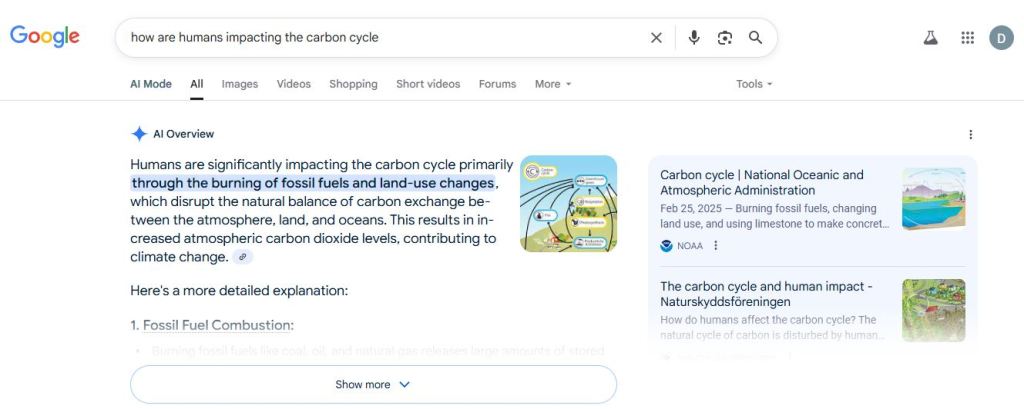
Now, my student hadn’t done anything atypical of today’s learner. He had typed his query directly off my instruction sheet into Google and awaited the response. It is, of course, not a good research habit (and one I keep trying to fight), but when I saw what it had produced, I was unnerved; I had not realized how much AI had invaded internet search engines. Here I had spent all this time teaching my students how to vet websites for academic and scientific reliability—an essential critical thinking skill, especially in today’s flood of misinformation and disinformation—and yet, here, confronting me on my student’s screen was an AI summary of only potentially relevant sources with no distinct authors or web addresses for my student to cite. No wonder he was confused!
So I showed my student how he could click on the little link symbol you can see there on the image right after the word “change” in order to bring up the list of web sites the AI had used for its summary, and I demonstrated how to find the source he needed among those sites so that he could formally cite it in his project. But if not for my own critical thinking skills enabling me to know what the AI was doing, both my student and myself would have been left in the dark, making unsubstantiated claims, reporting the thoughts of others as our own without any attribution to the original thinkers. The literal definition of plagiarism.
To say that I, as an educator, was appalled and alarmed by this development is like stating that hydrogen bombs make a noise when they go off (hyperbole intended!). However, I shortly thereafter read an editorial piece on Bloomberg that reminded me that my collegiate level colleagues have it even worse right now. At the preK-12 level, good schools are still doing a lot with pencil and paper in their classrooms, including formal assessments that require actual knowledge and the ability to think through a problem unaided by technology. But presently in academia—at institutions whose very raison d’être is the production and refinement of critical thinking!—“outsourcing one’s homework to AI has become routine” and “assignments that once demanded days of diligent research can be accomplished in minutes…no need to trudge through Dickens or Demosthenes; all the relevant material can be instantly summarized after a single chatbot prompt.”
Even more incredible (confirming a rumor I’d heard) is the fact that apparently more and more professors are starting to employ AI themselves to evaluate student work, leading to the mind-boggling and ultimately untenable reality of “computers grading papers written by computers, students and professors idly observing, and parents paying tens of thousands of dollars a year for the privilege.” The Editorial Board of Bloomberg News is indeed spot on when they declare that “at a time when academia is under assault from many angles, this looks like a crisis in the making.”
The coffin’s nail for me, though…the camel’s straw, the road’s end, the coup de grace…pick your cliché for finality and mine from this past month was the screenshot below:
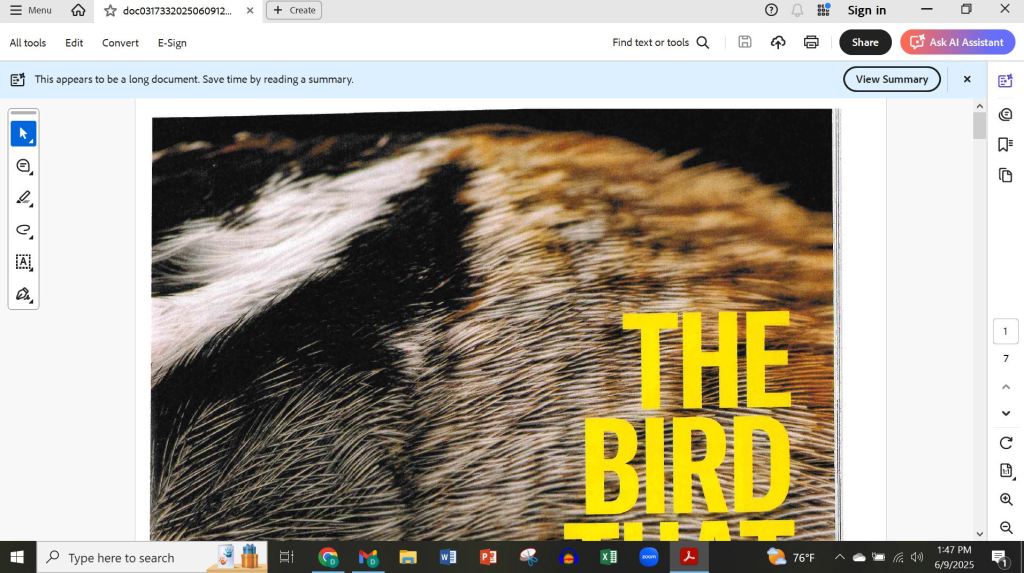
I had read this remarkable article in Scientific American on the genetic fluidity of sex and gender in sparrows, and I wanted to share it with my fellow biology teachers for use in our inheritance unit next year (as well as some separate electives we each teach). So I scanned the article as a PDF to make it more permanently accessible for all of us, and that’s when I saw the message from ADOBE up there in the lefthand corner: “This appears to be a long document. Save time by reading a summary.”
I spluttered; I fumed; I cursed:
“Of course it’s a long document you [expletive deleted] piece of software! That’s the whole point! To provide the reader with rich, nuanced knowledge and understanding of one of the most complex ideas in all of biology!!! If I had wanted my colleagues and I to have a [further expletive deleted] ‘summary,’ I first would have written it myself before giving it to them and then I still would have provided them the formal citation!”
In case you cannot tell, gentle reader, I was pissed. Pissed at the seeming systemic and systematic attack on the human capacity to think (let alone actually valuing that capacity). Pissed that there is clearly a market for this disparagement of thinking, and pissed that so few in our world seem to be upset by this dying of the light. I have known that scientific reasoning has been under assault for some time now, but the death of basic thinking itself?!
I know, I know. One more thing to add to the agenda for my often Sisyphean-feeling profession. But I’m not just pissed. I am also deeply concerned, and something neuroscientist, Hanna Poikonen, wrote earlier this year is a good way to end this brief ragging on my part:
Each time we off-load a problem to a calculator or ask ChatGPT to summarize an essay, we are losing an opportunity to improve our own skills and practice deep concentration for ourselves…when I consider how frenetically people switch between tasks and how eagerly we outsource creativity and problem-solving to AI in our high-speed society, I personally am left with a question: What happens to our human ability to solve complex problems in the future if we teach ourselves not to use deep concentration? After all, we may need that mode of thought more than ever to tackle increasingly convoluted technological, environmental, and political challenges.
“May need” indeed. My money’s on “will,” not “may.”
References
Maney, D. (March 2025) The Bird that Broke the Binary. Scientific American. Pp. 48-55.
Poikonen, H. (Feb. 2025) How Expertise Improves Concentration. Scientific American. Pp. 81-82.
The Editorial Board (May 27, 2025) Does College Still Have a Purpose in the Age of ChatGPT? Bloomberg News. https://www.bloomberg.com/opinion/articles/2025-05-27/ai-role-in-college-brings-education-closer-to-a-crisis-point?utm_source=pivot5&utm_medium=newsletter&utm_campaign=nvidia-breaks-records-with-44-billion-sales-despite-china-ban-1&_bhlid=31b2ce1fa3444fd1982e5d64eb0f1a1b6d1ab0f3.

 Light a Candle