
Deep in the backcountry of the Bandelier Wilderness, there is a site that has been sacred to modern Puebloans and their ancestors for at least a thousand years. It is an unpresuming place—a small ring of stones about fifteen feet across with two large cat-like figures carved into the volcanic tuff on its floor—and you would walk right by it if you didn’t know it was there. At one time, the National Park Service designated it as the “Shrine of the Lions” on their maps. But all reference to this locale has been gone now for almost 30 years because not every tradition is okay with tourists casually traipsing through their cathedrals. In fact, it is quite possible, given my age, that I may be among the remaining minority of non-Puebloans who know of the site and have intentionally visited its location.
Which may be the real claim that makes me stand out because to get to this place, you must cross Alamo Canyon, and to do that, there are only two options in the trail system. The lower crossing involves hiking down and then up a stone staircase thirty stories high (see picture on the left); while the upper crossing involves a 9-mile hike one way to the canyon’s origin (see picture on the right). The lower route is shorter, but the one (and only!) time I did it straight there-and-back, my knees wouldn’t let me walk correctly for a week. So ever since, I have combined the routes into a long 15-mile loop, and it is one of my favorite day hikes on the planet.
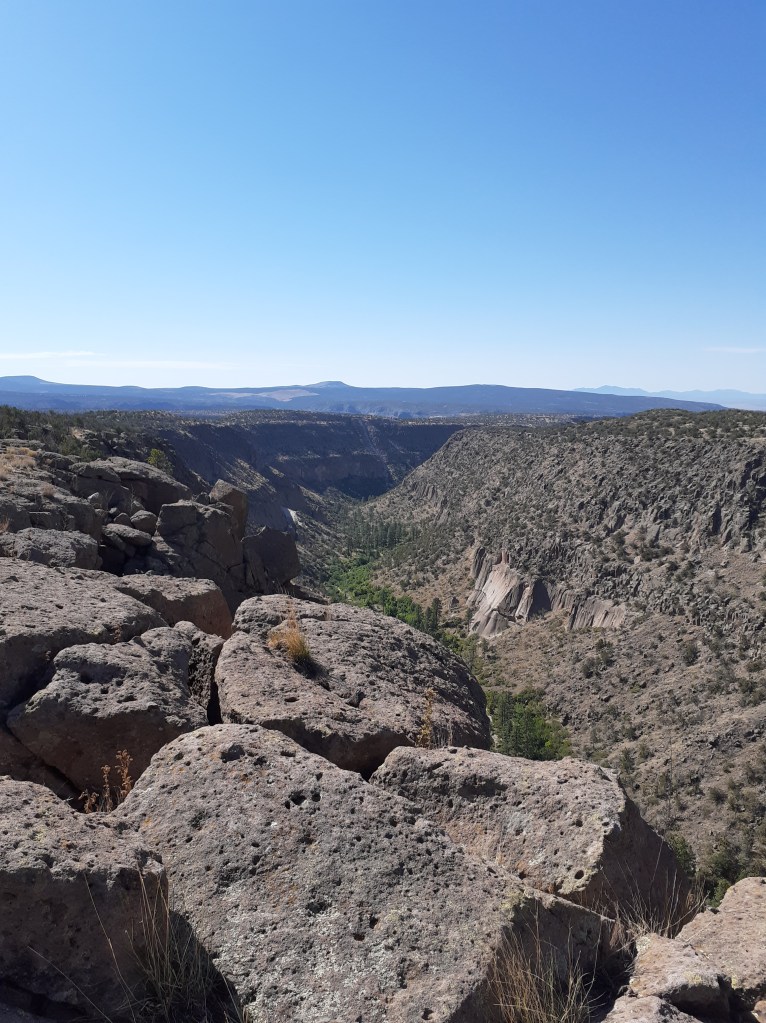
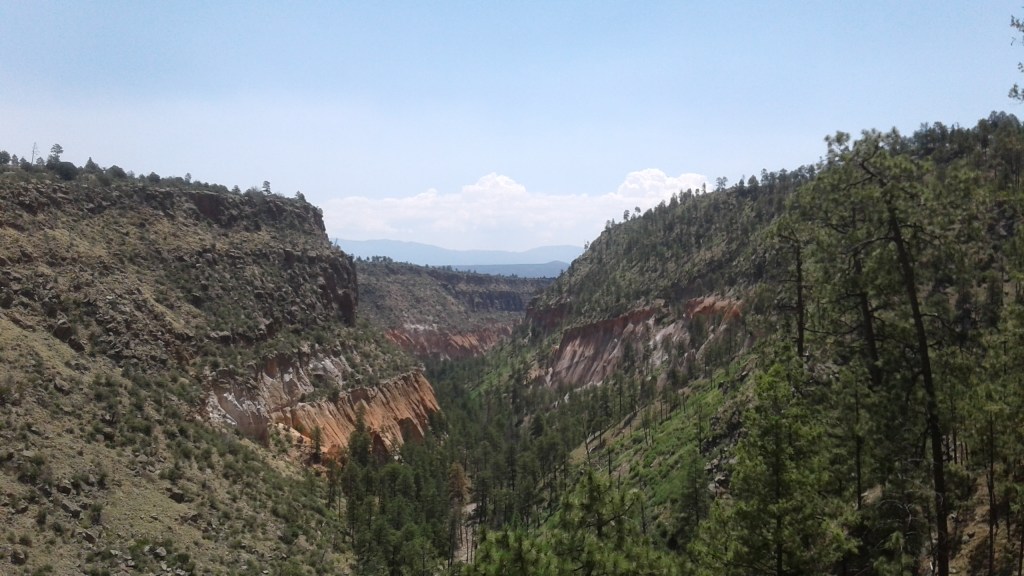
Or was. A few years ago, I was striding along the top of the mesa, about an hour out from the end of the trail, when I realized that I was doing this for the last time. The setting sun told me that I was cutting things closer than I ever had before, and the simple truth confronting me was that my aging body could no longer maintain the pace needed to do the full 15 miles in full daylight—something basic safety requires in a wilderness inhabited by large predators who are primarily nocturnal.
Yet rather than feel a sense of loss at that time, I was overwhelmed instead with a combined mixture of satisfaction, relief, fatigue, well-being, and closure that one can feel at the end of a long journey. It had been a 30-year blessing to hike this plateau so often and in so many seasons…to have visited a site that was now holy to me as well and where I now always left the desert’s most precious offering for the ancient pinon that lives there, some of my water, and I knew that this chapter of my life’s pilgrimage was concluding when I took my last step at the trail’s end.
Which any good author, playwright, or screen play would finish with an ellipsis…cue final embrace, setting sun, roll credits. I share this rather lengthy prologue, though, because it illustrates a similar moment I recently had in my classroom when I was finishing teaching a long-time favorite activity of mine about food and our bodies (psst! everybody has to eat somebody’s else’s baby to survive!). I was dumping my supply of snap-lock beads which I’d used to teach this important life lesson back into their storage bin when I suddenly realized I would not be taking them with me. You see, I’ve had this supply of snap-lock beads for over 30 years now, transporting them with every transition from one school to the next (because there is nothing in science snap-lock beads cannot be used to teach!), and it was dawning on me that I would not be taking the beads with me next time. That I would be leaving them behind for my remaining colleagues because “next time” will be my retirement…the end of the trail.
And just like that moment on the mesa, my emotional response was not one of loss or mourning but rather that same strange mix of contentment, resolve, and bittersweet gladness that positive endings can bring. The “hike’s” not quite yet over, but as I once did from the Upper Alamo, I can see the landmarks at “trail’s” end and that fills me with satisfaction, not melancholy.
Again, this is where the good K-drama leaves it. Nice anecdote with an uplifting ending. Happily-ever-after achieved. Move on. However, what my recent experience has me wondering about most—especially given the news items and statistics in this essay’s references—is the future of my chosen profession. Because while some variant of the transmission of knowledge from generation to generation has been around since parental care first evolved around a billion years ago and the symbolic transmission of knowledge has been around since the first modern primates emerged around 10 million years ago, teaching as a profession is a relatively recent phenomenon, with schools of any kind having been around only a few thousand years and formally dedicated institutions to education only a couple of hundred. Mine is simultaneously a primordial and embryonic occupation.
It is also one that is in serious difficulty right now. Morale among educators is at an all-time low in this country, where two-thirds of teachers report feeling like they do not matter at their schools and recruitment into the profession continuing to remain in steady decline. Those at all levels find themselves boxed in by numerous state legislatures, told what they can and cannot cover in their curricula, denied at times even the right to respect some of their students’ self-identities, and while one of my AI “soapboxes” is not this essay’s focus (regular readers know my thoughts and new folks can find them here), I will remind everyone that AI’s highly disruptive character cannot be contributing positively to the morale problem. Add in the fact that only 31% of the people in the U.S. think being well-educated matters anyway, and who can blame today’s teachers for feeling the way they do?
However, the real proverbial handwriting on the wall, the real disruptor facing teaching as a profession is demographics. Lower birthrates, while good for the planet and the possible future of our species, spell massive uncertainty for the future of institutional education, not just in this country but world-wide. I have already written about what demographics are doing to the small colleges in this country, and those stats are sobering enough. But to learn recently that the Los Angeles Unified School District—the second largest public system in America—has already lost nearly half its population of students in the past decade (down from around 700,000 to its current roughly 400,000) was startling. And to then learn that there are 4 million fewer children expected to be enrolled in any K-12 school setting of any kind by the end of this decade…well, that is simply alarming for the future of teaching as a profession.
Indeed, this demographic (and therefore economic) reality hits personally close to home. My own school faces stiff competition for student enrollment, down nearly 25% since the mid-2000s, and I am highly confident that my current position will not be filled when I retire within the next few years. I have been blessed to directly mentor three of my former students into this noble craft, but one of them teaches at a school now engaged in active contraction while another’s salary doesn’t allow for the costs of the motherhood she so deeply desires. A profession that once promised a secure job and a solid middle-class lifestyle can no longer seemingly guarantee either, leaving me openly pessimistic about the future of teaching as a career.
Not that it will disappear, obviously (again, the generational transmission of knowledge is a billion plus years and counting). But what qualities the profession of teaching will have, what kinds of people will pursue it, what impacts it will have on my current student’s children…these are BIG question marks in my mind right now, and with the recent dismantling of the Department of Education, I am reminded how much easier it is to destroy than it is to build. So how society answers my questions…how it responds to this mounting crisis in our schools…that “how” will have profound consequences for decades, maybe even centuries, of the children yet to come.
I just wish I had a better response to my own queries right now than “I have no expletive-deleted clue.”
References
Barrett-Parker, B. (Oct. 12, 2026) Headship: The Courage to Prune. National Association of Independent Schools. https://www.nais.org/resource-center/independent-ideas/october-2026/headship-the-courage-to-prune?utm_medium=email&utm_campaign=NAIS%20Bulletin%20101426&utm_content=NAIS%20Bulletin%20101426+CID_080178c8aaf7afd8399cc6449c747e17&utm_source=cm&utm_term=In%20this%20months%20headship%20series%20blog.
Brenan, M. (Oct. 1, 2026) Record-Low 31% Say College Education is “Very Important.” Gallup News. https://news.gallup.com/poll/715133/record-low-say-college-education-important.aspx.
Lumpkin, L. (Oct. 14, 2026) Roughly a Third of Educators Felt They Matter a “Great Deal” at School. The Washington Post. https://www.washingtonpost.com/education/2026/10/14/roughly-third-educators-feel-they-matter-great-deal-school/.
Mann, B. & Martinez, A. (Oct. 29, 2026) Birth Rates and Immigration Policies Are Causing an Enrollment Crisis for Schools. NPR Morning Edition. https://www.npr.org/2026/10/29/nx-s1-6019252/birth-rates-and-immigration-policies-are-causing-an-enrollment-crisis-for-schools.
Vasquez, L. (Nov. 3, 2026) New Restrictions at Texas Tech Are Changing What Professors Can Teach. NPR Morning Edition. https://www.npr.org/2026/11/03/nx-s1-5963883/texas-tech-academic-sb17-odyssey.


