As my regular readers know, I write from time to time more to inform about recent news and/or trends in the world of education than to editorialize or comment about them. Some have come in the form of simple updates; others as more formal declarations about the current state of education. But my express purpose with all these brief reports has been to collate what I have been learning lately into emerging patterns that can help my readers better understand the current climate impacting teaching in this country (though of course, what one chooses to discuss is, by definition, a type of commentary).
Well, it turns out that this past month has been a busy one in the world of schools, and while I was crafting my most recent graduation letter, a lot of interesting news was piling up on my digital desk. Thus, for those interested (and not already “in-the-know”), here’s what’s been happening recently in the K-16 world.
Obviously, at the top of the list is AI. Indeed, a month cannot pass these days (and probably a week!) without the topic of education’s frenemy producing multiple headlines, and April 2026 was no exception. Most interesting to this educator, though, was the nature of the stories AI was causing (but hopefully not actually writing) to be published. The mounting backlash against all things digital—the verdict in California against Meta and Google was huge!—has apparently started to reach the world of schools as parents across the United States are demanding a wholesale reduction of screens in the classroom—with those in New York City (the largest school district in the country) insisting that ChatGPT be removed entirely.
Furthermore, recent surveys of 14-29 year-olds (Gen Z) show growing distrust and anger when it comes to the ubiquity of AI in their daily lives. An increasing number of them are recognizing and openly acknowledging the negative impacts AI has already had on their mental capacities, and they are not happy about it. Put bluntly, their brains are still functional enough to grasp how poorly their brains now function, and they are pissed off! Perhaps there is hope for the future of the world’s IQs, CQs, and EQs after all.
Of course, not every AI headline was a positive one for teaching and learning, and I cannot lie (nor fail to editorialize at least a little bit) that I found it disheartening—and even more so because anyone who has worked with adolescent boys cannot find this news entirely unexpected—that more and more teenage males are choosing AI companions for their “girlfriends” instead of their actual fellow teenage females. As the headline for the story reports, they are doing so for “maximum control” of the relationship, with “zero [chance of] rejection” and total compliance on the part of their chosen “significant other”—i.e. the perfect narcissist fairytale of “boy meets girl; boy never risks losing girl; boy never has to get girl back.”
Yet, the potential societal cost of this so-called “fairytale” relates to another common theme in many of the stories about education this past month: employability. Without the soft skills honed by the realities of actual human relationship—negotiating resistance, healing emotional damage, developing patience and empathy—these Gen Z and Gen Alpha males will be unable to find success in the workplace of the future, where human-to-human interaction will be at a premium. Just ask the current graduating computer scientists coming out of today’s colleges and universities who cannot find jobs because AIs can already write code more cheaply and efficiently than their human counterparts. Tomorrow’s jobs—what we can know about them—are going to require skill sets that no AI can ever accomplish, namely the continual adaptability demanded by the eternal complexities of human relationship.
Interestingly enough, though, some of the other headlines related to education and employability suggest that we may be actively walking away from the very ability of schools to generate this kind of robust relational adaptability in the first place. As seen in the chart below, more than 25% of small liberal arts colleges in this country are in danger of closing within the decade, and even places as robust in their enrollment as Syracuse University have made the decision to close 93 of their 460 academic programs—with humanities and the fine arts representing the bulk of the majors going away.
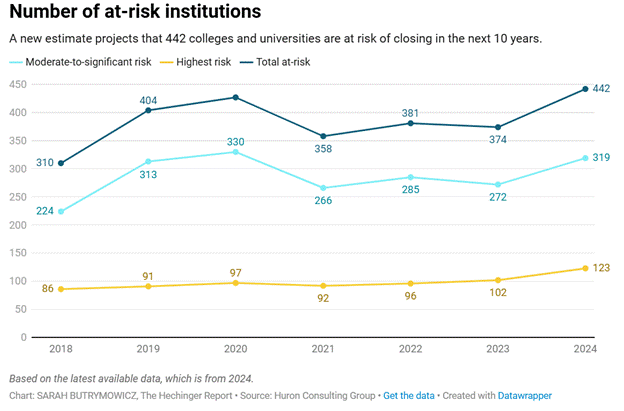
Of course, similar changes are occurring at schools throughout the U.S. as college-age students look for degrees they think will result in higher pay, and college administrators are simply following the market to try to attract the dwindling pool of higher education candidates. Eliminating under-enrolled academic offerings in the humanities saves money and keeps the proverbial doors open and the lights turned on in the face of changing demographics and demands on the part of the consumer.
However, for both higher education and its population, this trend may be self-defeating because what today’s economists are saying to today’s students is:
major in a subject that offers enduring, transferable skills. Believe it or not, that could be the liberal arts. [Harvard economist, David] Deming’s research shows that male history and social-science majors end up out-earning their engineering and comp-sci counterparts in the long term, as they develop the soft skills that employers consistently seek out. “It’s actually quite risky to go to school to learn a trade or a particular skill, because you don’t know what the future holds,” Deming [says]. “You need to try to think about acquiring a skill set that’s going to be future-proof and last you for 45 years of working life.”
Which is why I was excited to read that in spite of the current contraction happening in the humanities and the fine arts at the college and university level, there is a bit of a revolution happening in high schools for the skills these fields have traditionally promoted and developed. The 74 reports that emerging organizations such as Skills For The Future and Pathsmith are looking at the employability needs of the Gen Z and Gen Alpha populations, and they are creating actual curricula and assessments to meet these needs in today’s 9-12 classrooms and beyond. Indeed:
several companies and non-profits are taking these [“soft” or “durable”] skills that have been fuzzy concepts and working on giving them shape and definition. They’re gathering teachers, developers of tests, business leaders and other experts to break down these skills into smaller skills and then into even smaller subskills and nuances that can serve as steps toward mastery. Communications, for instance, could include negotiating and public speaking as subskills, [and] the resulting outlines of skills and subskills are like a tree branching out from its trunk into smaller and smaller limbs, all with an eye to making them as teachable and testable as math or English.
In other words, the three “Cs” (communication, collaboration, and cognition) may be coming soon to an SAT test near you!
And part of how this may actually get accomplished involves the last piece of recent news I want to report about, an article exploring an intriguing potential solution to the teacher shortage in this country. Written by former acting Governor of Massachusetts, Jane Swift, and former US Secretary of Education, Arne Duncan, these two members from opposite poles of the political spectrum propose that two challenges currently facing our society may, in fact, be one another’s solutions. They write:
Schools across the country are struggling to find enough teachers, with at least 411,000 teaching positions currently open nationwide. At the same time, more than 40% of recent graduates are underemployed. That means millions of young people have earned college degrees only to find themselves stuck in jobs that offer low pay, little security, and no clear path forward. These are not separate challenges, and taken together, they point to a solution hiding in plain sight. Teaching can be the entry point into the workforce that Gen Z graduates need.
Now, I will be forthright. My initial reaction upon reading this was a mixture of growl, teeth-grinding, and grimace: not this old trope again! “Those who can, do; those who can’t, teach”…“glorified babysitters; how hard can it be?”…“cushy job; only work 9 months a year and get summers off!” The list of misperceptions about my chosen profession that I have heard over the decades still leaves me with a smoldering sense of frustration and even anger. After all, this is the profession documented to be second only to that of ER surgeons for the number of critical decisions that have to be made every minute, and since more than half the people who enter it burnout and leave after just 3 years, I’m not sure that “cushy” is a term I would use to describe it.
However, as I continued reading Swift’s and Duncan’s argument, I realized they were not saying that simply anyone can do this job. Instead, they were arguing something more subtle:
Teacher shortages are already impacting classrooms nationwide. And schools in rural districts and lower-income communities are particularly struggling to fill vacancies. Research shows that persistent vacancies and reliance on substitute teachers undermine student learning and achievement. For students who overcome these challenges and make it to college, another problem awaits. Just half of all college graduates secure roles that require a degree. For those college graduates struggling to secure a college-level job, teaching can help them climb the career ladder as well.
Hence, what I am understanding Swift and Duncan to be reasoning is that in a world where AI is becoming the equivalent of the mechanical robots that took over much of the manufacturing sector, teaching offers a pathway for some of today’s college graduates to find stable, meaningful—potentially long-term—employment that perfects the “soft” skills they will need for the future while filling a need for caring, consistent, and well trained adults in the lives of children who would otherwise be left academically adrift. They are not saying that just anyone can successfully teach but that encouraging those who have the potential to enter the profession by making the path for doing so more straightforward and attractive (e.g. making the “student teaching” requirements of most licensing programs paid internships) could possibly solve two challenges we currently face in our society at the same time.
Like I said, I find their ideas intriguing—if for no other reason than A) teaching is likely to remain pretty AI proof for the foreseeable future since it is rooted by its very nature in the messiness of human relationship; B) those adolescent boys with their chatbot girlfriends would learn how to navigate the complexity of person-to-person interaction real fast in a roomful of 10-year-olds; and C) I’m going to retire someday and somebody’s got to take my place.
Time will tell, and I encourage anyone interested in any of these updates from the world of education to explore the references below.
Coda
As I was finishing writing this, two articles arrived in my in-box reminding me that formal education systems in this country face a far greater crisis in the relatively near term than AI, cancelled academic departments, and under-employed Gen Z-ers combined. The fertility level in the economically developed world is well below replacement value at this point—and continuing to drop—and it is estimated that in the New York City public schools alone, there will be 153,000 fewer students enrolled over the course of the next decade. Tough decisions about school closures are coming not just for the small liberal arts colleges of this land, and those currently entering the teaching profession could actually find themselves in a very competitive job market (Swift’s and Duncan’s 411,000 positions may simply evaporate by attenuation).
But what makes me write this “afterword” is the far greater issue than simply a probable near-term crisis for schools in the U.S. caused by decreasing fertility levels. Anyone who knows me knows that I think hope is a verb, and the ultimate act of hope is the deliberate choice to bring a child into the world. Yet as Anna Louie Sussman presents so brilliantly in her recent essay for the NYT, many in our two youngest generations who are in their reproductive years are not having children right now because of the chaotic uncertainty that there will even be a livable future for those hypothetical children to inhabit. Millennials and Gen Zs are finding themselves without hope in that most significant way that one can, and that shouldn’t just concern those of us in education. That should give us all pause.
Because the steadily more dystopian world we have chosen to create doesn’t have to remain the dysfunctional way it currently is. We have the power to change it. What haunts me is whether we have the will. Again, as I concluded with my graduating seniors, “maybe.”
References
Horowitch, R. (June 2025) The Computer-Science Bubble is Bursting. The Atlantic. https://www.theatlantic.com/economy/archive/2025/06/computer-science-bubble-ai/683242/.
Marcus, J. (April 13, 2026) More Than a Quarter of Private Colleges Are at Risk of Closing, New Projection Shows. The Hechinger Report. https://hechingerreport.org/more-than-a-quarter-of-private-colleges-are-at-risk-of-closing-new-projection-shows/.
Mervosh, S.; Paris, F.; & Cain Miller, C. (May 8, 2026) U.S. Schools Face a Crisis as the Number of Children Drops. The New York Times. https://www.nytimes.com/2026/05/08/upshot/public-schools-enrollment-crisis.html.
Napolitano, J. (April 9, 2026) Gen Z Increasingly Skeptical of–And Angry About–Artificial Intelligence. The 74. https://www.the74million.org/article/gen-z-increasingly-skeptical-of-and-angry-about-artificial-intelligence/.
O’Donnell, P. (April 21, 2026) Creating Communicators and Critical Thinkers: Soon There Will Be a Test for That. The 74. https://www.the74million.org/article/creating-communicators-and-critical-thinkers-soon-there-will-be-a-test-for-that/.
Otterman, S. (April 3, 2026) Syracuse Drops 84 Majors Including Classics, Ceramic and Italian. The New York Times. https://www.nytimes.com/2026/04/01/nyregion/syracuse-university-degrees-eliminated.html?unlocked_article_code=1.X1A.CZh8.XEtP0OnmSuDJ&smid=url-share.
Royle, O.R. (April 17, 2026) Teen Boys Are Choosing AI Girlfriends Over Real Ones for “Maximum Control, Zero Rejection”–Experts Say It Could Make Them Unemployable. Fortune. https://fortune.com/2026/04/17/teen-boys-dating-ai-chatbot-girlfriend-experts-warn-kill-social-skills-gen-alpha-network-promotions/.
Singer, N. (May 6, 2026) In Backlash Against Tech in Schools, Parents Are Winning Rollbacks. The New York Times. https://www.nytimes.com/2026/04/29/technology/parents-school-tech-backlash.html?unlocked_article_code=1.elA.Fg2u.0ouroYo_g8zF&smid=nytcore-ios-share.
Sussman, A. L. (May 7, 2026) Why So Few Babies? We Might Have Overlooked the Biggest Reason of All. The New York Times. https://www.nytimes.com/2026/05/07/opinion/birthrate-kids-parents-demographics-future.html.
Swift, J. and Duncan, A. (April 7, 2026) The Case for More Gen Z Teachers. TIME. https://time.com/article/2026/04/07/the-case-for-more-gen-z-teachers/.

 Light a Candle
One of your best reflections! Thank you, David.
LikeLike